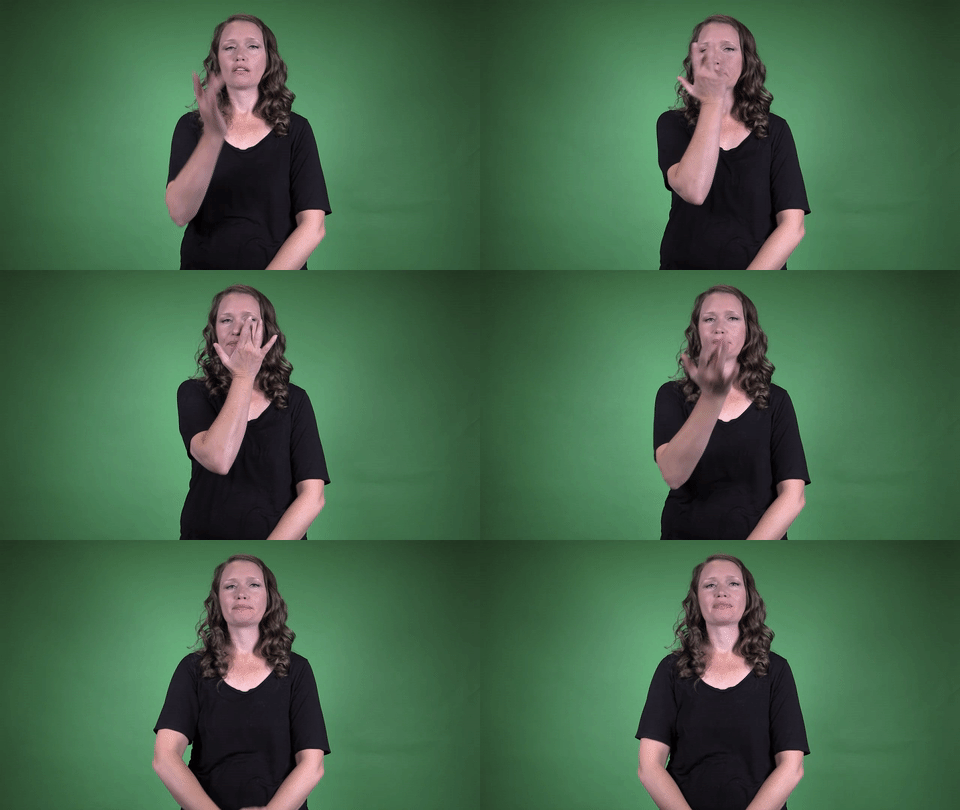
Sign for CONTACTS in ASL | 📇 ASL Dictionary

Definition: A list of contacts.

Sign for CONTACTS in ASL

YouTube player

Practice Activities:

To practice the sign for CONTACTS in ASL, start by using a mirror. Sign it slowly while focusing on handshape, location near the eye, and facial expressions. Repeat it ten times to build muscle memory. Try alternating dominant and non-dominant hand use to see which feels more natural to you.

Create short phrases or single-sentence examples using the sign for CONTACTS in ASL. Try sentences like: “I wear contacts every day,” or “She forgot her contacts.” Rehearse signing these slowly and then faster as you become more confident. Pay attention to transitions between signs to improve fluidity.

Record yourself signing three sentences with the sign for CONTACTS in ASL and then watch the video. Look closely at hand placement and ask, “Does it look like inserting a contact lens?” Compare your sign with a validated video or model for self-correction. This process builds visual feedback and enhances retention.

Pair up with a practice partner and take turns describing someone’s morning routine that includes the sign for CONTACTS in ASL. You can say, “He wakes up, puts in contacts, and gets ready for work.” Doing this in a conversational context helps reinforce vocabulary while improving receptive and expressive skills.

Storytelling works great as a practice tool. Make up a short narrative about a person who loses their contacts before an important event. Add emotion and facial expressions to emphasize panic or worry. Telling the story in full ASL helps place the sign within functional communication.

Set up flashcards with daily routine vocabulary, including the sign for CONTACTS in ASL. Shuffle the deck and sign each card as it comes up, integrating the signs into a mini routine to simulate natural context. This gets you comfortable using the sign fluidly along with others.

Cultural Context:

In the Deaf community, the sign for contacts in ASL carries meaning beyond just the physical lenses people wear. It connects to discussions around vision, accessibility, and daily routines, particularly in educational and work settings where clear visibility is essential.

When someone uses the ASL sign for contacts, it often arises in conversations about self-care habits and morning routines. Deaf individuals may visually describe taking care of their appearance or preparing for the day by signing about contacts in ASL, creating a full picture of their lifestyle.

Using the sign for contacts in ASL helps Deaf users communicate with healthcare professionals about eye care and prescription lenses. It standardizes the terminology in medical and optometry appointments, ensuring clarity and direct understanding.

In beauty and style conversations, the sign for contacts in ASL can also refer to colored or decorative lenses. This adds a layer of personal expression that is often shared in casual conversations among friends who use ASL to discuss makeup, outfits, or changing styles.

The sign for contacts in ASL can function as an instructional term when teaching others how to apply or remove contact lenses. In classrooms, interpreting situations, or peer-to-peer support groups, it plays a role in helping students or clients manage personal hygiene and health practices.

Deaf youth who use contact lenses might learn the sign for contacts in ASL as part of their early vocabulary development. It introduces terms relevant to body awareness and personal items early on, expanding their functional communication tools.

At eye doctor appointments or vision screenings, using the sign for contacts in ASL gives confidence to Deaf individuals who want to discuss their eyesight needs clearly. It reduces barriers in healthcare access and supports autonomy and informed decisions.

In videos, vlogs, and visual storytelling platforms, creators often include the sign for contacts in ASL when sharing daily routines or self-care tips. It supports representation and educates wider audiences on how ASL expresses modern health and beauty topics.

For Deaf professionals, the sign for contacts in ASL may come up during workplace discussions, especially when requesting accommodations like better lighting or screen adjustments. These discussions reinforce how vision impacts accessibility in everyday life.

In social and dating contexts, the sign for contacts in ASL can be used to describe physical appearance during introductions or when talking about preferences. ASL users may share style choices, including contact lens color, to express individuality visually and verbally.

The sign for contacts in ASL helps bridge communication about vision-related issues in both formal and informal environments. Whether through storytelling, education, or daily chats,

Extended Definition:

The sign for contacts in ASL refers to the American Sign Language gesture used to represent either contact lenses or making connections with people. The meaning depends on the context in which it is used, as ASL is a visual and contextual language. Understanding the sign for contacts in ASL can help signers communicate more clearly and naturally about both personal care and social interaction.

When referring to contact lenses, the sign for contacts in ASL typically mimics the motion of putting a small item, such as a lens, into the eye. This is usually done by using the index finger near the eye, suggesting the placement of the lens on the surface. Facial expressions can help distinguish whether the signer means eyeglasses or contacts.

In a social context, the sign for contacts in ASL might relate more closely to the idea of making contact with someone, like reaching out, staying in touch, or networking. This use might involve signs similar to connect, relationship, or communication, depending on what kind of contact is meant. It highlights how one word in English can have several nuances in ASL.

Context is always essential when learning and using the sign for contacts in ASL. A signer talking about morning routines and pointing to the eye is likely referencing contact lenses. On the other hand, someone discussing relationships, texting, or email might mean social or professional contacts instead.

Understanding the nuances of the sign for contacts in ASL is especially important for interpreters, students, or educators working within the Deaf community. It helps avoid misunderstandings and enables more fluid and expressive ASL usage. As with many signs, how the gesture is made — including speed, facial expressions, and movement — can all change the meaning.

The signer’s age, region, and level of fluency may also influence which version of the sign for contacts in ASL is used. Just like spoken languages, ASL evolves across locations and generations. Learning multiple variations ensures better communication in diverse settings.

When using the sign for contacts in ASL in the context of contact lenses, it may also be helpful to pair the sign with others like vision, eye doctor, or glasses. This further clarifies the topic and builds richer, more descriptive ASL sentences. ASL often combines concepts to create more detailed expressions.

If discussing contact information, such as phone numbers, email, or addresses, the sign for contacts in ASL can be paired with fingerspelling or specific informational signs. This helps convey complete messages during conversations or presentations. It

Synonyms: connections, acquaintances, references, associates, correspondents

Educational resources: Find related learning materials in our course bank!

Want more? Check out some of our popular learning activities on the homepage!

Need to look up a sign? Use our highly rated dictionary: https://aslinteractive.com/best-asl-dictionary/

Follow us on tiktok: https://www.tiktok.com/@aslinteractive. More social media links at the bottom of this page!

Long-tail Keywords: what is the sign for contacts in ASL, how do you sign contacts in ASL, ASL sign for contacts

Categories:

tags: Contacts, Vision, Objects, Accessories, Everyday Activities

Parameters

*Handshape*:

The handshape for the sign for CONTACTS in ASL typically involves both hands in a flat “O” shape, similar to the gesture used when inserting contact lenses. The dominant hand moves toward the eye, mimicking the action of placing a contact lens on the eyeball.

This handshape and motion help clearly indicate the meaning behind the sign for CONTACTS in ASL. It’s important to maintain the rounded “O” shape to accurately convey the idea of a contact lens.

*Palm Orientation*:

The palm orientation for the sign for CONTACTS in ASL involves both hands in flat “O” handshapes, starting near the eyes. Palms face inward toward the face as if mimicking the action of placing contact lenses onto the eyes.

This movement helps express the concept of the sign for CONTACTS in ASL clearly. Maintaining a gentle inward palm orientation adds to the visual accuracy of the sign. ️ ️

*Location*:

The sign for CONTACTS in ASL is typically made in the neutral space just in front of the chest. Both hands may come together in front of the torso, depending on the variation of the sign being used.

This position allows clear visibility and is common for signs involving interpersonal relationships or communication. When teaching or demonstrating the sign for CONTACTS in ASL, make sure the hands are not too high or too close to the body to maintain clarity.

*Movement*:

To perform the sign for CONTACTS in ASL, use your dominant hand in a bent “L” handshape, holding it up near the eye. Tap or lightly touch the eye area as if placing a contact lens . The movement is small and subtle, mimicking the real-life action of inserting a contact.

The sign for CONTACTS in ASL visually represents the everyday act of applying contact lenses and is typically done once or twice depending on emphasis. Make sure your facial expression stays neutral or slightly focused to match the context.

*Non-Manual Signals*:

The non-manual signals for the sign for CONTACTS in ASL typically involve a neutral or mildly inquisitive facial expression, depending on the context—such as asking if someone wears contacts or providing information. Eyebrows may raise slightly if it’s used within a yes/no question, enhancing clarity.

Maintaining direct eye contact is important during the sign for CONTACTS in ASL, especially when distinguishing it from similar signs like glasses. A brief eye squint or head tilt might also be used to emphasize focus or clarity when referring specifically to contact lenses ️.

*Prosody, Dominant/Non-Dominant Hand*:

The sign for CONTACTS in ASL uses a dominant hand in a bent “L” shape to mimic the action of placing a contact lens on the eye. The non-dominant hand is not used, as the gesture is performed near the dominant eye. This sign accurately represents the concept of contact lenses by showing the motion of applying one.

When explaining or demonstrating the sign for CONTACTS in ASL, consistency in handshape and location is key. Make sure the movement is small and deliberate to clearly show the intent. This helps distinguish the sign from similar eye-related signs used in ASL ️.

Tips for Beginners:

When learning the sign for CONTACTS in ASL, it’s helpful to understand whether you’re referring to contact lenses or general contacts like people or communication. For contact lenses, the sign mimics the motion of placing a lens in your eye. Use your dominant hand in a flattened “O” shape or pinch-like gesture and bring it near your eye while slightly tapping or hovering over the area with controlled motion.

Beginners often struggle with nasal or facial expressions, which should match the context. If you’re talking about communication or staying in touch, the sign involves both index fingers touching and then separating, symbolizing two people maintaining contact. Practice both variations—one for lenses and one for human connections—because the sign for CONTACTS in ASL can differ depending on context.

To improve, practice in front of a mirror to ensure accuracy in hand placement and facial expression. Be consistent with handshapes; many learners confuse a simple point with a contact motion. Repetition and mindful muscle memory will go a long way in making your sign fluid and readable.

A common mistake is rushing through the motion, which can make your sign hard to understand. Especially with the version that mimics inserting a lens, keep your motion clear and slow enough to be distinguishable from other eye-related signs. Making eye contact during signing also boosts confidence and helps you connect better with your communication partner.

If you’re fingerspelling “contacts” as a proper noun or brand name, make sure each letter is crisp, especially the double “C” and “T” sounds that can blur if rushed. Practice fingerspelling at an even pace during downtime—like while watching TV—to build muscle memory.

The sign for CONTACTS in ASL can vary slightly by region, so exposure to different signers is key to full comprehension. Watch ASL videos or join a local Deaf community event to refine your skills and broaden your learning.

Connections to Other topics:

The sign for CONTACTS in ASL often relates to other signs connected to communication, personal relationships, and interaction. Since “contacts” can denote people you know or electronic contact lenses, the sign might change depending on the context. In the context of social or professional networking, it closely relates to signs like CONNECT, NETWORK, and MEET, which emphasize creating or maintaining relationships.

You may see a compound structure or a contextual adaptation like combining the sign for PEOPLE or FRIENDS with the gesture for CONNECT to express social contacts or associations. When referring to phone or digital contacts, signers may use combinations involving PHONE, MESSAGE, or even a classifier showing a list being accessed, mimicking the motion of scrolling through a contact list on a smartphone .

For contact lenses, the sign can borrow from visual cues tied to EYE or GLASSES, with additional specificity added using descriptive signing or fingerspelling CONTACTS for clarity. This shows how the sign for CONTACTS in ASL can bridge health and vision-related vocabulary, overlapping with medical discussions or optometry-specific terms.

Additionally, the concept connects naturally with emotional and social signs. CONTACTS, in terms of close connections, can be associated with TRUST, COMMUNICATE, RELATIONSHIP, or SOCIAL. These connections help deepen understanding of how setting, context, and nuance affect sign selection in ASL conversations .

Learning the sign for CONTACTS in ASL opens opportunities to explore how ASL categorizes and contextualizes abstract versus concrete ideas. It helps build vocabulary for more complex discussions about social circles, support systems, and digital technology. These connections are crucial in understanding how ASL navigates topics that often require layered meaning or explanation.

Summary:

The sign for CONTACTS in ASL can vary slightly depending on the context—whether referring to contact lenses, social contacts, or communication. For contact lenses, the sign typically mimics the motion of placing a lens near the eye, involving a pinching handshape approaching the eye area softly.

When referencing social contacts or making connections with others, the sign generally involves both hands touching fingertips and then separating. This motion symbolizes people coming into contact with one another and can be closely related to the idea of connections or networks.

Facial expressions often enhance the meaning of the sign for CONTACTS in ASL. When the sign is used in a medical context, such as placing contacts into eyes, the facial cues are often neutral or focused. For social contexts, facial expressions might be friendlier or reflect the tone of the interaction—enthusiastic for meeting new people or neutral for casual references.

This sign has connections with other ASL terms such as COMMUNICATE, MEET, and CONNECT. It shares some structural features with MEET, where both index fingers (representing people) approach each other, emphasizing interaction. This emphasizes ASL’s visual grammar and how spatial relationships communicate metaphorical ideas.

Linguistically, the sign for CONTACTS in ASL is rich because of how it uses location, movement, and handshape. In optical contexts, the location near the eye is key for clarifying meaning. In social contexts, proximal space between hands highlights the metaphor of people interacting in a shared space.

The cultural significance of the sign for CONTACTS in ASL is notably attached to the Deaf community’s value on connection and communication. Making contacts is not just about socializing—it’s about building networks within and across communities. This strengthens access to shared knowledge, resources, and inclusion.

When used in casual conversations, this sign can refer to people one may reach out to for help, information, or opportunities. In community-building settings or advocacy discussions, using the sign may indicate formal or influential contacts that help move initiatives forward.

In healthcare-specific contexts, interpreting the sign for CONTACTS in ASL requires great clarity. A signer referencing vision correction or eye appointments would benefit from adding classifiers to distinguish from social contacts. This makes the conversation more accessible and reduces ambiguity.

The classifier CL:C can simulate holding a small round object, useful in miming a contact lens for precision. This is an effective linguistic strategy, reinforcing spatial and visual description in a way spoken language can’t directly match.

In educational settings, students learn the differences in ASL signs for contacts depending on topic areas. It becomes essential for fluent signers and interpreters to distinguish meanings based on context, as identical signs can carry vastly different concepts depending on setting, intonation, and accompanying signs.

The sign for CONTACTS in ASL also plays a role in digital or virtual interactions. As more Deaf users engage online, the need to discuss LinkedIn connections, email contacts, or phone contacts surfaces. In such cases, signers might modify the contact-related sign by adding signs for PHONE, EMAIL, or COMPUTER to create clarity.

In storytelling or narratives, this sign frequently serves to show encounters, relationships forming, or even moments when paths cross. ASL’s visual modality allows intricate layering—describing when, why, and how the contacts took place—without overloading the viewer with verbal details.

Applied linguistics in ASL finds the sign for CONTACTS significant for its polysemy and contextual dependency. Educators use it to teach students about semantic range—how one sign may carry multiple meanings and how co-occurring gestures and grammar tell the viewer which version is intended.

The syntax in which the sign for CONTACTS in ASL is placed often follows the topic-comment structure. For example, “MY EYE — CONTACTS LOST” allows the signer to quickly establish the focus, then describe the issue. Similarly, “PEOPLE CONTACTS, I NEED NEW” might appear in a conversation about updating a phone address book.

Emergent ASL signers sometimes over-rely on fingerspelling for the word CONTACTS, unaware of the more established signs. While fingerspelling is appropriate for clarity or new topic introduction, it’s generally more fluent to use the standard sign with added classifiers or descriptors if needed.

In Deaf culture, making meaningful contacts is often more valued than simply networking. The concept of genuine connection and mutual support is emphasized over superficial social accumulation. So, using the sign for CONTACTS in ASL in those contexts holds deeper emotional and social implications.

Sign variation is not uncommon depending on region or age group. Some signers might use a modified motion or alternative handshape depending on if they learned ASL from a residential school environment or community-based instruction. This highlights the fluidity and diversity within ASL.

The use of space in ASL allows signers to visually track multiple contacts. One side of the signing space could represent work-related contacts, while another could indicate contacts for recreational life. ASL’s spatial

Want more? Check out some of our popular learning activities!

ASL Interactive Resources

ASLInteractive YouTube Channel

Follow us on tiktok: @aslinteractive.com

Follow us on Instagram: aslinteractive

Facebook page: aslinteractive

Facebook group: aslinteractive

LInkedIn: ASL Interactive LLC

Twitter: @ASL_interactive

*Some information on this page is AI-generated. AI can make mistakes. Please check the information.

Sign for CONTACT LENSES in ASL, Sign for CONTACTS in ASL

Responses