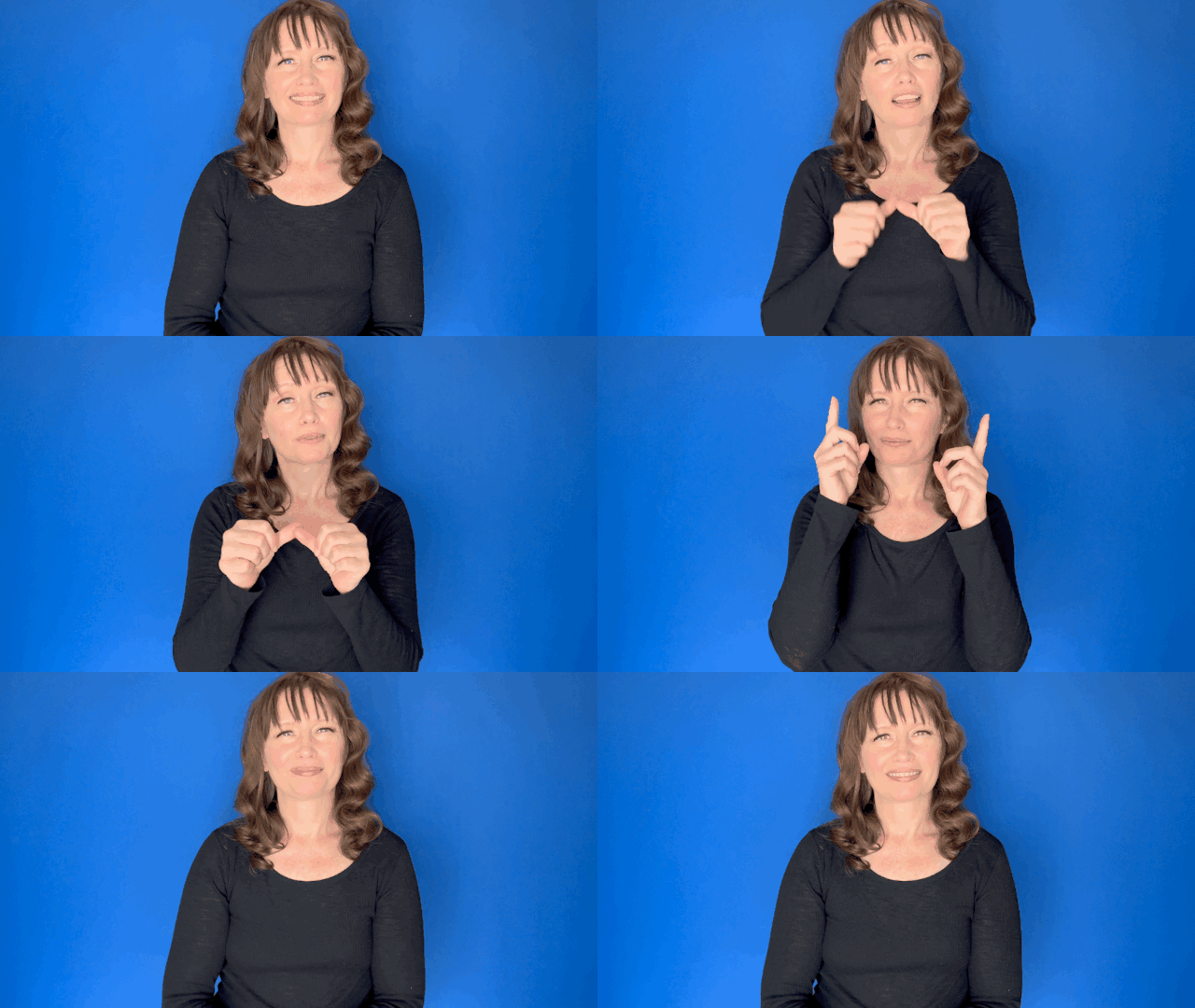
Sign for CONTINUING EDUCATION in ASL | 🎓 ASL Dictionary

Definition: Ongoing learning pursued after formal education to enhance skills, knowledge, or career opportunities.

Sign for CONTINUING EDUCATION in ASL

YouTube player

Practice Activities:

Start by practicing the sign for CONTINUING EDUCATION in ASL in isolation. Use a mirror or record yourself signing to check if your handshape, movement, and facial expressions match model examples. Repeat the sign several times to build muscle memory.

Use flashcards with images or English translations to prompt signing the phrase. Include related vocabulary such as LEARN, SCHOOL, and COLLEGE. Also, alternate between watching a video model and signing back in real time to reinforce visual recognition and expressive accuracy.

Create simple sentences incorporating the sign for CONTINUING EDUCATION in ASL, such as “I want continuing education” or “My mom takes continuing education classes.” Practice saying the sentences aloud while signing to help reinforce both the concept and syntax.

Try storytelling exercises using the sign for CONTINUING EDUCATION in ASL. Describe an adult returning to school or attending night classes. Use transition words like BEFORE, NOW, and FUTURE to help structure your narrative clearly in ASL grammar format.

With a partner, take turns asking and answering questions. One might ask, “Why is continuing education important?” and the other can answer with a full ASL sentence using proper non-manual markers and spatial referencing. Swap roles and vary the responses to build fluency.

Identify people in your life involved in continuing education and sign about them in short monologues. Practice phrasing such as “My brother studies after work” or “She continues education online.”

Interactive activities like charades or role-play can help reinforce the sign in fun ways. Pretend to register for a continuing education class, talk to a teacher, or explain your goals in ASL.

End each session by reviewing how the sign for CONTINUING EDUCATION in ASL fits into everyday conversation. Challenge yourself to use the sign a few times throughout the day, even in casual signing situations.

Cultural Context:

The sign for CONTINUING EDUCATION in ASL reflects deeply held values within the Deaf community about lifelong learning and personal growth. Continuing education is not only a concept but also a practice that supports access, inclusion, and empowerment for Deaf individuals across all age groups and backgrounds.

In Deaf culture, the pursuit of continuing education goes beyond academics. It includes learning practical skills, exploring career paths, expanding communication strategies, and participating in Deaf Studies. The sign for CONTINUING EDUCATION in ASL is frequently used in conversations about college classes, professional development, certification programs, and community workshops.

Deaf individuals often seek opportunities for continuing education through Deaf-friendly institutions, online courses with captioning or interpreters, and programs specifically designed with accessibility in mind. Using the sign for CONTINUING EDUCATION in ASL helps advocate for resources that are inclusive and meet the needs of Deaf learners.

Language access remains a central concern when discussing continuing education in the Deaf community. The sign for CONTINUING EDUCATION in ASL represents a vision of equity in classrooms, virtual learning environments, and training sessions. Providing interpreting services, visual aids, and ASL-fluent instructors is key to making education truly accessible.

Families of Deaf children and professionals working in Deaf education also regularly use the sign for CONTINUING EDUCATION in ASL. It becomes a part of IEP meetings, transition planning, and post-secondary goal setting. This sign motivates ongoing learning that helps build independence and self-advocacy.

The sign for CONTINUING EDUCATION in ASL is often seen at community events, college fairs, and online ASL forums. It symbolizes not just education but a stronger future for Deaf professionals, entrepreneurs, artists, and leaders. It continues to inspire individuals to push beyond limits and chase lifelong learning goals ⭐

Deaf adults return to school for various reasons: new careers, intellectual curiosity, or to gain skills in new technologies. Whatever the motivation, the sign for CONTINUING EDUCATION in ASL shows commitment and determination. It captures a journey that’s both personal and cultural.

Cultural values in the Deaf community prioritize self-improvement and shared success. Mentorship, peer support, and group learning are common experiences, and the sign for CONTINUING EDUCATION in ASL frequently emerges as part of these networks. It expresses the belief that learning never stops and that opportunities grow with knowledge

By using the sign for CONTINUING EDUCATION in ASL, Deaf individuals can more

Extended Definition:

The sign for continuing education in ASL represents the concept of pursuing additional learning after formal schooling. It includes ongoing studies through classes, workshops, training programs, or self-directed learning. This sign helps communicate the importance of lifelong learning within both personal and professional contexts.

In American Sign Language, the sign for continuing education typically combines signs related to learning or education with a sign that conveys the idea of something ongoing or continuing. This shows how ASL expresses abstract concepts using movement and placement, which is different from spoken languages. The sign may vary slightly depending on region or community, but the core meaning remains the same.

When using the sign for continuing education in ASL, context matters. You might use it when talking about going back to school, attending night classes, or enrolling in professional development programs. The sign supports a wide range of conversations related to adult education and personal growth.

ASL is a visual language, so facial expression and body movement also play key roles in expressing intention and tone. When signing continuing education, a look of determination or enthusiasm might be used. These non-manual markers help provide depth and clarity to the meaning of the sign.

This sign is commonly seen in discussions about career advancement. Many people use the sign for continuing education in ASL when talking about obtaining certifications or enhancing their qualifications. It fits into conversations about goals, motivation, and professional progress.

It can also be used within educational settings like community colleges, universities, or technical schools. ASL users often use this sign with classmates, educators, or Deaf professionals to discuss returning to education or staying updated in their field. It’s a helpful sign when networking or explaining one’s educational journey.

Parents who sign with their children may use the sign for continuing education in ASL when encouraging older children to consider future schooling. It can help model the value of ongoing learning. In this way, the sign supports family discussions about long-term goals.

Deaf professionals and students attending seminars or virtual webinars may also use this sign to talk about their learning experiences. Whether in person or online, continuing education is an important concept in the modern workplace. Signing about it helps people share and connect over their goals.

In ASL classes or interpreting programs, instructors often teach the sign for continuing education when discussing future career paths or the importance of staying current with new knowledge. It becomes part of a greater conversation about community and academic growth.

Understanding how to use the sign for continuing education in ASL not only expands vocabulary but also empowers users to discuss lifelong learning

Synonyms: continuing ed, continuing education courses, professional development, lifelong learning, adult education

Educational resources: Find related learning materials in our course bank!

Want more? Check out some of our popular learning activities on the homepage!

Need to look up a sign? Use our highly rated dictionary: https://aslinteractive.com/best-asl-dictionary/

Follow us on tiktok: https://www.tiktok.com/@aslinteractive. More social media links at the bottom of this page!

Long-tail Keywords: what is the sign for continuing education in ASL, how do you sign continuing education in American Sign Language, ASL sign for continuing education

Categories:

tags: continuing education in American Sign Language, ASL continuing education programs, professional development in ASL, advanced American Sign Language courses, ASL education resources

Parameters

*Handshape*:

The handshape for the sign for CONTINUING EDUCATION in ASL uses two different configurations. For CONTINUING, both hands take on the “A” handshape, with thumbs extended and touching, moving forward in a circular motion. For EDUCATION, it often begins with the “O” handshape near the forehead, transforming into a flat “O” as the hands move outward, mimicking the idea of pulling knowledge from the head.

The sign for CONTINUING EDUCATION in ASL combines these elements sequentially. Each handshape transition helps express the flow of ongoing learning. These handshapes clearly represent the meaning behind the sign, showing persistence and structured knowledge development.

*Palm Orientation*:

In the sign for CONTINUING EDUCATION in ASL, the palm orientation varies slightly depending on the individual signs used to convey “continuing” and “education.” Typically, the sign for “continuing” involves both hands in a modified “A” handshape with palms facing downward and slightly inward, moving forward in a small circular motion.

For the “education” portion, the palm orientation usually changes from inward to outward as the fingertips move away from the forehead in an open-close motion, symbolizing knowledge being released. Combined, the sign for CONTINUING EDUCATION in ASL maintains fluid palm transitions that represent ongoing learning .

*Location*:

The sign for CONTINUING EDUCATION in ASL typically takes place in the neutral space in front of the body, slightly above the waist and below the chest. Both parts of the phrase—CONTINUING and EDUCATION—are produced sequentially in this area without shifting locations drastically.

In the sign for CONTINUING EDUCATION in ASL, the movement stays within the central signing space, allowing for clarity and smooth transitions. The hands maintain a consistent distance from the torso, ensuring the sign remains visible and accessible to the viewer.

*Movement*:

To sign the concept in the sign for CONTINUING EDUCATION in ASL, begin by using both hands in bent handshapes (flat “O” shapes), positioned in front of your body, fingertips pointing forward. Make a circular forward motion with the dominant hand, suggesting continuous action or ongoing movement .

Follow this with the sign for “education,” where flat hands near the sides of the forehead open outward, resembling knowledge being released from the mind . This combination creates the full meaning of the sign for CONTINUING EDUCATION in ASL, representing lifelong learning or further studies.

*Non-Manual Signals*:

The non-manual signals for the sign for continuing education in ASL involve a focused, thoughtful facial expression, often accompanied by slightly raised eyebrows to indicate engagement and ongoing effort. The signer may also maintain soft eye contact and a slight forward head tilt to suggest progression or continuation.

When describing the sign for continuing education in ASL, it’s helpful to use a look of intent, matching the concept of lifelong learning . These facial cues reinforce the idea of continuous growth or academic pursuit.

*Prosody, Dominant/Non-Dominant Hand*:

The sign for CONTINUING EDUCATION in ASL uses both hands in a sequenced motion. The dominant hand, shaped in a flat “O” or “C” for “continue,” pushes forward slightly over the non-dominant hand, also shaped the same way, indicating progression. Then, for “education,” both hands form the “E” shape near the forehead before flicking outward, suggesting the transfer of knowledge .

In the sign for CONTINUING EDUCATION in ASL, the dominant hand initiates motion and leads the action, while the non-dominant hand acts as a base or receives the directional intent. This sign clearly expresses the idea of ongoing learning, with prosodic emphasis on continual motion followed by active mental engagement. Ideal pacing captures the flow from continuity to learning .

Tips for Beginners:

When learning the sign for CONTINUING EDUCATION in ASL, it’s important to break it into two parts: “continuing” and “education”. “Continuing” is typically shown with both flat hands palm-down, moving forward repetitively as if something is progressing. For “education”, signers often use the letter E near the forehead that moves out and away in a short motion, symbolizing knowledge being shared or obtained.

Beginners should first focus on mastering each individual part before combining them for fluid expression. Practicing “continuing” with smooth, intentional movement helps ensure it’s not mistaken for other progress-related signs. Similarly, be precise with the handshape for “education”—forming a clear E and executing the motion outward, not downward or to the side.

Be careful with transitions between the two signs to maintain clarity. The hand positioning can sometimes shift awkwardly if you’re not used to moving between these signs. Practicing in front of a mirror will help ensure consistency, especially as fluidity is one of the most noticeable issues for new learners signing phrases like the sign for CONTINUING EDUCATION in ASL.

Another tip is to keep facial expressions and body language in sync with the meaning. Since this phrase often refers to ongoing learning or professional development, it’s helpful to project enthusiasm or seriousness depending on the context. A neutral or mismatched expression can confuse your audience and reduce the effectiveness of communication.

Lastly, observe native signers through videos or in-person sessions whenever possible. Seeing how fluent signers use spatial orientation and natural rhythm when signing phrases like the sign for CONTINUING EDUCATION in ASL will reinforce correct usage and enhance your confidence in conversation. Regular practice and thoughtful observation will accelerate your learning journey.

Connections to Other topics:

The sign for CONTINUING EDUCATION in ASL connects closely with the broader concept of lifelong learning in Deaf culture, where access to education is seen as a vital right and tool for empowerment. This sign combines the idea of something ongoing or progressive with the foundational concept of learning or schooling, linking it semantically to other signs like LEARN, SCHOOL, STUDY, and ADVANCE. Just as the concept in English conveys persistence in knowledge, the ASL sign emphasizes forward motion or constant development, aligning with visual-spatial grammar to express continuity.

This sign often appears in educational and professional contexts where Deaf individuals pursue opportunities beyond high school, such as college or vocational training. It can be related to other compound signs like HIGHER EDUCATION or PROFESSIONAL DEVELOPMENT, which are constructed by combining foundational signs like EDUCATION and LEVEL-UP or WORK-SKILL, respectively. In this way, the sign for CONTINUING EDUCATION in ASL serves as a gateway to understanding more complex topics involving goals, ambition, and future planning.

The grammatical strategy used in the sign for CONTINUING EDUCATION in ASL often includes directional movement or repetition, which learners encounter in many other process-oriented signs like IMPROVE, GROW, or DEVELOP. This shared motion highlights the way ASL visualizes long-term or progressive change. Learners can better grasp these abstract time-based ideas when they see how one sign lays the foundation for others using repeated movement or directional shifts in space.

The sign also ties into workplace and career-related vocabulary in ASL. For example, signs such as TRAINING, CERTIFICATION, or JOB PROMOTION are conceptually linked through the idea that continued education leads to better skills and professional growth. Understanding these relationships enriches a learner’s vocabulary and prepares them for conversations about academic goals, self-improvement, and future aspirations within the Deaf community ✨.

Summary:

The sign for CONTINUING EDUCATION in ASL typically merges the concepts of “continue” and “education” into a fluid two-part phrase. The dominant hand starts with a “thumbs up” handshape pushing forward over the back of the non-dominant hand, symbolizing continuation. This is followed by the sign for “education,” depicted by forming the letter “E” with both hands near the forehead and then flicking them outward, similar to the sign for “teach.”

In combining these two signs, the phrase captures the idea of never-ending learning or pursuing knowledge over time. ASL interpreters and native signers often express this concept with a rhythmic motion, emphasizing the ongoing, forward-momentum aspect of learning. The space between the signs may be narrowed to express the unity of the idea.

The sign for CONTINUING EDUCATION in ASL holds cultural and personal importance within the Deaf community. It is frequently used to denote adult learning, professional development, or personal enrichment long after formal schooling. The concept highlights a value placed on lifelong learning in both Deaf and hearing cultures.

ASL frequently emphasizes concepts through movement and space, and this sign is no different. “Continue” focuses on linear progression, while “education” adds an outward flow, combining internal knowledge with the dynamic act of sharing. The visual cues support a clear, unified concept understood widely among signers.

In educational and institutional settings, the sign for CONTINUING EDUCATION in ASL can be seen used during enrollment discussions, community workshops, or vocational classes. Signers may localize the sign slightly depending on regional dialects or personal style. However, the core structure and message remain consistent across regions.

Grammatically, this sign falls into the category of noun-verb pairings when presented in analogy with English structure. “Continue” serves as the verb, and “education” as the noun, mirroring English syntax without directly mimicking it. This showcases how ASL uses space and movement to indicate grammatical relationships.

Linguistically, the sign for CONTINUING EDUCATION in ASL exemplifies how classifier handshapes and motion incorporate abstract ideas into physical representations. It effortlessly converts a linear timeline into visual, spatial meaning. Gesture and metaphor both play key roles in reinforcing this.

From an applied linguistics standpoint, the sign offers insight into how ASL handles compounding and temporal concepts. By blending two individual components—time and learning—it demonstrates how language adapts to communicate complex, layered thoughts efficiently. This process enhances communication in academic, casual, and professional environments.

Beyond its functional use, the sign for CONTINUING EDUCATION in ASL reflects evolving attitudes toward personal growth and self-improvement. In the Deaf community, access to education beyond the K-12 years represents a critical turning point in achieving equity and opportunity. Empowerment through knowledge is central to that journey.

The concept also carries social justice implications, particularly as Deaf individuals advocate for training, career tools, and equal opportunity to higher education. The act of signing CONTINUING EDUCATION reflects values of persistence and determination. It likely resonates deeply with individuals pursuing education despite systemic barriers.

In discussions around equity, inclusion, and disability rights, the sign for CONTINUING EDUCATION in ASL is a vehicle to express continuing advocacy. It ties into broader discourse around educational access and language rights. It offers a direct sign for representation in these conversations.

The sign connects to related terms like “training,” “learning,” and “schooling,” which may be expressed with slight variations but often appear together or in context with one another. A signer might scaffold these concepts to add clarity or emphasis when discussing types of continuing education programs. The context helps determine how to expand or condense the phrase.

Within ASL’s visual spatial grammar, duration and repetition of the sign can suggest levels of commitment or time. A long, repeated “continue” motion can imply lifelong or in-depth learning. A sharper, crisp gesture may suggest short-term or workshop-based engagement.

This duality reflects a broader theme present in ASL: intention and context always guide the shape of communication. Mood, audience, and physical space all moderate how the sign for CONTINUING EDUCATION in ASL is produced and understood. It’s customized communication at its best.

Emotional affect can further nuance the meaning. A motivated or passionate facial expression underlines eagerness and self-motivation, while a relaxed tone might suggest casual skill-building. Facial grammar is integral to a complete understanding of this concept.

The phrase is often used in academic or motivational signing contexts, especially within community centers, colleges, or online Deaf events. It shows up in job training seminars and in vocational support conversations. Its usage shows the continued evolution of ASL to match the professional and educational goals of the community.

In Deaf culture, the drive toward continuing education is not new. It represents resilience and tenacity across generations. Using the sign is both a reflection of personal journey and

Want more? Check out some of our popular learning activities!

ASL Interactive Resources

ASLInteractive YouTube Channel

Follow us on tiktok: @aslinteractive.com

Follow us on Instagram: aslinteractive

Facebook page: aslinteractive

Facebook group: aslinteractive

LInkedIn: ASL Interactive LLC

Twitter: @ASL_interactive

*Some information on this page is AI-generated. AI can make mistakes. Please check the information.


Responses