Sign for CONTROLLING in ASL | 🕹️ ASL Dictionary

Definition: Exercising control.

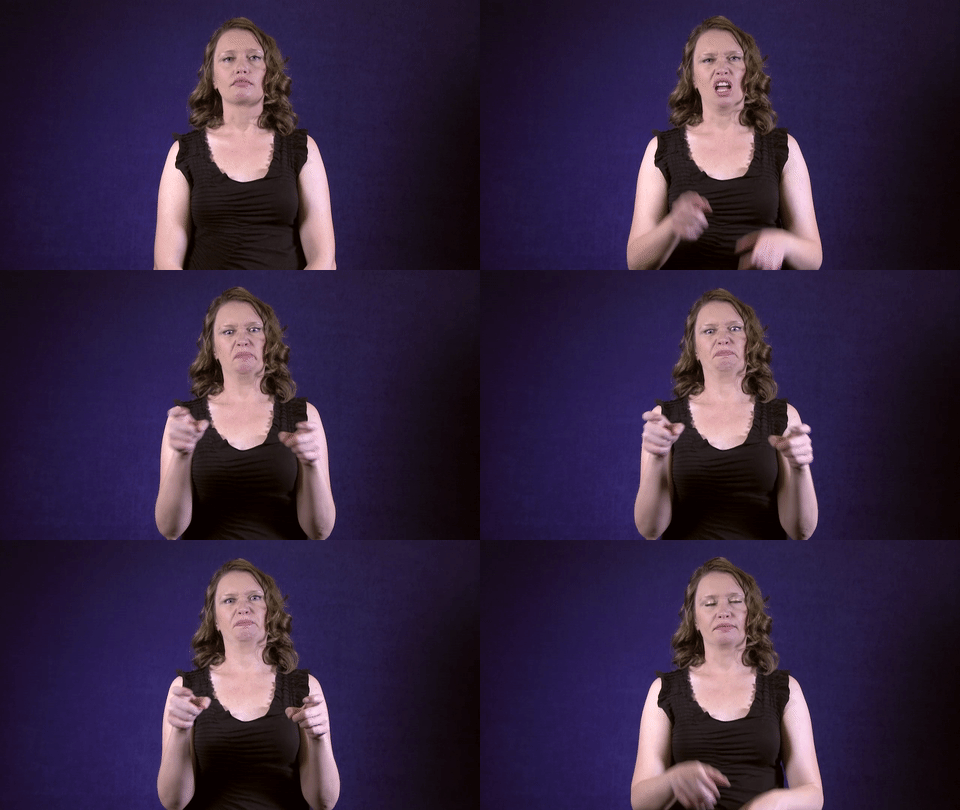
Sign for CONTROLLING in ASL

YouTube player

Practice Activities:

To begin practicing the sign for CONTROLLING in ASL, start by isolating the sign itself. Stand in front of a mirror and repeat the motion several times while maintaining proper handshape and movement. Focus on clarity and consistency, making sure your facial expression matches the concept of control—think determined or focused.

Next, try incorporating the sign into short phrases. Examples include “controlling behavior,” “controlling the situation,” and “she is controlling everything.” Sign these phrases slowly, then try them at a conversational pace. This helps with fluency and muscle memory while reinforcing vocabulary.

Use the sign for CONTROLLING in ASL in complete sentences. An example sentence could be, “My manager is controlling the project.” Another could be, “He is controlling the remote.” Practice signing each sentence to a partner, tutor, or in front of a camera to review later. Pause to reflect on how the sign feels in context and whether it clearly expresses the intended message.

For storytelling practice, create a short narrative where a character has to take control of a chaotic event. For example, tell a story about a group of students getting too noisy and the teacher controlling the class. This allows learners to naturally insert the sign for CONTROLLING in ASL into a real-world application.

Engage in partner dialogues using prompts like, “Who is controlling the team?” or “How do you feel when someone is controlling?” This gives both signers a chance to ask and respond using the target vocabulary in a meaningful context. Emoji roleplay activities like organizing a meeting ️ or managing pets can also make the practice visual and fun.

Repeat all activities multiple times using different situations to solidify understanding and fluency with the sign for CONTROLLING in ASL.

Cultural Context:

In the Deaf community, the concept of controlling can carry various nuances depending on the context in which it’s used. When expressing the sign for controlling in ASL, it’s important to consider not just the mechanics of the sign but also how the concept is interpreted within Deaf culture.

The sign for controlling in ASL often relates to managing situations, actions, or even emotions. Within everyday conversation, this sign is commonly used when talking about taking charge or having influence over a person, task, or environment. Understanding when and how to use this sign appropriately depends on recognizing how control is valued or viewed in diverse situations.

In group dynamics, such as in Deaf clubs or social gatherings, the sign for controlling in ASL might be used to describe someone who takes the lead or coordinates activities. This usage is viewed positively when done with collaboration and mutual respect. However, overuse or misuse of this sign can change the tone and imply domination, which may not be welcomed.

Control can also relate to emotional expression in ASL. For example, a person might use the sign for controlling in ASL when discussing how they manage their feelings or reactions in high-pressure social or family situations. This application touches on themes of self-awareness and emotional intelligence, which are valued qualities in the Deaf community.

The sign for controlling in ASL can also be discussed in educational or professional settings—such as learning how to control classroom behavior or managing a group project. In these environments, the sign supports conversations about leadership, decision-making, and responsibility. Using the correct sign helps convey precision and prevents miscommunication.

Parents within the Deaf community might use the sign for controlling in ASL when speaking about guiding or supervising their children. Here, the sign reflects care and attention, more than strict authority. It is helpful in describing parenting styles or discussing boundaries in family life.

Artists and performers in the Deaf community may also talk about controlling the rhythm, mood, or direction of a performance. In this case, the sign for controlling in ASL communicates the idea of artistic direction and mastery. This adds a creative layer of meaning to the sign and showcases how versatile it can be.

In relationships between Deaf and hearing individuals, the use of the sign for controlling in ASL can help navigate and describe power dynamics, especially when advocating for accessibility or autonomy. It may appear in conversations about communication access, interpreting services, or equal participation. Here, control becomes a theme of empowerment and self-determination.

Understanding the cultural context of the sign for controlling in

Extended Definition:

The sign for controlling in ASL refers to the concept of managing, regulating, or exerting influence over a person, object, or situation. In American Sign Language, controlling is expressed with a motion that captures the act of maintaining order or directing an outcome.

To show the sign for controlling in ASL, a commonly used method combines handshapes and directional movement. The hands often mimic the idea of guiding or holding something steady. This visual representation makes the sign intuitive, especially when associated with abstract ideas like power or regulation.

Like many ASL signs, the sign for controlling in ASL can change depending on the context. If you’re talking about someone controlling a group, the movement might slightly expand to emphasize authority. For more personal contexts, the sign may appear more contained and subtle.

The concept of control in ASL doesn’t just apply to people. It’s also used when referring to emotions, technology, or even physical reactions. For example, a person might sign about controlling their temper or controlling a machine. These meanings are usually clarified by facial expressions and surrounding signs.

Facial expressions play a significant role in how the sign for controlling in ASL is understood. A firm, serious expression can help communicate authority or dominance, while a calm expression might suggest gentle regulation or support. These visual cues enrich the sign’s meaning and add depth.

Native signers often adjust the movement within the sign to match the level of control being described. A more aggressive motion may relate to strict oversight, while a softer motion suggests light guidance. This flexibility is one of the things that makes ASL so expressive.

The sign for controlling in ASL can also be integrated into compound signs or full sentences. For instance, you might see it used in signs like controlling behavior or controlling schedule. In these phrases, the controlling sign connects smoothly with other signs to build a clear narrative.

This keyword phrase is commonly used when discussing relationships, work environments, or emotional management. Social workers, teachers, and mental health professionals, for example, may use this sign to describe behaviors in different settings. Understanding how to use this sign correctly can help improve communication in many fields.

Learners of ASL often find the sign for controlling in ASL helpful when expressing complex ideas. Its use in both literal and metaphorical situations allows a wide range of conversation topics. Practicing the sign with different facial expressions strengthens fluency and accuracy.

Common variations of the sign may be seen in regional dialects or among Deaf communities. Some signers may

Synonyms: managing, regulating, supervising, monitoring, commanding

Educational resources: Find related learning materials in our course bank!

Want more? Check out some of our popular learning activities on the homepage!

Need to look up a sign? Use our highly rated dictionary: https://aslinteractive.com/best-asl-dictionary/

Follow us on tiktok: https://www.tiktok.com/@aslinteractive. More social media links at the bottom of this page!

Long-tail Keywords: what is the sign for controlling in ASL, how do you sign controlling in American Sign Language, controlling in ASL sign

Categories:

tags: Commands, Language Learning, Activities, Verbs, Major Decisions

Parameters

*Handshape*:

The handshape for the sign for CONTROLLING in ASL typically uses both hands in the “X” handshape, resembling hooked index fingers. These hands alternate in a forward motion, as if guiding or keeping things in line. The movement and handshape together emphasize regulation or guidance over a situation.

In the sign for CONTROLLING in ASL, the “X” handshape plays a central role in conveying the act of managing or directing. This handshape reinforces the idea of control, direction, or oversight, reflecting both the literal and abstract meanings of the word.

*Palm Orientation*:

The palm orientation for the sign for CONTROLLING in ASL generally has both hands facing downward or slightly inward, depending on the variation. The dominant hand often moves over or across the non-dominant hand in a controlling motion, with palms staying flat.

In the sign for CONTROLLING in ASL, both hands may remain angled slightly toward each other, resembling a guiding or restraining action. This palm orientation emphasizes the concept of regulation or direction, which aligns with the meaning of the sign. ✋

*Location*:

The sign for CONTROLLING in ASL is produced in the neutral signing space directly in front of the torso. The hands typically stay at chest to upper stomach level, allowing clear visibility and comfortable articulation.

This location helps convey the idea of regulation or command, aligning with the meaning of the sign for CONTROLLING in ASL. Maintaining this central location emphasizes control over a concept or environment.

*Movement*:

The hands begin in front of the body, both in a modified “X” handshape (or like grabbing onto imaginary reins), palms facing downward. Move the hands forward slightly in tandem, then shift them side to side as if holding and guiding a steering wheel or reins.

This movement mimics the sense of managing or directing something, which aligns with the sign for CONTROLLING in ASL. The motion expresses the idea of exerting influence or having command.

*Non-Manual Signals*:

When using the sign for CONTROLLING in ASL, the signer typically exhibits a focused and intentional facial expression. Eyebrows are slightly furrowed, and eyes are directed at the subject being controlled, showing authority or influence.

The intensity of the signer’s facial tension can vary depending on how forceful or firm the control is. The sign for CONTROLLING in ASL often includes a slight tilt of the head forward to enhance a sense of assertiveness.

*Prosody, Dominant/Non-Dominant Hand*:

The sign for CONTROLLING in ASL is typically made using both hands in a specific movement pattern. The dominant hand uses an open “X” handshape, while the non-dominant hand mirrors it. Both hands move alternately in a slight zigzag forward motion, as if guiding or managing something.

In the sign for CONTROLLING in ASL, the dominant hand leads the directional motion, showing who is taking charge or maintaining guidance. This prosody visually represents regulation or influence, often used when describing authority, moderation, or emotional control in conversation.

Tips for Beginners:

When learning the sign for CONTROLLING in ASL, it’s helpful to focus on keeping your hand placement and movements clear and intentional. This sign often involves a dominant hand gently moving over the top of the non-dominant hand, symbolizing exerting influence or managing something. Pay close attention to directionality and control of motion—too fast or abrupt, and it can change the meaning or confuse your message.

A common beginner mistake is letting the hands drift too far apart or using inconsistent motion. Keep your hands close and movements smooth and steady, as the idea behind the sign for CONTROLLING in ASL is about steady influence, not erratic command. Facial expressions can add valuable context. Try using a serious or composed facial expression to show that you’re talking about guidance and regulation rather than manipulation.

Practice in front of a mirror to monitor the alignment of your hands and ensure your dominant hand moves correctly. Repetition with feedback from a fluent signer or video reference source is key. Regular review will help bond the motor patterns to memory, making the sign feel natural and fluid.

Context will affect how the sign for CONTROLLING in ASL is received, so try pairing it with topic-specific vocabulary. For example, the way you sign it when referring to controlling a group of children might include a different facial tone than when discussing software or data. Being flexible and adapting your delivery will help you appear more fluent.

Don’t rush the process; take the time to observe how native or advanced signers use the sign in different contexts. Incorporating the sign into sentences early on will make it easier to retain and build on. Keep fingers relaxed and movement purposeful—you’re signaling influence, not force .

sign for CONTROLLING in ASL, asl sign CONTROLLING, how to sign CONTROLLING in ASL, learn CONTROLLING in ASL, CONTROLLING sign language meaning

Connections to Other topics:

The sign for CONTROLLING in ASL has strong conceptual ties to signs like CONTROL, MANAGE, and SUPERVISE. These signs often use similar handshapes and movement patterns, emphasizing the act of directing or overseeing. Understanding this network of signs helps learners grasp how ASL conveys hierarchy, authority, and regulation.

This sign also connects with abstract concepts such as POWER, AUTHORITY, and DISCIPLINE. These related signs can be used in discussions about emotional self-regulation, leadership roles, and systems of governance . For example, when discussing controlling emotions or controlling a situation, this sign pairs well with FEEL or SITUATION to provide clarity.

The sign for CONTROLLING in ASL can play a key role in derived signs or phrases like CONTROLLING-BEHAVIOR or CONTROLLING-PARENT. These compound meanings highlight the emotional or interpersonal implications of the sign. In context, a signer may say something like “SHE CONTROLLING-relationship,” indicating manipulation or dominance in personal dynamics.

It also links to technology-based concepts like CONTROLLING-ROBOT or REMOTE-CONTROLLING, which are increasingly relevant in a digital context . These compound signs reflect modern usage and demonstrate how traditional lexical concepts expand for contemporary needs.

Grammatically, this sign can function as both a verb and an adjective depending on placement and facial expressions. When discussing roles or conditions, combining signs such as PERSON or STYLE modifies CONTROLLING to describe traits or behaviors. For example, CONTROLLING-PERSON vividly communicates someone with a dominant personality.

In story-telling or workplace settings, the sign for CONTROLLING in ASL supports clarity in describing roles like manager, leader, coordinator, or even villain. Knowing how this sign connects to others creates a fuller understanding of narrative integrity, professional language, and emotional nuance.

Summary:

The sign for CONTROLLING in ASL typically uses a variation of the verb “control,” which is often produced with both hands in flat ‘O’ or closed ‘F’ handshapes, facing palm down. The dominant hand taps or moves slightly forward in a guiding manner over the non-dominant hand. This motion conveys the sense of guiding, directing, or exerting influence over something or someone.

In terms of spatial grammar, the sign for CONTROLLING in ASL benefits from use within classifier structures, especially if discussing physical control over objects, machines, or environments. When applying to emotional or metaphorical control, the sign can be placed more abstractly in the signing space. The placement can indicate who or what is being controlled for clarity.

Sometimes, the sign can also be seen expressed with the dominant ‘X’ handshape controlling or hooking over another hand, implying the idea of restriction or intentional grasp. This variation is often used depending on regional dialect or clarity within context. Users should be aware of the slight differences depending on community and fluency level.

Grammatically, the sign for CONTROLLING in ASL functions as a verb and can act transitive or intransitive, depending on structure. For example, “I controlling the device” uses a subject-verb-object format in ASL, with directional verb use enabling an object to be visually referenced or pointed at. Facial expressions often enhance whether the control is strict, lax, emotional, or mechanical.

Culturally, the concept of control in Deaf communities directly ties into themes of autonomy and oppression. Many Deaf individuals experience external controlling forces in institutions, educational placements, or medical decisions about assistive devices. So, the sign for CONTROLLING in ASL may unintentionally evoke broader discussions about who has power and agency.

This sign frequently appears in ASL discourse when talking about controlling behavior in relationships, both healthy and abusive dynamics. In these contexts, facial affect and body tension often increase, underscoring the negatively perceived tone of being too controlling. ASL storytellers use spatial shifts to represent shifting control dynamics among characters.

The sign for CONTROLLING in ASL also connects to other conceptual signs: POWER, INFLUENCE, MANAGE, DOMINATE, RESTRICT, and GUIDE. These semantic neighbors allow for nuances in conversation. For instance, “manage” indicates a more neutral tone, whereas “dominate” suggests negative force or authority without permission.

Linguistically, control-oriented signs illustrate how ASL builds meaning beyond individual words—space, movement, palm orientation, and non-manual cues all contribute. For the sign for CONTROLLING in ASL, a downward or inward movement can show increasing pressure, constraint, or self-control. In contrast, lifting outward can reflect relinquishing control or loosening boundaries.

Applied linguistics research in discourse analysis highlights how control metaphors in signed languages often emerge visually. For example, depicting one hand manipulating another object mimics real psychological or social dynamics. The human brain processes these metaphors not only linguistically but sensorimotorly through mirror neurons.

Children acquiring ASL may learn the sign for CONTROLLING through routines involving toys, remote controls, or behavior management. Sign choice imbues messages with subtle social messages about what’s acceptable or not. Thus, caregivers must model control signs with awareness and contextual empathy.

In counseling and education settings, the sign for CONTROLLING in ASL is useful to evaluate emotional regulation. For example, “controlling my feelings” would require both the emotional state sign plus use of control, often modified to show self-direction. Clinicians adapt the rhythm of the sign to match emotional intensity levels.

The sign also appears frequently in discussions around substance use, where individuals may refer to “controlling addiction” or note lack of control. The sign’s presence in these contexts demonstrates its versatility across psychological and health-oriented topics. ASL’s breadth allows such abstract terms to take physical form on the hands.

From a sociolinguistic lens, examining regional and generational variants of the sign for CONTROLLING in ASL can highlight language change. Younger signers may simplify the sign with quick movements or borrow simplifications from mainstream media. Older Deaf signers may emphasize clarity and maintain traditional forms tied to storytelling sensibility.

Digital communication among Deaf YouTubers and TikTok creators shows evolving use of the sign for CONTROLLING in ASL. They may blend humor and critique by exaggerating sign motion to mock overly controlling figures or systems. These performative shifts shape modern ASL expression and its socio-political relevance.

Some spiritual or philosophical conversations in ASL incorporate the sign for CONTROLLING to describe divine power, fate, or karma. In those settings, sign modifiers or role-shifting portray God or external forces as exerting or relinquishing control over human lives. Facial expressions here help convey reverence or frustration.

Animators, interpreters, and ASL poets use this sign artist

Want more? Check out some of our popular learning activities!

ASL Interactive Resources

ASLInteractive YouTube Channel

Follow us on tiktok: @aslinteractive.com

Follow us on Instagram: aslinteractive

Facebook page: aslinteractive

Facebook group: aslinteractive

LInkedIn: ASL Interactive LLC

Twitter: @ASL_interactive

*Some information on this page is AI-generated. AI can make mistakes. Please check the information.

Sign for CONTROLLING in ASL

Responses