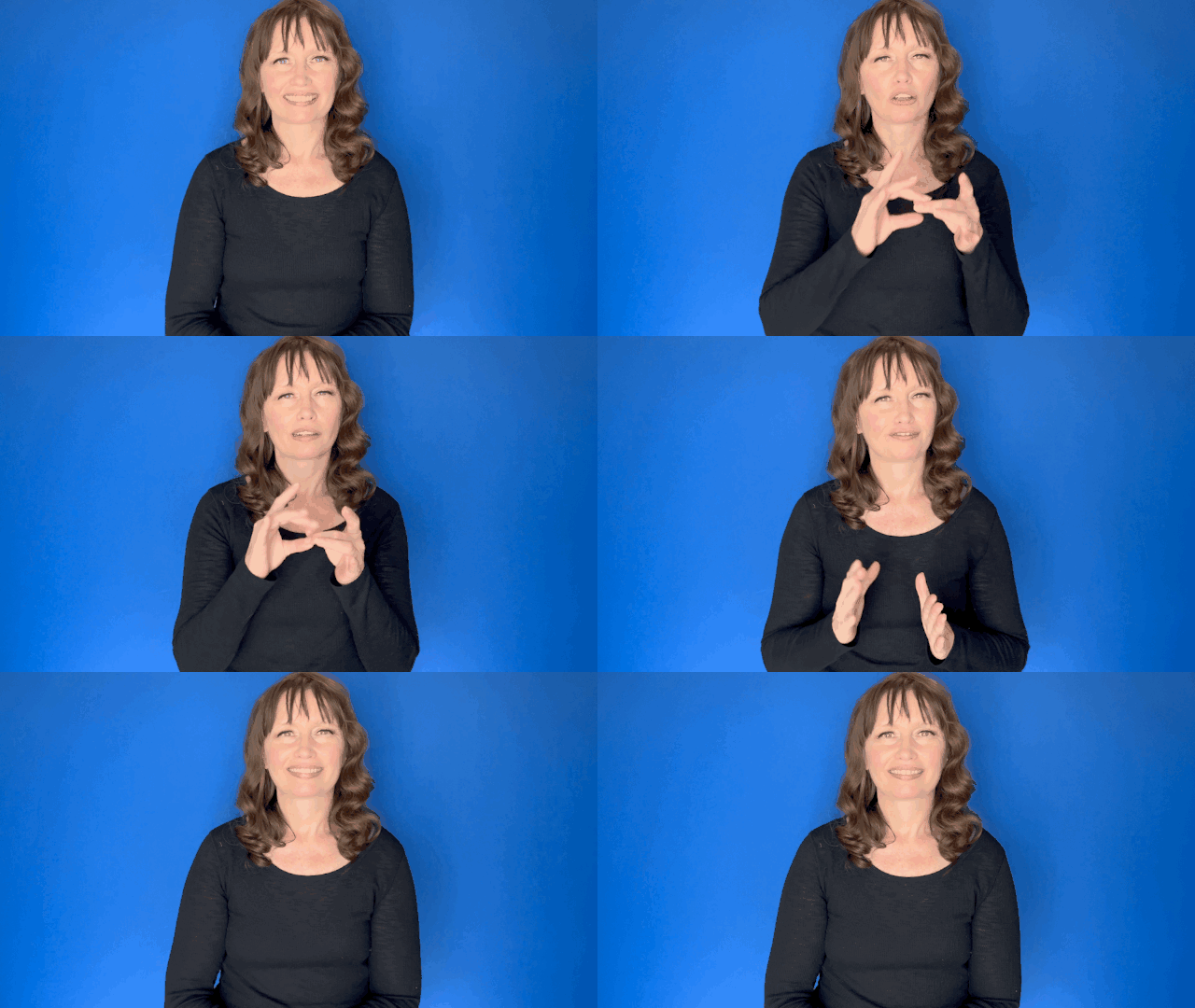
Definition: A person who coordinates activities.
Sign for COORDINATOR in ASL

Practice Activities:
To practice the sign for COORDINATOR in ASL, start by rehearsing the sign in front of a mirror. Focus on handshape, palm orientation, and movement. Repeat it slowly and then build up to natural signing speed. Use flashcards with job titles and identify which ones could involve a coordinator. Then, sign them along with the sign for COORDINATOR in ASL.
Engage in context-based practice by inserting the sign into short, simple sentences. For example, try “My event needs a COORDINATOR,” “The team has a new COORDINATOR,” or “She’s the project COORDINATOR.” Sign each sentence slowly, emphasizing clarity. Record yourself and review it or ask a peer to give feedback.
Create a short story about hiring a COORDINATOR for a school event or community project. Include details like what kind of coordination is needed, how many people are involved, and what problems the COORDINATOR might solve. Make sure to use the sign for COORDINATOR in ASL multiple times throughout your story.
With a partner, plan a mock event like a festival, workshop, or meeting. Decide who in the team is acting as the COORDINATOR and role-play dialogues about the planning process. Practice asking and answering questions using signs like WHO, WHEN, WHERE, and FINISH alongside the sign for COORDINATOR in ASL to develop fluency in conversation.
Another useful activity is describing different types of coordinators such as school COORDINATOR, wedding COORDINATOR, or volunteer COORDINATOR. Match each context with its responsibilities and sign out the descriptions. This will strengthen vocabulary and real-world application of the sign.
Use social media or video apps to watch Deaf professionals discuss their roles and try to notice how often the sign for COORDINATOR in ASL appears. Observe their facial expressions and transitions for a more natural signing style.
Cultural Context:
In American Sign Language, the sign for COORDINATOR reflects more than just a job title—it connects to the value of collaboration in the Deaf community. A coordinator often takes on roles that help groups work together efficiently, which is essential in environments where communication access and inclusivity are priorities. The sign for COORDINATOR in ASL acknowledges this need for organizational clarity and teamwork.
The Deaf community often relies on interpreters, event planners, and outreach specialists in coordinator roles to ensure successful communication at gatherings, events, or services. Having a clear and recognizable sign for COORDINATOR in ASL strengthens accessibility and leadership across settings. Whether you’re referring to a school coordinator, event organizer, or community leader, the sign reflects a structured role rooted in communication and support.
The sign for COORDINATOR in ASL can sometimes vary depending on region or context, but it typically combines elements that convey organization and management. Within Deaf culture, responsibilities often extend beyond the job description, especially in communal settings. So, using the correct sign both respects the role and aligns with how Deaf individuals describe responsibility and leadership.
Cultural respect is an important part of signing roles like COORDINATOR accurately. Since coordination often involves overseeing multiple people or elements, the ASL sign uses visual grammar that implies control and connection—concepts that are significant in both language and culture. It’s not just about the word; it’s about how that concept functions in social spaces within the Deaf world.
In educational settings, a COORDINATOR in ASL might be someone helping with academic programs, interpreter scheduling, or communication access. Knowing the proper sign for COORDINATOR in ASL makes it easier for students and staff to communicate essential roles, leading to smoother interactions in daily life. At universities or Deaf schools, the role of coordinator is central to equitable education.
In community events or Deaf expos, the COORDINATOR plays a vital role in making sure participants’ language and access needs are met. The sign for COORDINATOR in ASL shows respect for the person’s efforts and clarifies their position during the event. Cultural norms within the Deaf community often emphasize group involvement, and a coordinator ensures that everything runs according to plan .
Workplace accessibility is another area where the sign for COORDINATOR in ASL is highly relevant. This could involve project managers, accessibility coordinators, or HR staff ensuring equitable conditions for Deaf employees. Using the correct ASL sign helps
Extended Definition:
The sign for coordinator in ASL represents someone who brings people or efforts together to accomplish a shared goal. In American Sign Language, this concept is often expressed by combining signs related to organizing, managing, or connecting different parts or people.
To express the sign for coordinator in ASL, signers typically use the sign for “coordinate” and add an agent marker to indicate personhood. The movements and facial expressions used may vary slightly depending on regional sign variations or the context in which it’s used. This sign communicates the idea of someone responsible for aligning tasks, managing schedules, or overseeing collaboration.
A coordinator could be someone in a workplace who makes sure a project runs smoothly. In school settings, the word can refer to someone who organizes programs or events. In both cases, when using the sign for coordinator in ASL, clarity and context help define the exact meaning being conveyed.
Because ASL is a visual language, the sign for coordinator involves handshapes and motion that reflect the idea of things coming together. The agent marker at the end gives the sign its “person” quality, transforming the concept of coordination into the role of someone doing that work. This is common in many signs for occupations or roles, helping signers communicate job titles clearly.
When using the sign for coordinator in ASL, it’s important to use proper non-manual signals such as eyebrow movement and eye gaze. These elements add emphasis and meaning to the sign, especially in more formal or professional situations. Facial expression supports the tone of the message—whether the coordinator is helping with an event or managing complex logistics.
In conversations, the sign for coordinator in ASL can be used when describing someone’s role or when assigning tasks. For example, during a meeting, someone might ask who the coordinator is, or whether a coordinator has been assigned to a specific activity. It helps streamline discussions and supports clear communication within a group.
There are many types of coordinators—event coordinators, project coordinators, academic coordinators—and this sign can represent all of these depending on context. You might modify or add signs for the specific field to clarify which kind of coordinator is being discussed. For instance, signing “event” and then “coordinator” makes it clear you’re referring to the role associated with organizing an event.
The sign for coordinator in ASL is practical, adaptable, and used in both professional and everyday settings. From hospitals to universities to businesses, knowing how to sign coordinator helps Deaf and hearing individuals communicate more effectively
Synonyms: organizer, facilitator, planner, administrator, manager
Educational resources: Find related learning materials in our course bank!
Want more? Check out some of our popular learning activities on the homepage!
Need to look up a sign? Use our highly rated dictionary: https://aslinteractive.com/best-asl-dictionary/
Follow us on tiktok: https://www.tiktok.com/@aslinteractive. More social media links at the bottom of this page!
Long-tail Keywords: what is the sign for coordinator in asl, how do you sign coordinator in american sign language, asl sign for coordinator
Categories:
tags: Coordinator in American Sign Language, ASL sign for Coordinator, how to sign Coordinator in ASL, Coordinator ASL translation, learn ASL Coordinator sign
Parameters
*Handshape*:
The handshape used in the sign for COORDINATOR in ASL typically involves both hands forming the “F” handshape , where the tips of the thumb and index finger touch to make a circle, and the remaining fingers are extended upwards. These “F” handshapes represent the concept of linking or connecting ideas or people.
In the sign for COORDINATOR in ASL, the “F” hands move toward each other and may tap or interlock slightly to show coordination. This handshape effectively conveys the idea of organizing or aligning multiple elements together.
*Palm Orientation*:
The palm orientation for the sign for COORDINATOR in ASL generally involves both hands formed in the “F” handshape. The palms face each other horizontally as the tips of the index fingers and thumbs touch to form small circles. This motion symbolizes connection or coordination. When performing the sign for COORDINATOR in ASL, the circular motion adds clarity, emphasizing the role of bringing parts together smoothly.
*Location*:
The sign for coordinator in ASL is typically produced in the neutral space in front of the torso. Hands are brought together in front of the chest area when forming the sign, keeping the movement centered in this region. This positioning helps maintain clarity and emphasis on the meaning.
When signing the sign for coordinator in ASL, both hands stay relatively close to the body, between the shoulders and midsection. This neutral zone allows for easy visibility and fluid hand motion.
*Movement*:
The sign for COORDINATOR in ASL uses both hands in the “F” handshape. Start with the fingertips of both “F” hands touching in front of the chest, then move them outward and slightly apart in small, mirrored circular motions to represent the concept of organizing parts together.
This movement symbolizes the connection and facilitation role of a coordinator. The sign for COORDINATOR in ASL effectively conveys managing or linking elements in a task or group.
*Non-Manual Signals*:
When using the sign for COORDINATOR in ASL, the facial expression should be focused and neutral, showing mental concentration and organizational intent. Slightly raise the eyebrows to indicate attentiveness, especially when emphasizing someone’s role as a coordinator.
Keep the head steady and direct, signaling authority or control, which supports the meaning behind the sign for COORDINATOR in ASL. A calm and engaged demeanor enhances clarity.
*Prosody, Dominant/Non-Dominant Hand*:
The sign for COORDINATOR in ASL uses both hands in the F handshape. Each F hand is held in front of the chest, palms facing each other, with the tips of the index finger and thumb from each hand touching to form small circles. The hands alternate slightly forward and back in a brief back-and-forth movement to resemble interconnectedness.
Both hands move equally, emphasizing collaboration and mutual connection. The sign for COORDINATOR in ASL reflects someone managing or linking people or tasks together, often in a professional or organizational context .
Tips for Beginners:
When learning the sign for COORDINATOR in ASL, it’s helpful to understand that you are often modifying the more general sign for “coordinate” or “organize” and then adding the person-agent suffix. The movement should be precise—usually involving both hands in an alternating motion that mimics the action of organizing or linking ideas or events. After that, use the person-agent marker: both hands in flat “B” shapes moving downward in front of the body.
Practice maintaining symmetry and clean execution when forming the person-agent suffix. One of the most common mistakes beginners make is rushing the motion or making inconsistent handshapes. Take your time; clarity and controlled movement will help you communicate more effectively and be better understood in real-life conversations.
Focus on your facial expressions as well, since they add important context to the sign for COORDINATOR in ASL. If you’re trying to show that someone is a lead coordinator or has specific authority, a slight shift in facial expression can convey leadership or hierarchy. This adds clarity and makes your signing more dynamic and nuanced.
Beginners often forget spatial referencing, which is crucial in the sign for COORDINATOR in ASL, especially when showing collaboration among different people or events. Practice using the signing space to indicate different roles or participants. This adds depth to your storytelling and demonstrates your awareness of ASL grammar and structure.
To help with long-term memorization, associate the motion of linking or connecting with someone who manages or coordinates parts to make them work together, like in a project. Repetition, along with visualization techniques, will make it easier to recall the sign for COORDINATOR in ASL when needed in real conversations.
sign for coordinator in asl, coordinator in american sign language, how to sign coordinator in asl, asl vocabulary coordinator, asl job title coordinator
Connections to Other topics:
The sign for COORDINATOR in ASL connects closely to signs for roles and occupations, such as MANAGER, SUPERVISOR, or ORGANIZER. These terms often involve similar handshapes and movement patterns emphasizing control, structure, and oversight. Understanding common role-related signs can deepen comprehension of how ASL emphasizes function over direct one-to-one translations.
ASL learners benefit from seeing how the sign for COORDINATOR in ASL can be broken down or built up using compound signs. For example, combining signs like PLAN and MANAGE may be used in various contexts to describe coordinating tasks. In work or school environments, signs that incorporate RESPONSIBLE, ASSIGN, or GROUP work in tandem with COORDINATOR to describe collaboration and delegation.
A common derivative context is in team settings where one might say PROJECT COORDINATOR. This often merges PROJECT and COORDINATOR or uses fingerspelling for specific job titles. In signed discussions, the visual clarity of assigning specific roles allows for easier understanding of how tasks are distributed among participants.
The concept behind the sign for COORDINATOR in ASL also shares elements with the sign for ORGANIZE. Both involve structured movement suggesting arranging or bringing elements together. These connections help learners generalize movement and spatial arrangement concepts across related vocabulary.
In interpreting or educational fields, COORDINATOR may appear alongside EVENT, INTERPRETER, or PROGRAM. Using classifiers and directional verbs with these related signs helps flesh out more detailed conversations. For instance, one might sign MEETING COORDINATOR using MEETING plus COORDINATOR for a fuller idea.
Finally, the sign for COORDINATOR in ASL reflects the broader framework of responsibility and leadership signs. Recognizing the commonalities among these role-based signs—like similar palm orientation, symmetry, or body positioning—builds stronger intuitive bridges for students advancing through occupational or professional vocabulary in ASL.
Summary:
The sign for COORDINATOR in ASL often begins with the concept of two roles or entities being brought together. Typically, it uses the classifier-like movement of both F-handshapes in front of the body, circling or interlocking slightly to represent the merging or managing of people or parts. This sign strongly implies involvement in overseeing or aligning efforts.
By using the F-handshapes from both hands, there is a parallel to the sign for ORGANIZE, making the two signs closely related. The motion, however, is slightly more active and task-based for the sign for COORDINATOR in ASL, indicating a position of facilitation rather than just sequential or structural planning. This subtle difference articulates how the role involves interpersonal dynamics.
In terms of placement, the sign is usually made in the neutral space in front of the torso. The circular or cooperative movement of the hands helps symbolize the synthesis and collaboration required in this role. This movement encodes the abstract idea of coordination into a visual-spatial expression.
Linguistically, the sign for COORDINATOR in ASL uses a morphological blend that demonstrates how ASL constructs job titles out of core actions. It pairs a base sign such as ORGANIZE or CONNECT with a person-marker movement, even though ASL doesn’t always need a separate suffix for “-er.” The role is implied through movement and context.
From a grammatical perspective, the sign functions within ASL sentence structure by usually following the topic-comment order. When emphasizing someone’s role as a coordinator, the noun comes after the subject or topic is established. For example, “SHE COORDINATOR,” would mean she serves that role, possibly followed by what exactly she coordinates.
Within Deaf culture, a COORDINATOR may take on added importance because of the linguistic access challenges often present in majority Hearing spaces. The sign for COORDINATOR in ASL can refer to someone responsible for arranging interpreting services, meetings, or events in a way that makes them fully accessible. This tends to give extra cultural weight to the position.
In vocational and educational settings, the role of a coordinator might include acting as a liaison between d/Deaf individuals and institutions. In these contexts, the person serves not only an organizational function but often a bridging function socially and communicatively. The sign reflects that nuance through its inclusive, interconnected movement.
A related sign is MANAGE, which uses X-handshapes in an alternating forward motion. The sign for COORDINATOR in ASL places more emphasis on synergy, while MANAGE implies hierarchy or direction. This helps distinguish roles based on autonomy and collaboration.
Another adjacent sign is SCHEDULE, which is relevant when the coordinator role involves time and event planning. While SCHEDULE involves mapping out on a palm or grid, COORDINATOR involves overseeing the interaction between those mapped elements. These distinctions are critical for expressive accuracy in ASL.
Fingerspelling might be used, especially in more formal or professional contexts. Some people simply fingerspell (FS) COORDINATOR when specifying a job title on introductions or nametags. Fingerspelling allows precision when the setting requires it but lacks visual clarity for fluid conversation.
Semantic expansion frequently occurs with the sign for COORDINATOR in ASL due to the broad spectrum of settings in which the term can be used. It might represent an event planner, case manager, volunteer lead, or team facilitator. Its versatility makes it a high-frequency sign in nonprofit, academic, and advocacy domains.
Through usage, the sign has gained conceptual ties with TEAMWORK and NETWORK. These concepts often come up in conversations about an individual’s collaborative responsibilities. Whether used officially through job title or casually to describe someone’s function, the sign is adapted to context.
When signing with facial expressions and body language, additional information is conveyed about how the person coordinates. Raised eyebrows might show respect for the role, while a specific directional orientation toward different referents can illustrate who is being coordinated with or between. This kind of layering is typical in ASL narratives.
In performance interpreting and logistical planning, the sign for COORDINATOR in ASL might additionally be used with signs for TRANSLATOR, INTERPRETER, and PLAN. This further establishes the interdisciplinary nature of many coordinator roles within the Deaf and signing communities. The connector function is clear in all these contexts.
Applied linguistics sees this sign as a prime example of how role names in ASL are deeply rooted in function rather than title alone. The movement clues you in to what the person does more than who they are by designation. This means ASL foregrounds doing over labeling in occupational signs.
In interpreting training, the sign for COORDINATOR in ASL often arises when practicing job description vocabulary. It’s part of Deaf professionals’ and interpreters’ toolkits for describing the people involved in setting up events and ensuring access. Mastery of this sign also equips interpreters to clarify roles during team assignments.
From a
Want more? Check out some of our popular learning activities!
ASL Interactive Resources
ASLInteractive YouTube Channel
Follow us on tiktok: @aslinteractive.com
Follow us on Instagram: aslinteractive
Facebook page: aslinteractive
Facebook group: aslinteractive
LInkedIn: ASL Interactive LLC
Twitter: @ASL_interactive
*Some information on this page is AI-generated. AI can make mistakes. Please check the information.


Responses