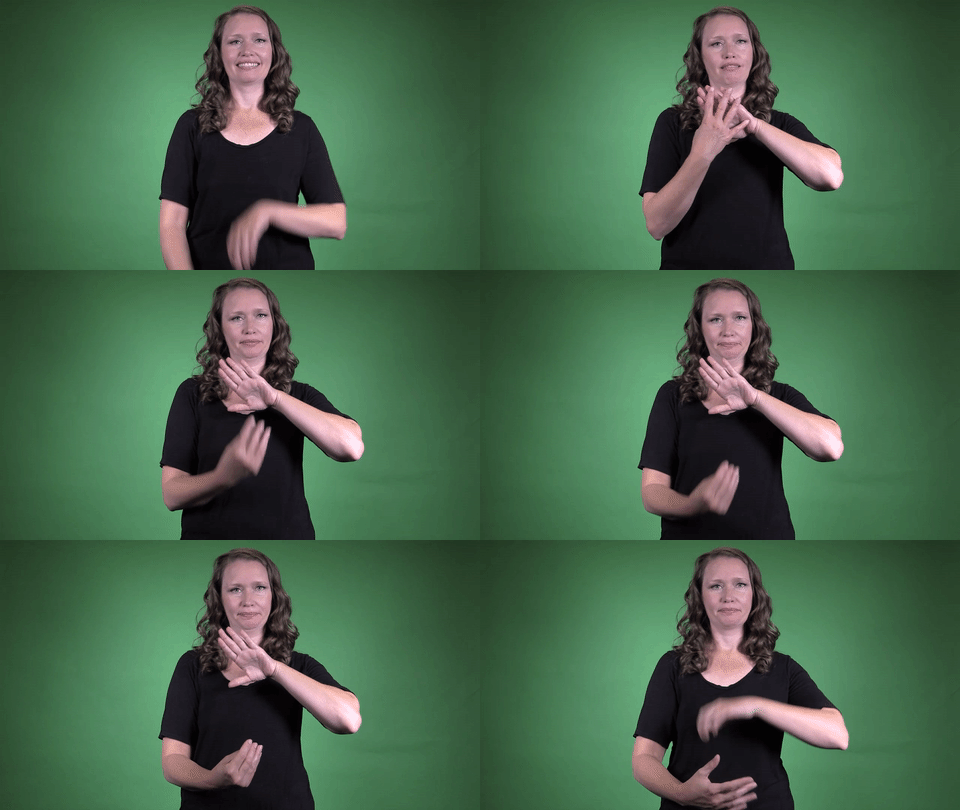
Sign for COPY ME in ASL | 👩‍🏫 ASL Dictionary

Definition: To copy something from someone.

Sign for COPY ME in ASL 

YouTube player

Practice Activities:

Start by practicing the sign for COPY ME in ASL in front of a mirror. Focus on facial expressions and handshape accuracy. Repeat the sign multiple times slowly, then increase speed as your comfort level improves. Use your non-dominant hand as the surface and your dominant hand to “pull” the information, simulating the idea of copying.

Next, practice the sign in context. Create short sentences like “COPY ME, please,” “You COPY ME, okay?” or “Follow along – COPY ME.” Sign these in front of a mirror or record yourself to check clarity. Try using different facial expressions depending on whether you’re giving a command, making a request, or asking a question.

Use flashcards showing various actions or signs. One person signs an action, and the other must copy not only the action but also sign “COPY ME” afterward. This promotes memory building and context recognition. It’s great for partner work and helps reinforce when to appropriately use this phrase.

Storytelling prompts are helpful, too. Create a scene where you’re teaching someone to sign or draw something new — build a story where you show an action and follow up with the sign for COPY ME in ASL. For example, “I start drawing a star, then tell my little brother, COPY ME.”

Try a game of “Simon Says” in ASL style. Instead of saying “Simon says,” use “COPY ME” with each command. This makes learning more engaging and interactive, especially in group settings or classrooms.

For solo practice, film a tutorial on how to do something simple using everyday objects. Sign your actions step by step and say “COPY ME” as if you’re guiding someone through it. This helps embed the sign into functional language use and mimics real-world scenarios.

Cultural Context:

In American Sign Language, the sign for COPY ME in ASL is more than just a simple command. It can reflect a wide range of meanings depending on the tone, context, and relationship between signers. Whether playful, assertive, or instructional, this phrase often carries as much emotional weight as it does linguistic content.

The sign for COPY ME in ASL is commonly used among Deaf children during games or storytelling. It expresses a character’s desire or need to be imitated, often in a fun and friendly manner. In classroom settings, teachers use this sign to encourage students to mimic handshapes and movements, promoting language acquisition and motor coordination.

Within Deaf culture, mimicry is not always negative. When someone signs COPY ME in ASL, it might indicate admiration or respect, particularly when used to mirror a skill or talent. This is different from the hearing world’s interpretation, where copycat behavior can sometimes be frowned upon. Understanding this cultural nuance allows for more accurate and respectful social interaction.

In family environments, parents sign COPY ME in ASL to teach their children new signs, behaviors, or routines. It fosters bonding and reinforces learning through visual demonstration. This type of communication plays a key role in language development for Deaf children, particularly during early childhood.

Social media and online content creators within the Deaf community also use the sign for COPY ME in ASL when creating challenge videos or tutorials. It encourages followers to learn and replicate signs or dance moves. This trend has become a way of celebrating Deaf creativity while spreading sign language awareness to broader audiences.

In storytelling settings, especially in ASL poetry or performance, COPY ME in ASL signals a shift in narration or a call-and-response sequence. The audience is expected to mirror the signer, creating a collective and immersive experience. This strengthens the sense of community and shared language.

When used in a classroom with hearing students learning ASL, the sign for COPY ME in ASL becomes a bridge between spoken English and visual communication. Learners use it to confirm they are following along correctly or to engage actively with the instructor. This application helps reinforce ASL’s importance in inclusive education.

In conflict or teasing scenarios, the phrase can take on a sarcastic or mocking tone. The sign for COPY ME in ASL is not just about the movement of hands—it involves facial expressions and body language. These non-manual markers are essential in conveying whether the intent is light-hearted or offensive.

Adults might also use COPY ME in ASL in mentorship or

Extended Definition:

The sign for copy me in ASL is a combination of gestures that conveys the idea of duplication or imitation, directed toward the signer themselves. This phrase is commonly used in educational settings, social interactions, and performance settings, where someone is asking others to mimic their actions or signs. It plays an important role when giving instructions or leading a group activity.

To create the sign for copy me in ASL, you start with one hand open, palm facing the other hand, which is in a flat or slightly cupped position. The motion moves outward, usually away from the dominant hand, indicating something being taken or mirrored. Then, the non-dominant hand gestures toward oneself, showing the personal direction of the action. This combination expresses the concept of taking what’s being done and repeating it.

This phrase can be useful when teaching someone how to sign or demonstrating a sequence of signs, especially to learners of ASL. A teacher might sign copy me at the beginning of a lesson to get students actively involved. Parents may also use the sign for copy me in ASL when communicating with young children learning both spoken and signed language.

In practical use, body language and facial expressions add clarity and intention to the sign for copy me in ASL. For example, raising your eyebrows while signing can help show that it’s an invitation or a command. Expressive signing helps the viewer understand the context, whether it’s a casual request or a structured instruction.

This sign is also popular in group settings, such as ASL music videos, storytelling sessions, or sign-along events. The leader might indicate the sign for copy me in ASL to prompt participants to follow along with synchronized motions. It becomes a visual cue that unifies the group and supports learning through repetition.

You may also see variations of the same sign depending on the region or personal signing style. Some individuals prefer a one-handed version or incorporate directional signs to show who should be copying. Despite these slight changes, the overall message remains that imitation is being requested.

Understanding the sign for copy me in ASL helps improve communication in both structured and informal environments. It is particularly important in early childhood education and among ASL instructors, speech therapists, and interpreters. The sign helps establish engagement and encourages active participation from communication partners.

When searching for resources or videos about this phrase, it’s helpful to use visual dictionaries that demonstrate the handshapes and movement involved. Seeing the sign for copy me in ASL performed by native or fluent signers will help

Synonyms: duplicate me, mimic me, imitate me, replicate me, follow my actions

Educational resources: Find related learning materials in our course bank!

Want more? Check out some of our popular learning activities on the homepage!

Need to look up a sign? Use our highly rated dictionary: https://aslinteractive.com/best-asl-dictionary/

Follow us on tiktok: https://www.tiktok.com/@aslinteractive. More social media links at the bottom of this page!

Long-tail Keywords: what is the sign for copy me in ASL, how do you sign copy me in ASL, ASL sign for copy me

Categories:

tags: Commands, Language Learning, Activities, Classroom Picture, Education

Parameters

*Handshape*:

The handshape for the sign for COPY ME in ASL generally uses a flat non-dominant hand held palm-up to represent a surface or paper. The dominant hand begins in a flat “O” handshape above the non-dominant hand and moves upward or sideways while opening into a spread hand, symbolizing the action of taking or copying something.

This motion and handshape combination in the sign for COPY ME in ASL illustrates the concept of transferring or duplicating information. The contrast between the stable base hand and the dynamic motion of the dominant hand reinforces the meaning visually.

*Palm Orientation*:

For the sign for COPY ME in ASL, the dominant hand typically starts with the palm facing the non-dominant hand, which is held steady with the palm facing upward. The dominant hand pulls an imaginary paper or information from the non-dominant hand, changing orientation to face outward as it moves.

This shift in palm orientation emphasizes the idea of transferring or copying something from one person (me) to another. Understanding the palm orientation helps clarify the nuances in the sign for COPY ME in ASL ️.

*Location*:

The sign for COPY ME in ASL takes place primarily in the neutral space in front of the torso. The dominant hand begins near the open non-dominant hand, which is held steady at chest level with the palm facing up. The dominant hand performs a grasping motion off the non-dominant hand and moves toward oneself, indicating copying to the signer.

This spatial positioning emphasizes the idea of something being transferred or taken from another and internalized. The neutral zone in front of the body allows for clear visibility and reinforces the directional component of the sign for COPY ME in ASL.

*Movement*:

The sign for COPY ME in ASL starts with your dominant hand open and slightly curved, hovering above the non-dominant flat hand, palm facing up. Move the dominant hand downward as if you’re pulling or scooping something from the non-dominant hand, then bring it toward your chest to indicate “me.”

This movement represents taking something from another and applying it to yourself. The sign for COPY ME in ASL visually conveys the idea of imitation or replication directed toward the signer.

*Non-Manual Signals*:

When using the sign for COPY ME in ASL, the non-manual signals typically include direct eye contact and a slightly raised brow to emphasize the request or command. A confident facial expression reinforces the intention behind the sign, whether it’s instructional, playful, or assertive.

Depending on context, you might also add a slight head nod forward to suggest encouragement or urgency. These facial cues support clarity and tone when using the sign for COPY ME in ASL.

*Prosody, Dominant/Non-Dominant Hand*:

The sign for COPY ME in ASL uses both hands with distinct roles. The dominant hand begins open near the non-dominant palm, then pulls away while forming a flat “O” shape, symbolically extracting or copying information. The non-dominant hand stays still, palm up and flat, representing the source.

To emphasize the sign for COPY ME in ASL, the motion is directed toward the signer, showing that the action is being requested. Facial expressions and slight repetitions can convey urgency or tone.

Tips for Beginners:

When you’re learning the sign for COPY ME in ASL, start by breaking it down into its components. COPY is typically signed by using your dominant hand to pull an imaginary item or piece of information from your non-dominant hand, while ME is simply pointed back at yourself. Practice combining these smoothly so it feels like one fluid motion rather than two separate signs.

Consistency in handshape is key when signing COPY. Your dominant hand should start as an open or flat hand and transform into a closed hand or flat-O shape as you pull away from the palm of your non-dominant hand. Make sure not to rush the motion—your audience should see the transition clearly. Sloppy transitions can make the meaning unclear, especially for beginners.

Facial expressions are just as important as the hand movements in the sign for COPY ME in ASL. Use eye contact and a slightly inquisitive or commanding look depending on context. If you’re asking someone to copy you, raise your brows a little to indicate a directive. If it’s a casual instruction, stay neutral and relaxed.

Beginners often forget about the spatial orientation of the sign. COPY should move away from the non-dominant palm toward yourself, not the other way around. Reversing the direction or signing with the wrong hand can change the meaning entirely. Make sure to practice in front of a mirror to self-correct this common error.

To internalize the sign for COPY ME in ASL, use it regularly in real conversations. Try practicing with a friend, where one person performs a sign and the other has to copy it upon cue. This will condition your muscle memory and improve your comfort level with everyday signing. Repetition and feedback are the fastest paths to fluency .

Connections to Other topics:

The sign for COPY ME in ASL connects to several core ASL concepts such as directionality, role shifting, and personal pronouns. This sign uses movement from one location on the body to another, often from the dominant palm to the other hand or toward the person being addressed, demonstrating how ASL utilizes spatial grammar and placement to indicate subject-object relationships.

COPY ME shares structure with other directional verbs like GIVE, SHOW, and TEACH. These signs often adopt a starting location and an end location based on the subject and object of the action, which aligns with the way COPY ME indicates one person copying or mimicking another. Understanding this principle helps learners recognize how signed space impacts meaning in ASL sentences.

In conversation, the sign for COPY ME in ASL may be compounded with facial expressions or non-manual signals to express sarcasm, frustration, or encouragement, depending on the context. These elements are essential in conveying tone, much like how intonation works in spoken language. For example, raising eyebrows and tilting the head while signing COPY ME might turn it into a playful or questioning phrase like “You’re copying me?”

Related signs include COPY (in general), FOLLOW, and LEARN. All share elements that symbolize transmission of information or behavior from one person to another. Exploring these relationships helps deepen the understanding of how concepts spread across ASL and how modifiers like facial expressions and body shifts influence meaning.

Additionally, directional movement in COPY ME links to grammar lessons in ASL classifiers and agreement verbs. Learners often encounter COPY ME during roleplay exercises, especially when practicing commands, instructions, or mirroring activities in language labs. Recognizing these links builds a strong grammatical foundation for using the sign for COPY ME in ASL fluently in social or instructional contexts.

Summary:

The sign for COPY ME in ASL combines the sign for COPY with appropriate facial expression and directionality to indicate the recipient. It’s a directional sign, which means the movement of the sign itself conveys the subject and object relationships. This directional quality is vital to ASL grammar and emphasizes how visual and spatial the language is.

To perform COPY, the dominant hand starts open and moves from the non-dominant palm, shaping into a closed form as if you’re pulling something from a surface. To indicate COPY ME, this motion is directed toward the signer’s body, pointing visually to self as the object. The source of the movement shows who is being copied, and the destination shows who should copy.

This sign is often used in classrooms, learning environments, and peer interactions. Teachers may use the sign for COPY ME in ASL to guide students during instruction, encouraging them to mimic or repeat visual actions. It carries a tone of modeling or imitation, usually intended for clarity and instructional support.

The sign emphasizes the visual learning nature of ASL communication. Copying here implies more than duplication—it means learning by imitation. That learning happens through observation reinforces the visual modality of Deaf Culture and ASL linguistic tradition.

Facial expression supports the meaning with an expectant or instructive look. Slight eyebrow raise or head tilt forward can signal the instruction more clearly. Non-manual markers carry tone and reinforce the directional intent.

The sign illustrates ASL’s ability to fluidly express command structures. You aren’t just asking someone to copy in general, but copy you specifically. The sign shows how economy of motion can yield high grammatical precision when using ASL’s spatial grammar.

When discussing the sign for COPY ME in ASL, it’s important to consider its place in broader command forms. ASL often compresses multiple English words into a single directional verb. These verbs adapt meaning by altering their physical direction in space rather than adding more signs.

Culturally, COPY ME is not considered disrespectful. It often translates to “do it like I’m doing it” or “follow my lead.” In Deaf-led settings, copying is part of visual learning and mentorship; the concept does not carry academic dishonesty connotations unless used with clear negative context.

This sign also indirectly aligns with the concepts of modeling and mentorship in education. In Deaf culture, showing and demonstrating are often favored over verbal instruction. The sign supports this ethos, as copying implies learning through watching and doing.

The sign reflects ASL’s core value of showing rather than telling. Copying me, in essence, means observe what I’m doing and replicate it. It’s how knowledge is passed between peers, elders, students, and teachers.

Directional verbs like COPY ME demonstrate how ASL naturally combines subject and object. This eliminates the need for pronouns or names in many cases, as directionality makes it clear who is involved. It shows the elegance and efficiency embedded in ASL grammar.

The structure of COPY ME mirrors other directional verbs such as LOOK-AT-ME or GIVE-ME. This consistent framework simplifies learning and supports clear communication across contexts. Learners often find that understanding one directional verb opens up comprehension for many others.

The sign for COPY ME in ASL also offers insight into the language’s morphology and syntax. Though composed of a base verb motion, it gains full meaning through spatial orientation, non-manual cues, and context. This showcases ASL’s polysynthetic nature.

Since the sign uses both hands, dominant-hand orientation is critical. Left-handed signers mirror the motion, ensuring that the dominant hand does the active part of the sign. This is a consistent principle across two-handed symmetric signs.

When used in casual interactions, the sign can take on a playful or teasing tone. Friends may jokingly gesture COPY ME to suggest someone is imitating their fashion or slang. This highlights ASL’s expressive range in informal settings.

You might also see COPY ME in group settings like choir or performance rehearsals. Leaders may sign COPY ME to keep performers synchronized visually. The sign conveys both directive leadership and collaborative intent.

In telecommunication contexts like video relay services (VRS), the sign for COPY ME in ASL may be used to ensure clarity of information, urging the other person to repeat or align with one’s actions. This is one reason clear signing space and camera framing are crucial in digital ASL settings.

There are associated signs that revolve around the concept of copying or duplicating. The sign for COPY may relate closely to signs like IMITATE, FOLLOW, or STEAL, though each has distinct movements and connotations. Context and expression help distinguish between these fine semantic lines.

In early childhood education within the Deaf community, the sign for COPY ME plays a vital role. ASL teacher aides and parents often use this sign when guiding toddlers through word learning, motor-skills training, or reciting poems visually.

Applied linguistics highlights how the sign for COPY ME in ASL reflects behavioral modeling, a natural language acquisition strategy

Want more? Check out some of our popular learning activities!

ASL Interactive Resources

ASLInteractive YouTube Channel

Follow us on tiktok: @aslinteractive.com

Follow us on Instagram: aslinteractive

Facebook page: aslinteractive

Facebook group: aslinteractive

LInkedIn: ASL Interactive LLC

Twitter: @ASL_interactive

*Some information on this page is AI-generated. AI can make mistakes. Please check the information.

Sign for COPY ME in ASL 

Responses