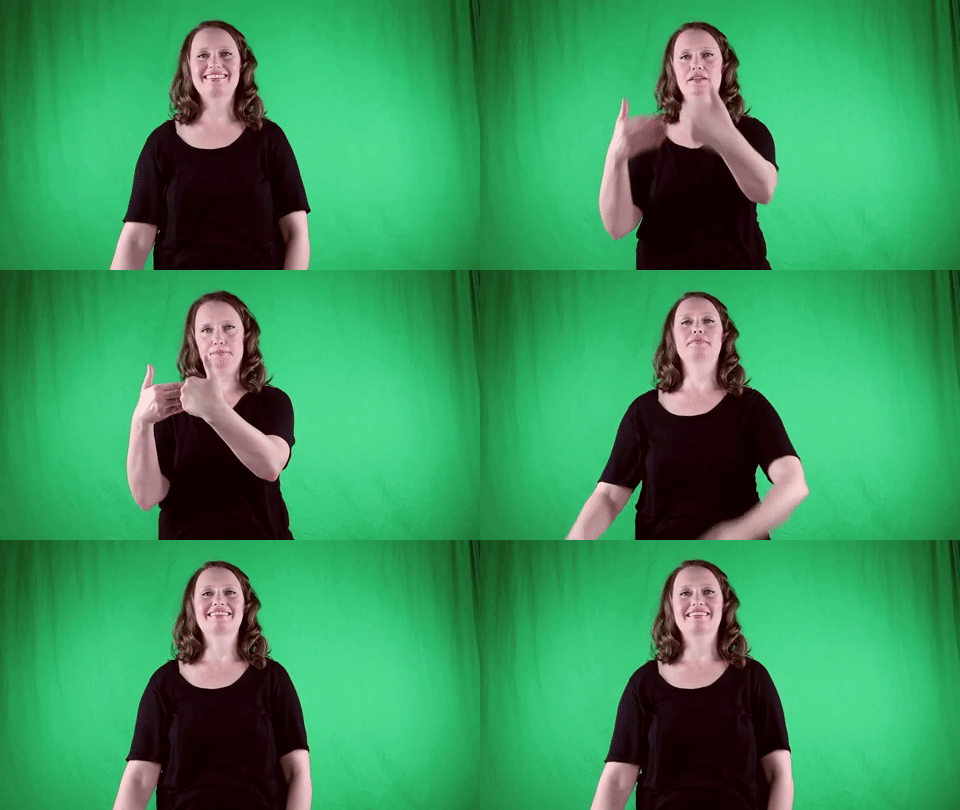
Definition: The far right corner.
Sign for CORNER FAR RIGHT in ASL

Practice Activities:
Begin practicing the sign for CORNER FAR RIGHT in ASL by isolating each concept. Start with the sign for “corner,” then “far,” and then “right.” Practice each sign individually in front of a mirror, paying attention to palm orientation, movement, and facial expressions. Once you’re comfortable with the individual signs, combine them smoothly into one phrase with appropriate directional space use.
To build fluency, create five short sentences that use the sign for CORNER FAR RIGHT in ASL. For example, try phrases like “Put the chair in the far right corner” or “She is standing in the corner far right of the room.” Sign the full sentence while emphasizing the directional modifier to indicate distance and location.
Try describing a room or space and explain where items are located using this directional phrase. You might say, “The lamp is in the corner far right,” or “My backpack is in the corner far right next to the window.” This helps you apply spatial referencing, a key skill in ASL storytelling and description.
Work with a partner and play a location-based game, where one person describes an object by signing its location using signs like the sign for CORNER FAR RIGHT in ASL, and the other guesses what it is. You can also create a map or floor plan drawing, then describe where various items are placed using ASL, incorporating this sign consistently.
Record yourself signing descriptions that include the phrase multiple times and review for accuracy. Using a video will help you compare your spatial use to standard ASL norms. Reinforce the association by pointing physically to where “far right corners” would be in your environment. This adds muscle memory to visual-spatial understanding, reinforcing your comfort with the sign for CORNER FAR RIGHT in ASL.
Cultural Context:
Understanding the sign for CORNER FAR RIGHT in ASL involves more than just handshape and movement—it connects to cultural and spatial awareness within the Deaf community. American Sign Language communicates not only words but also visual and spatial concepts, which are central to expressing location and direction. Signing locations like far corners relies on the use of classifiers, perspective, and understanding how to frame a space in front of the signer.
The sign for CORNER FAR RIGHT in ASL reflects the Deaf community’s strong connection to visual-spatial language. In ASL, spatial referencing is key. When you describe something located in the far-right corner, you must use eye gaze, body orientation, and sometimes classifiers to show its precise location from the signer’s point of view. This visual storytelling method is commonly used in both daily conversation and ASL storytelling traditions.
In Deaf culture, physical space is used to construct meaningful visual imagery. The sign for CORNER FAR RIGHT in ASL is often used when discussing rooms, furniture arrangements, or describing directions. It’s common in classroom discussions and storytelling, where positioning plays a foundational role in unfolding the narrative. The way this sign helps paint a mental map is a perfect example of why ASL is considered a three-dimensional language.
For Deaf children learning ASL, mastering spatial vocabulary such as the sign for CORNER FAR RIGHT in ASL allows them to interpret and engage with their environment more accurately. Teachers and parents frequently use this directional sign to help clarify room orientation, safety protocols, and classroom seating arrangements. These signs are taught early and often reinforced through play and experiential learning.
Art and design in Deaf culture also embrace this spatial orientation. When describing visual layouts or positioning elements in a diagram or map, the sign for CORNER FAR RIGHT in ASL is frequently used. This helps deaf individuals navigate buildings, understand visual art, or discuss seating for plays and concerts. Knowing how to sign such locations supports independence and accessibility in both physical and digital environments.
Using the sign for CORNER FAR RIGHT in ASL also emphasizes how ASL is not a word-for-word translation of English but a language with its own structure and conceptual mapping. Instead of focusing on literal words, ASL users convey ideas based on shape, direction, and context. This makes the sign useful in both formal and informal conversations, especially in community spaces where accurate directions matter.
In digital communication, especially during Zoom calls or virtual events, the sign for CORNER FAR RIGHT in ASL helps participants orient themselves and describe visual placement
Extended Definition:
The sign for corner far right in ASL is a directional concept using spatial referencing, a key part of American Sign Language. This sign combines location, direction, and space to describe a specific place on the far right edge of a corner or area. Signing this correctly ensures accurate communication, especially when giving directions or describing placement.
To produce the sign for corner far right in ASL, begin with the sign for corner. This is done by mimicking the shape of a corner with both hands, usually with the dominant hand forming a perpendicular angle against the non-dominant hand. Then, with a shift in body movement or pointing, you incorporate the far right location. This spatial modification is important in ASL and indicates direction more clearly.
American Sign Language relies heavily on how signs are placed in physical space. The sign for corner far right in ASL is an example of how visual space gives exact meaning. A signer might indicate that something is not just at a corner, but at the far right side of that corner, usually by shifting their signing space toward their right side, sometimes accompanied by eye gaze or slight head movement to that direction ➡️.
When describing locations, particularly when giving instructions or telling someone where to go, the sign for corner far right in ASL adds detail. It’s especially helpful in real-world settings like navigating a building, street, or when giving landmarks in storytelling. These visual references anchor the subject for the listener and make the conversation more vivid and specific.
It is common practice in ASL to use classifiers and space to support directional signs. To fully express the sign for corner far right in ASL, a signer could use a Classifier handshape to represent a building or an object and then move it to the designated far right area. Context will always influence the intensity or length of the movement. If distance is significant, the movement toward the right may be more extended.
Beginners often misunderstand this sign as just pointing to the right. However, the concept of “corner” must also be clearly portrayed, or the meaning can be lost. Learning how to combine both visual cues is part of mastering directional signs in American Sign Language.
This sign has no direct one-word English equivalent. It’s a combination that depends on the situation, so it might vary slightly depending on what is being described. Signing space works like a canvas, and the sign for corner far right in ASL uses that space effectively to depict exact meaning .
In casual conversations or structured
Synonyms: far-right corner, extreme right corner, rightmost corner, outer right corner, far end right
Educational resources: Find related learning materials in our course bank!
Want more? Check out some of our popular learning activities on the homepage!
Need to look up a sign? Use our highly rated dictionary: https://aslinteractive.com/best-asl-dictionary/
Follow us on tiktok: https://www.tiktok.com/@aslinteractive. More social media links at the bottom of this page!
Long-tail Keywords: what is the ASL sign for corner far right, how to sign corner far right in American Sign Language, ASL sign for corner far right
Categories:
tags: Directions, Location, Commands, Language Learning, Classroom
Parameters
*Handshape*:
The handshape for the Sign for CORNER FAR RIGHT in ASL typically involves both hands forming the “L” handshape . The non-dominant hand stays stationary, and the dominant hand moves in an outward direction to the far right, mimicking the shape of a corner turning to the right side.
This representation helps visually depict the specific spatial orientation needed in the Sign for CORNER FAR RIGHT in ASL. The formation and movement of the “L” handshape clearly define the angle and direction being described.
*Palm Orientation*:
For the sign for CORNER FAR RIGHT in ASL, the dominant hand forms a flat palm facing left or slightly downward, while the non-dominant hand forms a wall-like position with the palm facing forward. The dominant hand moves to intersect with the non-dominant, suggesting the idea of a corner.
To indicate “far right,” the dominant hand then moves outward to the right side in a smooth motion. Throughout the sign for CORNER FAR RIGHT in ASL, palm orientation reflects spatial accuracy, reinforcing direction.
*Location*:
The sign for CORNER FAR RIGHT in ASL typically takes place in the space slightly in front and to the far right of the signer’s body. The dominant hand moves from a central point outward toward the far right, mimicking the spatial concept of reaching toward a distant corner.
This sign requires clear use of directional space to convey both the idea of a corner and its far-right position. When producing the sign for CORNER FAR RIGHT in ASL, maintaining consistent eye gaze and arm extension helps reinforce the physical orientation being described.
*Movement*:
To produce the sign for CORNER FAR RIGHT in ASL, start by forming both hands into flat B shapes. Place them in front of your body, palm-facing-in, with the dominant hand slightly behind the non-dominant. Move the dominant hand forward in a right-angle motion, simulating the edge of a corner, then arc it to the far right side in a swift deliberate motion .
This movement highlights both spatial orientation and distance, essential to indicating the corner far right. The sign for CORNER FAR RIGHT in ASL uses space effectively to convey direction and relative position.
*Non-Manual Signals*:
When signing the sign for CORNER FAR RIGHT in ASL, the signer should maintain a focused gaze toward the far-right direction to match the spatial reference. Slight head movement or a subtle nod toward the right corner emphasizes the location being discussed.
Eyebrows remain neutral unless the sign is used in a descriptive or comparative sentence, in which case a slight raise can add emphasis. The signer’s body may lean gently toward the far right to reinforce the spatial context in the sign for CORNER FAR RIGHT in ASL.
*Prosody, Dominant/Non-Dominant Hand*:
The sign for CORNER FAR RIGHT in ASL uses the dominant hand to form an L-shape to represent a corner, while the non-dominant hand stays steady to indicate a fixed point. After forming the corner angle, the dominant hand moves sharply to the right and away from the body, emphasizing distance and direction ➡️.
Facial expression and eye gaze help clarify that the location is far to the right. The sign for CORNER FAR RIGHT in ASL may include a slight lean or head shift to the right to enhance spatial meaning.
Tips for Beginners:
When learning the sign for CORNER FAR RIGHT in ASL, it’s helpful to break the concept down into two parts: corner and direction. Start by mastering the sign for “corner,” which is typically shown by forming two L-shaped hands that meet perpendicularly, mimicking the physical shape of a corner. Then practice directional placement by moving the sign to the far right of your signing space to indicate “far right.”
Facial expressions play a big role in communicating spatial distance in ASL. For the sign for CORNER FAR RIGHT in ASL, make sure your eyes and head move toward the far right area where your hands are indicating. Use eyebrows or slight head tilts to emphasize distance, which helps convey that the corner being referenced is not near but far away on the right side.
A common mistake beginners make is not using enough space to indicate “far right.” Don’t keep your signs too close to your body—extend your arms outward to the right when signing “far right” to show clear spatial detail. Using too tight of a signing space can confuse the meaning or make the direction less clear.
It’s a good idea to practice in front of a mirror to see how your signs appear from the viewer’s perspective. With the sign for CORNER FAR RIGHT in ASL, visibility and directionality are critical. Make sure your corner shape is clearly formed and placed in the appropriate location.
Also, always consider the context. The sign for CORNER FAR RIGHT in ASL could shift slightly depending on whether you’re describing a room layout, map, or navigating a street. Take time to observe fluent signers and copy their use of space for directional signs to build confidence and fluency.
Connections to Other topics:
The sign for CORNER FAR RIGHT in ASL combines spatial referencing with directional indicators, making it closely related to other location-based signs like LEFT, RIGHT, NEAR, and FAR. Understanding the use of classifiers and dominant/non-dominant hand usage is essential in mastering this sign, as it often incorporates 3D space to describe exact placement. This is particularly useful in storytelling or describing layouts and room orientations, where precision is needed.
This sign connects to broader spatial concepts in ASL, such as indexing and eye gaze. For example, when discussing locations or giving directions, you might use the sign for CORNER FAR RIGHT in ASL along with directional classifiers. This helps create a visual map that the viewer can follow, mirroring the cognitive mapping strategies found in visual languages.
In narrative contexts, this sign often appears in compound expressions like HOUSE CORNER FAR RIGHT or DESK IN CORNER FAR RIGHT, providing more detail and enhancing descriptions. Learners benefit from practicing these compound forms to build fluency in real-life situations. These combinations also reinforce vocabulary retention through contextual use.
The sign for CORNER FAR RIGHT in ASL also shares structural similarities with other spatial direction signs such as BACK, FRONT, and MIDDLE. Mastering this sign enables smoother transitions between subjects and environments in a fluent discourse. It also demonstrates how ASL uses spatial grammar to convey complex concepts economically.
Additionally, this sign can be paired with temporal or situational markers to describe locations over time, like WAIT IN CORNER FAR RIGHT or STAND FAR RIGHT CORNER DURING CLASS. These contextual pairings reveal the adaptability of ASL in conveying both static and dynamic states. They also highlight the importance of spatial congruity in maintaining clarity and cohesion in communication.
Summary:
The sign for CORNER FAR RIGHT in ASL combines spatial referencing with directional classifiers to represent a specific physical location. It often uses both dominant and non-dominant hands to indicate a literal or metaphorical corner positioned far to the right side of the signer or the referent. This sign may incorporate classifiers such as CL: L or CL: Bent Ls to frame the idea of an edge or boundary space.
In natural ASL usage, corners and directional spaces like far right are used for establishing spatial relationships in storytelling, instructions, or descriptions. The sign for CORNER FAR RIGHT in ASL becomes especially important when explaining locations in rooms, map navigation, or built environments such as buildings and city layouts. It also appears when conceptualizing abstract or visual-spatial metaphors.
To form the sign, the non-dominant hand may represent a flat surface or an edge while the dominant hand, using fingers in a bent position, moves outward and to the right at an angular pattern. This movement indicates distance with a slight arc or hold to communicate “far.” The far right direction is generally established early in the discourse space to avoid ambiguity.
This spatial reference is not arbitrary. ASL users often pre-establish locations within their signing space when naming points or places. For a phrase like CORNER FAR RIGHT, location holds meaning; referents in that section are tied back to that area through cohesive pointing or directional shifts. This is central to ASL’s grammar and visual modality.
Classifiers give great flexibility, conveying angles, corners, limits, and depth. For the sign for CORNER FAR RIGHT in ASL, the classifier may simulate a wall turning into a hallway or a corner turning to a specific direction, helping visualize the physical or implied angle. The “far” part is added through exaggerated motion or increased facial expression to reinforce distance conceptually.
Directionality in ASL is not just linguistic—it’s cultural. Visual learners and signers contextualize space in a three-dimensional way. In Deaf culture, orientation and spatial feedback help support clearer communication. So placing a corner far to the right helps reinforce orientation rooted both in language and sensory experience.
Facial expressions are essential in supporting the meaning of the sign. When indicating “far,” eyebrows may slightly lift or lips may part to visually show distance. The concept isn’t literally “measurable” but is strengthened by non-manual signals that emphasize scope or remoteness.
For younger learners or emerging signers, the sign for CORNER FAR RIGHT in ASL may be introduced alongside basic spatial vocabulary such as near, left, next to, or behind. Understanding these spatial contrasts helps build fluency in location-based storytelling or instructional commands. It reinforces how ASL relies heavily on positional cues.
This sign intersects with the structural grammar of ASL, particularly in the use of constructed environments. When building a mental or visual scenario, signers may label a space as a corner and then mark it “far right.” That placement becomes a fixed referent point for future signs to interact with or return to during description.
In narrative contexts, the sign for CORNER FAR RIGHT in ASL often appears when characters are introduced and move within created settings. For example, “the dog ran to the corner far right” becomes a visually grounded story detail that enhances the imagination of the viewer. This is one way ASL storytelling brings visual realism into life.
Map-related or geographic references also use this spatial pattern. Whether explaining where Alaska sits relative to Texas or designating a key in grid placement, directional references like “far right” are interpreted using the signer’s space. A slight shift of gaze and angle enhances the authenticity of that spatial map.
English spatial terms like “far right corner” rely on prepositions that are not directly translatable into ASL. Therefore, the sign for CORNER FAR RIGHT in ASL must rely on classifiers, gaze, and space assignment to establish meaning. It’s not a word-for-word translation but rather a conceptual rendering that favors movement and space.
Pedagogically, teaching this sign can involve mini-games on spatial placement or room navigation. Students may use object models or floor plans to practice describing things in “corners,” especially where directional gestures are keys to understanding. This enhances their command of classifiers and real-world references.
Culturally, Deaf signers are attuned to environmental cues and often use precise directional references in daily conversation. If someone says you’ll find the phone in the corner far right of the room, this location is signed with a strong visual cue—and hundreds of native signers will recognize exactly what that means.
Applied linguistics connects this sign to a broader category of spatial deixis. Deixis refers to context-dependent elements such as “this,” “that,” “here,” and “there.” The sign for CORNER FAR RIGHT in ASL depends on deixis to exist—it is only meaningful in contrast with “other corners” or spatially assigned elements previously mentioned.
The alignment
Want more? Check out some of our popular learning activities!
ASL Interactive Resources
ASLInteractive YouTube Channel
Follow us on tiktok: @aslinteractive.com
Follow us on Instagram: aslinteractive
Facebook page: aslinteractive
Facebook group: aslinteractive
LInkedIn: ASL Interactive LLC
Twitter: @ASL_interactive
*Some information on this page is AI-generated. AI can make mistakes. Please check the information.


Responses