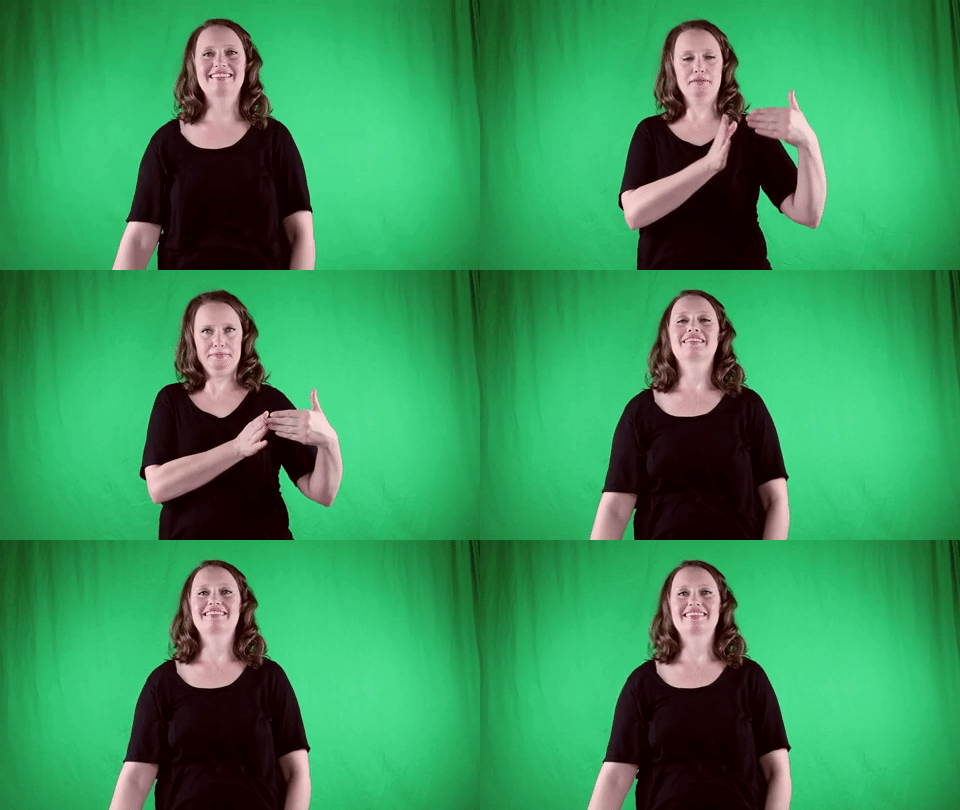
Sign for CORNER NEAR LEFT in ASL | ⬅️ ASL Dictionary

Definition: The near left corner.

Sign for CORNER NEAR LEFT in ASL

YouTube player

Practice Activities:

Start with practicing the sign for CORNER NEAR LEFT in ASL in isolation. Stand in front of a mirror and use the correct handshapes and movement to show the location of a corner to your left. Repeat the motion slowly, then more naturally, while thinking about how to incorporate facial expressions to emphasize proximity and location.

Once you’re confident with the isolated sign, try using it in simple descriptive sentences. For example, sign phrases like “trash can corner near left,” “my book is on the table corner near left,” or “lamp is by corner near left.” Repeat these sentences while visualizing or pointing to areas in your room to reinforce the use of space in ASL.

Create a short story using spatial references, placing at least three objects relative to the corner near the left. An example plot might involve giving someone directions around a room: “start at the door, walk straight, the chair is near the left corner, the window is behind the chair.” Express each idea using the correct spatial grammar and classifiers where appropriate.

Work with a partner and set up a mini room or area using simple objects. Take turns describing where each item is placed, making sure to incorporate the sign for CORNER NEAR LEFT in ASL clearly each time. Challenge each other by moving the objects and retelling the layout to reinforce spatial understanding.

Play a game of “Where Is It?” where one person thinks of an object located in a specific area, and the other guesses using directional and location signs. Use the sign for CORNER NEAR LEFT in ASL any time the object is in that position to build familiarity with its spatial context and usage in everyday conversation.

Cultural Context:

In American Sign Language (ASL), spatial awareness is an essential part of communication. The sign for CORNER NEAR LEFT in ASL uses visual-spatial orientation to show exact placement or direction. Signers often rely on their viewer’s perspective, which makes direction-based signs like this culturally significant in the Deaf community.

The sign for CORNER NEAR LEFT in ASL is not just about the words themselves. It’s about creating a visual map in the signing space. Deaf signers use their hands and body to show physical positions or locations in the environment. This helps convey a clear picture of where something is in relation to something else.

In Deaf culture, directional signs hold more than literal meanings. When you sign CORNER NEAR LEFT in ASL, you’re describing spatial relationships, but also showing how the Deaf community thinks visually. These signs reflect how signers navigate the world based on landmarks and body orientation.

Using the sign for CORNER NEAR LEFT in ASL can come up in everyday conversations. It may be used when giving directions to someone’s apartment, talking about where to stand in a room, or explaining where something is located. This makes it a very practical sign and increases its usage in different everyday interactions.

Body orientation matters a lot in ASL. When someone uses the sign for CORNER NEAR LEFT in ASL, they align their body to show proximity and direction. This turning and positioning isn’t random—it’s deeply embedded in the grammar of ASL. Understanding this helps learners develop better fluency and comprehension.

Deaf individuals often learn to interpret and use signs by watching how they are placed in space. For example, matching the position for CORNER NEAR LEFT in ASL requires knowing how to adjust based on the signer’s and viewer’s perspectives. This enhances mental mapping and supports visual language development.

The sign for CORNER NEAR LEFT in ASL also reflects values in the Deaf community, such as clarity, openness, and directness. Visual placement reduces confusion because the picture painted through sign is immediately understandable. This way of thinking promotes precision in communication and makes interactions faster and clearer.

Cultural knowledge impacts how signs are understood. The sign for CORNER NEAR LEFT in ASL might seem simple, but knowing the cultural expectations around space and direction adds depth. It’s more than hand shapes—it’s about representing environments in a way that feels natural to native signers.

Children who grow up in Deaf households are introduced to these concepts early. They

Extended Definition:

The sign for CORNER NEAR LEFT in ASL combines spatial orientation and descriptive signing to convey a specific location or direction. In American Sign Language, spatial references are essential for giving accurate context when describing positions, especially when using directional terms like left, near, and corner.

To sign CORNER NEAR LEFT in ASL, you need to understand the individual components. Start by establishing a base location to represent the overall space. Then sign the concept of a corner by showing two flat hands creating a right-angle shape. The angle typically mimics the visual perspective of a corner.

Next, indicate the direction of left by using your non-dominant hand, which generally represents the left side of your signing space. Use a simple flat-hand movement or point to the left side based on standard ASL directionality. Finally, insert the concept of near by bringing one hand close to the left-side location while maintaining your reference to the corner.

This sign is especially useful when giving directions, describing layouts of rooms or buildings, or explaining the position of an object relative to a specific space. The clarity of using the sign for CORNER NEAR LEFT in ASL helps avoid confusion and provides immediate visual understanding.

Facial expressions and body language play a significant role in this sign. Leaning slightly toward the left or emphasizing the proximity of your hands while indicating near adds extra meaning. ASL relies heavily on these non-manual markers to enhance the accuracy of what is being portrayed.

The sign for CORNER NEAR LEFT in ASL does not follow one universal motion for everyone. It adapts based on context. For instance, describing a room’s layout in a house compared to giving street directions may slightly alter how the sign is used or combined with other signs.

In everyday communication, this phrase often comes up when telling stories, giving instructions, or playing location-based games. Because ASL is a visual language, describing physical spaces in relation to one another is a regular part of conversation. The sign for CORNER NEAR LEFT in ASL allows you to be specific and accurate in these discussions.

When interpreting or learning ASL, understanding spatial semantics like this one is critical to fluency. It helps build descriptive language skills and enhances communication flow. Beginners might first learn the component signs separately and then combine them to accurately express the full phrase.

Using the correct grammar and word order in ASL helps preserve meaning. Typically, location details like left or near precede or follow the noun based on emphasis.

Synonyms: corner on the left, left-hand corner, near left corner, edge on the left, left-side corner

Educational resources: Find related learning materials in our course bank!

Want more? Check out some of our popular learning activities on the homepage!

Need to look up a sign? Use our highly rated dictionary: https://aslinteractive.com/best-asl-dictionary/

Follow us on tiktok: https://www.tiktok.com/@aslinteractive. More social media links at the bottom of this page!

Long-tail Keywords: what is the sign for corner near left in ASL, how to sign corner near left in American Sign Language, ASL sign for corner near left

Categories:

tags: directions, location, spatial concepts, classroom, positional language

Parameters

*Handshape*:

The handshape for the sign for CORNER NEAR LEFT in ASL uses both hands in the “L” handshape . The dominant hand represents one wall and the non-dominant hand represents the intersecting wall, creating a corner shape.

To express “near left,” position the sign slightly to your left side while the fingertips meet at a right angle. This emphasizes the spatial relationship described in the sign for CORNER NEAR LEFT in ASL.

*Palm Orientation*:

For the sign for CORNER NEAR LEFT in ASL, the palm orientation of the dominant hand typically faces inward or slightly toward the non-dominant side, depending on the signer’s handedness. The non-dominant hand forms a wall-like surface, palm facing the dominant hand, creating the visual of a corner structure.

When expressing the concept of something being near and to the left, the palm of the dominant hand may continue to face inward while moving toward the left side of the signing space. This helps visually anchor the sign for CORNER NEAR LEFT in ASL with spatial referencing.

*Location*:

The sign for CORNER NEAR LEFT in ASL is performed in the signing space slightly in front and to the left of the signer’s torso. Both hands are commonly used with fingers bent at a 90-degree angle, forming an “L” shape to represent the corner.

To show the concept of “near left,” the signer shifts the sign’s location toward the left side while maintaining proximity to the center of the signing space. This positioning helps clearly convey the spatial relationship in the sign for CORNER NEAR LEFT in ASL ⬅️.

*Movement*:

To sign the concept in the Sign for CORNER NEAR LEFT in ASL, begin by forming both hands into flat B-handshapes. Position the right hand vertically, palm facing left, and the left hand horizontally, palm facing down, meeting at a right angle to create the corner shape. Move this forming position toward your left side in a slight arc to indicate “near left” .

After creating the corner angle, maintain the contact of fingertips as you subtly shift the entire shape closer to the left side of the signing space. The shifted movement communicates both proximity and direction, essential for clearly expressing the Sign for CORNER NEAR LEFT in ASL. Keep movements controlled and deliberate.

*Non-Manual Signals*:

When showing the sign for CORNER NEAR LEFT in ASL, your facial expression should indicate spatial awareness and specificity. Slightly tilt your head to the left to match the directional aspect of the sign. Raise your eyebrows if emphasizing a specific location or asking for clarification.

Mouth movements like “cha” or a small puff of air can help depict nearness or relative distance. Facial engagement enhances clarity when demonstrating the sign for CORNER NEAR LEFT in ASL .

*Prosody, Dominant/Non-Dominant Hand*:

The sign for CORNER NEAR LEFT in ASL uses both hands to depict spatial relationships. The non-dominant hand, palm facing inward, acts as the left wall, while the dominant hand, also palm facing inward, represents the intersecting wall. They meet at an angle to form the shape of a corner.

To show “near left,” the signer shifts the entire motion to the left space in front of the body. This spatial placement emphasizes proximity and direction. The sign for CORNER NEAR LEFT in ASL helps express specific locations in three-dimensional space effectively.

Tips for Beginners:

When learning the sign for CORNER NEAR LEFT in ASL, it’s important to take your time with spatial orientation. This sign is made up of multiple concepts, so think through each word and how it plays a role in the overall message. Understanding how to layer “corner,” “near,” and “left” can help you build this into a cohesive and accurate expression.

Start by visualizing the physical layout: a corner on your left that’s also nearby. In ASL, each piece of information has a sign, and how you orient your hands and body helps express the meaning with clarity. Practice in front of a mirror to ensure your orientation is clear, especially when showing “left” from the viewer’s point of view. It’s easy to confuse left and right hand placement, so be mindful and consistent.

Beginners often struggle with classifier use when showing the spatial concept of “corner.” Use appropriate classifiers to shape the idea of two surfaces meeting at a perpendicular angle. Then, convey “near” by bringing your dominant hand slightly closer to your body in reference to the imaginary location. To complete the sign for CORNER NEAR LEFT in ASL, gesture to your left side and maintain eye contact to emphasize context and avoid ambiguity.

One helpful technique is to set up visual space in front of you—this becomes your reference field. Once you’ve clearly established your left side in this spatial field, use pointing or locational referencing to show where the corner is in relation to it. Practice each component separately before combining them.

In conversations, sign fluidly but clearly. Rushing can reduce accuracy. If unsure, fingerspell as a backup and ask for feedback. Watching fluent signers and pausing videos to analyze their palm orientation and movement path can also strengthen your understanding of the sign for CORNER NEAR LEFT in ASL.

Connections to Other topics:

The sign for CORNER NEAR LEFT in ASL connects closely with spatial referencing and directional signs in ASL. Understanding this sign helps learners grasp how location and orientation within a visual space are conveyed. It also shares features with signs like LEFT, RIGHT, NEAR, and FAR, making it easier to interpret or produce related spatial phrases in ASL communication.

Incorporating space for location-based terms helps reinforce classifiers and directional referencing, which are foundational in ASL grammar. For example, the concept of a “corner” can be adapted using classifiers to indicate building corners, street intersections, or object positioning. The sign for CORNER NEAR LEFT in ASL often depends on using visual-spatial adjustments to show where something occurs in relation to the signer’s point of view.

This sign also links to compound expressions like STREET CORNER, which combines signs for STREET and CORNER to form a location-specific concept. Similarly, HOUSE NEAR CORNER LEFT may use the same directional cues to indicate both proximity and corner position. Understanding how to sign CORNER NEAR LEFT helps in framing narratives, especially when describing routes, stories, or scenes with depth and spatial orientation.

Another important connection is how this sign supports storytelling. When describing where an event happened, signers can build a mental map that guides the viewer visually through the scene. The sign for CORNER NEAR LEFT in ASL allows seamless integration into map descriptions, directions, or relational positioning—critical in both daily and academic ASL use.

Lastly, this sign can enhance comprehension in educational or professional contexts where direction and relative location are discussed. It brings together the concepts of geometry and spatial placement, making it useful in STEM settings. Mastery of the sign for CORNER NEAR LEFT in ASL enriches a signer’s ability to describe environments accurately and visually.

Summary:

The sign for CORNER NEAR LEFT in ASL is a spatial-concept, location-based phrase that emphasizes both direction and relational distance. To express this sign accurately, classifiers, body shift, and palm orientation all play critical roles, enhancing the visual grammar inherent to ASL.

Understanding the sign for CORNER NEAR LEFT in ASL begins with the foundation of depicting the idea of a corner. This is typically represented using classifiers that illustrate intersecting lines or meeting walls. The non-dominant hand usually forms a flat wall, while the dominant hand indicates a perpendicular surface, often at a right or acute angle.

The concept of “NEAR” in ASL is nuanced and often signed using a proximity gesture where the dominant flat hand approaches the back of the non-dominant flat hand. It suggests closeness without touching, indicating how nearby the object or location is in physical or metaphorical space.

LEFT is directional and is signed by moving the left hand to the left side of the signer’s body with the palm facing outward or downward, depending on the context. In depicting spatial relations like directions, signing LEFT requires a clear understanding of ASL’s spatial agreement principle, where locations are maintained in space to represent real-world directions.

When combining all three elements—CORNER, NEAR, and LEFT—the sign for CORNER NEAR LEFT in ASL involves layering spatial classifiers with clear movement and body shift. The signer typically orients their body slightly to the left side of their signing space while establishing the corner location first.

Body shifts in this sign are significant. To communicate “LEFT,” the signer may slightly rotate their shoulders or torso to create a clear visual lane representing the left direction. This gives the viewer a spatial anchor and maintains the referential consistency throughout the conversation.

Facial expressions contribute to clarity as well. Slight pursing of the lips or head tilting can convey proximity, enhancing the meaning of “near.” Non-manual markers in ASL fulfill grammar roles, often simulating the tone, focus, or emphasis one might find in spoken language intonation.

Grammatically, the sign for CORNER NEAR LEFT in ASL functions as a locative phrase. It can appear at the beginning of a sentence to establish setting or reference, adhering to ASL’s topicalization structure. In storytelling, this placement aids the narrative flow, orienting the audience to spatial contexts before actions occur.

For example, in a dialogue or narrative, a signer might first establish an object positioned at the “corner near left” before expanding on what happens there. The sign builds context quickly and spatially, allowing for efficient communication that aligns with how Deaf culture values visual spatial awareness.

There are cultural dynamics at play with using specific spatial descriptors like the sign for CORNER NEAR LEFT in ASL. In many Deaf narratives, especially visual storytelling forms like ASL storytelling competitions or community events, directional signs help set scenes vividly. They mirror stage blocking in theater, giving viewers clear visual information instantly.

The phrase can also emerge in instructional contexts, like guiding someone in a building, and even in emergency communication. Describing a suspect, locating items, or reporting an incident would all call on signs like CORNER NEAR LEFT to tactically inform without ambiguity.

The use of space in ASL represents a broader linguistic theme: embodiment. Unlike most spoken languages, ASL distributes meaning through body movement, handshape, and facial expression. The sign for CORNER NEAR LEFT in ASL exemplifies embodiment, as the signer physically maps concepts onto space.

Applied linguistics explores this mapping strategy in education, emphasizing how spatial languages train visual thinking. For ASL learners, mastering such signs enhances memory and comprehension by assigning stories, descriptions, or environments to specific parts of space.

In contrast to linear languages like English, ASL allows for simultaneous information delivery. For instance, while signing the sign for CORNER NEAR LEFT in ASL, a signer can include the speed at which something approaches or add emotion via facial expression—all in one cohesive sign. This multi-layered approach deeply enriches communication.

Linguistically, this phrase intersects well with classifier theory, spatial referencing, and directional verbs in ASL. Classifiers such as CL:1 (for people), CL:3 (for vehicles), or CL:B (for flat surfaces) can be moved toward the left to attach to the concept of CORNER NEAR LEFT, creating cohesive descriptions deeply grounded in space.

In a bilingual education context, working between English and ASL, teachers often scaffold these concepts by pairing gestures with labeled diagrams. Mapping “corner,” “near,” and “left” helps learners understand how positional words in English become embodied descriptive signs in ASL.

Psycholinguistic studies show that Deaf signers process space-based language differently than hearing individuals using spoken language. The sign for CORNER NEAR LEFT in ASL activates both linguistic and visual-spatial brain regions, emphasizing ASL’s complexity and cognitive engagement.

Want more? Check out some of our popular learning activities!

ASL Interactive Resources

ASLInteractive YouTube Channel

Follow us on tiktok: @aslinteractive.com

Follow us on Instagram: aslinteractive

Facebook page: aslinteractive

Facebook group: aslinteractive

LInkedIn: ASL Interactive LLC

Twitter: @ASL_interactive

*Some information on this page is AI-generated. AI can make mistakes. Please check the information.

Sign for CORNER NEAR LEFT in ASL

Responses