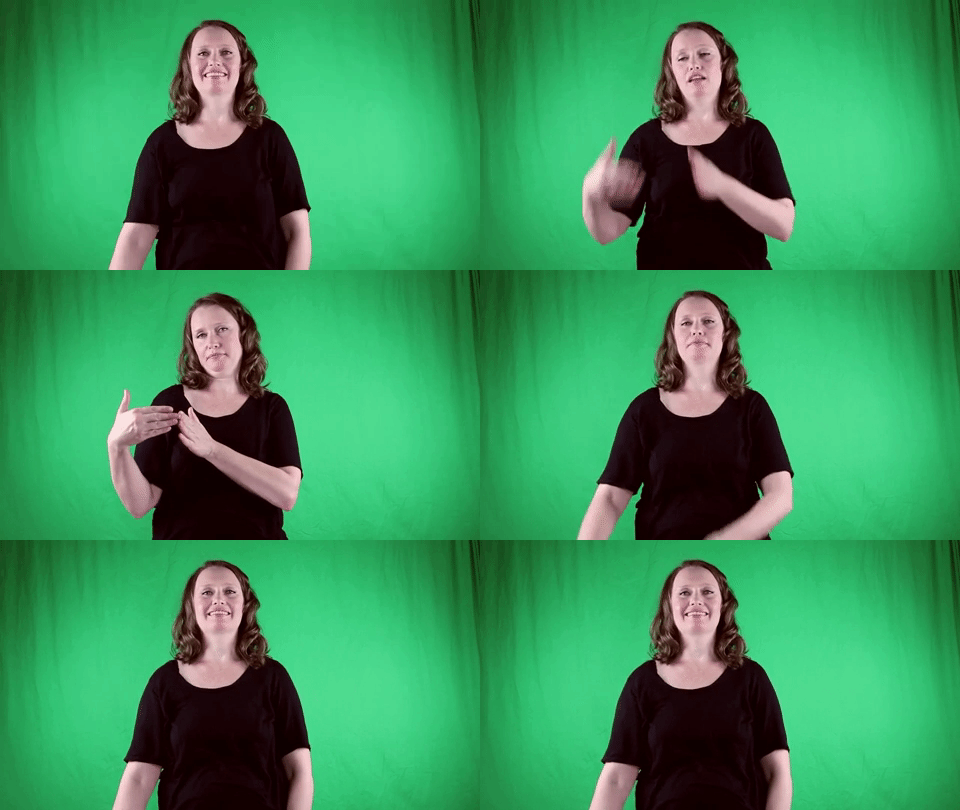
Definition: The near right corner.
Sign for CORNER NEAR RIGHT in ASL

Practice Activities:
Begin practicing by isolating each of the concepts in the sign for CORNER NEAR RIGHT in ASL. Start with “corner” by forming an “L” handshape with each hand, intersecting them to represent the angled shape of a corner. Practice this in front of a mirror to observe hand placement and sharpness of the angle. Follow this with “near,” using a dominant bent hand moving close to the passive flat hand. Pair this movement fluidly to show proximity.
Next, work on “right” as a directional term by pointing to your right side while maintaining appropriate eye gaze or body orientation. Create a spatial relationship as you combine these movements to reflect the sign for CORNER NEAR RIGHT in ASL. Repeat the complete sign slowly, then gradually increase speed while keeping the transitions smooth and clear.
Use common scenarios to reinforce the sign. Practice with sentences such as: “The coffee shop is at the corner near right,” or “Turn at the corner near right to find the house.” These simple phrases help strengthen spatial concepts and improve fluency. Record yourself or use a mirror to self-correct.
Create story prompts that involve directions. For example, tell a partner how you got lost but found your way by turning at the corner near right. In another scenario, describe a neighborhood walk including several corners and directions. This supports clear communication involving spatial referencing.
With a partner, quiz each other using objects placed around the room. Give prompts like “show me the corner near right of the desk” or “describe which corner near right has the plant.” These activities enforce understanding of the spatial direction embedded in the sign for CORNER NEAR RIGHT in ASL and encourage real-world application of the sign within descriptive contexts.
Cultural Context:
In American Sign Language, the sign for CORNER NEAR RIGHT in ASL carries more than just spatial meaning. It reflects how Deaf culture expresses detailed positioning and orientation in a visual format, which is essential for clear and accurate communication.
Spatial awareness and location-specific descriptions are critical when using ASL. The sign for CORNER NEAR RIGHT in ASL allows signers to give precise directions or describe a specific location in relation to a fixed point. Whether telling a story or giving directions, using space correctly ensures the viewer understands exactly where something is.
In Deaf culture, space isn’t just a background element like in spoken language. It plays an active part in constructing meaning. The sign for CORNER NEAR RIGHT in ASL might be used in everyday situations—like pointing out where an object is placed in a room, referring to a corner of a building, or explaining where someone is standing during an event.
ASL uses classifiers and spatial organization to convey this kind of information effectively. The sign for CORNER NEAR RIGHT in ASL may involve classifiers that show the shape and position of objects or people. This cultural difference emphasizes visual structure and placement, which is a core value in ASL and the Deaf community.
For example, when Deaf people talk about past events or give instructions, they often use signs like CORNER NEAR RIGHT to set the scene. Once that reference point is established in space, the rest of the conversation builds off it. This is a unique feature of ASL that doesn’t have a direct equivalent in English or other spoken languages.
In a school, home, or city setting, knowing how to sign CORNER NEAR RIGHT in ASL helps learners and native signers provide clear details. Instead of just saying right or left, the signer might give exact placement using their body and hands to map out a physical space for the viewer.
This use of space is more than directional—it also shows respect for clarity and shared understanding. In Deaf culture, it’s considered good signing etiquette to establish location early in a conversation. So the sign for CORNER NEAR RIGHT in ASL is part of a broader practice that values visual storytelling and interactive detail.
Within educational settings, interpreting, and everyday conversation, mastery of locations like CORNER NEAR RIGHT helps broaden a signer’s expressive range. It shows cultural fluency and awareness of ASL’s reliance on spatial logic. This aspect makes the sign for CORNER NEAR RIGHT in ASL an important part of everyday communication.
Understanding how
Extended Definition:
The sign for corner near right in ASL refers to a specific way of showing spatial relationships using American Sign Language. In ASL, describing locations or directions often involves classifiers and physical space to represent real-world positions. The phrase corner near right combines directional terms with spatial referencing, so it’s important to understand how these concepts work together in ASL to convey meaning clearly.
To sign this phrase, you typically use both hands to represent the layout of the space. The dominant hand (usually your right hand) can be used to indicate the position of the object or person that is near the right side of a corner. When describing this concept, a signer may use flat hands or bent hands to show the shape of a room or structure, and then modify the position of one hand to indicate that something is near the right corner.
The sign for corner near right in ASL is commonly used when giving directions or describing the layout of a space like a room, building, or street. It helps convey exactly where something is located with relation to the environment. For example, if someone is telling you where to find a piece of furniture or an exit, they might use this sign to show it is placed close to the right side of a corner.
Facial expressions and body positioning also play an important role when using the sign for corner near right in ASL. Slight shifts in the torso or head direction can enhance the clarity of the spatial reference being signed. Signers often lean slightly or adjust hand positions to stress which corner and side they are emphasizing.
Learning spatial concepts like this is vital for ASL fluency. ASL is a highly visual language, and its effectiveness comes from using space to represent physical surroundings. Using the sign for corner near right in ASL properly involves a mix of handshapes, location, and movement that matches the real-world orientation being described.
You might see this sign used in both casual and formal contexts. Whether narrating a story, giving step-by-step directions, or explaining the layout of a new apartment, the concept of corner near right in ASL is a practical tool for effective communication. It also allows signers to clearly distinguish between similar locations, like the left and right corners, adding precision.
If you’re learning this sign, it’s helpful to practice in front of a mirror or with a partner. Pay close attention to how your dominant hand represents the object’s location and how the corners are formed with both hands. Watching native signers use this sign in conversation will
Synonyms: Corner Near Right has an ambiguous meaning, so please clarify whether you’re referring to a physical space, direction, or term used specifically in ASL for a certain concept. Some possible interpretations for “corner near right” could involve spatial, directional, or geometric indications, and these will each generate different kinds of synonyms. Could you confirm the context before proceeding with synonyms?
Educational resources: Find related learning materials in our course bank!
Want more? Check out some of our popular learning activities on the homepage!
Need to look up a sign? Use our highly rated dictionary: https://aslinteractive.com/best-asl-dictionary/
Follow us on tiktok: https://www.tiktok.com/@aslinteractive. More social media links at the bottom of this page!
Long-tail Keywords: what is the sign for Corner Near Right in ASL, how do you sign Corner Near Right in American Sign Language, ASL sign for Corner Near Right
Categories:
tags: Directions, Locations, Classroom Picture, Describing Residence, Language Learning
Parameters
*Handshape*:
The handshape used in the sign for CORNER NEAR RIGHT in ASL involves both hands forming an “L” handshape , with the thumbs and index fingers extended while the other fingers remain closed. One “L” hand usually represents a vertical wall while the other represents a horizontal wall, creating the shape of a corner.
In the sign for CORNER NEAR RIGHT in ASL, the dominant hand typically moves toward the right side of the body to indicate specific directionality. This spatial use of the handshape helps clarify the concept of the corner being to the right and nearby.
*Palm Orientation*:
For the sign for CORNER NEAR RIGHT in ASL, both hands are typically in a flat “B” handshape. The dominant hand represents the perpendicular edge and the non-dominant hand represents the adjacent surface. The palms are oriented so the dominant palm faces left and the non-dominant palm faces forward, forming a visual “corner.”
In conveying the meaning of the sign for CORNER NEAR RIGHT in ASL, the signer shifts slightly to indicate spatial direction toward the right. The palm orientation helps establish the nearby corner’s location and orientation clearly.
*Location*:
The sign for CORNER NEAR RIGHT in ASL is typically located in the signing space in front of the body, slightly to the right side to reflect spatial accuracy. The dominant hand, representing the corner or edge, generally moves near the nondominant hand while maintaining a position close to the right side of the signer.
For the sign for CORNER NEAR RIGHT in ASL, positioning is crucial, as the hands must simulate the idea of a nearby corner from a rightward perspective. The movement occurs at chest or upper torso level, reinforcing the concept of spatial proximity and direction.
*Movement*:
To show the sign for CORNER NEAR RIGHT in ASL, start with both hands in flat B-handshapes. Place the dominant hand palm-out, fingertips pointing left; non-dominant palm-down, fingertips pointing forward. Move them to form a right angle, representing a corner.
To show NEAR, bring the dominant bent hand close to the non-dominant bent hand without touching. For RIGHT, point with the dominant index finger toward the right side. The sign for CORNER NEAR RIGHT in ASL combines these directional elements fluidly.
*Non-Manual Signals*:
When showing the sign for CORNER NEAR RIGHT in ASL, the signer often shifts their head slightly to the right to reflect spatial placement. Eyebrows may raise slightly to indicate reference or location, and the eyes should look toward the right side with a slight tilt of the head for clarity.
The non-manual signals help distinguish the orientation of the sign for CORNER NEAR RIGHT in ASL by emphasizing spatial relationships. A relaxed mouth and slight directional lean to the right give the depiction better grounding .
*Prosody, Dominant/Non-Dominant Hand*:
The sign for CORNER NEAR RIGHT in ASL uses both hands in a specific spatial relationship to convey location. The non-dominant hand remains upright, palm facing slightly inward to form an edge, while the dominant hand forms the other edge of the “corner” by moving toward the non-dominant hand at a right angle, simulating a physical corner.
To indicate “near right,” the dominant hand stays near the right side of the signer’s body, maintaining proximity without touching. This precise arrangement helps show spatial orientation clearly in the sign for CORNER NEAR RIGHT in ASL ➡️.
Tips for Beginners:
When learning the sign for CORNER NEAR RIGHT in ASL, it’s important to break it into parts: each concept (corner, near, and right) has its own sign and they are produced in sequence to form the complete idea. Practice each sign individually until you’re comfortable with the handshapes, movements, and facial expressions that match each meaning. Then, combine them in smooth succession to express the full phrase.
Start with the sign for “corner” by creating an L-shape with each hand and bringing them together at a right angle, as if outlining a corner of a room. For “near,” hold your dominant curved hand close but not touching your non-dominant flat hand. Finally, sign “right” by forming both hands into the shape of an “L” or fists (depending on the variation) and cross the dominant hand over the non-dominant. Putting this all together fluidly is key to mastering the sign for CORNER NEAR RIGHT in ASL.
One common pitfall is sloppy hand positioning, especially with directional terms like “right.” Be sure your movements are clear and intentional with precise angles and spatial referencing. If the spacing or direction is off, the meaning can easily be misunderstood. Always use facial expressions to give context—slight eyebrow raises, eye gaze, or head tilts can emphasize the location being referred to.
Keep in mind that spatial awareness plays a central role in ASL grammar. When practicing the sign for CORNER NEAR RIGHT in ASL, visualize the corner of a room to help anchor your signs spatially. Sign in front of a mirror or record yourself to self-correct. Consistent repetition and feedback from fluent signers will boost your confidence and accuracy.
Sign for CORNER NEAR RIGHT in ASL, ASL sign for CORNER NEAR RIGHT, how to sign CORNER NEAR RIGHT in ASL, CORNER NEAR RIGHT in American Sign Language, learn the sign for CORNER NEAR RIGHT in ASL
Connections to Other topics:
The sign for CORNER NEAR RIGHT in ASL is closely tied to directional and spatial concepts, which are key components of ASL grammar and structure. Understanding this sign helps develop a broader sense of how ASL users describe location, positioning, and proximity in physical space. These concepts aren’t just functional for everyday conversation—they’re essential for descriptive storytelling, coding environments, and giving directions.
The sign for CORNER NEAR RIGHT in ASL also connects to classifiers, particularly when describing settings in narratives or visual-spatial environments, such as mapping out the interior of a room or distinguishing between objects on a table. Classifier handshapes like CL:1 or CL:L can be integrated after this sign to describe people or objects occupying that corner. This makes the sign foundational when learning spatial referencing in ASL.
It also combines naturally with signs like NEAR, RIGHT, and CORNER as individual units, which are often used in directional cues. Once learners are comfortable with the compound form, they can break it down into parts to rearrange or substitute elements for variation, such as “corner near left” or “near corner across.” This flexibility increases expressive range when discussing spatial relationships.
In storytelling or when giving directions, the sign for CORNER NEAR RIGHT in ASL is used with non-manual signals to emphasize precision or contrast locations. Eyegaze, head direction, and body leans enhance the clarity of where something is located in ASL discourse. These techniques elevate simple signs into complex, visually rich communication.
The vocabulary surrounding this sign also overlaps with topics like geography, architecture, traveling, and household navigation. For example, describing where the bathroom is in relation to a hallway may require use of the sign for CORNER NEAR RIGHT in ASL and similar signs, reinforcing comprehension of directionality and placement in a native-like way.
Summary:
The sign for CORNER NEAR RIGHT in ASL involves multiple directional indicators and spatial classifiers that work together to create meaning. ASL uses a visual-spatial modality, so conveying relative position, like “near right,” depends heavily on the signer’s and viewer’s shared spatial references.
To express “corner,” signers typically use both hands in a classifier-like representation to form a 3D shape. One common version involves forming right-angle classifier shapes with both hands, suggesting the visual of a joint or intersection of two planes.
The dominant hand (often the right hand for most signers) and non-dominant hand form perpendicular shapes, mimicking the corner of a room or structure. The movement is angled outward to show the physical space where the two walls meet.
To express “near,” a common sign includes using a flat dominant hand moving close to but not touching the back of the non-dominant hand. Fingers remain extended and slightly curved to imply proximity without contact.
When discussing orientation like “right,” ASL uses the signer’s own spatial reference. The sign for right is typically represented by pointing to the right side of the signer’s body using the index finger, or by moving the location of the object in the signer’s signing space to that side.
Combining these, the sign for CORNER NEAR RIGHT in ASL is built modularly. First the corner is shown using spatial classifiers, then “near” is shown by classifier positioning and movement direction, and finally “right” is indicated directionally in space.
This sign requires an understanding of ASL’s classifier system. Classifiers are not standalone vocabulary items but tools that describe shape, location, and depth in three-dimensional space, allowing for high visual precision.
Grammatically, prepositions and direction indicators, such as “near” and “right,” function differently in ASL compared to English. They are often not specific signs but gestures that manipulate the spatial grammar inherent in the communication.
The sign’s structure allows flexibility depending on context. For example, describing a corner of a room versus a corner on a map may alter how “corner” is signed. The physical orientation remains grounded in the visual reference points available to both signers and viewers.
The sign for CORNER NEAR RIGHT in ASL emphasizes the spatial logic of the language. It reflects how ASL represents directions not through linear syntax but through physical space and relational visualization.
Culturally, space is deeply embedded in Deaf communication. It allows for a nuanced and precise conveyance of geometry, position, and movement within a shared signing environment, something particularly valued in community spaces or storytelling.
The concept of “right” can shift depending on point-of-view. When giving directions or referencing spatial elements, the signer often aligns with the viewer’s orientation, requiring a mental rotation of space to maintain comprehensibility.
Applied linguistics shows that a sign like CORNER NEAR RIGHT in ASL leverages the cognitive power of spatial referencing. This aligns with studies in language acquisition indicating that Deaf children learn such expressions naturally through rich visual interaction.
In classroom environments, teaching this phrase involves guided practice with spatial mapping. Students must learn perspective-taking and motor control to produce the right angles and directional cues clearly and consistently.
The sign also demonstrates ASL’s economy of thought. Rather than separate words stitched together in order, meanings co-occur and overlap within signed space, revealing deep linguistic integration between morphology and syntax.
The evolution of this sign forms part of the broader discussion in visual linguistics about how physical space is grammaticalized. It also links to iconicity in signed languages, where form frequently resembles meaning.
Variants can exist based on regional or generational preferences. Some communities may place more emphasis on spatial positioning while others may lean on fingerspelling if clarification is needed.
When used in narratives, the sign for CORNER NEAR RIGHT in ASL can describe setting and movement vividly. A signer might use their hands to show a character turning a corner to the right, helping the viewer visualize spatial movement.
In storytelling or poetic ASL, the sign can have embellished movements. This allows for a richer dynamic and a heightened visual rhythm, supporting expressive depth and emotional tone.
Understanding the sign in context requires awareness of deixis in ASL—pointing and referential indexing that ties spatial grammar to real-world location and metaphorical reference.
Linguistically, this phrase encompasses handshape configurations, spatial orientation, nonmanual signals, and pragmatic intention. All these linguistic elements combine to create nuanced meaning in an efficient visual package.
Philosophically, signs like this underscore how language adapts to human perception. ASL grammar mimics the way humans experience and imagine space, turning abstract positions like “right” into embodied gestures.
In translation work, this sign can challenge interpreters tasked with recreating visual-spatial logic in spoken language. The layering of classifier, proximity, and direction may not have a one-to-one spoken equivalent.
The sign’s visual structure is
Want more? Check out some of our popular learning activities!
ASL Interactive Resources
ASLInteractive YouTube Channel
Follow us on tiktok: @aslinteractive.com
Follow us on Instagram: aslinteractive
Facebook page: aslinteractive
Facebook group: aslinteractive
LInkedIn: ASL Interactive LLC
Twitter: @ASL_interactive
*Some information on this page is AI-generated. AI can make mistakes. Please check the information.


Responses