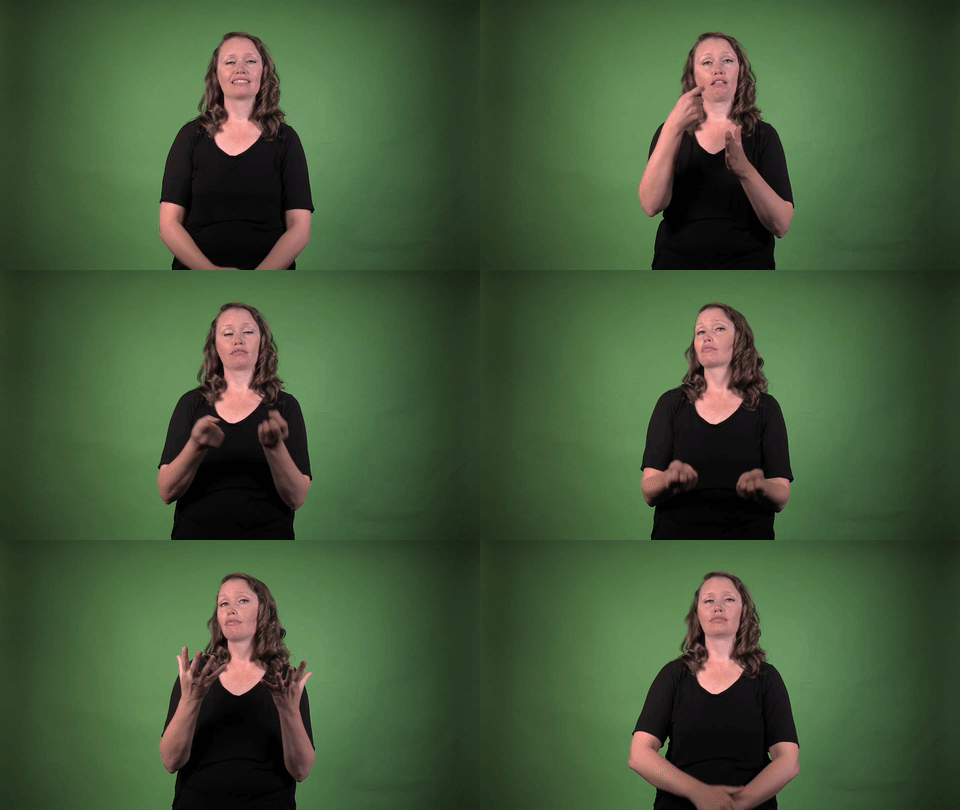
Definition: How much something costs.
Sign for COSTS HOW MUCH in ASL

Practice Activities:
Practice the sign for COSTS HOW MUCH in ASL by isolating the motion and handshape first. Use a flat non-dominant hand as a base, while your dominant hand uses the index finger and thumb to mimic a quick rubbing movement on the tips of the non-dominant fingers. Repeat this several times in front of a mirror to ensure correct placement and motion.
Create short answer questions using the sign for COSTS HOW MUCH in ASL. For example, find five everyday objects—like a book, phone, water bottle, sunglasses, and shoes—and ask about their price using facial expressions with the question. This will help you master both the sign and non-manual marker needed for WH-questions.
Use context-based practice by signing short scenarios. Practice asking “COSTS HOW MUCH” at a restaurant, grocery store, or clothing shop. Record yourself to see if your questioning tone is clear with the correct facial expressions. You can add gesture-based responses like signing “EXPENSIVE” or “CHEAP” to build fluency.
Partner up with another learner and roleplay customer and cashier situations. Take turns showing or pretending to hand over an item while the other responds with the full question using the sign for COSTS HOW MUCH in ASL. Switch roles and try at least five different items each.
Create a mini story about shopping for a birthday gift. Include characters asking the price of different items and reacting to the cost. Share your story by signing to a peer or recording it for self-review. This narrative exercise gives you more real-life fluency with the sign and lets you practice transitions and expressions.
Make a price guess game using pictures of products. One person shows the item, and the other signs the question using the sign for COSTS HOW MUCH in ASL. This keeps the practice light and engaging while encouraging repetition and vocabulary expansion.
Cultural Context:
In American Sign Language (ASL), understanding how to communicate basic questions like the sign for COSTS HOW MUCH in ASL is essential for everyday interactions. This sign is especially important in contexts like shopping, dining out, or asking about service fees. For Deaf and Hard of Hearing individuals, being able to inquire about price clearly helps promote independence and equal access.
The sign for COSTS HOW MUCH in ASL is rooted in daily cultural exchanges. Asking about cost is a routine part of navigating both personal and public life. Whether you’re at a local market or just comparing products online, the ability to use the sign for COSTS HOW MUCH in ASL bridges gaps in communication and supports smoother transactions.
Deaf culture values direct communication, and the phrase COSTS HOW MUCH is a perfect example of this. Rather than small talk or vague pricing questions, signers often get straight to the point. Using the sign for COSTS HOW MUCH in ASL reflects the practical and efficient communication style typical in Deaf communities.
Body language and facial expressions are vital when signing. Asking how much something costs involves not only the correct hand movement but also a specific questioning expression. These visual cues help make the sign for COSTS HOW MUCH in ASL clear and meaningful to the person you’re signing with.
In Deaf-owned businesses or at events within the Deaf community, using signs like COSTS HOW MUCH properly shows respect and inclusion. It indicates that you’re making an effort to communicate in a culturally appropriate and accessible way. Mastering the sign for COSTS HOW MUCH in ASL can even open up opportunities for better community engagement.
Language access is a key aspect of Deaf rights, and learning essential signs like COSTS HOW MUCH supports those rights. When more people can use ASL for common interactions, it makes public spaces more inclusive. The sign for COSTS HOW MUCH in ASL helps promote equal participation in commerce and social life.
Parents, educators, and interpreters commonly teach basic phrases like COSTS HOW MUCH early in ASL learning. It’s practical vocabulary that empowers Deaf children and ASL students to interact confidently with others. The sign for COSTS HOW MUCH in ASL is a building block of functional communication and essential to understand.
From a cultural standpoint, being able to confidently use signs that involve questions about money promotes equity. It reduces barriers for those navigating financial transactions in a hearing-centric world. The sign for COSTS HOW MUCH in ASL represents more than a question—it’s a tool for empowerment.
Learning the
Extended Definition:
The sign for COSTS HOW MUCH in ASL is a commonly used phrase when asking about prices or the value of an item. It’s an essential part of everyday conversations, especially when shopping, asking about services, or discussing financial matters. Knowing how to sign this phrase allows Deaf individuals and ASL learners to navigate these conversations with ease and clarity.
To make the sign for COSTS HOW MUCH in ASL, the movement typically starts with the dominant hand in a flat position, mimicking a gesture of pinching or picking up a price tag. This is followed by a furrowed brow to indicate a question and a palm-up motion to show inquiry. Non-manual signals, such as raised eyebrows and a questioning facial expression, are important to convey that you’re asking a question rather than stating a fact.
This phrase falls under the category of WH-questions in American Sign Language. These are questions that begin with who, what, when, where, why, or how. The phrase “how much” specifically is used to inquire about the cost or quantity of something and can vary in context based on tone and expression.
The sign for COSTS HOW MUCH in ASL can be used in various real-life settings, from inquiring about prices in a store to asking how much something will cost in terms of time or effort. For example, asking how much a shirt costs at a retail store would use this same phrase. Context is key, and understanding subtle differences in signing can add meaning to the interaction.
In casual ASL, users may shorten or modify the movement of the phrase based on regional dialect or speed of conversation. However, the foundation of the sign generally stays consistent across different parts of the U.S. Whether you are a student purchasing supplies or a traveler asking about tickets, using the correct sign for COSTS HOW MUCH in ASL will make the communication effective and natural.
For ASL students and interpreters, mastering this phrase is fundamental. Video practice, mirroring exercises, and observation of Deaf signers in real settings can help with fluency. Watching how native signers use facial expressions along with the signs will also improve your understanding and comfort with the phrase.
When signing the phrase, keep your body relaxed, and be sure to use appropriate spacing between signs to ensure clarity. This will help the person you’re communicating with better understand your intent. Clear signing improves connection and minimizes confusion, especially in commercial or public service interactions.
In digital communication, such as ASL video
Synonyms: How much does it cost, What is the price, Price check, What is the cost, How much
Educational resources: Find related learning materials in our course bank!
Want more? Check out some of our popular learning activities on the homepage!
Need to look up a sign? Use our highly rated dictionary: https://aslinteractive.com/best-asl-dictionary/
Follow us on tiktok: https://www.tiktok.com/@aslinteractive. More social media links at the bottom of this page!
Long-tail Keywords: what is the sign for costs how much in ASL, how do you sign costs how much in ASL, ASL sign for costs how much
Categories:
tags: Wh-words, Numbers, Language Learning, Everyday Activities, Basic Grammar
Parameters
*Handshape*:
The handshape for the sign for COSTS HOW MUCH in ASL begins with the dominant hand forming a flat “O” shape, similar to the hand position used when picking up a small object like a coin. This flat “O” is usually placed on the tip of the non-dominant hand’s index finger, which is held upright in front of the body.
As the flat “O” hand contacts the index finger, the motion typically involves a quick sliding or tapping movement downward, representing the action of calculating or inquiring about price. This handshape is essential in clearly conveying the meaning behind the sign for COSTS HOW MUCH in ASL .
*Palm Orientation*:
In the sign for COSTS HOW MUCH in ASL, the dominant hand typically starts in a palm-up orientation, positioned under the chin or near the mouth. The fingers are loose and relaxed, similar to the setup for a question or inquiry.
As the sign progresses, the fingertips of the dominant hand flick forward, turning the palm slightly downward. This natural motion emphasizes curiosity or inquiry, which aligns with the meaning of the sign for COSTS HOW MUCH in ASL.
*Location*:
The sign for COSTS HOW MUCH in ASL is typically located in front of the body, just above waist level. The dominant hand starts with the index finger and thumb touching, resembling a small pinch, then flicks outward as if showing a price tag being released.
This motion takes place near the center of the torso and is often accompanied by a questioning facial expression to emphasize the inquiry. The consistent body placement helps clearly express the sign for COSTS HOW MUCH in ASL.
*Movement*:
The sign for COSTS HOW MUCH in ASL starts with the dominant hand in the shape of the letter “X,” positioned near the palm of the non-dominant flat hand, which is held steady in front of the chest facing upward. The “X” hand quickly pulls across the palm in a short, downward flicking motion, similar to “peeling” something off.
This gesture is often paired with raised eyebrows and a questioning facial expression to properly convey the meaning. The sign for COSTS HOW MUCH in ASL may be followed by a slight forward head movement to indicate the question more clearly.
*Non-Manual Signals*:
When signing the phrase, use a questioning facial expression with furrowed eyebrows and slightly tilted head to enhance the interrogative nature of the sign for COSTS HOW MUCH in ASL. Keep your eyes focused on the conversation partner for clarity and engagement.
A slight forward lean of the body can indicate genuine curiosity or confusion. These non-manual signals are essential in conveying the full meaning of the sign for COSTS HOW MUCH in ASL .
*Prosody, Dominant/Non-Dominant Hand*:
The sign for COSTS HOW MUCH in ASL uses the dominant hand in an F-handshape. The non-dominant hand is held palm-up in a flat B-handshape, acting as a base. The dominant hand brushes downward against the fingers of the non-dominant hand, signifying a price interaction. Facial expression includes raised eyebrows when expressing the question.
This sign for COSTS HOW MUCH in ASL often includes a questioning facial expression or head tilt to indicate inquiry. It’s usually performed with a quick, fluid motion to mimic asking about the price of something .
Tips for Beginners:
When learning the sign for COSTS HOW MUCH in ASL, beginners should start by familiarizing themselves with the facial expressions that go along with the sign. This sign typically uses a non-manual marker that shows questioning or curiosity, such as raised eyebrows or a slight head tilt. Without the proper facial expression, the meaning can be lost or misunderstood, especially in everyday conversation.
This sign often begins with the dominant hand forming an “F”-handshape (thumb and index finger touch to make a circle), tapping or brushing lightly on the tips of the non-dominant hand fingers, palm facing up. This shows the concept of money, followed by a furrowed brow or inquisitive expression to represent the question, “how much.” Practicing this in front of a mirror can help improve both your hand movement and facial expressions.
A common mistake among beginners when learning the sign for COSTS HOW MUCH in ASL is rushing or using exaggerated motions. It’s important to keep movements smooth and natural. Also, ensure the “F”-handshape is precise because unclear handshapes can alter the meaning. Over time, watching fluent signers use this phrase can show how subtle and quick the motion can be in natural conversation.
Consistency is key when repeating this sign in different settings. Use it in practical situations where you’re asking about prices or costs. This constant usage reinforces memory ⏳ and sharpens accuracy.
Lastly, remember that context matters. The sign for COSTS HOW MUCH in ASL might appear slightly different depending on regional usage or sentence structure, so exposure to varied signing will help. Watching ASL YouTube channels ️ or attending Deaf events can increase your confidence with this phrase and improve your comfort in real conversations.
sign for COSTS HOW MUCH in ASL, sign for COST HOW MUCH in American Sign Language, how to sign how much cost in ASL, sign for price how much in ASL, ASL sign COSTS HOW MUCH
Connections to Other topics:
The sign for COSTS HOW MUCH in ASL is closely connected to the broader concept of money and financial transactions. This sign often incorporates the sign for COST or PRICE, which may look like a downward movement with a bent-handshape brushing against the palm. It’s used in a variety of settings including shopping, budgeting, and comparing expenses.
This sign is commonly seen in combination with other money-related signs like BUY, SELL, AFFORD, or CHEAP. For example, a signer might use COSTS HOW MUCH along with the sign for BUY to ask, “How much does it cost to buy that?” This creates a more in-depth understanding of how grammatical structure in ASL adapts to context.
The sign for COSTS HOW MUCH in ASL is conceptually related to HOW MANY and HOW LONG, as they all fall under the broader category of quantity and measurement questions. While HOW MUCH relates to price, HOW MANY targets countable items and HOW LONG refers to time duration. Understanding these related structures can enhance a learner’s ability to ask questions naturally in ASL.
This sign also aligns with conversational signs used in negotiating or shopping environments. It often appears alongside facial expressions indicating confusion, curiosity, or surprise, which are essential to conveying the intent of the question in ASL. Learners benefit from practicing these non-manual signals to build fluency.
In storytelling or educational contexts, using the sign for COSTS HOW MUCH in ASL can introduce discussions about value, needs versus wants, or financial literacy. Teachers might combine this with signs for MONEY, SAVE, or EXPENSIVE to create vocabulary themes. This promotes deeper comprehension and retention while building thematic vocabulary.
Summary:
The sign for COSTS HOW MUCH in ASL is an expressive blend of visual grammar and meaning. It typically includes facial expressions that emphasize curiosity, surprise, or sometimes disbelief, depending on context. These facial cues are crucial to accurately conveying the question and establishing the social tone.
Handshape and movement are also pivotal in this sign. Typically, the non-dominant hand holds a stationary flat surface, representing an object or a conceptual base. The dominant hand uses an index finger and thumb in a squishing or picking motion downward, as though lifting or tagging something—a metaphorical representation of price.
Facial expression is indispensable when signing COSTS HOW MUCH. The brow is furrowed or raised, the head may tilt slightly forward, and the eyes may squint or pop open depending on emotion. These visual queues contribute deeply to the sign’s meaning and intensity.
There’s often a quick, sharp wrist motion in the final part of the sign for added emphasis. This helps mark it as a question, particularly a WH-question, reinforcing grammatical clarity. You might also see the WH-word “HOW MUCH” formed separately afterward using a flicking motion of the dominant hand’s fingertips upward, further reinforcing the inquiry.
In casual usage, the sign for COSTS HOW MUCH in ASL may be shortened. Cultural fluency determines when such reductions are appropriate. Deaf users often rely on context and mutual understanding to tailor sign length and emphasis.
Grammatically, this sign is used at the end of a sentence in ASL, aligning with standard WH-question syntax. Questions in ASL use non-manual markers—raising eyebrows for yes/no questions and furrowing brows for WH-questions. In this case, furrowed brows signal that specific information is being requested.
The variation in delivery supports the strong visual-spatial nature of ASL. The physicality of the motion mirrors how Deaf culture visually conceptualizes ideas like value or transaction. It’s not just how the sign is formed but how it is presented in space.
In dialogue, the sign for COSTS HOW MUCH in ASL often forms part of broader exchanges discussing shopping or budgeting. For example, it might appear alongside other signs like BUY, EXPENSIVE, CHEAP, or MONEY. Each of these signs enriches the context and creates an environment of narrative flow.
Applied linguistics helps explain why physical metaphor underlies this sign. The gesture of plucking or measuring aligns with cognitive theories on embodied language. Research confirms that sign languages utilize metaphorical gestures to express abstract ideas like worth or pricing.
In Deaf culture, price and expense also hold symbolic social implications. Asking how much something costs can sometimes suggest deeper concerns—equity, access, or fairness. In this way, the sign becomes more than just currency-related; it can interrogate systemic disparities.
Learning the sign for COSTS HOW MUCH in ASL requires mastering complementary elements like timing, rhythm, and intensity. Beginners often overuse hand tension or fail to use facial grammar, leading to confusion. Effective instruction addresses these nuances, emphasizing both accurate form and expressive features.
The cognitive processing for this sign relies on multimodal cues. Visual stance, eye contact, and spatial precision all influence how the sign is understood. This supports linguistic scholarship on ASL syntax and discourse, where tangible visual relationships shape linguistic structure.
The sign is highly relatable and universally applicable in daily life. It plays an important role in conversations about consumerism, budgeting, and personal value systems. Across generational lines in the Deaf community, this sign equips members to navigate economic spaces confidently.
In digital ASL education, video resources showcasing the sign for COSTS HOW MUCH in ASL are effective. Slow-motion demonstrations and annotated visuals highlight key components like finger articulation and wrist flick. Learners benefit from seeing multiple perspectives and cultural contexts for usage.
Variation exists within regional and generational groups. Some signers insert the sign MONEY first and then gesture HOW MUCH. Others might fuse the concepts within one fluid movement, emphasizing efficiency and rhythm.
Certain classifiers in ASL help elaborate on size or expense during the same conversation. For instance, a large C-handshape sliding across the palm may indicate a big price. Classifiers bridge the gap between specific signs and broader sensory descriptions.
The sign for COSTS HOW MUCH in ASL integrates iconic and arbitrary sign elements. While the movement may mimic a tag flicking or a price fluttering, its meaning depends on social convention. This duality makes it fascinating to study within linguistic analysis.
Discourse analysis in ASL reveals that this sign is regularly followed by negotiation signs or expressions of reaction. Signs such as TOO MUCH, REALLY?, or WHY? naturally follow, illustrating a natural arc of conversation. This rhythm mimics spoken language narrative structure.
The sign is often used with head tilt and subject referencing in spatial grammar. For instance, pointing to a displayed item before asking COSTS HOW MUCH provides clarity. Visual anchoring supports comprehension and reflects ASL’s spatial agreement rules.
In educational
Want more? Check out some of our popular learning activities!
ASL Interactive Resources
ASLInteractive YouTube Channel
Follow us on tiktok: @aslinteractive.com
Follow us on Instagram: aslinteractive
Facebook page: aslinteractive
Facebook group: aslinteractive
LInkedIn: ASL Interactive LLC
Twitter: @ASL_interactive
*Some information on this page is AI-generated. AI can make mistakes. Please check the information.


Responses