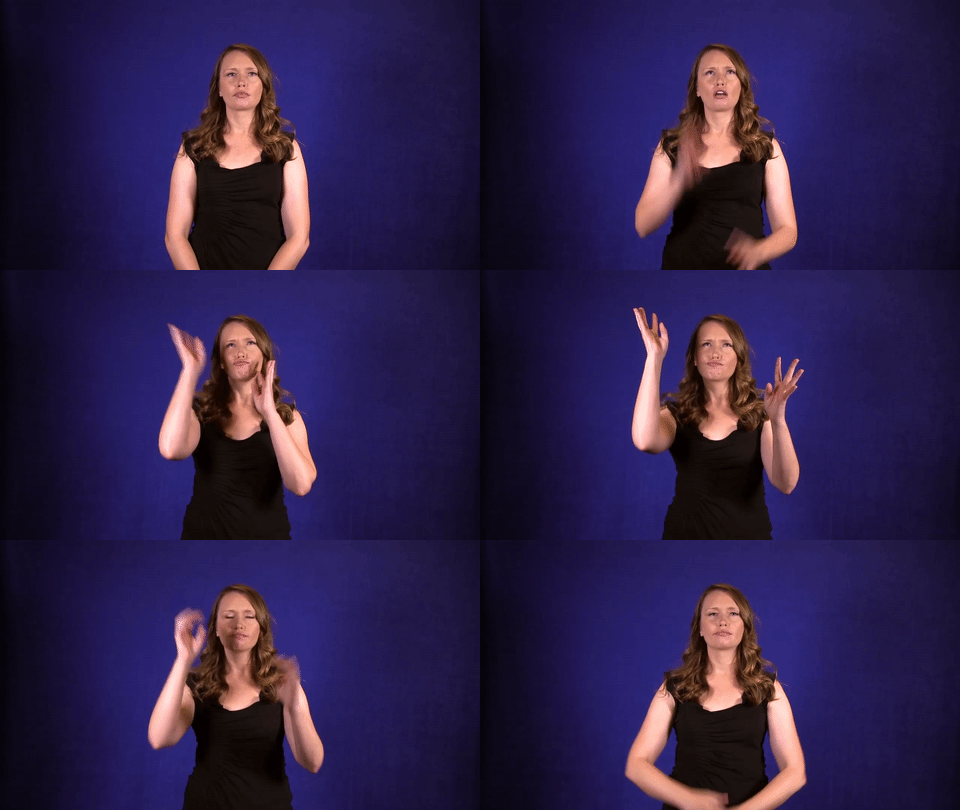
Sign for CREATIVE in ASL | 🎨 ASL Dictionary

Definition: Having the ability to create.

Sign for CREATIVE in ASL

YouTube player

Practice Activities:

To practice the sign for CREATIVE in ASL, begin by isolating the motion and repeating it several times in front of a mirror. Focus on the movement from the forehead outward, as if illustrating an idea coming from the mind. Practice this slowly, then gradually speed up as you become more confident and fluent with the sign.

Use flashcards with different personality traits or qualities written in English, and when you see one that fits, like CREATIVE, immediately sign it. Pair this activity with spoken English for reinforcement if needed, especially for beginner learners building their vocabularies around personality descriptors. Try signing common phrases like “She is creative” or “I feel creative today” to reinforce the sign in context.

Create storytelling prompts that challenge you to use the sign for CREATIVE in ASL multiple times. For example, construct a short narrative about an artist making a new sculpture or a student solving a problem in a unique way. This gives you a chance to contextualize the sign within different sentence structures while developing fluency and expressive skills.

With a partner, take turns listing hobbies or professions and decide whether they might require someone to be creative. For each one, state your opinion using the sign for CREATIVE in ASL. This back-and-forth exercise encourages conversational use and cultural understanding of how the concept is interpreted in different situations.

Record yourself signing a few sentences using the sign, watch it back, and evaluate your clarity and facial expressions. Adjust your timing and fluidity as needed. Integrating expressive nuances makes your signing more native-like and natural.

Try labeling a vision board or project with signs, using the sign for CREATIVE in ASL to describe your inspirations. This practice builds confidence in using descriptive language and supports developing sign fluency in creative contexts.

Cultural Context:

In American Sign Language (ASL), the sign for CREATIVE represents a concept deeply rooted in the Deaf community’s cultural values of originality, visual expression, and problem-solving. This sign captures the spirit of imagination and the importance of visual storytelling that defines the Deaf experience. Creativity plays a major role in how Deaf individuals communicate, educate, and connect with each other in both formal and informal settings.

The sign for CREATIVE in ASL is often used in community settings that celebrate self-expression, such as Deaf theatre, poetry slams, and art events. It reflects the way Deaf culture encourages unique modes of communication and the use of visual space. This strong cultural emphasis on creating and sharing through visual means aligns naturally with what the word creative implies across languages and communities.

In Deaf culture, being creative is often associated with being resourceful. Many Deaf individuals navigate through a world designed for hearing people, and this requires inventive thinking and a flexible mindset. Thus, the sign for CREATIVE in ASL symbolizes more than just artistic skills—it also acknowledges the cultural resilience and adaptability within the Deaf community.

ASL students and fluent signers alike use the sign for CREATIVE in storytelling, academic discussions, and casual conversations that describe someone with imagination or artistic ability. This sign can describe people, ideas, work, or methods that stand out as original or innovative. It’s a key part of communicating admiration for new ideas and originality in Deaf spaces.

The Deaf community highly values visual art and performance, and the sign for CREATIVE in ASL plays a central role in discussions about art, design, and performance. Deaf artists and performers thrive in boundary-pushing environments where imagination leads. The language itself supports visual representation, making creativity a natural part of ASL conversation.

From Deaf poetry to signed music and visual vernacular, the sign for CREATIVE in ASL is encountered in almost every form of communication and art among signers. Deaf creators often blend traditional Deaf cultural elements with their unique visions, reinforcing the idea that to be creative is to be culturally expressive. This makes the sign for CREATIVE deeply relevant when discussing identity, community, and expression.

Parents and educators in Deaf education settings use the sign for CREATIVE to encourage children to explore and think outside the box. Schools for the Deaf promote activities and academic programs where innovative thinking is nurtured through ASL. This signing not only supports vocabulary growth but also reinforces a cultural value that uplifts diverse thinking.

Whether in classrooms, theater rehearsals, art galleries

Extended Definition:

The sign for creative in ASL reflects the concept of imagination, innovation, and originality. In American Sign Language, creativity is shown by using expressions and hand movements that suggest forming new ideas or bringing something into existence from one’s mind.

To express the sign for creative in ASL, signers typically start with both hands near the forehead, resembling the “thinking” area, and then move outward or downward slightly, often with a twist of the fingers or hands. This movement represents the idea of thoughts being turned into something new. Facial expression is important here—raising the eyebrows or showing a look of inspiration adds emphasis to the meaning.

The concept of creativity goes beyond just artistic talents. When using the sign for creative in ASL, it’s not limited to painting or music. It can also apply to problem-solving, inventing, or coming up with new ways to handle situations. The signing context will help clarify what kind of creativity is being referred to.

In ASL, signs often capture the essence of the word rather than a direct translation. The sign for creative in ASL might differ slightly depending on regional variations or the person’s signing style. Some people emphasize the “thinking” aspect more, while others draw attention to the “producing” aspect of being creative.

When teaching this sign to ASL learners, it’s helpful to associate it with signs like think, imagine, or idea. These signs are often connected in conversations, especially when discussing projects, hobbies, or innovative thinking. Including the sign for creative in ASL during discussions about design or strategy makes the message more clear and expressive.

Using the correct palm orientation and movement is key for the sign to be understood. The sign for creative in ASL usually has a gentle or flowing motion, which symbolizes the flexibility and freedom of imagination. A stiff or robotic version might distort its meaning and confuse the receiver.

In storytelling and visual descriptions, the sign for creative in ASL is used to highlight someone’s ability to invent or bring unique elements into a narrative. This is especially common in poetry, visual vernacular, and other expressive ASL performances. Creativity is highly valued in Deaf culture, especially in fields like theater, storytelling, and visual artwork.

If adding the sign for creative in ASL to your vocabulary, it’s beneficial to practice it with other related signs. For example, pair it with signs like smart, idea, or make. These combinations often appear in fluent signing and help reinforce the concept of being inventive.

Understanding how to use the sign

Synonyms: innovative, imaginative, inventive, original, artistic

Educational resources: Find related learning materials in our course bank!

Want more? Check out some of our popular learning activities on the homepage!

Need to look up a sign? Use our highly rated dictionary: https://aslinteractive.com/best-asl-dictionary/

Follow us on tiktok: https://www.tiktok.com/@aslinteractive. More social media links at the bottom of this page!

Long-tail Keywords: what is the sign for creative in ASL, how do you sign creative in ASL, creative in American sign language

Categories:

tags: Language Learning, Describing Residence, Family, Emotions, Activities

Parameters

*Handshape*:

The handshape used in the sign for CREATIVE in ASL typically begins with both hands in the flat “O” handshape, where the fingertips and thumbs touch to form an “O” shape. This handshape allows for flexibility and fluid movement, indicating imaginative or abstract thought.

The sign for CREATIVE in ASL uses these “O” handshapes to show ideas forming or developing. As the hands move outward and then apart, it gives a visual representation of something being created or brought to life. ✨

*Palm Orientation*:

The palm orientation for the sign for CREATIVE in ASL generally starts with both hands in an “S” handshape near the sides of the forehead. The palms are facing inward toward the head, often slightly angled toward each other.

As the motion continues, the dominant hand moves outward and forward, opening into a claw or curved handshape, with the palm remaining mostly inward or angled slightly toward the center. This sign reflects the idea of thoughts forming and expanding, which aligns with the concept expressed by the sign for CREATIVE in ASL.

*Location*:

The sign for CREATIVE in ASL typically takes place near the forehead or top of the head. This location relates to the concept of thinking and imagination, which are core meanings of the word. The dominant hand moves in a circular or gesturing motion close to the head, emphasizing the mental process involved.

Consistently placing the sign for CREATIVE in ASL at the side or front of the head helps communicate innovation or original thought. The location supports the mental imagery associated with creativity, aligning the physical sign with its abstract meaning.

*Movement*:

The sign for CREATIVE in ASL typically begins with both hands in “C” handshapes near the temples. The movement involves simultaneously circling the hands outward and away from the head in small alternating motions, as if stimulating ideas coming from the mind .

This movement helps convey imagination and inventiveness. The sign for CREATIVE in ASL emphasizes original thought, making it suitable when discussing art, innovation, or problem-solving.

*Non-Manual Signals*:

The non-manual signals for the sign for CREATIVE in ASL often include a thoughtful or imaginative facial expression. Slightly raised eyebrows and an inquisitive look can emphasize the idea of generating new ideas or being inventive.

A soft, engaged gaze and a slight head tilt also add meaning to the sign for CREATIVE in ASL, reinforcing the mental process of creating. These non-manual cues help convey abstract thought and originality.

*Prosody, Dominant/Non-Dominant Hand*:

The sign for CREATIVE in ASL uses the dominant hand shaped in a “C” while the non-dominant hand takes the same “C” form. Both hands start near the forehead and move outward in small, circular motions, suggesting imaginative thinking or the generation of new ideas. Facial expression often includes raised eyebrows to show mental effort or inspiration.

To express the concept clearly with the sign for CREATIVE in ASL, make sure the dominant hand leads slightly in movement, showing the direction of thought or invention. The hands should remain relaxed, and the motion should feel fluid and intentional.

Tips for Beginners:

When learning the sign for CREATIVE in ASL, it’s helpful to focus on the idea of mental originality and imagination. This sign typically utilizes the dominant hand circling near the forehead, representing thought or brainstorming, and may transition into a gesture that indicates forming or constructing something in the mind. Practice the motion with a smooth flow and controlled pace to make your intention clear.

One of the best tips for beginners is to connect the sign to real-world concepts, like imagining an artist painting or a writer generating ideas. This helps internalize the meaning of the sign for CREATIVE in ASL, making it easier to remember and use naturally. Don’t rush—spend time mastering the hand based near the forehead and how it flows outward to symbolize innovation.

A common pitfall is using stiff or jagged movements, which can confuse the meaning or make the sign appear less fluid. The sign should look thoughtful and intentional. Another mistake is incorrectly placing the movement too far from the head or using both hands unnecessarily—stick with the most widely accepted version first before branching into regional variants.

Pay attention to non-manual markers like facial expression. A thoughtful or slightly inspired expression helps convey the abstract idea of creativity. Always watch native signers to understand how they express the sign for CREATIVE in ASL in context and how body language supports the meaning.

It’s also beneficial to sign in front of a mirror to assess your accuracy and adjust your movements. Repetition is key—practice the sign in full sentences so that it flows naturally in conversation. The more you see and use the sign for CREATIVE in ASL, the more confident and expressive your signing will become.

sign for CREATIVE in ASL, ASL sign for CREATIVE, how to sign CREATIVE in American Sign Language, CREATIVE sign meaning in ASL

Connections to Other topics:

The sign for CREATIVE in ASL connects closely with a range of cognitive and mental processes expressed in sign language. It often shares similarities with signs like THINK, IDEA, and IMAGINE, which also involve referencing the head to indicate mental activity. This emphasizes how ASL visually links related concepts by modifying or combining handshapes and locations near the head.

This sign can be a base for compound expressions such as CREATIVE-THINKING or CREATIVE-WRITING, where additional signs like WRITE or BRAINSTORM are added to provide context. The sign for CREATIVE pairs well with descriptions in academic, professional, or artistic settings, supporting more nuanced discussions in ASL.

In discussions about professions or skills, the sign for CREATIVE is useful when combined with WORK or JOB to form compound ideas like CREATIVE-JOB or CREATIVE-WORKER. These help convey specific career-related concepts, such as art, design, or advertising roles, where creativity is essential. Using the sign in these ways builds expressive capability in ASL discourse.

There are also situational signs like CREATIVE-PROBLEM-SOLVE, which merges the idea of generating ideas with solving challenges. It exemplifies how conceptual layering in ASL enhances communication through spatial and gestural means. This technique helps convey abstract and complex ideas visually and efficiently.

The concept behind the sign for CREATIVE in ASL is fundamentally linked to freedom of thought, often relating to expressions like UNIQUE, DIFFERENT, and INVENT. In educational contexts, it can support discussions about learning styles, innovation, and classroom approaches. This makes it a valuable sign for both everyday and specialized vocabulary development.

Learners exploring the sign for CREATIVE in ASL are also indirectly exposed to classifiers that describe mental or imaginative actions. These connections deepen a signer’s understanding of how ASL represents internal experiences visually, supporting fluency and comprehension in descriptive and narrative formats.

Summary:

The sign for CREATIVE in ASL reflects both abstract thinking and inner imagination, often formed near the front of the head to represent mental processes. The most common sign involves the dominant hand moving in small outward circular motions near the forehead, mimicking the idea of mental generation or invention. It often follows the structure and tone found in signs for THINK or IMAGINE.

The sign uses the dominant hand in a modified C-handshape or open 5-handshape, depending on regional and individual variation. The hand hovers near the temple or forehead area, suggesting an active thought process. The movement is smooth and continuous, embodying the flow of ideas.

The sign can be nuanced depending on the context. If one is describing artistic creativity, some signers incorporate a more expressive face, possibly widening the eyes or adding an excited affect. For more scientific or logical creativity, the affect may be focused and thoughtful.

The sign for CREATIVE in ASL can be accompanied by classifiers or supporting signs to clarify the type of creativity involved, such as ART, MUSIC, or IDEA. This type of grammatical support is common in ASL, which often uses multiple signs to convey subtleties that English expresses with adjectives or adverbs.

In a cultural context, creativity is highly valued in Deaf communities, not only in artistic pursuits but also in problem-solving and adaptive thinking. Visual language users are often engaged in visually inventive ways of expressing complex ideas, making the concept of creativity central to both language and culture.

Because the sign for CREATIVE in ASL is conceptually driven rather than a direct translation, it aligns well with how ASL tends to describe internal states or intangible concepts. The language favors metaphor and visual mimicry of concepts. Therefore, this sign is not just lexical—it is iconic.

The sign fits into broader linguistic categories such as abstract noun signs and cognitive process terms. It shares semantic space with signs like THINK, IDEA, and INSPIRE. These signs often originate from the forehead or temple, marking them as part of a mental lexicon location in ASL’s spatial grammar.

A key linguistic insight about the sign for CREATIVE in ASL is its reliance on nonmanual signals to add deeper meaning. Eyebrow movement, eye gaze, and mouth morphemes may shift depending on the intensity or type of creativity being described. ASL relies heavily on these nonmanual components for clarity and nuance.

When used in ASL sentences, the sign for CREATIVE in ASL can function as both an adjective and a noun, depending on its placement and accompanying signs. For example, it can be preceded by a classifier noun like PERSON or followed by signs for traits such as SMART or UNIQUE. This flexibility enhances expressive depth.

When fingerspelling is necessary—such as in formal settings or when emphasizing terminology—the word CREATIVE may be fingerspelled for specificity or accuracy. This tends to happen in academic discussions or lectures involving detailed concepts. However, the signed form is more natural in everyday conversation.

Variants of this sign exist between different regions and communities. Some people may show a more exaggerated circular motion or use both hands. Others may shift the hand motion closer to the side of the head or expand it outward, showing an idea being released into the world.

Children learning ASL as their first language often pick up this sign later in development, as abstract concepts like creativity are usually taught with example-based learning. Teachers might present drawing or songwriting as examples paired visually with the sign. This scaffolded learning allows for internalization of abstract signs.

For second-language learners of ASL, mastering signs like CREATIVE involves understanding more than just structure. They must grasp how ASL uses spatial representation and visual metaphors. Many students mistake this sign as limited to artistic contexts, but native users understand it much more broadly.

The sign for CREATIVE in ASL symbolizes the integration of imagination, intellect, and expression—all components highly revered in ASL poetics and storytelling. Creative storytelling in Deaf culture often involves elaborate use of these cognitive signs. The language prioritizes originality and expressiveness.

In Deaf art and cultural expression, creativity holds a unique position. Visual rhyming, handshape consistency, and spatial symmetry are all methods through which Deaf creatives showcase mastery. The concept of creativity is embedded deeply in performance, ASL poetry, and visual vernacular.

ASL instructors often integrate the sign for CREATIVE in ASL when encouraging students to take risks or think outside traditional grammatical forms. This pedagogical use highlights how the sign isn’t confined to a dictionary entry—it motivates behavior and sets tone. Creativity is encouraged not just practically, but linguistically.

The sign also aligns with educational goals in Deaf pedagogy. Encouraging creative projects supports language acquisition and concept development simultaneously. Schools for the Deaf emphasize performance and visual arts, where this concept and its corresponding sign are frequently applied.

Research into ASL lexicon development shows that signs for abstract concepts like creativity often have iconic roots but transform over time. This evolution mirrors the

Want more? Check out some of our popular learning activities!

ASL Interactive Resources

ASLInteractive YouTube Channel

Follow us on tiktok: @aslinteractive.com

Follow us on Instagram: aslinteractive

Facebook page: aslinteractive

Facebook group: aslinteractive

LInkedIn: ASL Interactive LLC

Twitter: @ASL_interactive

*Some information on this page is AI-generated. AI can make mistakes. Please check the information.

Sign for CREATIVE in ASL

Responses