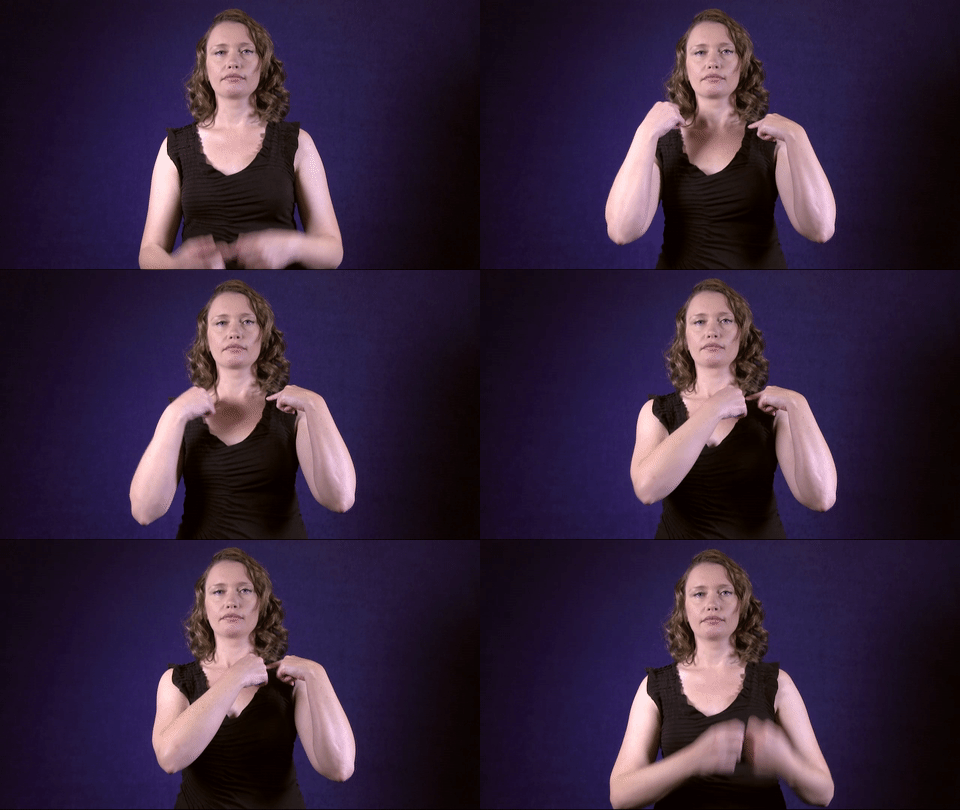
Definition: A type of neckline.
Sign for CREWNECK in ASL

Practice Activities:
To practice the sign for CREWNECK in ASL, begin by isolating the sign. Stand in front of a mirror and repeat the sign slowly while observing your handshape and facial expressions. This helps with muscle memory and accuracy. Aim to sign it five to ten times while checking that you are representing a rounded neckline accurately around your own neck area.
Next, combine the sign for CREWNECK in ASL with basic clothing words like shirt, sweater, and sweatshirt. For example, sign phrases such as “blue crewneck sweater” or “crewneck shirt today.” This builds fluency and comfort with integrating the sign into full descriptions. Practice describing what you’re wearing or what a friend is wearing while incorporating color and clothing type for variety.
Create short dialogues describing clothing preferences. For example, sign “I like crewneck shirts” and ask your partner to respond with their preferences. Try comparing a crewneck to a V-neck or turtleneck in sign. This allows you to contrast styles and reinforce vocabulary. Use question signs such as “which do you prefer?” to keep the dialogue going.
Storytelling is another powerful tool. Create a story about shopping for a new outfit and emphasize the part where you look for a crewneck shirt. Include signs for store, clothes, try-on, and size. You might say, “I went to the store. I looked for a crewneck. I tried it on. It fit!”
With a partner, play a clothing guessing game. One signs details about a clothing item someone is wearing or imagining, and the other guesses what it is. Include the sign for CREWNECK in ASL in your clues. This encourages quick recall and practical use in context.
Lastly, watch ASL videos or vlogs where clothing is discussed and see how the sign for CREWNECK in ASL is used naturally. Try to copy the signer’s speed and expression for a more authentic style.
Cultural Context:
In American Sign Language, the sign for crewneck refers to a specific clothing style known for its round neckline. It’s a common term used to describe shirts and sweaters that lack a collar and have a simple, circular neck opening. The sign for crewneck in ASL captures this distinctive feature visually.
Clothing terms in ASL reflect both fashion and function. When signing the word for crewneck, Deaf individuals often use context to add clarity, especially since clothing styles can be similar. The sign for crewneck in ASL is most often used in conversations involving shopping, fashion, or identifying someone’s attire.
ASL uses visual space and classifiers to describe clothing designs. The sign for crewneck in ASL may involve outlining the shape of the neckline or using handshapes placed near the neck area. This allows signers to quickly identify and describe articles of clothing with precision and ease.
Understanding how to sign clothing terms like crewneck shows familiarity with Deaf culture. Fashion and appearance are regular discussion topics in the Deaf community, just as in hearing culture. Using the appropriate sign for crewneck in ASL helps maintain clear communication and reflects cultural norms.
In Deaf culture, descriptive signs such as the sign for crewneck in ASL are valuable because they convey more than just vocabulary. They represent awareness of detail and attention to how items appear visually. For instance, using the wrong sign could confuse a crewneck with a V-neck or turtleneck, which are distinctly different.
The ASL community values clarity and visual alignment with the object being described. The sign for crewneck in ASL fits into a group of fashion-related signs that help users navigate everything from a casual conversation about outfits to shopping with friends. It bridges communication between those buying or selling clothes in a Deaf-friendly manner.
When creating new signs or adapting styles, cultural respect for standardized signs is crucial. The sign for crewneck in ASL may vary slightly by region or generation, but the general motion remains widely understood. This makes it useful in nationwide settings—from schools to social events.
ASL learners often benefit from practicing clothing signs in real-world settings, like trying on outfits and signing their features. Using the sign for crewneck in ASL during activities like this reinforces vocabulary and confidence in everyday communication. It also expands their comfort with describing personal preferences.
The sign for crewneck in ASL is part of a broader conversation about visual language and its relation to modern style. By including signs for specific styles like crewneck, ASL continues to
Extended Definition:
The sign for crewneck in ASL is a visual representation that reflects the rounded neckline typical of crewneck shirts and sweaters. In American Sign Language, clothing terms often use iconic signs that mimic the shape or function of the clothing item. The sign for crewneck in ASL is no different, usually focusing on hand movements around the neck area to indicate the rounded collar.
To form the sign for crewneck in ASL, the fingers generally trace a circular or half-circular motion around the collarbone area. This motion mimics the rounded neckline of a typical crewneck shirt. This type of sign is easy to remember because it visually connects to the physical characteristic of the shirt style. It also communicates clearly in conversations about fashion, dress code, or clothing preferences.
ASL students and fluent signers benefit from knowing specific clothing vocabulary because it helps describe styles in greater detail. The sign for crewneck in ASL is particularly useful in contexts like shopping for clothes, discussing wardrobe choices, or describing someone’s outfit. Including the word “crewneck” in your ASL vocabulary increases your ability to communicate with precision.
There are many types of necklines in fashion such as v-neck, scoop neck, and turtleneck. The crewneck is one of the most common, making its ASL sign an important addition to one’s vocabulary. From casual t-shirts to formal sweaters, the crewneck design appears in many types of apparel. That ubiquity makes the sign for crewneck in ASL especially relevant.
You may come across variations in how people sign crewneck, depending on regional or individual signing preferences. Still, the essence of the sign remains consistent—drawing attention to the neck area with circular motions. If you’re unsure, it’s helpful to watch videos or practice with a native or fluent ASL user to ensure you’re producing the sign correctly.
When documenting signs like this one on a dictionary-style page, visual aids and video demonstrations are extremely helpful. Seeing the sign for crewneck in ASL performed in motion helps reinforce memory and understanding. Spoken language dictionaries rely on phonetics, but in ASL, visual cues are everything, which is why embedding short demo clips can very effectively illustrate signs.
The term crewneck originated in the U.S. as a reference to the style of sweatshirts worn by rowers or “crew” teams. Over time, it became a fashion staple, especially for casual wear. Now that the style is so prevalent, having a sign for crewneck in ASL allows
Synonyms: pullover, round-neck sweater, collarless sweatshirt, round-neck shirt, basic sweatshirt
Educational resources: Find related learning materials in our course bank!
Want more? Check out some of our popular learning activities on the homepage!
Need to look up a sign? Use our highly rated dictionary: https://aslinteractive.com/best-asl-dictionary/
Follow us on tiktok: https://www.tiktok.com/@aslinteractive. More social media links at the bottom of this page!
Long-tail Keywords: What is the sign for crewneck in ASL, How to sign crewneck in American Sign Language, How do you sign crewneck in ASL
Categories:
tags: Clothing, Language Learning, Appearance, Objects in the Classroom, Everyday Activities
Parameters
*Handshape*:
The handshape used in the sign for CREWNECK in ASL typically involves both hands in a relaxed “C” shape to represent the neckline. These “C” hands are placed near the base of the neck, mimicking the round shape of a crewneck collar.
This visual gesture helps clearly convey the concept behind the sign for CREWNECK in ASL . The curved handshape effectively illustrates the style of a collarless, rounded neckline, common in t-shirts.
*Palm Orientation*:
The palm orientation for the sign for CREWNECK in ASL typically involves both hands open and flat, with palms facing inward toward the neck or chest. This orientation mimics the shape of a rounded neckline, a feature central to the concept behind the sign for CREWNECK in ASL
As the hands trace or hover around the base of the neck in a semi-circular motion, the inward-facing palms help emphasize the garment’s neckline. This orientation enhances the visual representation and clarity of the sign.
*Location*:
The sign for CREWNECK in ASL is typically located at the upper chest or collar area, mimicking the shape of a crewneck shirt’s neckline. The hand moves near the base of the neck, arching slightly in a circular shape to represent the rounded collar.
This location accurately conveys the concept of the crewneck garment and helps visually distinguish the sign for CREWNECK in ASL from other clothing-related signs.
*Movement*:
To show the sign for crewneck in ASL, first use both index fingers to trace a circular neckline shape around the base of the neck, mimicking the curve of a crewneck collar. Start at the sides of the neck and move the fingers forward and downward in a semi-circular motion toward the front center of the neck.
This movement visually outlines the simple round shape typical of a crewneck shirt. The sign for crewneck in ASL may be paired with the sign for shirt or sweater to clarify the context.
*Non-Manual Signals*:
For the sign for crewneck in ASL, maintain a neutral facial expression that mirrors the simplicity and everyday use of a standard crewneck shirt. No exaggerated mouth movements are needed, but a slight head tilt or subtle focus with the eyes might help emphasize the neckline area being described.
When describing the sign for crewneck in ASL, keep your lips relaxed and your expression composed. The focus should remain on the circular motion or shaping near the neck, so avoid any distracting non-manual signals that could confuse the meaning.
*Prosody, Dominant/Non-Dominant Hand*:
The sign for CREWNECK in ASL typically uses both hands to depict the shape of the neckline. The dominant hand, usually in a bent “C” shape, mimics the rounded collar line starting at the front of the neck and tracing around slightly. The non-dominant hand may remain at rest or assist lightly to emphasize the shape.
When explaining or demonstrating the sign for CREWNECK in ASL, it’s helpful to include facial expressions that show specificity, such as size or style. Some signers also incorporate a brief downward movement to indicate the shirt’s placement on the torso. This prosodic use reinforces the visual aspect of a crewneck collar .
Tips for Beginners:
When learning the sign for CREWNECK in ASL, it’s helpful to know that this term is typically fingerspelled. Since there’s no universally established sign for specific clothing styles like crewneck, fingerspelling is the clearest way to communicate this item. Practice fingerspelling “C-R-E-W-N-E-C-K” clearly and smoothly at a steady pace.
A helpful tip is to keep your hand in a neutral space near your shoulder or upper chest while fingerspelling, as this is a natural and visible area. Avoid making your letters too fast or mixing up similar-looking ones like “C” and “G.” Repetition and using a mirror can drastically improve your fluidity.
When using the sign for CREWNECK in ASL in conversation, consider the context. You can fingerspell the term and then gesture a circular neckline at your collarbone to visually reinforce what you mean. This combination of fingerspelling and gestural cues helps ensure understanding, especially if your fingerspelling isn’t yet fluent.
Many beginners forget the importance of facial expressions in ASL. Stay engaged when you demonstrate the sign for CREWNECK in ASL, especially when describing styles of clothing. A confused face can send mixed signals or imply a different meaning, so keep your expression neutral or descriptive.
Avoid dropping your hand too low or turning it away from your communication partner when fingerspelling. Clarity is more important than speed, and clean, consistent handshapes will lead to better comprehension. Regular practice with a partner or qualified signer will also help.
Using the sign for CREWNECK in ASL during real-life conversations will build both confidence and familiarity. Try incorporating the sign when describing outfits, discussing clothing preferences, or while shopping. Frequent use improves retention and helps sharpen your signing accuracy .
Connections to Other topics:
The sign for CREWNECK in ASL connects directly with signs for clothing, styles, and specific necklines. When discussing clothing in ASL, modifiers such as neckline, sleeve type, or fabric texture often combine with general signs like SHIRT, SWEATER, or WEAR. The sign for CREWNECK in ASL can appear as a descriptive classifier, showing the shape of the neck area using hand movement around the neck.
This construction relates to other signs like V-NECK or TURTLENECK, where the handshape and placement indicate the apparel’s neckline. The classifier use of C or curved hands to mimic the shape has parallels in how signs invoke physical representation—making this a natural extension of descriptive signing. Once the foundation for the sign is taught, learners can use this visual-spatial concept to describe other garment features clearly.
There’s also a connection to body part signs like NECK and CHEST, which often serve as referential anchor points for classifier signs dealing with clothing styles. For example, starting with the torso area and explaining where the neckline sits gives context for describing a crewneck, differentiating it from a scoop neck or collared shirt.
In conversations about fashion, ASL often leans on descriptive sign clusters rather than single-word signs. So, the sign for CREWNECK in ASL may appear in tandem with signs for COLOR, MATERIAL, or SEASON (like WINTER or SUMMER), especially when signing sentences like “I like wearing blue crewneck sweaters in winter.”
Using the structure of directional and descriptive signs allows ASL users to fluently navigate the world of apparel. By mastering how the sign for CREWNECK in ASL fits into this system, learners can better discuss style preferences, shop for clothes, or describe outfits. Combining it with context-specific signs like CASUAL or FORMAL creates richer, more accurate communication.
Summary:
The sign for CREWNECK in ASL is often conveyed by using classifiers or descriptive strategies because there may not be a standardized sign inherently understood across all communities. In most cases, signers refer to the shape and position of the neckline, modeling the concept around the collar area. This is typically done by outlining the round shape at the base of the neck using the dominant hand or both hands.
The visual approach usually employs the index finger or a curved C-hand moving in a semi-circular path close to the upper chest or neck. Handshape, movement, and location are key in illustrating the round nature of a crewneck collar. Because a crewneck lacks a collar and sits flush with the neck, the sign must communicate simplicity and roundness at the neckline.
The sign for CREWNECK in ASL may be accompanied by FS-CREWNECK to clarify intent, especially when the clothing term needs specificity. In fashion or retail contexts, the fingerspelled term often supports the sign or replaces it entirely. Deaf consumers familiar with garment-related vocabulary tend to recognize the sign juxtaposed with descriptive framing.
Culturally, clothing signs like the one for CREWNECK emphasize the importance of visual detail in ASL. Since ASL communicates ideas visually, describing clothing involves indicating shape, fit, and style through spatial references. The crewneck, being a universally known neckline, is easily described with circular motion, but context elevates clarity.
ASL’s design-first orientation makes it well-suited to depict fashion elements, such as the cut of a shirt or how fabric situates around the body. The sign for CREWNECK in ASL interacts with the field of visual linguistics, relying on mental imagery to construct a shared understanding. Users must be proficient in contextual inferences, as no universal sign for CREWNECK exists.
Related signs include T-SHIRT, SHIRT, and COLLAR, which often blend into the discourse when referencing garments. These connections allow signers to reduce ambiguity and enhance meaning through comparison or contrast. A signer may transition from T-SHIRT to showing its neckline to specify it’s a crewneck, not a v-neck or scoop neck.
Understanding the sign for CREWNECK in ASL also intersects with spatial grammar. The signer must localize the curved motion correctly along the neck without exaggerating, so it’s not mistaken for a necklace or a different neckline. The use of classifiers, especially the CL:5 classifier to outline or indicate areas of the body, may supplement the explanation.
In many bilingual settings, deaf users may fingerspell the term while borrowing from English, particularly in technical or fashion-specific conversations. Fingerspelling CREWNECK maintains linguistic integrity when an equivalent visual sign is unavailable or not universally adopted. Loan signs may evolve, but for now, the term relies on description.
From an applied linguistics perspective, signs like this demonstrate the adaptability of ASL to modern vocabulary, including style trends. ASL does not remain fixed—it shifts to accommodate new apparel styles, making the language grow alongside culture. The sign for CREWNECK in ASL represents that expansion of language via the community’s visual literacy.
Fashion contexts create space for a hybrid signing system that includes descriptive movements, fingerspelling, and mimicking garment features. For instance, miming pulling a shirt over the head paired with illustrating the neckline helps clarify a crewneck versus a hoodie or turtleneck. The more shared visual experience signers have, the simpler the communication becomes.
Sociolinguistically, the way deaf individuals describe fashion reflects generational shifts in vocabulary and language. Younger signers might fingerspell CREWNECK more frequently, drawing from exposure to English-based media and online fashion content. Older generations might rely more on classifiers and broad garment descriptions.
The depiction of a crewneck may also vary slightly due to regional usage, community consensus, or subcultural influence. Signers in fashion-forward cities or education settings may innovate more streamlined signs based on practicality and visual economy. Community feedback often helps establish standardization for newer terms.
Interestingly, the sign for CREWNECK in ASL can shift depending on whether it refers to a shirt, sweatshirt, or sweater. The thickness and texture implied by the crewneck often influences how much detail a signer shows. For a sweatshirt, a wider curve and more hand tension may indicate the heavier material.
When explaining wardrobe distinctions, the sign for CREWNECK in ASL may be paired with adjectives or NMMs (non-manual markers) to show preference, size, or trendiness. A signer may raise eyebrows or nod while signing to suggest whether the crewneck is favored or casual. These non-manual elements enrich ASL’s descriptiveness.
ASL also accommodates compound structures like using FS-CREWNECK + SHIRT, particularly when communicating to learners or non-signers. These combinations assist with defining terms and scaffold learning in educational settings.
Want more? Check out some of our popular learning activities!
ASL Interactive Resources
ASLInteractive YouTube Channel
Follow us on tiktok: @aslinteractive.com
Follow us on Instagram: aslinteractive
Facebook page: aslinteractive
Facebook group: aslinteractive
LInkedIn: ASL Interactive LLC
Twitter: @ASL_interactive
*Some information on this page is AI-generated. AI can make mistakes. Please check the information.


Responses