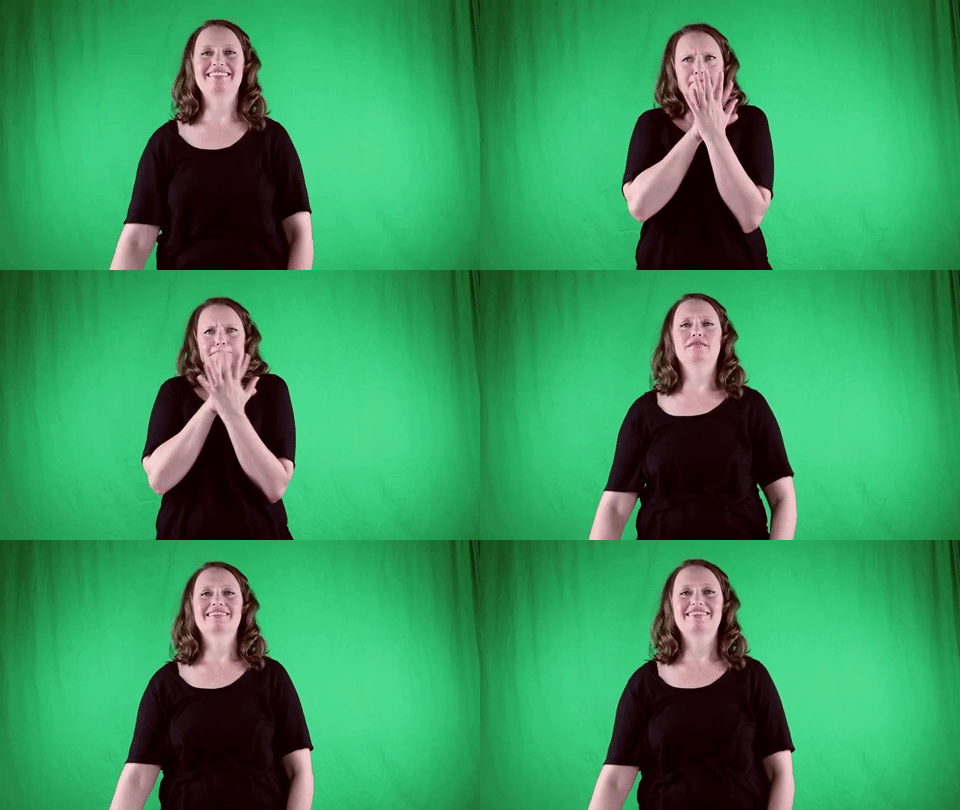
Sign for CROWDED in ASL | 👥 ASL Dictionary

Definition: Very crowded with people.

Sign for CROWDED in ASL

YouTube player

Practice Activities:

Begin by practicing the sign for CROWDED in ASL in isolation. Stand in front of a mirror and repeat the sign multiple times while focusing on your handshape, movement, and facial expression. CROWDED is a concept that often includes a facial expression that shows discomfort or tightness, so make sure your expression matches the idea of being tightly packed or overwhelmed.

Use flashcards with different locations or scenarios such as “bus”, “mall”, “school hallway”, and then pair them with the sign for CROWDED in ASL. For example, sign “SCHOOL HALLWAY CROWDED” while visualizing the crowd. Say or sign the full sentence out loud or in sign to help increase retention and fluency.

Create simple sentences to include the sign for CROWDED in ASL. Try: “MOVIE THEATER CROWDED”, “STORE CROWDED HOLIDAY”, or “SUBWAY MORNING CROWDED”. Practice signing them slowly and clearly, then increase your speed as you grow comfortable. Pay special attention to how your signing space fills slightly when you describe the crowded setting.

Use storytelling prompts to build context. Sign a short story like, “Yesterday I went to the concert, and it was very crowded. I couldn’t move at all.” Focus on transitions and how body shifts can help show the setting. Add signs describing feelings to deepen the meaning, such as “FRUSTRATE” or “TIRED”.

Partner up and do role-play scenes. One person explains a situation where they were uncomfortable in a crowd, and the other reacts or adds to the story. Include directional signs, describe movement through the crowd, and exaggerate expressions to show the crowded environment vividly.

Watch vlogs or videos in ASL and identify each time the sign for CROWDED in ASL appears. Pause and copy what you see. This reinforces natural usage and helps you see how the same sign can shift slightly depending on context.

Cultural Context:

In American Sign Language, understanding the cultural context behind signs can deepen your appreciation and fluency. The sign for CROWDED in ASL reflects shared experiences within the Deaf community about how physical and social environments are perceived. This sign captures more than just a packed space — it conveys the emotional feel of being surrounded, especially in large or busy gatherings.

When using the sign for CROWDED in ASL, the speaker may be talking about cramped areas like public transportation, packed events, or when too many people are in a room. Deaf culture places high value on visual space and body language. So, what might be a simple annoyance for hearing people can be extremely impactful for Deaf individuals who rely on visual communication.

Visual clarity is essential in Deaf culture. When spaces become too full, signing effectively becomes difficult. The sign for CROWDED in ASL doesn’t just describe physical fullness — it can also express frustration, limitation, or discomfort due to limited signing visibility. This emotional nuance is crucial for better interpreting and using the sign in everyday conversations.

In Deaf culture, personal space is important to allow clear visibility for communication. So, using the sign for CROWDED in ASL can suggest more than congestion. It can carry subtle cues about awkward social dynamics, environmental stress, and the inability to communicate clearly — all of which are taken very seriously in the ASL community.

During public events or in communal settings like DeafExpos or large Deaf social nights, conversations about how crowded it was are common. The sign for CROWDED in ASL often sparks shared understanding among community members. It can be used humorously to describe chaotic fun or more seriously to talk about accessibility challenges.

Deaf storytelling often involves rich visual elements and physical space. When narrating stories, the use of the sign for CROWDED in ASL can set a vivid scene, conveying how closely people were packed together and how it affected the interaction. ASL storytellers use their body to show spatial relationships, and mentioning a space being crowded enhances the descriptive quality of a story.

Respecting cultural context is key when learning ASL signs. The sign for CROWDED in ASL should not be reduced to a simple gesture — it’s interconnected with cultural, emotional, and visual experiences that are specific to the Deaf and signing communities. Understanding when and how to use it appropriately shows cultural competence as well as language skill.

Whether you’re learning online or engaging with the Deaf community, recognizing the significance of spatial tension or limited mobility

Extended Definition:

The sign for crowded in ASL conveys the concept of a tightly packed or overfilled space. It can describe anything from a busy room, a packed elevator, a bustling street, or even a crowded schedule. Understanding how to use this sign in context can help you express situations where space or capacity is limited due to the presence of too many people or objects.

To sign crowded in ASL, both hands are typically used. One common version involves cupping both hands and stacking them as if showing people close together, sometimes followed by a shaking movement to show tightness or limited space. Facial expressions play a crucial role in emphasizing how crowded the situation feels. A scrunched face or widened eyes can give more depth to the meaning.

The sign for crowded in ASL may vary slightly depending on regional differences or personal signing styles. However, the concept of overcrowding or packed spaces remains central no matter the variation used. Watching fluent Deaf signers or reliable ASL video dictionaries is helpful in getting the motion and expression just right.

When using the sign in a sentence, understanding the context is important. For example, you might sign crowded in ASL to describe a classroom full of students, a traffic jam, or a concert venue. This word fits comfortably into many daily scenarios where space is an issue or things feel too tight.

American Sign Language relies heavily on visual clarity, so the sign for crowded often includes directional or size-based modifications. Signing it near your body might suggest a personal or tight physical space, while signing it further out might refer to a larger area like a stadium or park. These subtle adjustments help the sign make more sense in your conversations.

You can combine the sign for crowded in ASL with related signs like “room,” “street,” “event,” or “schedule” to expand your vocabulary. For example, saying that your calendar is crowded suggests being overbooked and can be shown by using time-related signs along with the crowded motion. This lets you express complex ideas clearly using visual language.

It’s worth noting that some signers may use different signs or combine concepts depending on the level of crowdedness they want to express. With ASL being so rich and expressive, creativity in using signs is often encouraged among fluent users. Still, sticking to commonly understood signs like these is always a good idea for clarity.

Whether you’re a learner or an experienced signer, mastering the sign for crowded in ASL can improve how you communicate about space, time, and social environments. This

Synonyms: packed, congested, overfilled, jam-packed, crammed

Educational resources: Find related learning materials in our course bank!

Want more? Check out some of our popular learning activities on the homepage!

Need to look up a sign? Use our highly rated dictionary: https://aslinteractive.com/best-asl-dictionary/

Follow us on tiktok: https://www.tiktok.com/@aslinteractive. More social media links at the bottom of this page!

Long-tail Keywords: what is the sign for crowded in ASL, how do you sign crowded in ASL, ASL sign for crowded

Categories:

tags: Crowds, Events, Busy Places, People, Activities

Parameters

*Handshape*:

The handshape for the sign for CROWDED in ASL typically involves both hands using clawed “5” handshapes with fingers spread and curved slightly. These hands symbolize multiple people or objects tightly packed together.

In the sign for CROWDED in ASL, the fingers on each hand represent density or lack of space. The clawed handshapes press or overlap slightly to convey a compact or overloaded environment. This handshape helps show physical closeness or congestion.

*Palm Orientation*:

The palm orientation for the sign for CROWDED in ASL typically features both hands in a claw-like “5” handshape. The palms are facing each other horizontally, angled slightly downward, as if pressing inward toward an imaginary central point. This orientation enhances the visual representation of people or objects tightly packed together.

When signing the sign for CROWDED in ASL, the inward-facing palms help emphasize the sense of lack of space, often accompanied by a subtle squeezing or compressing motion. This orientation visually conveys the idea of a tightly packed or congested area. ‍ ‍

*Location*:

The sign for CROWDED in ASL is typically made in the neutral space in front of the torso, slightly below chest level. Both hands engage in the motion, and the location emphasizes the closeness of people or things. This space allows clear visibility while illustrating the concept of being packed or densely populated.

When explaining the sign for CROWDED in ASL, it is important to note that the hand movements representing compression or tightness occur outward from the center of the body. This reinforces the idea of limited personal or physical space, matching the meaning of the term.

*Movement*:

To show the sign for CROWDED in ASL, both hands form the curved “claw” handshape (fingers spread and bent slightly). The hands start apart at chest level then move toward each other in a zig-zag or bumpy motion, ending close together in the center. This dynamic conveys the idea of many things or people packed tightly into one area.

The movement of the hands in the sign for CROWDED in ASL should feel restricted and tight, reflecting limited space. Facial expression plays a key role—squeezed or compressed features help reinforce the concept visually. This sign effectively suggests a packed or congested environment ‍♀️ ‍♂️.

*Non-Manual Signals*:

Facial expressions play a key role in the sign for CROWDED in ASL. The eyebrows are often furrowed, and the eyes may squint slightly, showing discomfort or the sense of limited space. The mouth might be slightly pursed or exhibit a tense grimace to reflect how packed or tight the area feels.

This non-manual signal amplifies the meaning of the sign for CROWDED in ASL by displaying emotional and spatial tension. Paired with appropriate hand movements, these expressions enhance the visual representation of being in a densely populated or confined setting.

*Prosody, Dominant/Non-Dominant Hand*:

The sign for CROWDED in ASL uses both hands. The dominant hand typically forms a claw or bent-5 shape, and the non-dominant hand mirrors that shape. Starting slightly apart, both hands move together toward the center, overlapping or interlocking slightly as if indicating many people or things in a tight space.

Facial expression helps emphasize the meaning of the sign for CROWDED in ASL, often showing discomfort or pressure. The motion is contained, showing how space is filled to capacity.

Tips for Beginners:

When learning the sign for CROWDED in ASL, keep in mind that spatial awareness and hand movement are crucial. Typically, this sign involves both hands with fingers spread and moving slightly in a twisting or rotating motion toward each other, showing a tight or packed group. It’s important to not rush the movement—keep it deliberate and slightly compressed to show a feeling of being “jammed” or “squeezed in.”

For beginners, body posture adds a lot to the clarity of the sign. You may want to hunch your shoulders slightly or create a tense facial expression to support your meaning. The visual impact of your sign strengthens when facial expressions match the tone of the word, so don’t neglect your face—it tells just as much of the story as your hands! ‍

Avoid the common mistake of just randomly bringing your hands together. There should be a sense of tension and pressure as the hands move inward. Think of your hands representing groups of people or objects being forced into a small space. If your hands are too loose or the motion too soft, the sign loses meaning.

Practicing in front of a mirror can be especially helpful with the sign for CROWDED in ASL. This will let you observe the placement of your hands and check the symmetry of the movement. Repetition helps build muscle memory and ensure you’re signing in a fluid, confident way.

Lastly, watch Deaf signers use the sign for CROWDED in ASL in real conversations, either in person or through videos. Their natural flow, timing, and embellishments can give you a better sense of how the sign works in context. By immersing yourself in authentic examples, you’ll improve both comprehension and expressiveness.

Connections to Other topics:

The sign for CROWDED in ASL connects to spatial and environmental concepts such as FULL, BUSY, and OVERWHELMED. These signs rely on handshape, movement, and facial expressions to depict limited space or excessive presence of people or objects. When expressing crowded environments, classifiers (CLs) are often used to show where people or things are in relation to each other.

This sign can tie into discussions about personal space, such as how to describe a packed bus, an overbooked classroom, or a crowded amusement park. The sign is often used with directional indicators and location-specific vocabulary, which teaches learners to combine spatial reasoning with sign movement. In contexts like describing city life or holiday travel, the sign for CROWDED in ASL becomes part of broader storytelling.

The sign for BUSY is semantically related and often appears alongside crowded when conveying a hectic schedule or occupied space. Additionally, the signs for TRAFFIC, FULL, and PEOPLE combine to give nuanced descriptions, especially in conversations about urban experiences. These linked signs help learners build compound ideas like “the train was so crowded” or “the room filled up quickly.”

Facial expressions are significant when signing crowded. Intensity of emotion—frustration, discomfort, or amazement—is communicated via non-manual markers. This aligns the sign for CROWDED in ASL with broader emotional vocabulary and gives learners a reason to practice expressive signing .

In storytelling or ASL narratives, signs like GROUP, MANY, and PUSH might join crowded to convey a scene more vividly. This enriches a learner’s ability to talk about community gatherings, public events, or uncomfortable close contact in noisy environments. The sign for CROWDED in ASL builds an important bridge to discussing social dynamics, transitions between places, and describing atmosphere in more detail.

Summary:

The sign for CROWDED in ASL visually embodies the idea of limited space filled with people or objects. It uses a combination of handshapes and movements to represent tightness, congestion, or density. Typically, it’s shown using two curved 5-handshapes, palms facing each other, pushed together as if squeezing something between them.

This spatial compression in the sign communicates the feeling of a tight or jam-packed space. It reflects how ASL often mirrors real-world concepts through physical representation. The sign can suggest physical crowding, like in a subway or a concert, or abstract crowding, such as overwhelming thoughts or overbooked schedules.

The sign for CROWDED in ASL is typically directional and modifiable. You can slightly alter speed, facial expressions, and intensity to show different levels of crowding. For example, puffing your cheeks or squinting your eyes adds emphasis and emotion, indicating discomfort or even chaos.

Grammatically, the sign can function as an adjective or as a descriptor within a facial expression-driven sentence structure. ASL uses topic-comment structure, so often a signer may set up a location or situation first, then sign CROWDED to explain that context. Facial grammar plays a key role in clarifying exact meaning.

Another way to conceptualize the sign for CROWDED in ASL is through its relation to the broader category of spatial and density-related signs like FULL, PACKED, and BUSY. Each of these conveys different types of “filled” spaces but with varying implications. CROWDED typically focuses on human presence or close quarters among people.

The cultural significance of the sign lies in its ability to convey shared experiences within the Deaf community. Whether it’s crowded Deaf events, rallies, or simply navigating busy environments, the sign for CROWDED in ASL helps foster community storytelling. It helps depict common experiences in visual and emotive ways.

In terms of applied linguistics, the sign illustrates ASL’s capacity for visual metaphor. The movement and proximity of the hands in the sign metaphorically map the concept of overcrowding. This spatial mapping is a core feature of ASL’s visual-spatial modality.

Moreover, the sign exemplifies how ASL conveys non-linear, layered meaning. Where spoken English says “it was so crowded,” ASL might show the place, pause, then sign CROWDED with associated facial grammar. This creates a nuanced narrative structure that is both economical and expressive.

In bilingual environments, signers may code-switch between the sign for CROWDED in ASL and the fingerspelled English word—especially in academic or multilingual conversations. This reveals the syntactic flexibility and adaptability of ASL among speakers with varied linguistic backgrounds.

In conversations about social or political space, the sign can take on metaphorical weight. For example, describing a legislative session as CROWDED may refer not only to literal crowding but also to a metaphorical congestion of opinions or ego. The sign’s modulation and surrounding context decide this layering of meaning.

Facial expression is crucial to the comprehensibility of the sign. Frowning eyebrows or pursed lips express negative reactions to overcrowding. In contrast, a surprised expression might reflect astonishment at how full a place is, without implying displeasure.

The sign for CROWDED in ASL is especially useful in urban narratives. Many Deaf signers living in cities often recount hospital visits, public transit issues, or large Deaf community events—often starting with this sign to convey intense environments. It becomes a storytelling gateway.

You might also observe that regional variations exist. Some signers might use a slightly different handshape or movement speed influenced by local practices or family heritage. Despite this, the core visual metaphor of closeness and compression remains effective cross-regionally.

The sign can compound with others to create more specific meanings. For example, combining it with SCHOOL or ROOM can vividly express the idea of a crowded classroom. Spatial grammar allows these signs to be arranged to describe scene-based visual layouts.

In educational settings, teaching the sign for CROWDED in ASL often involves role-playing or dramatization. Students act out scenarios of crowds at malls, parks, or performances, using classifiers and visual space to amplify their storytelling. This reinforces language acquisition through embodied learning.

Digital communication among Deaf users often retains aspects of this sign visually in GIFs or video chats. People might send short video clips signing CROWDED when texting friends about a busy event, underscoring the expressivity of the language through technology.

The sign also provides a glimpse into how ASL handles abstract concepts. Not all signs are literal—crowded doesn’t mean you see people; it might just mean “too many” of something. The hallmark of ASL is its ability to depict that invisible sense of “too much” in a visual format.

Linguists studying ASL analyze signs like CROWDED to understand embodiment and cognition in language. How the face contributes to mood, or how space

Want more? Check out some of our popular learning activities!

ASL Interactive Resources

ASLInteractive YouTube Channel

Follow us on tiktok: @aslinteractive.com

Follow us on Instagram: aslinteractive

Facebook page: aslinteractive

Facebook group: aslinteractive

LInkedIn: ASL Interactive LLC

Twitter: @ASL_interactive

*Some information on this page is AI-generated. AI can make mistakes. Please check the information.

Sign for CROWDED in ASL

Responses