Sign for CURLY HAIR in ASL | 🌀 ASL Dictionary

Definition: Having curly hair.

Sign for CURLY HAIR in ASL

YouTube player

Practice Activities:

To begin practicing the sign for curly hair in ASL, start with signing in front of a mirror. Focus on handshape, movement, and facial expressions to make the sign visually clear. Repeat the sign several times while maintaining accurate circular hand motion around the head. Slowly increase speed while keeping the shape consistent.

Once you feel comfortable signing curly hair in ASL by itself, move on to simple descriptive sentences. Practice sentences like: MY SISTER HAVE CURLY HAIR or HIS CURLY HAIR VERY LONG. These help reinforce the sign in everyday descriptions and provide practice with sentence structure.

Try using the sign in storytelling scenarios. For example, tell a short story about a character with curly hair and how the hair plays a role in the tale. Use description signs along with curly hair, like COLOR, SHORT, or SOFT to enrich the narrative. You can also describe hairstyles, such as SOMEONE HAVE CURLY HAIR PONYTAIL or MY DOG CURLY HAIR ALL BODY.

Practice with a partner by playing a guessing game. One person signs a sentence using curly hair in ASL, and the other guesses who or what is being described. This activity promotes attention to details like descriptive classifiers and encourages interactive use of the sign.

As a fun solo activity, find photos of people with different hairstyles and describe them using the sign for curly hair in ASL and related vocabulary. This boosts vocabulary and enhances visual recognition paired with expressive signing.

Record yourself signing and watch the video to check accuracy. Pay attention to the circular movement pattern and whether the overall meaning feels clear. Repetition is key to building confidence. Practicing in various situations helps solidify both the form and natural integration of the sign in daily ASL use.

Cultural Context:

In American Sign Language, the sign for curly hair in ASL reflects more than just a physical description—it carries cultural significance within the Deaf community. Appearance-related signs like curly hair in ASL help Deaf individuals describe themselves and others with accuracy and personality, promoting identity and representation. Signing descriptions such as curly hair in ASL also encourages self-expression, allowing individuals to communicate features that are important to how they see themselves and how they wish to be seen.

The sign for curly hair in ASL may vary slightly depending on the regional dialect or the individual signer’s style. In the Deaf community, being able to sign details like curly hair in ASL is part of the natural way people share stories, describe friends, or explain visuals in everyday life. Descriptive signs are often influenced by the unique characteristics of the person being described, and mentioning curly hair in ASL could add depth to communication.

ASL is a visual and expressive language, and describing hair textures like curly hair in ASL often involves movements that mimic the shape or feel of curls. These signs are intuitive and can be modified to match different hair lengths or curl types. When someone uses the sign for curly hair in ASL, it shows a connection between language and physical reality that is deeply rooted in the way Deaf culture values accessibility and clarity.

Curly hair is a trait that appears in many cultures, and the ability to convey it through sign language emphasizes the inclusivity of ASL. Whether someone has loose waves or tight coils, signing curly hair in ASL ensures that everyone can communicate their physical identity fully and clearly. It also brings visibility to diverse hair textures, highlighting how ASL encompasses a wide spectrum of human experiences.

Cultural representation in language plays a big role in community bonding and self-esteem. Using the sign for curly hair in ASL empowers Deaf individuals to express personal details without limitation. Language is more than communication—it reflects and affirms individuality, and describing curly hair in ASL does just that by celebrating appearance diversity.

In social settings, schools, or storytelling, being able to mention curly hair in ASL contributes to fuller, richer dialogue. Children learning ASL from an early age benefit from being taught signs that reflect their appearance, including the sign for curly hair in ASL. This helps them connect with others and builds confidence through accurate self-description.

Hair is often linked to identity, heritage, and style, and the sign for curly hair in ASL supports that connection. It makes it easier to talk about topics

Extended Definition:

The sign for curly hair in ASL is a visually descriptive sign that mimics the shape and texture of curls using hand movements. This sign helps identify someone with natural curls, waves, or spirals in their hair. In American Sign Language, hair descriptions often involve shape, length, and texture, making this sign useful in detailed physical descriptions.

When signing curly hair in ASL, the dominant hand usually makes a circular or coiling motion, often starting from the top of the head and moving downward or outward. The motion and placement of the sign may vary slightly depending on the thickness or length of the curls being described. This kind of iconic representation in sign language helps convey the natural texture of curly hair very clearly and efficiently.

The sign for curly hair in ASL can also be adjusted to show different degrees of curliness. For tight curls or coils, the hand movement may be tighter and closer together. For looser waves or ringlets, the motion may be more open and extended. These small variations allow signers to give more specific and accurate visual information.

This sign is useful in everyday conversations, storytelling, or when giving a visual description of someone’s appearance. When you describe someone in ASL, you often begin with general features like gender and height, followed by more detailed attributes like hair type. That’s where the sign for curly hair in ASL becomes essential in painting a full picture.

If you’re describing yourself or someone else, the sign is usually paired with the sign for hair to give full context. For example, you might sign “my hair curly” to say “I have curly hair.” This structure is quite common in ASL and reflects the natural flow of how physical traits are described in the language.

Knowing the sign for curly hair in ASL can be especially helpful for teachers, interpreters, and students learning descriptive vocabulary. It’s one of the basic physical characteristic signs that comes up often in lessons and conversations. The sign also appears in ASL children’s books, classroom settings, and description-related discussions.

Online ASL dictionaries like ASLinteractive often include the sign for curly hair to help learners build a stronger vocabulary related to people and personal descriptions. This makes it easier for users to find and practice this sign in context. When users search for “sign for curly hair in ASL,” they’re often looking for video demonstrations, handshape guides, and examples of natural usage.

Understanding how to sign curly hair in ASL also promotes cultural awareness. Hair texture and

Synonyms: wavy hair, ringlet hair, kinky hair, coiled hair, spiraled hair

Educational resources: Find related learning materials in our course bank!

Want more? Check out some of our popular learning activities on the homepage!

Need to look up a sign? Use our highly rated dictionary: https://aslinteractive.com/best-asl-dictionary/

Follow us on tiktok: https://www.tiktok.com/@aslinteractive. More social media links at the bottom of this page!

Long-tail Keywords: what is the sign for curly hair in ASL, how do you sign curly hair in ASL, learn how to sign curly hair in American Sign Language

Categories:

tags: curly hair in American Sign Language, ASL sign for curly hair, how to sign curly hair in ASL, curly hair ASL translation, learn ASL curly hair

Parameters

*Handshape*:

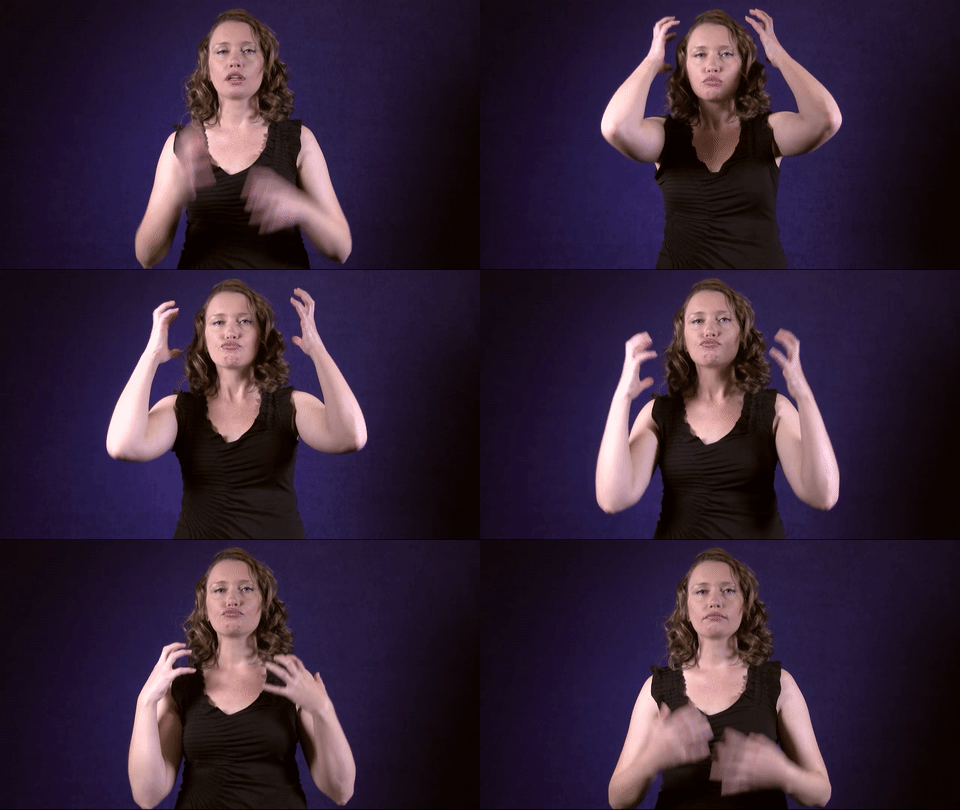
The handshape used in the sign for CURLY HAIR in ASL typically involves both hands using a loose claw or “C” handshape. Your fingers are spread slightly to mimic the shape and volume of curls.

This handshape smoothly moves downward in a bouncing motion, as if outlining the texture of curly hair. The sign for CURLY HAIR in ASL visually represents the spiraled, coiled look of tightly curled hair with the handshape playing a key role.

*Palm Orientation*:

For the sign for CURLY HAIR in ASL, the palm orientation typically faces inward toward the head. Both hands are often used, and the fingers open and close or move in a circular motion near the head, mimicking the shape or curl pattern of curly hair.

When forming the sign for CURLY HAIR in ASL, the palms remain semi-forward or inward throughout the movement. This palm orientation helps visually convey the texture and motion associated with curly hair, enhancing clarity for the viewer.

*Location*:

The sign for curly hair in ASL is performed in the area around the top or sides of the head, depending on hair length and curl type. This location represents where hair naturally grows, making it visually iconic and easy to associate with the concept of hair.

In the sign for curly hair in ASL, the hands often mimic the curling shape of hair strands. This visual action, near the scalp or temple area, helps convey the texture and form of curly hair effectively. ‍

*Movement*:

To show the sign for curly hair in ASL, form both hands into loose claw shapes. Begin near the top sides of your head and move the hands downward while making small, circular twisting motions to indicate ringlets or spirals, mimicking the texture of curly hair.

The movement should follow the natural path of where curly hair falls, and the curls can be exaggerated slightly to emphasize the curliness. The sign for curly hair in ASL visually captures the shape and texture of curly locks effectively.

*Non-Manual Signals*:

Facial expression should reflect a descriptive and slightly animated look, as if emphasizing the texture and shape of the curls. Raised eyebrows and a slight head tilt forward can help convey engagement or emphasis while signing.

When performing the sign for CURLY HAIR in ASL, the signer may subtly mimic the motion of curls with a light, playful expression . This adds visual interest and emphasizes the curly nature of hair being described. Eye gaze should be directed towards the curling motion or the apparent length of the hair.

*Prosody, Dominant/Non-Dominant Hand*:

The sign for CURLY HAIR in ASL uses both hands to mimic the texture and shape of curls. The dominant and non-dominant hands move in alternating small circular motions away from the scalp, representing the coiled pattern of curly hair.

In the sign for CURLY HAIR in ASL, the fingers are spread slightly, and the hands follow a downward path from the top of the head. This sign combines characteristics of hair with curly movement, offering a vivid visual cue for curly textures.

Tips for Beginners:

When learning the sign for CURLY HAIR in ASL, it’s important to practice the circular motion clearly and with purpose. This sign typically involves using your dominant hand to make a loose spiral or circular motion near the side of your head, mimicking the shape and texture of curls. The gesture represents how curly hair naturally loops or coils.

One helpful tip for mastering the sign for CURLY HAIR in ASL is to pay attention to the fluidity of the motion. Avoid making the circle sharp or too tight, as this can pull focus away from the natural quality of the curl you’re trying to express. Gentle, relaxed hand motion helps communicate your intention more authentically and clearly.

Facial expressions can enhance this sign greatly. If you’re referring to someone with very curly or long curly hair, a slightly exaggerated motion and expression can help. On the other hand, for shorter curls or waves, a shorter, more compact motion works best. Your non-dominant hand may also help frame the shape depending on the context, though this is optional.

Beginners often struggle by placing the circular motion either too far away from the head or making it too small to notice. Practicing in front of a mirror can help you gauge size, position, and clarity. Getting feedback from a fluent signer can also be beneficial to ensure you’re understood correctly.

Use the sign for CURLY HAIR in ASL in everyday conversation when describing yourself or others with this hair type. Repetition is key—include it in descriptions, storytelling, or casual dialogue to build confidence . As with many descriptive signs, adjusting the motion slightly based on what kind of curly hair you’re describing improves communication and shows cultural sensitivity within the deaf community.

CURLY HAIR in ASL, learning ASL hair signs, descriptive signs in American Sign Language, sign for curly hair texture, curly hairstyle ASL sign, ASL sign for hair types, visual description signs ASL

Connections to Other topics:

The sign for CURLY HAIR in ASL connects closely with visual description strategies used throughout the language. ASL relies heavily on classifiers and descriptive signs to convey physical traits, and curly hair is a prime example of how movement and handshape combine to show texture and form. The motion often mimics the spiral or coiled shape of curls, which also makes it relatable to signs like SPIRAL or CURL.

This sign fits into the broader topic of describing people using culturally appropriate and contextually sensitive features. In ASL conversations, when talking about someone’s appearance, signs like STRAIGHT HAIR, LONG HAIR, and BALD are often used in conjunction with the sign for CURLY HAIR in ASL to create an accurate and well-rounded description. These signs help establish identity and reference in narratives or social settings.

There are compound signs and descriptive classifiers that expand on the sign for CURLY HAIR in ASL. For example, combining it with signs for COLOR, such as BROWN or BLONDE, allows for richer detail. A signer might use a classifier indicating the length and let the hands move in a spiral motion to show long curly hair. This layering of signs is a hallmark of ASL’s visual and spatial grammar.

The sign is also taught alongside other grooming-related vocabulary, such as COMB, BRUSH-HAIR, or STYLE, especially in contexts discussing self-care routines. It links well with signs used in conversations about fashion and identity, where hair type may influence style choices or cultural expression. For young learners and those in beauty-related professions, understanding how to describe hair types correctly—including the sign for CURLY HAIR in ASL—is highly functional in daily conversation.

Summary:

The sign for CURLY HAIR in ASL emphasizes the unique texture and appearance of hair with curls or coils. This sign visually imitates the spiral, bouncy form of curly strands, offering a direct, illustrative gesture. The movement mirrors circular, coiling motions that reflect the natural shape of curly hair.

To produce the sign, use both hands with open, loose claw-like shapes. Begin near the scalp and make corkscrew or spiral motions outward, as if tracing curls falling from your head. These spiraling motions clearly depict individual curl formations.

The sign often starts with both hands placed near the temples or the top of the head. From there, the handshape and motion flow outward and downward, symbolizing the way curly hair typically grows or is perceived. The movement is fluid and expressive, offering a visual representation of hair with volume and texture.

The sign for CURLY HAIR in ASL is often dependent on context. For short curly hair, the size and trajectory of the spirals might be smaller and closer to the head. For longer or more voluminous curly hair, the spirals may be exaggerated, reaching down further to the shoulders.

There are subtle variations of the sign depending on hair type and personal style. For example, loose waves might be signed with broader, more fluid spirals, while tight coils may require small, quick corkscrew gestures. These distinctions help deliver more precise visual information.

Facial expressions play an essential role in the accuracy of the sign for CURLY HAIR in ASL. A signer may raise eyebrows and emphasize the curls with wide eyes to match the animated nature of particularly bouncy hair. More subdued expressions might accompany signs meant to describe looser or thinner curls.

The sign for CURLY HAIR in ASL is descriptive rather than lexicalized, meaning it belongs to a category of classifier-style expressions. It uses iconic representation rather than arbitrarily assigned forms, allowing for greater adaptability in communication. This showcases how ASL leans into imagistic and contextual description.

Classifier constructions in ASL are fundamental when describing physical characteristics. The sign for CURLY HAIR in ASL is an example of a descriptive classifier that conveys visual features of a person’s hair. Classifiers provide efficiency in expressing complex or visual concepts.

Cultural nuances are often embedded in how people use this sign. Within Deaf communities, hair — especially curly hair — may carry social or personal meanings, such as cultural identity or personal style. Describing one’s hair texture accurately can align with affirming cultural pride or representation.

Curly hair has different meanings across cultures, and the sign for CURLY HAIR in ASL allows Deaf users to participate in conversations involving racial or ethnic pride, fashion, and beauty. For example, Black Deaf individuals may use this sign in discussions around Afro-textured hair or natural hair movements. This creates a bridge between cultural identity and linguistic representation.

Linguistically, the sign draws from the visual strength of ASL to represent physical attributes. Unlike English adjectives, which rely on auditory descriptors, the sign for CURLY HAIR in ASL paints a picture of shape, movement, and placement. This demonstrates ASL’s spatial and kinetic strengths as a language.

The frequency of using this sign in everyday Deaf conversations can vary based on the importance of visual description. Because ASL prioritizes physical features, describing someone with curly hair may be more common and detailed than in spoken English. This enriches storytelling and identification of individuals.

In terms of applied linguistics, the sign for CURLY HAIR in ASL provides insight into how visual languages encode descriptive information. Its classification as an iconic, productive form shows that ASL permits a wide range of hair descriptions while maintaining cultural clarity and grammatical consistency. This supports the theory that sign languages are equally complex and adaptive.

Grammatically, the sign can function as an adjective within a sentence. For example, it often appears in noun-adjective order, as in: GIRL CURLY HAIR or SHE HAVE CURLY HAIR. This grammatical structure in ASL emphasizes the descriptive element after establishing the subject.

When used in casual or formal conversation, the sign for CURLY HAIR in ASL may also incorporate pointing or indexing to a person being discussed. This is part of the language’s use of spatial reference. Locating a person in “sign space” before or after showing their hair type provides a dynamic multidimensional narrative.

Related signs include those for STRAIGHT HAIR, SHORT HAIR, LONG HAIR, or WAVY HAIR. All of these signs use similar classifier handshapes and movements to signify different textures and lengths. This creates a whole lexicon around describing hair in the Deaf community.

The visual distinctions between signs for different hair types reflect broader themes of identity and inclusivity. The sign for CURLY HAIR in ASL allows people to celebrate their natural hair and connect through shared descriptors. It also provides a platform for conversations around diversity and representation.

Want more? Check out some of our popular learning activities!

ASL Interactive Resources

ASLInteractive YouTube Channel

Follow us on tiktok: @aslinteractive.com

Follow us on Instagram: aslinteractive

Facebook page: aslinteractive

Facebook group: aslinteractive

LInkedIn: ASL Interactive LLC

Twitter: @ASL_interactive

*Some information on this page is AI-generated. AI can make mistakes. Please check the information.

Sign for CURLY HAIR in ASL

Responses