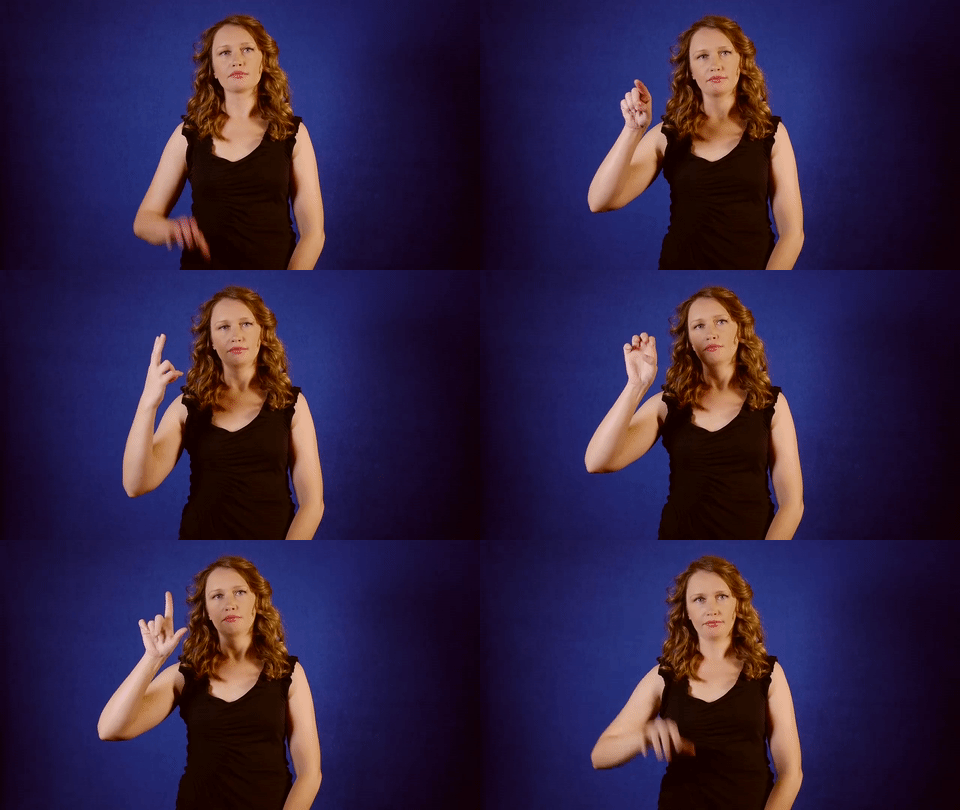
Definition: A country in Europe.
Sign for CZECH REPUBLIC in ASL

Practice Activities:
Begin by practicing the sign for CZECH REPUBLIC in ASL by standing in front of a mirror. Isolate the movement and handshape associated with the sign and repeat it slowly five times while watching your expression. Focus on consistent hand placement and smooth motion.
Next, incorporate this sign into basic sentences using proper ASL grammar. You can try short phrases such as “I VISIT CZECH REPUBLIC” or “CZECH REPUBLIC BEAUTIFUL COUNTRY.” Practice signing these sentences both slowly and then at a conversational pace. Record yourself and notice the clarity of the sign for CZECH REPUBLIC in ASL as you practice.
Work with a partner and ask simple questions like “YOU FROM CZECH REPUBLIC?” or “YOU VISIT CZECH REPUBLIC BEFORE?” Take turns responding with full ASL sentences. This not only helps reinforce the individual sign but also gives you practice using it in realistic dialogue.
Storytelling is a fun way to build fluency. Create a short story about an imaginary vacation to the Czech Republic. Include signs for travel, food, cities, and people. Use the sign for CZECH REPUBLIC in ASL multiple times to reinforce your memory of it within context.
Use flashcards with country names and play a timed matching game. When a country name appears, quickly sign it, including the sign for CZECH REPUBLIC in ASL when shown. If you’re working in a group or class, turn it into a race to encourage quick recall.
As an expressive practice task, describe the geography or culture of the Czech Republic using ASL. Try including details like weather, landmarks, and traditions, emphasizing when and how to use the sign for CZECH REPUBLIC in ASL clearly and smoothly.
Cultural Context:
Understanding the sign for CZECH REPUBLIC in ASL gives more than just a translation—it opens the door to cultural awareness and respectful communication. American Sign Language includes specific country signs that carry not just geographic meaning but also cultural nuance. Using the correct sign for CZECH REPUBLIC in ASL shows respect for the country’s identity and the Deaf community’s shared expressions.
The sign for CZECH REPUBLIC in ASL has evolved over time. Some older signs may no longer be widely accepted or could carry outdated or unintended connotations. That’s why it’s important to stay up to date with the most current and respectful version of the sign. Learning the correct sign for CZECH REPUBLIC in ASL honors both Deaf cultural standards and international understanding.
Cultural sensitivity plays a big role when using signs that reference other countries. The sign for CZECH REPUBLIC in ASL is uniquely tied to how the Deaf community in the U.S. perceives and references places around the world. It’s not a direct import from Czech Sign Language, which has its own signs and systems. So when using the ASL version, you’re engaging with a distinctly American Deaf perspective on the Czech Republic.
Flags, traditional clothing, landmarks like Prague Castle, and historical references often influence how a country’s name is expressed in sign language. The sign for CZECH REPUBLIC in ASL may reflect some of these visual or cultural points. This association makes the sign more meaningful and easier to remember. Understanding these influences enriches your knowledge of both languages and cultures.
Teaching the sign for CZECH REPUBLIC in ASL helps foster cross-cultural learning, especially in classrooms and global studies discussions. It can be part of a broader conversation about how signs for countries are developed, debated, and standardized in the Deaf community. Students benefit from exploring why certain signs are used and what they represent.
Travel and international communication are becoming more accessible for members of the Deaf community. Knowing signs like the one for CZECH REPUBLIC in ASL empowers Deaf individuals to discuss their own or others’ travel experiences more easily. It also enables smoother conversations when talking with interpreters, educators, or travel professionals.
Learning how to properly sign countries, including the sign for CZECH REPUBLIC in ASL, supports global accessibility. Accurate and respectful usage reduces the risk of miscommunication and fosters empathy between communities. As global awareness grows, so does the importance of accurate and culturally sensitive signs.
Diving into the sign for C
Extended Definition:
The sign for Czech Republic in ASL represents the country of the Czech Republic using hand movements that reflect elements of its geography or culture. This sign is commonly used in conversations about international travel, geography, or discussions related to European countries in educational and cultural settings. When learning American Sign Language, knowing how to express the names of different countries, like the Czech Republic, helps expand vocabulary and conversational skills.
To make the sign for Czech Republic in ASL, the dominant hand typically brushes across the face or uses a motion that references distinctive features associated with the country. Some variations may exist depending on the region or the signer’s background. This is common with country signs, as they may evolve or have localized differences based on usage and sign language communities.
The sign is primarily used in context when discussing topics such as European countries, world politics, travel destinations, or cultural history. For example, you might use this sign when saying that someone is from the Czech Republic or when referring to events taking place in the region. Students learning about European geography in ASL classes also use this sign to identify the country during lessons.
Understanding the sign for Czech Republic in ASL helps build deeper communication skills. It actively promotes awareness of global cultures within the deaf and hard-of-hearing community. Knowing country signs like this one allows users to participate in a broader range of conversations in both formal and informal settings.
Some users may spell out the country’s name using fingerspelling, especially if the sign isn’t widely recognized or if clarification is needed. However, most fluent signers prefer using established country-specific signs for smoother and faster communication. Still, fingerspelling Czech Republic is always a suitable alternative in professional or academic environments.
When learning the sign for Czech Republic in ASL, watching a video demonstration or practicing with a fluent signer is helpful. Using visual practice tools ensures accuracy in movement and meaning, while providing cultural context. Gesture clarity is important in country signs to prevent confusion with signs from neighboring nations.
In the deaf community, using proper signs for country names shows respect for cultural identity and individuality. Signing Czech Republic properly demonstrates linguistic awareness and helps foster inclusive environments. It emphasizes the importance of recognizing each nation as distinct in communication.
Whether you’re a beginner in ASL or advancing your international vocabulary, mastering the sign for Czech Republic in ASL adds value to your language knowledge. This sign also appears in topics related to European languages, international relations, and travel programs. It’s a useful addition for interpreters, educators, and AS
Synonyms: Czechia, Czech Republic, CZ, the Czech lands, Bohemia
Educational resources: Find related learning materials in our course bank!
Want more? Check out some of our popular learning activities on the homepage!
Need to look up a sign? Use our highly rated dictionary: https://aslinteractive.com/best-asl-dictionary/
Follow us on tiktok: https://www.tiktok.com/@aslinteractive. More social media links at the bottom of this page!
Long-tail Keywords: what is the ASL sign for Czech Republic, how do you sign Czech Republic in American Sign Language, what’s the correct way to sign Czech Republic in ASL
Categories:
tags: Czech Republic, countries, languages, language learning, Europe
Parameters
*Handshape*:
The handshape for the sign for CZECH REPUBLIC in ASL typically involves an open flat hand, also known as the “B” handshape. The fingers are close together and extended, with the thumb crossed slightly in front or touching the side of the palm.
This handshape is used in a gentle upward motion across the chin area to indicate the sign for CZECH REPUBLIC in ASL . This culturally respectful sign reflects traditional elements and ensures clarity when signing CZECH REPUBLIC in ASL.
*Palm Orientation*:
The palm orientation for the sign for CZECH REPUBLIC in ASL involves the dominant hand with an open palm facing inward toward the face. The fingertips lightly tap the area above the upper lip or the mustache area, resembling traditional facial hair associated with Czech cultural representation.
Throughout the sign for CZECH REPUBLIC in ASL, the hand maintains a relaxed position, with the palm consistently oriented toward the signer. This orientation helps clearly distinguish it from similar signs and maintains cultural authenticity .
*Location*:
The sign for CZECH REPUBLIC in ASL is made at the face, specifically at or just above the upper lip area. The dominant hand performs a flat-B handshape and lightly brushes across the upper lip in a gentle forward motion.
This location at the face helps highlight national or cultural connections, which is typical for many country name signs. When using the sign for CZECH REPUBLIC in ASL, be sure the movement remains centered on the face for clarity and proper context.
*Movement*:
To perform the sign for CZECH REPUBLIC in ASL, use your dominant hand with fingers extended and held together. Begin by placing the fingertips at the base of your chin, then gently arc the hand outward and slightly downward away from the face in a small, smooth motion.
This gesture mimics a respectful gesture seen in some Eastern European cultures. The sign for CZECH REPUBLIC in ASL captures cultural context through facial and hand movement.
*Non-Manual Signals*:
When producing the sign for CZECH REPUBLIC in ASL, maintain a neutral facial expression unless emphasizing context requires added emotion. Slight eyebrow raise may be used if asking a question like, “Do you know the sign for CZECH REPUBLIC in ASL?”
Head remains steady or with a small forward tilt during articulation. Eye gaze should remain direct, showing attention and clarity while signing the sign for CZECH REPUBLIC in ASL.
*Prosody, Dominant/Non-Dominant Hand*:
To produce the sign for CZECH REPUBLIC in ASL, use your dominant hand in a flat “B” handshape. Place the fingertips just under your chin, with your palm facing down, and then move the hand outward slightly away from the chin. The non-dominant hand remains neutral at your side. This motion mimics a gesture that reflects cultural associations.
The sign for CZECH REPUBLIC in ASL uses clear, central facial placement, emphasizing specificity. Make sure to maintain a neutral facial expression or adopt one that matches the context in which you’re referencing the country .
Tips for Beginners:
When learning the sign for CZECH REPUBLIC in ASL, it’s important to focus on hand placement and orientation. The sign typically involves using the dominant hand in a flat “B” shape tapped lightly on the chin. Make sure your fingers are together and your palm faces downward as your hand makes contact with the lower part of your face.
Beginners often struggle with the motion being too forceful or missing the correct location. Practice in the mirror to spot whether you’re hitting the chin accurately and gently. Keeping a relaxed wrist and fingers will help your sign look more natural and fluid.
A common mistake is confusing this sign with others that involve the chin area, such as the sign for CZECH or individual European countries. Be mindful of the distinction between signs to avoid miscommunication. Consistency is key—use the same handshape and motion each time until it becomes muscle memory.
If you’re in a setting where you’re unsure whether someone will recognize the sign for CZECH REPUBLIC in ASL, fingerspelling can be a backup option. This is especially useful when working with people who may use regional variations. Practice fingerspelling the full name clearly and at an even pace—speed will come with repetition.
Don’t forget to support the sign with appropriate facial expressions, especially when identifying the country in the context of a conversation. Expression adds clarity and depth, and it’s a huge part of effective ASL communication.
To master the sign for CZECH REPUBLIC in ASL, use video resources or native signers as models. Sign along with them to get a feel for the rhythm and pacing. With consistent, mindful practice, you’ll gain confidence in using the sign both conversationally and contextually. Keep signing and stay patient with yourself! ✋
sign for CZECH REPUBLIC in ASL, czech republic sign ASL, how to sign czech republic in ASL, ASL country signs europe, learn sign for czech republic
Connections to Other topics:
The sign for CZECH REPUBLIC in ASL connects to broader topics around geography, nationality, and cultural identity. In many cases, countries and nationalities in ASL are either fingerspelled or represented by unique signs, especially when the country has distinct cultural or historical significance. Understanding how to differentiate between a country and its people or language—like Czech (person) or Czech (language)—helps learners build a more detailed cultural lexicon in ASL.
This sign also relates to how ASL users denote Europe, Eastern Europe, and Slavic countries collectively. Learners familiar with the sign for EUROPE can connect these regional classifications while learning to incorporate facial expressions for context. The sign for CZECH REPUBLIC in ASL may be articulated with a flat hand brushing the chin or may be fingerspelled, depending on the community or interpreter’s preference, demonstrating how variations often exist based on regions or interpreter conventions.
In compound phrase construction, the sign is often paired with others to express more complex ideas. For example, adding the sign for COUNTRY or GOVERNMENT after CZECH REPUBLIC clarifies political discussions, while pairing it with HISTORY or LANGUAGE can adapt the context toward cultural studies, such as “Czech Republic history” or “Czech Republic language.” These compound uses help learners see how individual signs combine to form nuanced and meaningful expressions.
The sign for CZECH REPUBLIC in ASL also connects to discussions of travel, international relations, and historical events. For instance, when talking about European Union membership, war history, or tourism, this sign becomes part of longer narratives in ASL storytelling. It is equally relevant when discussing ancestry or heritage, especially for Deaf individuals who identify with Czech roots . Understanding its context-dependent usage reinforces fluency in describing cultures and global identities.
Summary:
The sign for CZECH REPUBLIC in ASL is a culturally significant expression that typically uses location and contact with the face to point to the country’s distinct identity. The most accepted way to sign CZECH REPUBLIC involves brushing the tips of the fingers (in a flat B-handshape) from the bottom of the chin outward. This conveys the idea of originating from the chin or mouth area, symbolizing cultural and spoken richness.
This sign mirrors how other countries in Central Europe are signed—often involving the face or upper body—providing a visual-linguistic anchor to that region. Unlike the sign for GERMANY or POLAND, which use single, distinct gestures, the sign for CZECH REPUBLIC is often seen as softer and more graceful in motion. This reflects not only the aesthetic sensibilities often ascribed to Czech culture but also reveals ASL’s capacity to encode subtle cultural impressions.
Grammatically, when using the sign for CZECH REPUBLIC in ASL within a sentence, it functions as a proper noun. As with most country names, it typically appears before a verb or adjective describing actions or qualities related to the place. You might sign CZECH REPUBLIC followed by VISIT, LIVE, or LANGUAGE depending on the context.
In more formal or educational signing, you may see people fingerspell C-Z-E-C-H followed by REPUBLIC or simply use the sign and then explain further. Context and familiarity of the conversation topic usually determine whether the full name needs to be fingerspelled. Regional variations within the Deaf community may further influence how frequently the straightforward sign is used versus the fingerspelled form.
Some people may still use signs based on older terminology like CZECHOSLOVAKIA, but this is generally discouraged unless discussing historical contexts. Prior to the 1993 split into the Czech Republic and Slovakia, there was less distinction needed. Now, accuracy matters in maintaining geopolitical differentiation within international conversation and storytelling.
The sign for CZECH REPUBLIC in ASL is related to signs like EUROPE, PRAGUE, and LANGUAGE when discussing topics in a broader geographical or cultural context. Natural flow can be seen when transitioning from CZECH REPUBLIC to signs like EUROPE or HISTORY, making the discourse resonate with visual cohesion. This richer narrative possibility is one of ASL’s strengths—creating smooth transitions across ideas within a spatial and embodied linguistic context.
In linguistic terms, the choice to sign from the chin outward aligns with the conceptual mapping found in other face-based signs. ASL frequently taps into the face as a source of ideas, identity, and communication—neatly aligning with how spoken language originates from the mouth. This metaphorical layering enhances the communicative depth of the sign for CZECH REPUBLIC in ASL.
Applied linguistics shows that people learning ASL as a second language often find such facial or body-based signs easier to remember. This is because the visual-spatial system tightly connects with the sign’s meaning. Kinesthetic motion combined with facial location creates muscle memory that anchors the lexical item more strongly in the learner’s mental lexicon.
The sign also plays a role in cross-cultural dialogue. In international sign language spaces, variations or simplifications might be used, but the core notion of representing a people through a culturally resonant gesture remains key. Representation in signing communities supports inclusivity and sociopolitical recognition, reinforcing individual and collective identity.
Understanding the sign for CZECH REPUBLIC in ASL also helps Deaf travelers, educators, and students to engage in international conversation with both clarity and respect. Just like spoken language learners memorize country names, ASL users must learn not only how to produce these signs but how to use them in context. Having a rounded understanding enhances articulation and clarity in diverse social settings.
From a cultural perspective, signs for specific countries often embody respect and recognition. The sign for CZECH REPUBLIC carries more than just geographic information—it signals awareness of a distinct national identity, heritage, and presence within global stories. Signs like these contribute to shaping how the Deaf community discusses international relations and cultures.
ASL signs tied to ethnicity or nationality also raise awareness about socio-political nuances. They can reflect how Deaf communities engage with issues like immigration, diplomacy, and diversity. When someone signs CZECH REPUBLIC in ASL, they’re not only referring to a place but invoking a body of history and cultural touchpoints.
In educational settings, the sign for CZECH REPUBLIC in ASL helps provide visual access to geography lessons, documentaries, and current events. Teachers adept in ASL can enrich curriculum content by including signs for various countries and linking them with key concepts. This accessibility removes linguistic barriers and fosters inclusion for Deaf and hard-of-hearing students.
Use of this sign can also link to signs for people from this region, such as CZECH (as an adjective or referring to the language). These variations maintain consistency in regional representation in ASL. Ad
Want more? Check out some of our popular learning activities!
ASL Interactive Resources
ASLInteractive YouTube Channel
Follow us on tiktok: @aslinteractive.com
Follow us on Instagram: aslinteractive
Facebook page: aslinteractive
Facebook group: aslinteractive
LInkedIn: ASL Interactive LLC
Twitter: @ASL_interactive
*Some information on this page is AI-generated. AI can make mistakes. Please check the information.


Responses