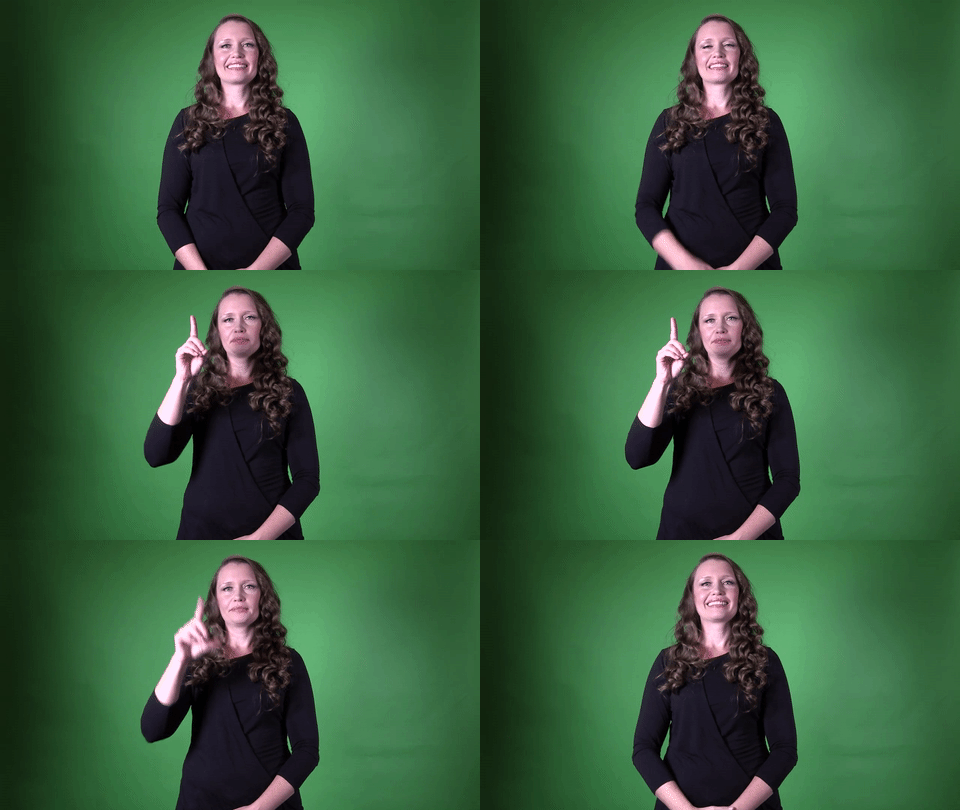
Sign for D in ASL | 🔡 ASL Dictionary

Definition: The fourth letter of the alphabet.

Sign for D in ASL

YouTube player

Practice Activities:

To practice the sign for D in ASL, start by forming the handshape repeatedly in front of a mirror. Make sure the index finger is pointing up while the thumb touches the tip of the middle finger, forming a circular shape with the rest of the fingers curled down. Check for accuracy and correct any finger positioning as needed.

Say the letter out loud as you form it to reinforce the association between the handshape and sound. Try spelling out simple words that begin with the letter D, like “dog,” “dad,” or “duck.” Doing so will help connect the sign for D in ASL to broader language use. You can also practice fingerspelling the alphabet, placing extra emphasis when arriving at D.

Work with a partner and take turns fingerspelling words. Your partner can try identifying each letter you sign, especially focusing when you use the sign for D. Switch roles for more practice with both receptive and expressive skills. Add time challenges to make the activity more interactive.

Create a short sentence in ASL that incorporates a name or word starting with D. For example: “My dad is funny” or “Do you like dogs?” Then sign those sentences, focusing on accurate letter formation for D during fingerspelling. This helps improve fluency when transitioning between signs and letters.

Consider a storytelling prompt involving a character whose name starts with D, such as Daniel or Daisy. Fingerspell the name at the beginning of the story, using the sign for D in ASL clearly and properly. Reusing the name throughout the story reinforces the handshape and its motion in contextual use.

Record yourself signing the alphabet backward and forward, clearly showing the sign for D in ASL each time. Rewatch videos to catch any errors and to track improvement.

Cultural Context:

The sign for D in ASL is more than just a simple letter in the American Sign Language alphabet. Like all letters in ASL fingerspelling, this handshape carries cultural and historical meaning within the Deaf community. It demonstrates the visual and spatial nature of ASL and showcases how manual alphabets are used for names, brands, and words that do not have a specific sign.

When someone learns the sign for D in ASL, they are also connecting with a long-standing linguistic tradition. The ASL alphabet developed from French Sign Language and has evolved with Deaf culture in North America. Each letter, including the sign for D in ASL, is a bridge between Deaf and hearing communities when clear communication is necessary.

Using fingerspelling, including the sign for D in ASL, is common in Deaf education and daily conversation. For many Deaf individuals, fingerspelling adds clarity when introducing themselves or referencing specific people or places. It is especially useful when signing proper nouns or technical terms that don’t yet have a conventional sign.

The ASL alphabet, where the sign for D in ASL belongs, is often one of the first things new learners are taught. It reinforces the idea that ASL is a complete language with its structure and grammar. The use of the manual alphabet fosters early comprehension and fluency, helping signers grow in confidence and skill.

In Deaf culture, knowing how to use each handshape, including the sign for D in ASL, demonstrates respect and awareness. It signals openness to the values and norms of the community, where visual learning is at the forefront. Taking time to practice accurate hand positioning is a form of cultural appreciation.

Being able to fluently use the sign for D in ASL can help learners fingerspell names clearly during introductions. It ensures the conversation flows smoothly, especially between Deaf and hearing individuals when clarity is key. It helps build social bridges and creates more inclusive communication settings.

Deaf individuals often rely on fingerspelling, including the use of signs like the sign for D in ASL, to work around limited vocabulary or when encountering regional sign differences. It allows for improvisation and adaptation, both of which are pillars of Deaf cultural identity. This flexible language tool is deeply embedded in daily interactions.

ASL learners are encouraged to watch native signers use handshapes like the sign for D in ASL in real-life conversations. Exposure to authentic use reinforces correct form and helps internalize cultural cues related to timing, facial expressions, and context

Extended Definition:

The sign for D in ASL is part of the American Sign Language alphabet, also known as the manual alphabet. This system allows users to spell out words and names by forming letters with their hands. Understanding the correct way to make the sign for D is essential for fingerspelling and communication in ASL.

To form the sign for D in ASL, hold up your dominant hand with your palm facing outward. Curl all the fingers down except for the index finger, which points straight up. Touch your thumb to the tip of your middle finger while keeping the other fingers gently curled. This creates a shape like the lowercase letter D.

People often learn the sign for D early on when studying the ASL alphabet. It’s a foundational sign that supports many aspects of language development, especially when spelling names, places, and unfamiliar words. Mastery of the sign for D will enhance your ability to fingerspell clearly and be understood.

Fingerspelling is commonly used in ASL to spell out words that don’t have established signs. This could include names of people, cities, or unique concepts. Knowing how to express each letter, such as forming the sign for D in ASL accurately, is critical for fluency in these situations.

In terms of visual recognition, the sign for D stands out because the index finger is upright with the thumb touching the middle finger. This makes it visually distinct compared to other ASL alphabet signs. Becoming familiar with this shape will help both in signing and understanding others.

You can practice the sign for D in front of a mirror or by watching videos of fluent signers. Consistent practice will build your comfort and speed in fingerspelling. Try integrating this sign into everyday communication or spelling exercises.

For teachers and parents introducing ASL to children, demonstrating the sign for D can be a fun and educational moment. Use flashcards, handouts, and interactive games to make learning the ASL alphabet enjoyable. Repetition and visual support are key to helping the sign for D become second nature.

The sign for D in ASL is also an important letter when forming acronyms or abbreviations. Whether you’re spelling out school subjects like “PE” or organizations like “ADA”, being able to correctly show the sign for D is essential. It makes any fingerspelled word accurate and meaningful.

ASL learners may confuse the handshapes for D with similar letters like F or L, but paying attention to finger placement will help prevent mistakes. Focus on where your thumb

Synonyms: Understood! Please provide the first word you want synonyms for.

Educational resources: Find related learning materials in our course bank!

Want more? Check out some of our popular learning activities on the homepage!

Need to look up a sign? Use our highly rated dictionary: https://aslinteractive.com/best-asl-dictionary/

Follow us on tiktok: https://www.tiktok.com/@aslinteractive. More social media links at the bottom of this page!

Long-tail Keywords: what is the ASL sign for D, how to sign D in American Sign Language, how do you sign letter D in ASL

Categories:

tags: Letters A-Z, Fingerspelling, Language Learning, Basic Grammar, Sign Parameters

Parameters

*Handshape*:

The handshape for the sign for D in ASL involves holding the dominant hand with the index finger extended straight upward while the thumb touches the middle finger, which is curved down. The ring and pinky fingers are also curved down, creating an open circular formation with the fingers and thumb.

To form the sign for D in ASL correctly, the palm faces forward, and the shape roughly resembles the printed letter D. This handshape is part of the ASL manual alphabet and is commonly used when fingerspelling names or unfamiliar terms. ✋

*Palm Orientation*:

The palm orientation for the sign for D in ASL is upright and facing forward, outward from your body. Your palm remains perpendicular to the ground, with the tip of your index finger pointing straight up and your other fingers touching the tip of the thumb to form an “O” shape below the extended finger.

When demonstrating the sign for D in ASL, be sure the hand remains in a stationary, open orientation. The front-facing palm helps make the letter clearly visible to the viewer.

*Location*:

The sign for D in ASL takes place in the neutral space in front of the upper chest or shoulder area. The hand remains steady about six to eight inches from the torso, allowing clear visibility of the finger position that forms the letter D.

This positioning is consistent with most of the ASL alphabet, keeping the hand within a comfortable and easily readable range. The sign for D in ASL maintains this placement to ensure clarity and ease of understanding during fingerspelling.

*Movement*:

To form the sign for D in ASL, begin with your dominant hand held upright. Curl your four fingers down so they touch your thumb, but leave your index finger pointing straight up. The overall handshape resembles a printed capital “D.” ️

There is no directional movement for the sign for D in ASL. The hand remains in a fixed position, typically raised in front of the shoulder or slightly off to the side for clarity.

*Non-Manual Signals*:

When demonstrating the sign for D in ASL, maintain a neutral or attentive facial expression. Your eyes should follow your dominant hand to show engagement, especially if teaching or emphasizing the handshape. Slight eyebrow raise is appropriate if the sign for D in ASL is used in a question or when clarifying. Avoid exaggerating expressions since this particular sign represents a single letter and doesn’t require emotional emphasis.

*Prosody, Dominant/Non-Dominant Hand*:

The sign for D in ASL uses the dominant hand. Form your hand into the shape of the English letter D: hold up your index finger while the thumb touches the middle finger, creating a circular shape. The remaining fingers are curled down to the palm.

The non-dominant hand is not used while making the sign for D in ASL. This handshape is part of the ASL alphabet and used in names and fingerspelling. ✋

Tips for Beginners:

When learning the sign for D in ASL, start by focusing on the correct handshape. The sign involves forming the hand into a shape similar to the printed letter ‘D.’ Your index finger should point straight up while the tip of your thumb touches the tip of your middle finger, forming a circle. Keep the remaining fingers curled down toward your palm. This will help ensure your sign stays neat and visually clear.

One common mistake beginners make with the sign for D in ASL is letting the other fingers flare out or keeping them extended, which can cause it to resemble other letter signs like F or L. Double-check your hand positioning in a mirror, especially in the beginning stages, to make sure you’re consistently using the correct form. Frequent, short practice sessions can help your muscle memory develop quickly and naturally.

Maintain good finger tension to keep the shape precise. If your fingers are too relaxed, your D can look sloppy or unclear. Pay attention to hand orientation as well—the palm should face forward so the receiving viewer can see the shape of the D clearly. This is critical when fingerspelling in conversations to avoid confusion.

Use your non-dominant hand to support practice by mirroring signs or using it as a reference. It helps reinforce learning and isolate finger movements. Some learners benefit from practicing the sign for D in ASL alongside adjacent letters like C and E to improve fluidity in fingerspelling.

Remember, signing accurately is more important than signing quickly. Slow, careful repetition builds accuracy, which will eventually lead to speed. The sign for D in ASL may seem simple, but perfecting it builds a solid foundation for learning the full ASL alphabet and effective communication.

sign for D in asl, sign language D, fingerspell D, how to make D in ASL, letter D in american sign language

Connections to Other topics:

The sign for D in ASL is part of the one-handed manual alphabet used for fingerspelling. It directly relates to literacy, spelling names, and expressing specific terms that don’t have assigned signs. Understanding individual letters like the sign for D in ASL is essential for spelling words like (FS)DOG, (FS)DAN, or acronyms such as (FS)DNA.

In conversational ASL, the sign for D in ASL often appears in initialized signs, where the handshape D modifies or clarifies the meaning of the base sign. For example, in older ASL versions, (FS)DEAF might use a D-hand near the ear and mouth. Although modern ASL has moved away from many initialized signs in favor of more conceptually accurate ones, recognizing the use of letter-based signs still aids in comprehension during fingerspelling-heavy exchanges.

This sign is also useful in understanding movement and orientation of fingers in space. Since the sign for D in ASL uses a round shape formed by the index finger extended upward and the thumb touching the middle finger—while the other fingers stay curled—it helps learners identify similar structures in signs like (FS)DO or (FS)DOOR, both of which may carry linguistic echoes in handshape or palm orientation.

Learning the sign for D in ASL connects directly with learning common suffixes or abbreviations that rely on fingerspelling, such as (FS)DR. for doctor or (FS)DDS for dentist. These abbreviations rely on clear, quick identification of letters, making automatic recall of individual letter signs a key skill.

Finally, the ability to recognize and produce the sign for D in ASL with fluency supports conversational use of classifier handshapes. Some classifiers use the D-handshape to represent thin or flat upright objects, such as a pen or post. This bridges the gap between spelling and classifiers, helping learners understand how individual handshapes function beyond the alphabet .

Summary:

The sign for D in ASL is part of the American Sign Language alphabet, which plays a key role in fingerspelling. This handshape is vital for spelling proper nouns, specific vocabulary, and unfamiliar words, especially in educational or formal contexts. The ASL alphabet acts as a bridge between signed communication and written English.

To create the handshape for the sign for D in ASL, hold your dominant hand up, forming a circle or oval between your thumb and middle, ring, and pinky fingers, while the index finger points straight up. The fingers resemble a printed, capital letter D. Keep your palm facing forward, parallel to your chest.

This sign is static and does not require movement. Proper positioning is critical for clarity, especially when spelling multiple letters in succession. Precision in the handshape ensures clear understanding by other ASL users.

The sign for D in ASL is one of the easiest to confuse with other manual alphabet signs, such as F or the number 1, due to its vertical index finger. However, visual context and fluidity in fingerspelling help distinguish these signs during conversation. Fluent signers recognize subtle handshape distinctions naturally.

Fingerspelling using the sign for D in ASL proves effective in spelling names like David, Dakota, or Denise. It’s commonly used alongside other letters to introduce oneself, fingerspell medical or technical terms, or specify uncommon vocabulary. This reinforces both comprehension and literacy among users.

When it comes to early ASL education, the sign for D in ASL aids children and adults alike in learning the manual alphabet. Educators often begin with these foundational signs during language acquisition. Games, flashcards, and repetition help reinforce recognition.

The use of the sign for D in ASL supports Deaf culture’s value on clear, articulate communication. It provides access to names and concepts that lack standard signs. It’s especially meaningful when showing respect for someone’s name or identity through fingerspelling.

In a linguistic context, the sign for D in ASL is classified as a single-handed, static manual alphabet character. From a phonological perspective, it belongs to the handshape category in ASL phonology. These elements are part of the five parameters: handshape, location, movement, palm orientation, and facial expression.

Applied linguistics explores the role of fingerspelling and the sign for D in ASL as a tool to bridge signing and English literacy. Research shows that children exposed to ASL and fingerspelling early on tend to develop better reading and spelling skills. The sign contributes to metalinguistic awareness.

In conversational ASL, signs like D are indispensable in forming abbreviations and acronyms. For example, DVD or FDA are often fingerspelled letter by letter. This keeps up with modern vocabulary without diluting traditional ASL structure.

The sign for D in ASL, while simple, must be learned as part of the broader conceptual framework of the fingerspelling system. It supports lexical borrowing, where English words enter ASL usage through spelling. This dynamic helps the language grow and evolve.

The handshape used in the sign for D in ASL is unique because it represents not only a letter but also participates in other signs. For example, the D handshape is used in signs such as DIVORCE or DOG (in some regions), depending on the dialect. This shows how letter handshapes are adapted.

Cultural significance also surrounds the sign for D in ASL when it is used in initials, such as those in name signs. Some individuals, especially in Deaf schools, receive name signs starting with D. These are personalized through combinations of the letter and a visual trait.

In storytelling or poetry within ASL, the D handshape offers creative flexibility. Performers may shape narratives around signs that use D for linguistic or visual effect. This adds richness and versatility to signed expression.

Fingerspelled signs using the sign for D in ASL can vary slightly by dialect or regional variation. Some signers might use looser or tighter handshapes depending on personal style or speed. However, clarity usually remains intact through shared context.

From a pedagogical standpoint, the sign for D in ASL is taught alongside other letters but often emphasized for its clarity and risk of being misunderstood. It serves as a model for handshape discipline and fine motor control, key aspects of sign language fluency.

Parents of Deaf children are encouraged to use the ASL alphabet, including the sign for D in ASL, regularly at home. This supports language development and provides children with the tools to engage fully with their community. Fingerspelling also fosters spelling awareness in written English.

For hearing allies or interpreters, mastering the sign for D in ASL and other fingerspelling signs is essential for clear and equitable communication. These signs form a fundamental layer of expressive ability, necessary for certifications and professional use.

Fingerspelling is often used to show emphasis or mark discursive boundaries. For example,

Want more? Check out some of our popular learning activities!

ASL Interactive Resources

ASLInteractive YouTube Channel

Follow us on tiktok: @aslinteractive.com

Follow us on Instagram: aslinteractive

Facebook page: aslinteractive

Facebook group: aslinteractive

LInkedIn: ASL Interactive LLC

Twitter: @ASL_interactive

*Some information on this page is AI-generated. AI can make mistakes. Please check the information.

fingerspelled letter D | ASL dictionary, Sign for D in ASL
Dd, Sign for D in ASL

Responses