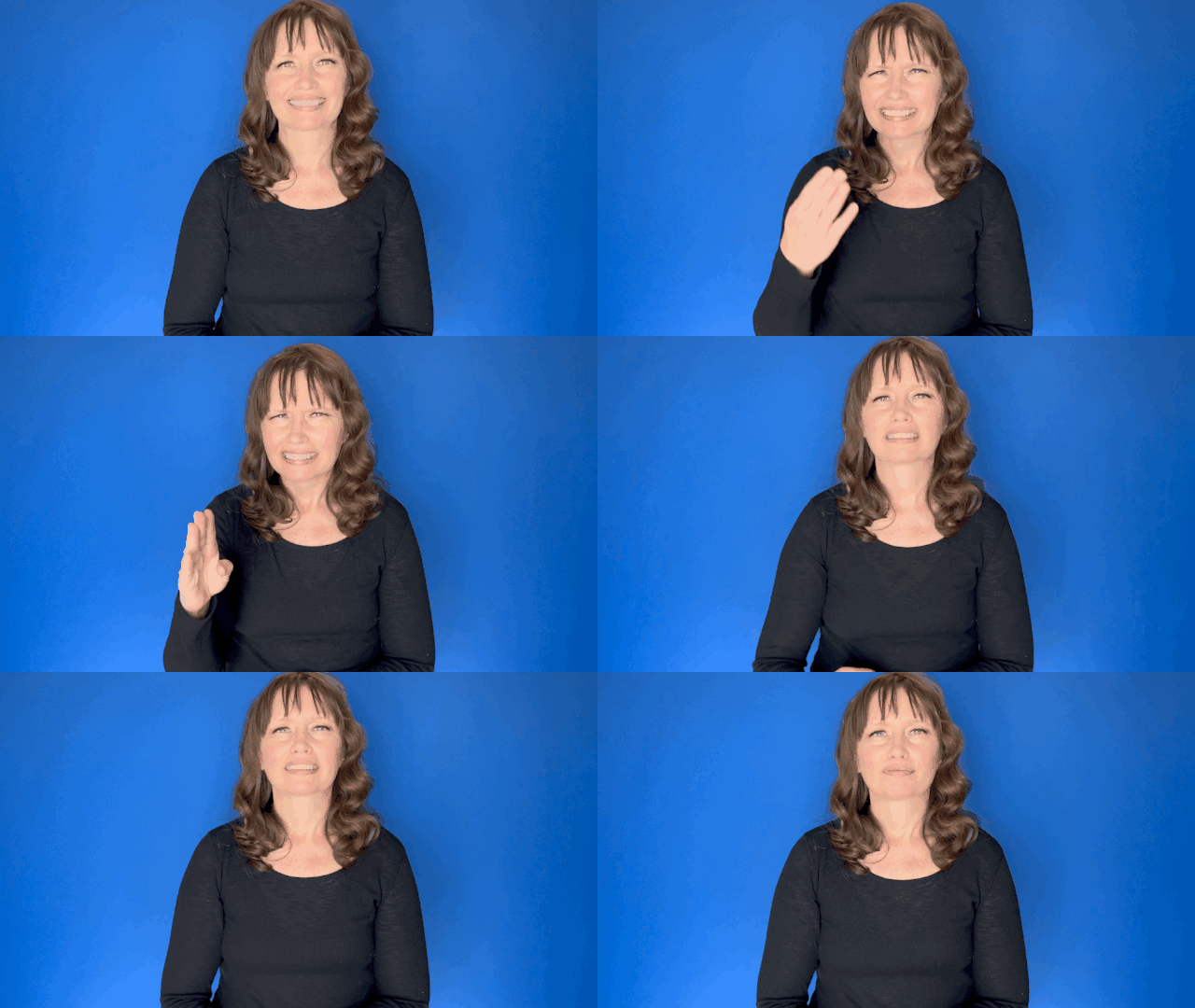
Definition: Dark blue color.
Sign for DARK BLUE in ASL

Practice Activities:
Start your practice with signing the concept of colors in isolation. Focus first on the sign for DARK BLUE in ASL by breaking it into two parts: the sign for “dark” and the sign for “blue.” Practice each part individually with clear facial expression and then combine them smoothly. Signing in front of a mirror helps you monitor your hand formation and movement.
Use flashcards or color swatches to randomly choose colors and label them using ASL signs. When a dark blue card appears, practice signing DARK BLUE slowly and then at conversational speed. Add a visual cue like pointing to something that is actually dark blue to strengthen the connection between the sign and the concept.
Create simple practice sentences using the sign for DARK BLUE in ASL. For example: “I have a dark blue shirt,” “The car is dark blue,” or “My favorite color is dark blue.” Say the sentence aloud in English, then pause and sign it entirely in ASL. Try this with a partner for feedback or record yourself and review the accuracy of your signs.
Incorporate storytelling exercises that include color descriptions. Describe a scene involving clothing, nature, or a room where something specific is dark blue. For instance, you can describe a beach scene with someone wearing a dark blue swimsuit or a night sky painted in dark blue hues.
Work with a partner to play a guessing game. One person describes an object using only ASL, including its color, and the other guesses it. Switch roles and make sure to include signs for many colors, with extra attention to using the sign for DARK BLUE in ASL accurately and naturally.
Use everyday life to find real-world examples. When you see something dark blue, pause and sign it. Making this a conscious habit will help internalize the sign and make it second nature.
Cultural Context:
In American Sign Language, colors often carry more than just visual meaning. The sign for DARK BLUE in ASL represents a specific shade that holds various cultural and emotional associations. It’s not just about saying “blue” but about expressing the deeper feeling that comes with the dark version of this color.
The sign for DARK BLUE in ASL is used in many contexts, from fashion choices to design discussions, and even in storytelling. ASL users may use this specific sign to describe clothes, skies, or feelings, giving their communication a richer and more vivid tone. When someone signs DARK BLUE, they’re often pointing toward something specific—like the color of a deep ocean or a serious mood.
In Deaf culture, the use of specific color signs like DARK BLUE is more than just communication. It’s about accuracy and expression. This sign helps convey mood and tone that would otherwise be difficult to express purely through spoken language. Using the sign for DARK BLUE in ASL shows an understanding that language is layered, and each shade of color has different meanings.
The sign for DARK BLUE in ASL might be taught early in conversational signs or during color-based ASL lessons. Children in Deaf education often learn to distinguish between basic colors and their variations, such as blue versus dark blue. This helps them understand not just vocabulary but descriptive language, which is crucial in forming detailed thoughts and expressions.
You’ll often see the sign for DARK BLUE in ASL used in artistic or emotional storytelling. Colors help create imagery, and choosing DARK BLUE over simply blue changes the mood. It’s more somber, mature, and sometimes mysterious. The richness of the color carries emotional weight, and the sign helps communicate that within ASL narratives or poetry.
In style and fashion conversations, the sign for DARK BLUE in ASL allows for precise descriptions. Someone might choose to describe pants or a dress using this specific shade, showing attention to detail. This is important in everyday ASL because nuance plays a major role in accurate communication.
The sign for DARK BLUE in ASL is also used when talking about nature and the environment. It may come up when describing the sky before a storm or the deep sea in marine life discussions. These visual cues are powerful, and the sign helps the speaker establish a clear setting or vibe.
Deaf artists and storytellers might favor the sign for DARK BLUE in ASL when they want to evoke strong moods. This contributes to a visual and emotional language that enhances their performances. The commitment to using specific color signs like
Extended Definition:
The sign for dark blue in ASL combines the concept of the base color blue with an adjustment to indicate darkness. In American Sign Language, many color signs are modified to show intensity or shade, and dark blue is no exception. This variation allows signers to add descriptive depth when discussing different shades.
To sign dark blue in ASL, you typically start with the standard sign for blue. This sign involves making a handshape like the letter B, then twisting the wrist back and forth slightly in front of your body. To modify it for dark blue, people often add a downward motion or a facial expression to indicate a deeper shade.
Facial expressions play an important role in ASL when indicating changes in tone or mood, including color variations. For dark blue, a signer might combine the blue sign with a more serious or intense facial expression to convey that it’s not just blue — it’s a darker version of blue. This kind of non-manual marker helps emphasize the shade visually.
Some signers also include a secondary sign to show darkness. This might involve using the sign for dark — a motion where both flat hands come down over the eyes — immediately before or after the blue sign. The combination helps clarify that the speaker is referring to the sign for dark blue in ASL and not just blue alone.
It’s important to consider context when using compound color signs. For example, if you’re describing clothing, a vehicle, or the sky, the clarity of signing dark blue without confusion relies on additional descriptors or pointing. You can also use classifiers to further describe the object that is dark blue in color.
The sign for dark blue in ASL may vary slightly between different regions or communities. ASL is a rich and diverse language, and while the general principles remain the same, people might adapt the sign to fit their local dialect or classroom instruction. Despite minor differences, the goal is universal understanding.
When teaching or learning about the sign for dark blue in ASL, it’s useful to watch native signers or instructional videos. By observing how others use the sign in real-life conversations, learners can develop a more natural feel for its use. This also helps reinforce the connection between signs and visual-spatial context.
ASL learners should practice the sign for dark blue along with other modified color signs. Doing so builds fluency and improves the ability to communicate more effectively in conversations that involve detailed or descriptive language. Including color contrasts like light blue and dark blue adds precision and richness to your signing vocabulary
Synonyms: navy, midnight blue, indigo, deep blue, royal blue
Educational resources: Find related learning materials in our course bank!
Want more? Check out some of our popular learning activities on the homepage!
Need to look up a sign? Use our highly rated dictionary: https://aslinteractive.com/best-asl-dictionary/
Follow us on tiktok: https://www.tiktok.com/@aslinteractive. More social media links at the bottom of this page!
Long-tail Keywords: what is the sign for dark blue in ASL, how do you sign dark blue in American Sign Language, ASL sign for dark blue
Categories:
tags: Colors, Language Learning, Classroom Picture, Colleges/Universities/schools, Describing Residence
Parameters
*Handshape*:
The handshape for the Sign for DARK BLUE in ASL uses a flat hand or “B” handshape with the fingers together and the thumb extended. Start with the palm facing the body near the chin or upper chest area.
To convey the meaning of DARK, a deliberate downward movement is added. The hand may curve slightly to show the “deep” or “dark” context. When signing the combined concept, both parts of the Sign for DARK BLUE in ASL flow smoothly to express color depth accurately.
*Palm Orientation*:
The palm orientation for the sign for DARK BLUE in ASL involves a downward or slightly inward-facing palm, especially when signing the color portion. When forming the sign for DARK, both hands typically start with palms facing down, crossing over to show the concept of darkness or shade. For BLUE, the dominant hand forms the letter “B” and rotates slightly outward with the palm facing forward.
In the sign for DARK BLUE in ASL, the palm begins with a downward orientation for DARK and transitions to a forward-facing position for BLUE. This fluid change in palm positions reflects the blending of darkness and color in the full sign. Always keep the hand relaxed and motion controlled for clear communication.
*Location*:
The sign for DARK BLUE in ASL is performed in the general neutral space in front of the upper torso. For the compound concept, DARK is signed first by bringing the flat hands down over the eyes in a crossing motion near the forehead area. Then BLUE is typically signed by shaking the “B” handshape side to side at about chest level. Both movements stay within personal signing space.
When signing the phrase together, ensure that the transition between DARK and BLUE remains smooth, with the signs flowing sequentially in front of the body. This positioning makes the sign for DARK BLUE in ASL clear and easily distinguishable within conversational space.
*Movement*:
To produce the sign for DARK BLUE in ASL, start with the dominant hand in a flattened “B” handshape, palm facing outward. Move the hand in a short, semi-circular motion away from the body, typically in front of the torso. This movement is associated with the color BLUE.
To modify for DARK, follow by placing both open hands near the face, then bringing them down and across the face area, slightly overlapping each other as if dimming light. Combining both elements accurately conveys the meaning of the sign for DARK BLUE in ASL .
*Non-Manual Signals*:
When using the sign for DARK BLUE in ASL, the facial expression typically includes a slightly furrowed brow or narrowed eyes to emphasize the intensity or depth of the color. The mouth may press into a neutral or slightly pursed shape, reflecting the darker shade.
Depending on context, you might subtly lean forward or give a brief nod for emphasis. These non-manual markers help clarify that the sign for DARK BLUE in ASL differs from lighter shades of blue.
*Prosody, Dominant/Non-Dominant Hand*:
The sign for DARK BLUE in ASL combines two distinct signs. Use your dominant hand to first sign “DARK” by placing both flat hands, palms facing down, above your face and bringing them downward in front of your face, as if casting a shadow. Then, sign “BLUE” by shaking your dominant hand in the “B” handshape side to side at shoulder level.
The non-dominant hand is not used in the “BLUE” portion, and both hands are briefly active during “DARK.” This two-part combination emphasizes both color and visual depth, enhancing clarity when expressing the sign for DARK BLUE in ASL .
Tips for Beginners:
When learning the sign for DARK BLUE in ASL, it helps to first recognize that it’s a combination of two separate concepts: “dark” and “blue.” Start by mastering the sign for “blue,” which typically involves extending your dominant hand in the “B” handshape and making a gentle twisting motion at the wrist. Once you feel confident with that, add the sign for “dark,” usually shown by bringing both hands over your face in a closing motion to suggest something getting covered or dimmed.
A helpful tip is to practice each part of the sign in front of a mirror so you can check your handshape and motion. Clarity matters—make sure your “B” handshape is firm and your twist doesn’t turn into a wave. Then, transition smoothly into the sign for “dark” without pausing too much, since these elements combine to convey a single color concept.
One common mistake while doing the sign for DARK BLUE in ASL is under-articulating the “dark” portion, which might cause confusion with just “blue.” Ensure both motions are clear but flow naturally together. Avoid over-exaggerating unless you’re emphasizing something dramatically in storytelling.
Use visual memory cues—imagine a deep ocean or night sky—this association can help you recall how to combine “dark” and “blue” into one cohesive sign. Also, observe native signers or watch ASL video dictionaries to see variations and better understand the flow and facial expressions that go with this sign.
The sign for DARK BLUE in ASL, like many compound signs, requires fluidity. Be patient and give yourself time to build muscle memory. Practicing with a partner or tutor can also give you real-time feedback, which is incredibly helpful for new learners. Consistency in practice will help you retain the movement and handshape more effectively.
Connections to Other topics:
The sign for DARK BLUE in ASL connects deeply to both color vocabulary and descriptive adjectives. In ASL, colors are often signed with deliberate facial expressions or movement modifications to show variations like light or dark. To express the depth of a color such as dark blue, the sign typically combines the sign for DARK and the sign for BLUE, emphasizing context and visual tone.
This compound use of signs is a central feature of ASL grammar. Many descriptive phrases in ASL are created using compounding methods, where base signs are paired to give more nuanced meaning. In signing DARK BLUE, the signer shows not just the base color but also modifies it to indicate intensity, a concept shared with signs like DARK GREEN or LIGHT BROWN. This shows how adjectives and colors interact dynamically in ASL.
Facial expressions and non-manual markers further support the meaning of the sign for DARK BLUE in ASL. For example, a more serious or focused facial expression might accompany DARK to emphasize its gravity, aligning with ASL’s visual nature. This use of facial grammar connects to broader ASL principles, where emotion and intensity are regularly shown through expression rather than only manual signs.
Learning how to sign DARK BLUE also opens pathways into discussing broader topics like clothing, art, or nature. For instance, conversations about favorite colors, fashion choices, or describing a painting’s color palette would all benefit from knowing this compound sign. This supports a learner’s ability to express complex descriptions fluently.
Additionally, understanding how to build descriptive color signs encourages learners to apply the same principles in creating other compound descriptors. Whether discussing mood, atmosphere, or aesthetics, the sign for DARK BLUE in ASL reinforces the importance of layered meaning in communication. This strengthens vocabulary expansion, storytelling, and nuanced conversation skills in ASL.
Summary:
The sign for DARK BLUE in ASL is a compound concept composed of two elements: the idea of “dark” and the color “blue.” Each component has its own distinct ASL sign, which are layered together to express the deeper shade of the color. The resulting sign is both visually descriptive and contextually flexible. ️
To sign “blue,” the dominant hand is formed into the letter “B” handshape and waved slightly in a small side-to-side motion near the shoulder or upper chest. This motion gives the impression of the abstract idea of the color itself. The movement is subtle and fluid, making it a graceful and commonly used sign in color classification.
To express “dark” in ASL, you start with both hands open and flat, palms facing downward, positioned near the forehead. They then move downward and slightly inward, ending with palms crossing loosely or close together near the chest. This signifies a reduction of light or something more intense or deep, which conceptually pairs well with darker shades of colors.
When signing the full phrase, sign “dark” first, followed by “blue.” This placement reflects the English descriptive word order, but it also remains intuitive in ASL grammar structure for adjectives. ASL allows some flexibility in word order depending on emphasis, but “dark” generally appears first to modify the color clearly.
The sign for DARK BLUE in ASL is more than just a literal indication of a color. It’s a descriptor of a nuanced visual experience. When someone uses this sign, it gives the impression of depth, seriousness, and context beyond just the hue.
Culturally, this phrase may be used in various contexts—from selecting wardrobe items to discussing artistic preferences. In Deaf culture, colors carry visual symbolism, and shades like navy or midnight blue can convey feelings or associations with formality, stability, or introspection.
The precision in signing shades like DARK BLUE in ASL reflects how ASL can be layered and expressive. The language embraces gradients and subtleties through movement, sequencing, and facial expressions. A slight variation in how “dark” is signed can change the tone from neutral to intense.
Facial expressions play a vital role here. When discussing a deeper or more saturated blue, furrowing the brows or squinting slightly adds emotional weight to the sign. It signals that the shade of blue being described is not just a preference but a particular kind of depth.
This layering demonstrates how ASL is not a one-to-one code for English but a spatial and visual language with its own syntax and grammar. You can’t just sign “DARK” and “BLUE” randomly. The clarity comes from how you sequence them and use body language to convey nuance.
In a bilingual household or educational setting, teaching the sign for DARK BLUE in ASL offers an excellent opportunity to explore color theory, cultural connotations, and expressiveness in storytelling. Describing objects with specific color shades encourages students to think more deeply about visual description.
One practical area where this sign appears frequently is in fashion or design discussions. When selecting clothing colors or house paints, more precise shades like DARK BLUE show how nuanced everyday vocabulary in ASL can be.
The sign allows Deaf signers to engage richly in conversations about preference, style, and mood. Usage of more precise shades like dark red, dark green, or dark blue demonstrates a growing interest in specificity and personalization in both signed and spoken dialogues.
Signs like DARK BLUE also reflect the flexibility of ASL to borrow and layer idealized meaning from spoken languages while honoring its own grammar. This kind of hybridization reveals the dynamic nature of signed languages. They evolve alongside their communities and absorb innovative usage patterns.
Students learning ASL often find color signs approachable and aesthetically pleasing. The sign for DARK BLUE in ASL is particularly satisfying due to the rhythm and contrast of the compound motion. This can help boost student engagement and retention.
Educational tools often isolate individual color signs at first. Signs like DARK BLUE serve as excellent exercises in understanding how modifiers work in real-time conversations. They reveal the importance of sequence and facial affect in achieving clarity.
The ASL sign for DARK BLUE connects to broader linguistic concepts such as semantic load and visual metaphor. In this case, “dark” doesn’t just refer to less light but invokes emotional undertones and atmosphere. Linguistically, that’s valuable in connotation lifting.
Color language is deeply tied to cultural and emotional resonance. For many Deaf individuals using ASL, colors like DARK BLUE are tied to associations of personality, branding, accessibility, mood, and even socio-political meaning. These elements influence how and when the sign is used.
Designating a color as dark implies comparison, and this comparative context is common in ASL. The use of DARK BLUE in ASL suggests a prior familiarity with the lighter version, showing how contrast is built into informal communication.
From an applied linguistics perspective, signs like DARK BLUE illuminate how compound signs grow organically to adapt to
Want more? Check out some of our popular learning activities!
ASL Interactive Resources
ASLInteractive YouTube Channel
Follow us on tiktok: @aslinteractive.com
Follow us on Instagram: aslinteractive
Facebook page: aslinteractive
Facebook group: aslinteractive
LInkedIn: ASL Interactive LLC
Twitter: @ASL_interactive
*Some information on this page is AI-generated. AI can make mistakes. Please check the information.


Responses