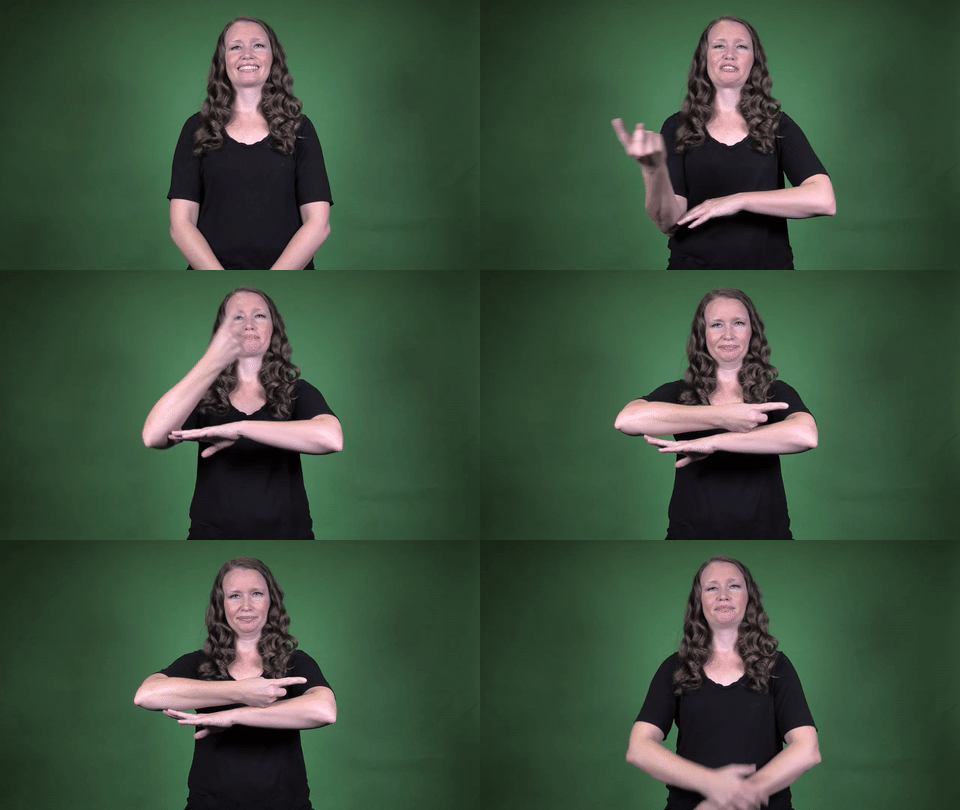
Sign for DAY in ASL | 🌞 ASL Dictionary

Definition: A 24-hour period.

Sign for DAY in ASL

YouTube player

Practice Activities:

Start by practicing the sign for DAY in ASL in isolation. Use a mirror to check your movement and handshape. Repeat the sign slowly and then try it at conversational speed. Focus on fluid motion from the dominant arm moving downward while the non-dominant arm remains horizontal like the horizon.

After you feel confident with the isolated movement, begin pairing the sign for DAY in ASL with simple time-related vocabulary. Try combinations like sunny day, rainy day, or busy day. Use these phrase combinations to build short ASL sentences, such as “TODAY BEAUTIFUL DAY” or “YESTERDAY HARD DAY.” Sign each sentence while considering facial expressions to match the mood.

Create a short daily routine story using the sign for DAY in ASL. Think through your schedule, then sign phrases like “MORNING WAKE-UP,” “DAY WORK,” and “NIGHT SLEEP.” This allows you to embed the concept of an entire day and practice sequencing in ASL. Record yourself or sign in front of a partner to get feedback on your fluency.

With a partner, take turns signing what happened during your day. Prompt each other with questions like “WHAT HAPPEN DAY TODAY?” or “YOUR FAVORITE DAY OF WEEK WHAT?” This encourages both receptive and expressive practice with the sign for DAY in ASL inside everyday dialogues.

Set a goal to use the sign for DAY in ASL at least five times in natural contexts each day. For spontaneous practice, describe the current weather and tie it to the time of day, like “TODAY COLD DAY” or “WARM DAY NICE WALK.” The more frequent and purposeful your use, the more natural the sign becomes in conversations.

To reinforce learning, watch ASL videos or stories where the sign for DAY in ASL is used frequently. Mimic the sign as you see it, and try retelling the story using your own signs incorporating the word DAY repeatedly.

Cultural Context:

In American Sign Language, the sign for DAY in ASL carries more than just a literal meaning. It reflects the rhythm of daily life and how the passage of time is visually expressed within Deaf culture. The concept of a “day” holds cultural significance when used in storytelling, social interaction, and temporal references.

The sign for DAY in ASL typically involves the dominant arm representing the sun moving across the sky, mimicking the arc from sunrise to sunset. This visual metaphor is rich in cultural value, as it mirrors the Deaf community’s natural way of expressing time through movement. It also connects deeply with the visual-spatial nature of ASL, allowing signers to talk about time in ways that are intuitive and vivid.

In Deaf culture, time is perceived and communicated differently than in spoken languages. The sign for DAY in ASL is often used in combination with other signs to talk about calendars, routines, and life events. Whether discussing work schedules, school days, or holidays, the sign for DAY in ASL becomes a basic yet powerful tool in relaying everyday information through a visual language.

When used in storytelling, the sign for DAY in ASL helps establish setting and sequence. It allows narratives to unfold clearly with marked beginnings and endings. For example, a story may begin with the sign for DAY in ASL, signaling the start of a new plot or event. This cultural storytelling method helps preserve traditions and share personal experiences in the Deaf community.

Certain expressions and idioms in ASL also revolve around the sign for DAY in ASL. Phrases like “all day,” “day after day,” or “another day” use variations of the same root sign. These phrases reveal how communal understanding and shared meanings evolve organically within the Deaf community, making the sign for DAY in ASL a cornerstone for unique cultural expressions.

Social conversations often highlight how central time and daily events are. So, the sign for DAY in ASL commonly surfaces in discussions about upcoming events, current news, and shared experiences. Whether it’s used to plan a gathering or to recall what happened during the day, this sign helps mark the cultural importance of shared time in Deaf interactions.

For Deaf children learning ASL, the sign for DAY in ASL is one of the first basic time-related signs they acquire. It helps them understand routines and builds their awareness of daily structure. It’s also commonly used in early educational settings to create schedules and explain time concepts visually instead of relying solely on written or spoken language.

Vis

Extended Definition:

The sign for DAY in ASL is a foundational vocabulary word used frequently in daily conversation. In American Sign Language, this sign conveys the concept of a full day, from sunrise to sunset, and is often used when discussing time, schedules, or events. Mastering this sign helps build essential time-related communication skills for both beginners and fluent signers alike.

To produce the sign for DAY in ASL, start by forming your non-dominant arm horizontally in front of you to represent the horizon. Place your dominant hand with the index finger pointing up—similar to a number 1—and move it from upright to lie flat across your arm, symbolizing the sun traveling across the sky. This movement captures the passage of one day in a visually iconic way.

This sign is commonly used in everyday conversations, such as asking how someone’s day was, talking about specific days of the week, or planning future events. When learning ASL, understanding how to sign DAY allows you to expand your time-related vocabulary significantly. It integrates smoothly with other time signs like today, yesterday, and tomorrow.

The sign for DAY in ASL also plays a key role in storytelling, narratives, and ASL poetry, where time is an important element. It provides a natural visual for illustrating the flow of time or setting a scene. In classroom settings, teachers often teach this sign early, as it’s necessary for using calendars and discussing schedules in ASL.

Regional variations for the sign for DAY in ASL are minimal, but context and facial expressions help convey specific meanings. For instance, you can use this sign to express ideas such as workday, weekend, or all day long. Pairing it with facial grammar enhances the clarity of your message and shows whether you’re talking about a regular day or a particularly long one.

In Deaf culture, signs that represent time are crucial because they ground conversations in context. Using the correct sign for DAY in ASL demonstrates a respect for visual language grammar and cultural norms. It also shows fluency and a deeper understanding of how ASL mirrors everyday life through physical movement and gesture.

This sign is also useful in educational environments like Deaf schools, ASL immersion classrooms, or when teaching hearing children and adults learning the language. Because of its versatility and frequency, the sign for DAY in ASL is often part of the beginner vocabulary list in most ASL courses. Its simplicity in execution also makes it a great sign for children just starting to learn American Sign Language.

To retain this

Synonyms: Day, daytime, daylight, sunrise to sunset, daylight hours

Educational resources: Find related learning materials in our course bank!

Want more? Check out some of our popular learning activities on the homepage!

Need to look up a sign? Use our highly rated dictionary: https://aslinteractive.com/best-asl-dictionary/

Follow us on tiktok: https://www.tiktok.com/@aslinteractive. More social media links at the bottom of this page!

Long-tail Keywords: what is the ASL sign for Day, how do you sign Day in ASL, how to sign Day in American Sign Language

Categories:

tags: Time, Days of the week, Everyday activities, Language Learning, Basic grammar

Parameters

*Handshape*:

The handshape used in the sign for DAY in ASL begins with your non-dominant hand forming a flat base using a horizontal B-handshape. Your dominant hand starts in a D-handshape, with the index finger pointed straight up, resting its elbow on the back of the non-dominant hand. This D-handshape then arcs downward, symbolizing the sun setting across the horizon. The handshape is essential in conveying the meaning of the sign for DAY in ASL . This movement and specific handshape work together to represent the passing of time from sunlight to dusk.

*Palm Orientation*:

The palm orientation for the sign for DAY in ASL involves the dominant hand starting in a horizontal “D” handshape. The palm faces down, parallel to the ground, while the non-dominant arm is held horizontally like a base.

To complete the sign for DAY in ASL, the dominant hand pivots downward from the elbow and rests on the back of the non-dominant arm with palm still facing down. This motion resembles the sun moving across the sky .

*Location*:

The sign for DAY in ASL is produced in the neutral space in front of the body, centered around the upper torso and chest area. The dominant arm moves from a vertical position into a horizontal one, resting on the non-dominant arm which stays horizontal throughout. This movement mimics the concept of the sun moving across the sky, aligning with the visual meaning of the sign for DAY in ASL .

*Movement*:

The sign for DAY in ASL uses the dominant arm extended horizontally like the horizon, while the non-dominant arm is bent at the elbow with the hand pointing up, representing the sun. Start with the elbow resting on the back of the non-dominant hand, then slowly lower the dominant arm until it’s lying flat, symbolizing the sun setting over the horizon.

This smooth downward arc helps convey the visual image of a complete day. The sign for DAY in ASL is graceful and easy to distinguish, making it a great foundational concept for time-related signs .

*Non-Manual Signals*:

When using the sign for DAY in ASL, the facial expression is typically neutral and calm, indicating the progression of time naturally. The eyebrows remain relaxed, showing it’s a straightforward concept without emotional intensity.

Slight head nodding forward may accompany the sign for DAY in ASL to emphasize the movement of the sun across the sky . There’s no exaggerated emotion—just a clear, matter-of-fact presentation of a daily occurrence.

*Prosody, Dominant/Non-Dominant Hand*:

The dominant hand in the Sign for DAY in ASL is typically the index finger, extended and pointing horizontally like an arm of a clock. The non-dominant arm is held horizontally across the body, palm facing down to represent the horizon.

The dominant hand starts upright, perpendicular to the non-dominant arm, then arcs downward slowly to lay on top of it, imitating the motion of the sun setting . This graceful movement visually conveys the passage of a day, central to understanding the Sign for DAY in ASL.

Tips for Beginners:

When learning the sign for DAY in ASL, it’s essential to focus on hand positioning and body orientation. The sign uses the non-dominant arm held horizontally in front of you, palm down, representing the horizon. Your dominant hand forms the index finger (with the rest of the fingers closed) and starts upright at the elbow of the non-dominant arm, then moves downward until it lies flat across the arm, like the sun moving across the sky.

A common pitfall beginners face when performing the sign for DAY in ASL is moving the dominant hand too quickly or not following a smooth arc. The motion should feel natural, steady, and not rushed. Jerky or incomplete movement could confuse it with other signs like sunrise or morning.

To enhance clarity, make sure your dominant index finger starts in a vertical position and pivots smoothly to end in a horizontal position. This mimics the sun’s path, which is central to the meaning of the sign. Beginners sometimes start with the finger too low or skip the lift at the beginning, which changes the meaning or creates ambiguity.

Practice in front of a mirror to check that your hand doesn’t block your face. Visibility is key in ASL, and the sign for DAY in ASL should be clearly visible to your conversation partner. Practicing from a side angle can also help refine the arc of the motion.

Try signing over-exaggerated at first to get a feel for the movement, then gradually dial it down. Muscle memory plays a big part in using the sign for DAY in ASL fluently. Use it in context: practice phrases with “day” like “what day?”, “every day,” or “today” to reinforce memorization. Frequent repetition in varied sentences will help lock in the motion naturally over time.

Connections to Other topics:

The sign for DAY in ASL is fundamentally connected to many other time-related signs, making it an essential building block for more complex concepts. Because DAY refers to a 24-hour cycle, it directly relates to signs like MORNING, AFTERNOON, NIGHT, TODAY, and TOMORROW. These signs often build off the same motion or positioning found in the sign for DAY, especially with the dominant arm’s downward movement, representing the passage of time from sunrise to sunset .

Learners will often encounter the sign for DAY in ASL when using compound phrases like EVERY-DAY, ALL-DAY, and YESTER-DAY. These compounds allow for greater nuance when expressing recurring actions or specific time frames. The orientation and repetition of the sign may change slightly to reflect temporal frequency, making context very important. For example, EVERY-DAY is signed with a repeated motion, demonstrating an ongoing pattern of time .

Another connection is with the sign WEEK, which integrates the sign for DAY to show a sequence of days. This is especially useful in discussions about calendars, schedules, or planning. Comparatively, signs like HOLIDAY or BIRTHDAY may indirectly relate through the concept of a special or designated day, demonstrating how the sign for DAY in ASL anchors many expressive ideas.

Grammatical use is also important. In ASL syntax, knowing whether to include sign modifiers or facial expressions with the sign for DAY helps show whether the message refers to the past, present, or future. A simple nod, head tilt, or non-manual marker can change the meaning of the sentence.

By understanding the sign for DAY in ASL, learners gain access to a rich family of vocabulary centered around time. This acts as a springboard for fluency in everyday conversations, storytelling, and event sequencing.

Summary:

The sign for DAY in ASL is a visually iconic one, rich with meaning and easy to recognize. It mimics the movement of the sun rising and setting over the horizon, offering a simple yet powerful depiction of the passage of time.

To make the sign for DAY in ASL, start by extending your non-dominant arm horizontally in front of you to represent the horizon. Your dominant hand, shaped into the “index finger” handshape (similar to the sign for ONE), starts pointing upward near your non-dominant elbow.

Then, pivot your dominant arm at the elbow and bring it downward so that the extended index finger arcs toward the horizontal arm. This motion illustrates the sun lowering across the sky—an allegory for the end of a day.

This sign is beautifully illustrative and serves as a great example of how ASL often draws from visual metaphors. The sweeping motion mirrors the concept of time and daylight passing by.

Culturally, the sign for DAY in ASL is central in daily communication. Whether expressing schedules, routines, or storytelling narratives, this sign frequently appears in both casual and formal language settings.

The sign is also often used in compound signs or idiomatic expressions related to time. Examples include signs like SUNDAY, MONDAY, or HOLIDAY, all of which either incorporate or build off the basic concept of a day.

In grammatical contexts, the sign for DAY in ASL operates primarily as a noun but can be part of time-related adverbial phrases. Using it repetitively can signify multiple days, an extended period, or a concept akin to “daily” when combined with other temporal modifiers.

For example, signing DAY multiple times quickly can mean “every day” depending on inflection and non-manual signals. This aspect of the sign supports the idea that ASL uses repetition and movement for grammatical modification.

The evolution of the sign for DAY in ASL is linked to older sign languages and gestural representations of nature. Like many signs in ASL, it reflects an intuitive understanding of the world through visuals and motion.

Linguistically, it exemplifies the principle of iconicity, where form closely resembles meaning—an important concept in sign language structure. The arc of the hand mirrors the journey of the sun, showing how semantics and movement intertwine.

Applied linguistics reveals that learners of ASL often remember the sign for DAY with ease because of its visual referent. Visual reinforcement accelerates memorization, especially for concepts that are naturally attached to imagery.

The sign supports temporal frameworks in ASL, such as tense and aspect. Whether describing a past event, daily habit, or future plan, DAY anchors time-based statements within conversations.

In terms of frequency, the sign for DAY in ASL is among the most commonly used time-related signs. This sign often initiates sentences that describe routines, order of events, or temporal comparisons.

Educators often teach this sign early because it builds a base for other time-related signs. Once students master DAY, it becomes easier to understand concepts like TODAY, YESTERDAY, and TOMORROW.

The sign for DAY in ASL also plays a role in narrative pacing. When a signer wants to indicate a passage of time in storytelling, they may use DAY in conjunction with facial expressions and rhythmic repetitions to show unfolding events.

This flexibility allows the sign for DAY in ASL to serve as both a factual marker and a literary tool. It’s not only about stating the day but evoking mood or showing duration.

The sign’s connection to the sun’s path subtly ties deaf culture to visual and natural phenomena. Unlike spoken languages, ASL often embeds naturalization in its vocabulary to aid meaning retention and community connection.

In this way, the sign for DAY in ASL contributes to cultural literacy among native and second-language learners of ASL. Understanding the roots and usage of the sign deepens not only language skills but also cultural empathy.

In Deaf households and schools, children become familiar with the sign at an early age, often as part of their morning routines. From calendars to discussions about the weather, the sign is foundational to conveying context and routine.

The sign for DAY also interfaces well with assistive technology and visual aids. ASL videos, captioning supplements, and communication boards regularly use this sign because of its clarity and easy recognizability.

Related signs, such as MORNING, NOON, and NIGHT, form a semantic network with the sign for DAY in ASL. Each of these signs represents segments of daylight and shares the progression concept seen in the DAY sign.

Such signs enhance ASL’s rich dimensionality, combining space, motion, and temporal landmarks. The sign for DAY serves as a hub around which other time signs revolve, linguistically and semantically.

For signers with hearing family members, teaching the sign for DAY in ASL can encourage widespread communication at home. It can be an invitation into daily signing practice, helping families develop bilingual routines

Want more? Check out some of our popular learning activities!

ASL Interactive Resources

ASLInteractive YouTube Channel

Follow us on tiktok: @aslinteractive.com

Follow us on Instagram: aslinteractive

Facebook page: aslinteractive

Facebook group: aslinteractive

LInkedIn: ASL Interactive LLC

Twitter: @ASL_interactive

*Some information on this page is AI-generated. AI can make mistakes. Please check the information.

Sign for DAY in ASL
Sign for DAY in ASL

Responses