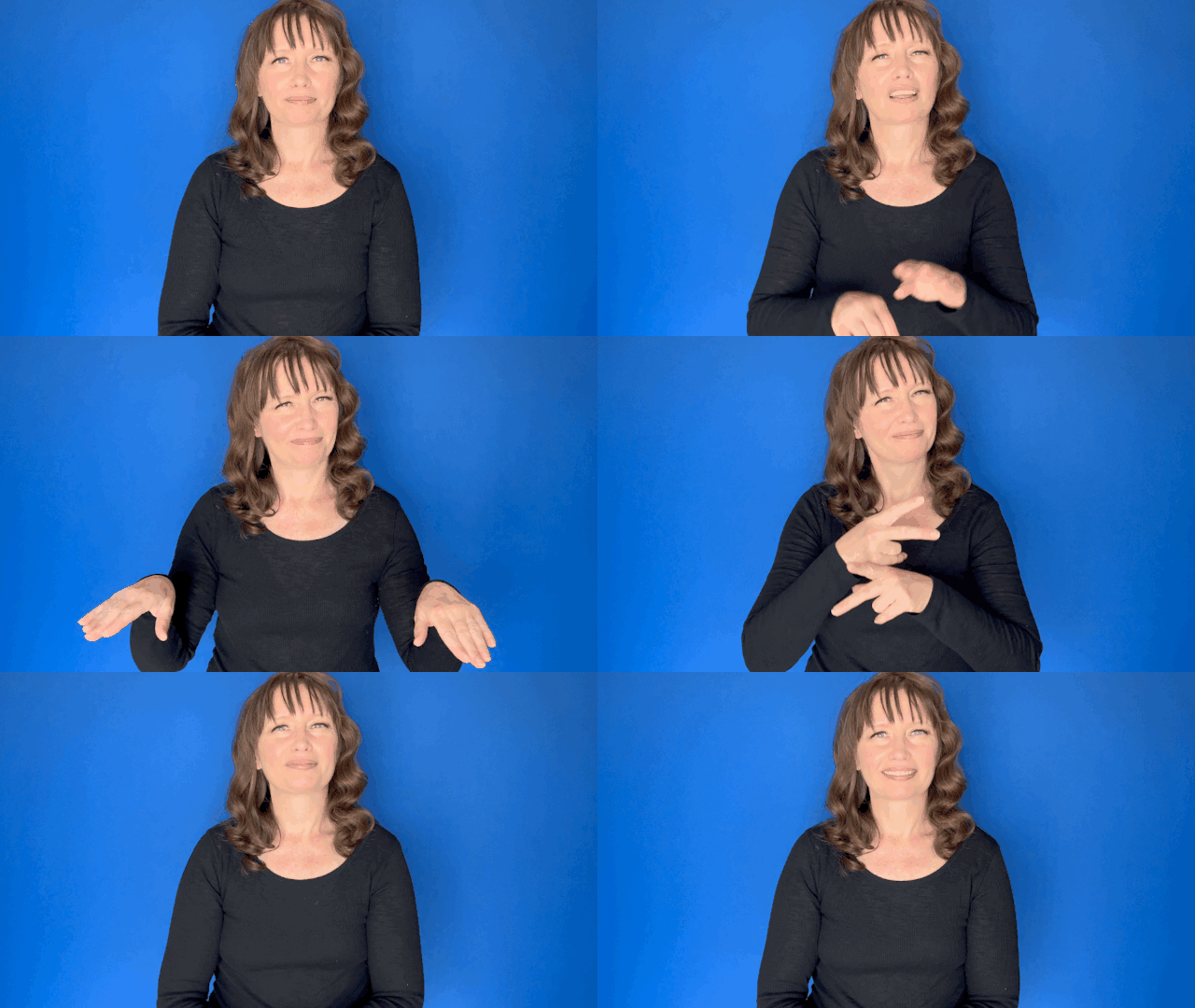
Sign for DAYCARE 3 CHILDCARE in ASL | 🧒 ASL Dictionary

Definition: A daycare center 3.

Sign for DAYCARE 3 CHILDCARE in ASL

YouTube player

Practice Activities:

To begin practicing the sign for DAYCARE 3 CHILDCARE in ASL, start by isolating each segment of the full sign. Repetition is key, so practice each part slowly in front of a mirror. Watch your handshape, palm orientation, and facial expressions to ensure accuracy. Then, try combining the components into the full sign for day care or childcare.

Next, say simple phrases using the sign for DAYCARE 3 CHILDCARE in ASL. Try signing sentences like “My son goes to daycare,” or “I work at a childcare center.” Vary the subjects and verbs to become more comfortable using the sign in different contexts. Challenge yourself to make 5 new sentences about daily routines that involve children being at daycare.

Storytelling is great for fluency. Create a short narrative about taking a child to daycare in the morning. Describe what the child packs, who they see at the center, and how their day goes. Retell it using signs, incorporating rich detail. This will help reinforce not just the sign for DAYCARE 3 CHILDCARE in ASL but also related vocabulary.

Partner work strengthens expressive skills. Have one partner describe a scene involving a childcare environment using only signs, and the other partner guesses or responds appropriately. Switch roles every few minutes. Include signs for teacher, play, eat, and nap to round out the context.

For receptive practice, watch short videos or clips in ASL that include scenes with kids, families, or schools. Try to identify when the sign for DAYCARE 3 CHILDCARE in ASL is used. If you don’t see it, try to imagine where it could fit or how it might be used in the scenario.

Finally, use emoji cues to build memory. Create flashcards using images of children, caregivers, or buildings ‍ and sign the phrase when each one appears.

Cultural Context:

In Deaf culture, access to early childhood education and daily care is just as important as in hearing communities. Knowing the sign for daycare 3 childcare in ASL helps promote inclusive communication between Deaf children, caregivers, and educators. It ensures that Deaf children feel safe, understood, and included from a young age.

The sign for daycare 3 childcare in ASL is frequently used in family conversations, educational environments, and social services. Parents of Deaf or hard-of-hearing children rely on this sign when discussing care options, making appointments, or asking about daily routines. It becomes especially useful during Deaf community events where parents exchange resources and stories.

ASL plays a key role in identity and community for Deaf people. Teaching the sign for daycare 3 childcare in ASL supports language development and opens the door for self-expression among young Deaf children. It also allows hearing parents to better connect with their Deaf toddlers and engage meaningfully during early developmental stages.

Many daycare centers and preschools strive to become more inclusive and often train staff in American Sign Language. Learning the sign for daycare 3 childcare in ASL allows staff to communicate directly with young Deaf children without constant reliance on interpreters. This boosts children’s sense of belonging, safety, and trust in caregivers.

In Deaf culture, communication is visual and rich in detail. Using the sign for daycare 3 childcare in ASL allows Deaf adults to clearly explain situations regarding their child’s activities, care plans, or behavioral concerns. It empowers Deaf parents to advocate for quality childcare services tailored to their specific needs.

Early exposure to ASL is proven to benefit cognitive, social, and emotional development. Using clear signs like daycare 3 childcare in ASL around infants and toddlers sets the foundation for lifelong language fluency. It also eases transitions between home and child care environments when familiar vocabulary and communication are consistently used.

In community support groups and parent meetups, the sign for daycare 3 childcare in ASL is commonly shared when expressing needs or offering recommendations. It helps create a safe, culturally relevant space for Deaf families to share resources and support. These exchanges often lead to stronger networks and better experiences for young Deaf children.

The growing demand for inclusive education and public services increases the importance of standardized signs. Mastering the sign for daycare 3 childcare in ASL ensures that common concepts related to early care are easily understood across different regions and groups. It bridges gaps between Deaf and hearing communities in ways that are respectful and accessible.

When ASL is used consistently

Extended Definition:

The sign for daycare 3 childcare in ASL is a useful phrase for parents, educators, and caregivers who communicate using American Sign Language. Understanding how to express concepts like daycare and childcare in ASL can help connect families, teachers, and kids in inclusive ways. This phrase can be broken into meaningful components that are commonly used across ASL conversations.

The sign for daycare typically combines the signs for day and care. For “day,” the sign involves placing your non-dominant arm horizontally while your dominant hand forms the letter D and pivots down like the sun setting on the horizon. For “care,” you place both hands in the shape of the letter S and stack them on top of each other with a gentle circular movement. Putting these signs together gives you the general idea of daycare in ASL.

To communicate childcare, signers often use “child” and “care” together. The sign for child or children is made by patting the air in front of you as if you’re patting the heads of small kids. When followed by the sign for care, the phrase conveys love, supervision, and nurturing support, all of which are critical elements of childcare.

Adding “3” into the phrase for daycare 3 childcare in ASL can have different meanings depending on context. It might refer to the age of the child, the group size, or even the number of staff or kids present. In ASL, numbers are incorporated naturally into conversations. The number 3 is made by holding up the thumb, index, and middle fingers. Be sure to place the number within the flow of the sentence in a grammatically correct location.

When signing daycare 3 childcare in ASL, it’s important to maintain facial expressions and proper ASL grammar. These visual and nonverbal cues add meaning and emotion to the signs. Signers regularly rely on facial expressions to show the difference between questions, statements, or emphasis.

This phrase is particularly helpful when making arrangements, asking about services, or discussing a child’s daily routine in an ASL-friendly setting. Whether you’re scheduling pickups, talking to staff, or coordinating with parents, knowing the correct signs improves clarity and confidence in communication.

As families become more diverse and inclusive, using ASL terms like daycare 3 childcare in ASL builds stronger community ties. It ensures everyone, including children of Deaf adults (CODA), hard-of-hearing individuals, and Deaf community members, can be part of daily life conversations about young children. It’s

Synonyms: daycare, childcare center, preschool, early learning center, child development center

Educational resources: Find related learning materials in our course bank!

Want more? Check out some of our popular learning activities on the homepage!

Need to look up a sign? Use our highly rated dictionary: https://aslinteractive.com/best-asl-dictionary/

Follow us on tiktok: https://www.tiktok.com/@aslinteractive. More social media links at the bottom of this page!

Long-tail Keywords: What is the sign for daycare in ASL, how do you sign daycare in ASL, ASL sign for child care

Categories:

tags: daycare in ASL, childcare signs in ASL, American Sign Language for daycare, how to sign childcare in ASL, ASL vocabulary for daycare

Parameters

*Handshape*:

The handshape for the sign for DAYCARE 3 CHILDCARE in ASL involves using the flat “B” hand and the open “5” hand. The dominant hand, in a flat “B” shape, typically represents the concept of “day” by moving from the chin area outward, resembling the sun setting.

For CHILDCARE, the hands shift to resemble the movement of caring for or overseeing children. The dominant hand uses a cradling or patting motion over the non-dominant hand in a loose “5” shape, emphasizing the nurturing aspect. The handshapes are critical in expressing the meaning behind the sign for DAYCARE 3 CHILDCARE in ASL .

*Palm Orientation*:

For the sign for DAYCARE 3 CHILDCARE in ASL, palm orientation plays a crucial role. The dominant hand typically starts in a flat handshape with the palm facing down during the initial motion, which may resemble the sign for DAY. When transitioning to the concept of CARE or CHILDCARE, both hands often form the “S” handshape, with palms facing each other or slightly inward, mimicking a rocking or protective gesture .

Incorporating the motion and palm positioning accurately is essential for conveying the sign for DAYCARE 3 CHILDCARE in ASL clearly. The palm orientation may shift subtly depending on regional variations or whether the signer wants to emphasize the concept of children or the act of caring.

*Location*:

The sign for DAYCARE 3 CHILDCARE in ASL takes place in the neutral space just in front of the torso, around chest level. This space allows for clear visibility of both components of the compound sign, typically combining concepts like parent or care with child or kids .

For the sign for DAYCARE 3 CHILDCARE in ASL, the hands may move from the signer’s body outward, mimicking the idea of placing children in care or a separate location. This location choice makes it easy to see the nuanced hand movement and facial expressions often used with this concept.

*Movement*:

The sign for DAYCARE 3 CHILDCARE in ASL starts by forming the sign for “day,” where your non-dominant arm is held horizontally across the chest and your dominant arm, in a flat handshape, moves downward like the sun setting behind the horizon. Then transition into the sign for “care,” where both hands form the letter **S** and tap the dominant hand on top of the non-dominant one near the chest in a gentle motion.

The movement in the sign for DAYCARE 3 CHILDCARE in ASL combines clear directional motion with facial expressions showing care or nurturing. The flow from “day” to “care” must be smooth, showing a connection between the concepts. This expressive transition helps clarify the meaning, evoking the idea of watching over children during the day .

*Non-Manual Signals*:

When performing the sign for DAYCARE 3 CHILDCARE in ASL, maintain a neutral facial expression with a slight focus in your eyes, as if referencing a location or object being cared for. Slight brow tension may occur to emphasize the concept of responsibility or attentiveness associated with children.

The non-manual signals should convey warmth and attentiveness. A gentle head nod and soft eye contact help reflect the nurturing nature of the sign for DAYCARE 3 CHILDCARE in ASL .

*Prosody, Dominant/Non-Dominant Hand*:

The sign for DAYCARE 3 CHILDCARE in ASL uses both hands. The dominant hand forms a flat hand shape representing “day” (a motion similar to the sun setting), while the non-dominant hand acts as the ground or base. Then, both hands transition into the sign for “care,” where both hands form the letter “S” and cross over each other twice at the wrists in a gentle, nurturing motion.

This movement combination represents the concept of caring for children during the daytime. The sign for DAYCARE 3 CHILDCARE in ASL conveys nurturing and protection, often used in educational or home care contexts .

Tips for Beginners:

When learning the sign for DAYCARE 3 CHILDCARE in ASL, it’s important to understand that this concept is typically expressed by combining multiple signs to represent both “day” and “care” or “childcare.” Begin by mastering the base signs individually—start with DAY, where your non-dominant forearm is held horizontally like the horizon and your dominant hand forms a D handshape moving downward like the sun setting. Then pair it with CARE, commonly done by stacking S-handshapes and tapping them lightly.

One of the most practical tips is to practice the fluid connection between these component signs. Don’t rush through them—smooth transitions matter in making the sign look natural and understandable. Also, be mindful of your facial expression; a neutral or positive affect is appropriate, as you’re referring to a nurturing and safe environment for children.

A common pitfall learners make when trying to use the sign for DAYCARE 3 CHILDCARE in ASL is focusing solely on the literal English construction. ASL is conceptual and not always word-for-word. So avoid trying to fingerspell full phrases when there’s a more natural sign combination available. Sometimes, adding the sign for CHILD before CARE is another natural variant that is widely understood.

It’s also helpful to observe native signers or videos that demonstrate the cultural nuances tied to this sign. The size, motion, and expression all play a huge role in conveying meaning accurately. Use a mirror or record yourself signing to self-correct hand placement and motion.

Stay consistent with dominant and non-dominant hands throughout the sign, especially in two-handed combinations. Practicing daily in context—like role-playing scenarios involving a daycare pickup or discussing childcare options—can solidify memory and improve fluency for signing the sign for DAYCARE 3 CHILDCARE in ASL.

Connections to Other topics:

The sign for DAYCARE 3 CHILDCARE in ASL connects closely with signs related to child development, education, and caregiving. ASL often uses compound signs to express broader concepts, and this sign merges elements of “CHILD” or “BABY” with concepts of supervision or a location of care, such as “HOUSE” or “CARE.” These combinations help illustrate the purpose and environment of daycare or childcare facilities .

This concept aligns with other signs like “SCHOOL,” “TEACH,” “LEARN,” and “BABYSIT.” For example, when discussing a preschool program at a daycare, one might shift toward signs like “EARLY” + “EDUCATION” or include “TEACH” to be more specific. The sign for DAYCARE 3 CHILDCARE in ASL fits into that system and helps storytellers or speakers establish age-specific services or routines in a child’s life .

Social and family-related vocabulary also connects with this sign. One might use the sign in combination with “WORK” to express parents going to work while children attend daycare. In this way, the sign for DAYCARE 3 CHILDCARE in ASL supports discussions around parenting, community life, and daily routines for families.

There is also a relationship between this sign and signs for roles such as “CAREGIVER,” “NANNY,” or “BABYSITTER.” These signs help explain who provides the care and can be used contextually to describe a person’s job or role. The sign for DAYCARE 3 CHILDCARE in ASL becomes integral when describing paid, structured environments as opposed to occasional home care .

Cultural context is important too—some families sign “STAY” + “HOME” + “CHILD” to communicate home-based childcare. In contrast, more formal centers or licensed facilities often inspire the usage of the full compound involved in the sign for DAYCARE 3 CHILDCARE in ASL, reflecting its structured nature and broader usage in community settings.

Summary:

The sign for DAYCARE 3 CHILDCARE in ASL generally combines the signs for “day” and “care,” or uses fingerspelling to convey clarity depending on the context. For example, a signer may use the sign for “day” by resting the dominant arm at the elbow of the non-dominant forearm and lowering the index finger from a vertical to horizontal position, symbolizing the passage of the sun through the sky. “Care” is often shown by stacking and gently tapping closed “S” hands on top of one another, implying nurturing or safeguarding.

In many situations, especially in formal settings or when Deaf children are involved, fingerspelling “D-A-Y-C-A-R-E” or “C-H-I-L-D-C-A-R-E” may be preferred for clarity or to reflect a specific facility’s name. This depends on regional variation as well. Signs can shift slightly based on whether the concept refers to a person providing the care, the place itself, or the abstract idea of supervision.

The sign for DAYCARE 3 CHILDCARE in ASL reflects a fundamental cultural emphasis on safety, support, and early education in the Deaf community. ASL prioritizes not just communication, but also expression of intent and tone. A signer might modulate speed or facial movement to indicate levels of warmth, assurance, or even formal detachment, depending on the context.

Signers also may incorporate facial grammar or directional verbs to indicate who is providing the childcare and to whom. For example, the sign “care” can be directionally targeted toward or away from the signer to show “I take care of,” “you take care of,” or “they take care of” a child. These nuances enhance storytelling and communication efficiency in native sign usage.

The concept behind the sign for DAYCARE 3 CHILDCARE in ASL extends beyond literal translation, connecting deeply with community values. Providing children with care is not only practical but often reflects a communal responsibility among Deaf families. Schools for the Deaf, Deaf clubs, and family networks all integrate childcare and protection as foundational principles, which influences how such concepts are signed.

Linguistically, the compound nature of this sign is illustrative of ASL’s morphological features. The sign’s components are often treated as separate morphemes — each adding semantic weight. The sign for “day” contributes temporal context, while “care” anchors the social function of support. Together, these elements form a conceptually dense but fluid construction.

Synonyms or related signs include “babysitter,” “nanny,” “nursery,” and “pre-school,” each having nuanced differences in sign form and usage. “Babysitter” is typically shown through the signs for “baby” and “watch” or “take care,” sometimes with alternate signs depending on region or community dialects. These relations enrich the semantic web that surrounds the sign for DAYCARE 3 CHILDCARE in ASL and support layered understanding.

Deaf parents or caregivers might use the sign for DAYCARE 3 CHILDCARE in ASL daily, highlighting it as part of their regular lexicon. In these contexts, its usage stays grounded in real-world applications and community engagement. ASL thrives on expressiveness, and signs related to children, family, and care are especially dynamic.

In applied linguistics, the sign for DAYCARE 3 CHILDCARE in ASL demonstrates how non-verbal cues integrate with lexical signs to shape full discourse. Variations in handshape or movement can subtly alter meaning. For instance, using a gentler motion when signing “care” might suggest affection, while a more rigid execution could connote institutional care.

This sign can also shift subtly across age demographics. While older ASL users might prefer traditional or fingerspelled versions, younger generations might innovate usage depending on exposure to signed media or education. This creates a living, evolving relationship between signers and their environment, exemplified in a common, functional sign like this.

Context significantly impacts the sign’s interpretation. If used in the middle of a narrative about working parents, the sign may center logistical concerns. In a discussion of community support systems, it takes on more socio-cultural weight.

The concept of childcare intersects with major themes in the Deaf experience, such as accessibility, communication access, and language acquisition. In Deaf-centric early childhood environments, the sign for DAYCARE 3 CHILDCARE in ASL becomes part of larger discussions on how language-rich, visually accessible spaces promote early ASL fluency.

The cultural dimension is also significant. Deaf families often seek daycare providers fluent in ASL to ensure linguistic and emotional continuity. Thus, signing daycare explicitly signals an inclusion of Deaf cultural values within caregiving spaces — which is critical for early identity formation.

When representing the concept artistically or in poetry, signers may modify the base signs, extending motion dramatically or incorporating classifiers. These creative shifts display the flexibility and beauty of the sign for DAYCARE 3 CHILDCARE in ASL within ASL

Want more? Check out some of our popular learning activities!

ASL Interactive Resources

ASLInteractive YouTube Channel

Follow us on tiktok: @aslinteractive.com

Follow us on Instagram: aslinteractive

Facebook page: aslinteractive

Facebook group: aslinteractive

LInkedIn: ASL Interactive LLC

Twitter: @ASL_interactive

*Some information on this page is AI-generated. AI can make mistakes. Please check the information.

Sign for DAYCARE 3 CHILDCARE in ASL

Responses