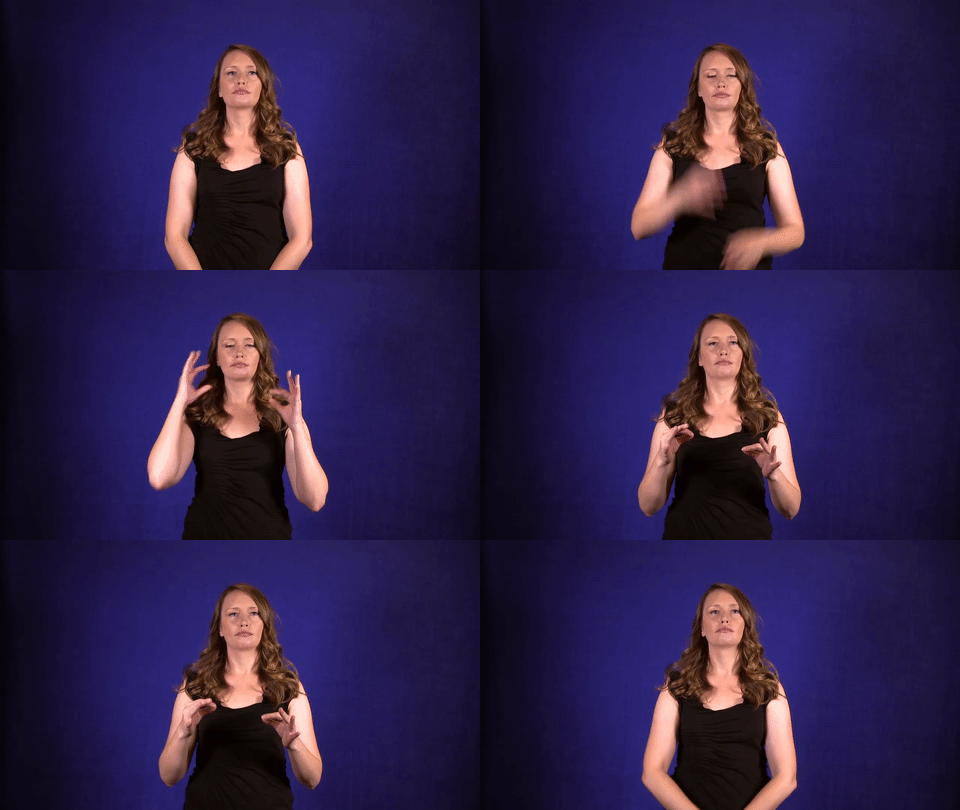
Sign for DECIDED in ASL | 👍 ASL Dictionary

Definition: Having made a choice.

Sign for DECIDED in ASL

YouTube player

Practice Activities:

To practice the sign for DECIDED in ASL, begin by isolating the movement and handshape. Use a mirror to watch your hand placement and facial expression. Sign the word repeatedly, focusing on the transformation from an open thought to a clear outcome, which the motion visually represents. This muscle memory will help you produce the sign more fluently.

Next, move into short sentences using the sign for DECIDED in ASL. For example, sign phrases like: I DECIDED TO GO, SHE DECIDED TO STAY, or WE DECIDED TO EAT. Emphasize clarity and use facial expressions that match the seriousness or lightness of the decision. Try signing the same sentence with different emotions to reflect how the meaning changes.

Use storytelling prompts to incorporate the sign into larger contexts. Tell a story about a time you DECIDED something important, like choosing a school, planning a trip, or solving a problem with a friend. Use at least three sentences and make the sign for DECIDED a clear focal point of the story. This kind of narrative practice builds fluency and confidence.

Work with a partner and take turns sharing short scenarios. One person tells a situation where a decision must be made, and the other person responds using the sign for DECIDED in ASL along with a complete ASL sentence. For example, Partner A signs: I CAN’T CHOOSE BETWEEN MOVIE OR DINNER. Partner B replies: I DECIDED ON DINNER.

Flashcard practice is another great activity. On one side, write various choices like SKATE or BIKE, APPLE or ORANGE. On the other side, sign the sentence using the sign for DECIDED in ASL. This encourages quick thinking and reinforcement of vocabulary in context.

Record yourself signing and then watch to self-correct. Look for smooth transitions, appropriate expression, and clear use of the sign for DECIDED in ASL.

Cultural Context:

In American Sign Language (ASL), signs often carry deeper cultural meaning beyond just their English translations. The sign for DECIDED in ASL is more than just a direct translation of the English word. It reflects how decisions are communicated visually and expresses clarity, intent, and finality within Deaf culture.

The sign for DECIDED in ASL captures the concept of making a firm or resolved choice. It’s not just about picking between options—it’s about expressing that a conclusion has been reached. This sign is used in conversation to show that something is settled or determined, often accompanied by facial expressions to emphasize certainty or finality .

Within the Deaf community, communication relies heavily on intent, clarity, and visual cues. When someone uses the sign for DECIDED in ASL, their expression can add emotional weight—like frustration, excitement, or confidence. This makes the cultural use of the sign very nuanced. The meaning can change subtly based on context, even though the hand movements stay the same.

ASL users frequently incorporate the sign for DECIDED in ASL while discussing personal goals, life choices, or everyday decisions. For example, a student might use it when talking about their college plans, or a parent might use it when discussing rules with children. It lets others know they are not just considering something—they’ve made up their mind .

Unlike spoken English, ASL often bypasses additional filler words and gets straight to the point. So while English might use a phrase like I’ve finally decided or After thinking all night, I decided, ASL may simply incorporate the sign for DECIDED in ASL alongside facial grammar to show that kind of process. The word economy in ASL makes each sign powerful and layered.

The sign itself reflects completion of thought. Once you use the sign for DECIDED in ASL, you’re indicating that all the information has been processed and you’re acting on a conclusion. In Deaf culture, saying you’ve decided conveys responsibility—it shows that you’ve engaged in critical thinking or emotional consideration before reaching that point .

In social interactions, especially in the Deaf community, being direct and clear is highly valued. Using the sign for DECIDED in ASL helps support honesty and clarity in conversation. It cuts out uncertainty and avoids misunderstandings, which is essential in a language that depends on visibility and physical awareness of others.

As with many ASL signs, context and body language can subtly shift the tone of DECIDED. A quick,

Extended Definition:

The sign for DECIDED in ASL reflects the concept of reaching a final choice or conclusion after considering options or possibilities. It expresses determination and a firm mental resolution. In American Sign Language, conveying the concept of DECIDED goes beyond a literal translation and uses visual-spatial aspects to show the thought process leading to a choice.

To make the sign for DECIDED in ASL, you typically start with signs that represent thinking or considering, followed by a movement that signifies finality or decision. The handshape and motion signify that a mental process has ended with a clear conclusion. Facial expressions play an important role in this sign, as they show the seriousness or confidence behind the decision.

People use this sign in various contexts, including personal decisions, professional choices, and emotional commitments. Whether you’re saying you’ve decided what to eat, which school to attend, or how to respond in a situation, the sign for DECIDED in ASL communicates that a conclusion has been reached. It often shows a sense of closure or forward movement.

In conversations, this sign may appear together with other signs that indicate preference, thought, planning, or consideration. For example, someone may sign THINK, THEN DECIDED to show the sequence of the decision-making process. The ASL sentence structure allows for flexibility, as long as the meaning stays clear through appropriate signing and non-manual signals like facial expressions .

The sign for DECIDED in ASL is especially useful when talking about long-term plans, relationship choices, or life goals. It’s a commonly used sign in both casual and formal ASL conversations. Students, educators, interpreters, and everyday users of ASL encounter this sign often.

Learning how to sign DECIDED correctly in ASL includes understanding its placement within ASL grammar. Instead of thinking in direct English word-for-word translation, it’s better to grasp the sign’s purpose within ASL’s visual language system. Positioning, facial expression, and context help the signer show that a decision was critical or simply routine.

The sign for DECIDED in ASL may also be modified slightly depending on who or what the choice refers to, or to show whether the decision was personal or shared. Culture and regional variations might affect the speed or style of the sign, so it’s important to study from native ASL users or qualified language instructors .

When watching fluent signers, you’ll see how smoothly this concept is woven into conversations about beliefs, opinions, and agreements

Synonyms: Determined, Resolved, Settled, Concluded, Certain

Educational resources: Find related learning materials in our course bank!

Want more? Check out some of our popular learning activities on the homepage!

Need to look up a sign? Use our highly rated dictionary: https://aslinteractive.com/best-asl-dictionary/

Follow us on tiktok: https://www.tiktok.com/@aslinteractive. More social media links at the bottom of this page!

Long-tail Keywords: what is the sign for decided in ASL, how do you sign decided in ASL, ASL sign for decided

Categories:

tags: Decisions, Verbs, Actions, Major decisions, Language Learning

Parameters

*Handshape*:

The handshape for the sign for DECIDED in ASL begins with both hands in the “open flat” or “5” handshape, palms facing each other near the sides of the head. As the movement progresses, both hands transition into an “F” handshape, where the index finger touches the thumb and the remaining fingers are extended.

This transformation from open to a precise shape helps visually represent the decision-making process. The sign for DECIDED in ASL emphasizes a thoughtful choice, starting from consideration and ending with clarity. ✅

*Palm Orientation*:

The palm orientation for the sign for DECIDED in ASL begins with both hands in a flat “B” handshape, palms facing each other near the temples. As the movement progresses, the hands move downward and outward, rotating so that palms end facing down toward the ground.

Throughout the sign for DECIDED in ASL, the hands maintain a controlled motion, with the orientation emphasizing the mental process of making a choice. This palm direction helps convey the concept of turning thoughts into a clear decision.

*Location*:

The sign for DECIDED in ASL begins near the forehead, at about eye level, indicating a thoughtful or mental process. The hands then move down to chest level, reflecting the outcome or finality of a conclusion. This location supports the meaning of making a decision after careful consideration. The sign for DECIDED in ASL uses space in front of the body to visually portray internal decision-making becoming external.

*Movement*:

Start with both index fingers pointing up near the forehead, as if forming the sides of a thought bubble. Then move both hands downward and slightly apart, changing into flat “O” handshapes and positioning them in front of the torso as if placing something down deliberately.

The sign for DECIDED in ASL symbolizes arriving at a conclusion or making a judgment. This movement expresses the transition from thinking to a clear determination. ✅

*Non-Manual Signals*:

The non-manual signals for the sign for DECIDED in ASL typically include a serious or neutral expression, showing that a firm decision has been made. The eyebrows are often slightly furrowed, and the lips may press together briefly as the decision is solidified.

These expressions help reinforce the finality conveyed by the sign for DECIDED in ASL. The face communicates resolve and clarity, matching the concept of making a definite choice.

*Prosody, Dominant/Non-Dominant Hand*:

The sign for DECIDED in ASL uses both hands. The dominant hand begins as a flat “O” hand near the temple, representing a thoughtful or considered choice. It then moves downward and transforms into a flat “H” or slicing motion, landing decisively into the palm or space near the non-dominant hand, which may be in a passive flat position. This conveys finality and resolution in the sign for DECIDED in ASL.

The non-dominant hand remains steady throughout, acting as a foundation or receiving surface for the decisive action from the dominant hand. Movement is typically firm and precise, helping to emphasize the conclusive nature of the sign for DECIDED in ASL ✅.

Tips for Beginners:

The sign for DECIDED in ASL can take a bit of coordination at first, especially since it involves a combination of expressive facial grammar and hand placement. A great way to start is by watching fluent signers and practicing in front of a mirror. This helps you match both your hand movements and facial expressions, which are crucial to conveying the firmness implied in the concept of “decided.”

Beginners often confuse the sign for DECIDED in ASL with related concepts like “choose” or “select.” While they can be similar, DECIDED tends to involve a more final and firm facial expression. Keep your brows slightly furrowed and your movements deliberate when signing this. Avoid rushed or floppy hand motions, as these can make the message unclear.

Make sure your dominant hand is doing the bulk of the expressive motion. In some variations, the sign uses a “think” gesture followed by flattening two “F” handshapes onto either side, like setting down two clear options and choosing definitively. Ensuring your transitions between hand shapes are clean and deliberate will help your sign be more accurate. Record yourself or get feedback from others to minimize ambiguity.

One of the most common pitfalls with the sign for DECIDED in ASL is lack of facial engagement. Since ASL is a visual language, facial expressions act like tone of voice. Practice adding a firm, resolved look to your face while signing. This really reinforces the meaning.

For better retention, try using this sign in sentences that reflect real decision-making contexts in your life. The more you use the sign for DECIDED in ASL in daily phrases, the more natural it will become in your expressive vocabulary. Consistent repetition and varied examples are key.

sign for DECIDED in ASL, how to sign decided in ASL, ASL vocabulary decided, learn ASL decided sign, ASL sign practice decided, sign language decided meaning

Connections to Other topics:

The sign for DECIDED in ASL connects closely to concepts like THINK, CHOOSE, and DECISION. It typically builds off the sign for THINK, transitioning into a sign that signifies a final choice or resolution. This illustrates how mental processing signs in ASL often evolve into signs that demonstrate action taken as a result of thought.

Understanding the sign for DECIDED in ASL can help learners grasp how abstract cognitive processes are visualized in sign language. For example, when combined with contextual signs like FUTURE or GOALS, it can convey complex ideas such as making long-term plans or resolutions. This mirrors how spoken language uses modifiers or additional words to clarify meaning.

The sign for DECIDED in ASL also connects with signs like PLAN, CHOOSE, and FINAL. These signs, when used in sequence or compound form, expand conversations and help structure narratives. For instance, “I DECIDED PLAN CANCEL” could be part of a conversational structure to explain a change of mind in plan-making.

In ASL storytelling or discourse, the sign for DECIDED in ASL can carry emphasis when paired with facial expressions and body language. It can indicate a wavering thought turned firm or show a sudden resolve in situations involving personal conflict, goals, or decisions affecting others. This demonstrates how ASL integrates emotion with conceptual accuracy.

Additionally, there are variations of DECIDED that reflect different contexts or degrees of decision-making. For example, a more casual or spontaneous decision might involve less intense facial expression and quicker signing, while a firm decision incorporates deliberate movement and firm handshape. This shows the nuanced layers ASL provides through modulations.

Recognizing the cultural and grammatical aspects of the sign for DECIDED in ASL enhances fluency. It is often used with role-shifting or rhetorical questions to frame decisions within dialogue. Understanding these connections offers richer, more authentic ASL usage for learners aiming to master both language and expression.

Summary:

The sign for DECIDED in ASL represents the act of reaching a conclusion or making a judgment after considering options or weighing choices. This sign often connects with concepts like choice, judgment, and determination. The motion and handshapes used in the sign reinforce the idea of narrowing ideas down to one solid outcome.

To perform the sign for DECIDED in ASL, you typically begin by forming two “F” handshapes (thumbs and index fingers touching to form a circle, other fingers extended). These handshapes start near the temples or forehead, indicating thought or consideration. Then you move them downward and outward, placing them apart near chest level, finishing as if placing an answer into the space. This reflects a common ASL metaphor of thoughts becoming decisions.

This sign can also resemble the sign for JUDGMENT or CONCLUSION when done in certain contexts, reflecting the cognitive aspects of deciding. In discussions emphasizing thinking versus emotional impulse, the sign may be contrasted with signs for FEEL or WANT. These subtle shifts show how ASL deeply integrates thought into expression through visual-spatial logic.

Linguistically, the sign for DECIDED in ASL is categorized under verb signs and represents a mental process. It incorporates both iconic and abstract features, balancing between literal gesture and conceptual metaphor. The sign utilizes space and directionality to convey finality or resolve.

Variation in the sign can exist depending on region or generational usage. However, the general structure of using “F” handshapes to show final selection is common across most ASL dialects. Some communities might start the motion above the head, while others keep it near the brow line, adapting to visual clarity or stylistic preference.

Culturally, the sign for DECIDED in ASL emphasizes the agency of the signer. In Deaf culture, expressing personal choice or decision is a valued part of conversational interaction. Making a decision is often associated with integrity, independence, and assertiveness within ASL discourse.

The concept of “deciding” is closely tied with autonomy in the Deaf community, where self-advocacy plays a big role. Educational, medical, and access decisions often depend on the ability to confidently express one’s decisions, making this sign powerful in everyday communication. The sign appears in scenarios from classroom activities to social or political conversations.

Grammatically, the sign for DECIDED in ASL is a verb and behaves similarly to other mental state verbs such as KNOW, THINK, and AGREE. It can be modified for tense or emphasis through facial expressions and non-manual markers. For instance, raised eyebrows and a sharp nod can intensify certainty and finality.

This sign functions in narrative as an action or a turning point, frequently combined with clauses like “I thought,” “Then I…” or “Finally…” to show progression. It’s often placed mid-sentence and precedes the result or consequence of the decision. The sign for DECIDED in ASL serves both temporal and logical syntax roles, depending on context.

In linguistic terms, the movement from the head outward shows a transition from internal thought to an externalized result. This spatial mapping parallels common ASL grammar patterns that place mental concepts near the forehead and outcomes in front of the body. Such visual arrangement offers high communicative clarity with minimal signs.

The repetition or doubling of this sign isn’t typical unless used for emphasis. Intensity instead is expressed through speed, facial expressions, or body posture. For example, a firm posture and quick execution of the sign show determination, while slower, hesitant signing may show uncertainty or the process of deciding.

Parents often use the sign for DECIDED in ASL in teaching children choice-making skills. It’s taught contextually during games, mealtime choices, or problem-solving activities. The ability to sign decisions empowers Deaf children to express boundaries and preferences early in life.

Educational interpreters often rely on this sign to relay classroom language, ensuring that decision-making processes in subjects like math or social studies are visually accurate. For example, in interpreting a math word problem where a student must choose a method or solution, this sign signals that a judgment has been reached.

The sign for DECIDED in ASL also appears frequently in legal, advocacy, and political discourse among Deaf professionals. When discussing public policy or negotiations, this sign affirms that a final stance or choice has been made. The formality of the sign fits well in structured environments while still being flexible in casual dialogue.

In conversations involving group decisions, such as voting or consensus, the sign may be accompanied by signs like GROUP, MAJORITY, or VOTE. This indicates that the decision was not merely personal but involved collective input. Such use reflects broader themes of community and shared values in Deaf spaces.

The sign connects thematically with signs like AGREE, CONCLUDE, CHOOSE, and FINAL. Each of these occupies a spectrum of mental processing verbs, showing how ASL views decisions as the culmination of multiple

Want more? Check out some of our popular learning activities!

ASL Interactive Resources

ASLInteractive YouTube Channel

Follow us on tiktok: @aslinteractive.com

Follow us on Instagram: aslinteractive

Facebook page: aslinteractive

Facebook group: aslinteractive

LInkedIn: ASL Interactive LLC

Twitter: @ASL_interactive

*Some information on this page is AI-generated. AI can make mistakes. Please check the information.

Sign for DECIDED in ASL

Responses