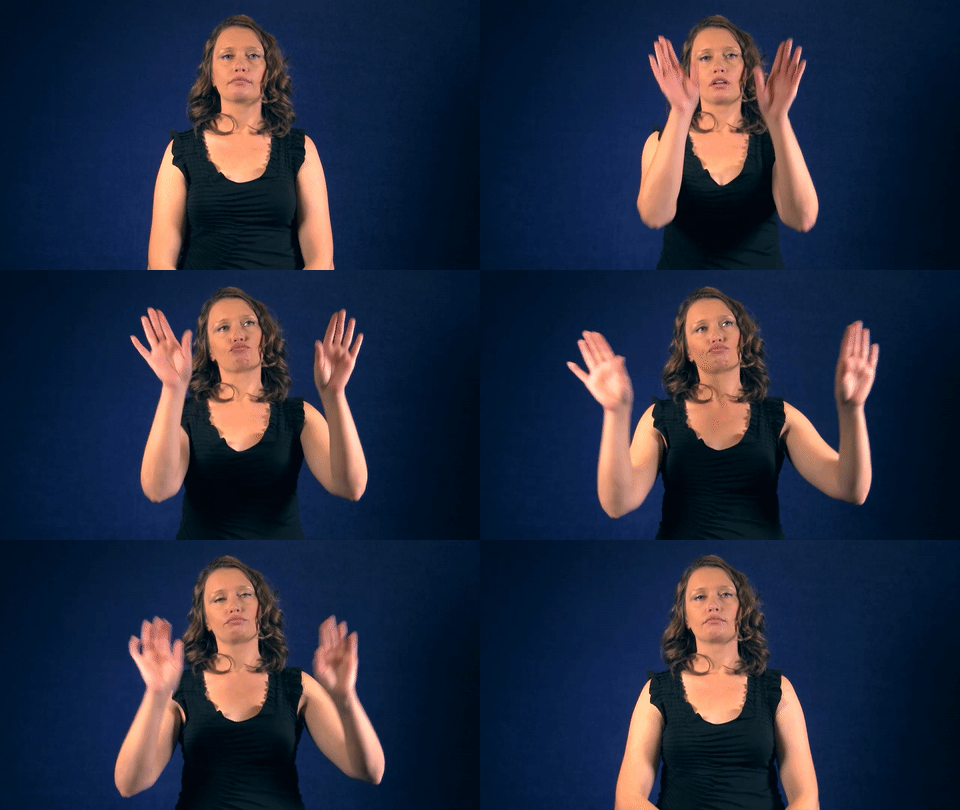
Definition: To add decorations.
Sign for DECORATE in ASL

Practice Activities:
To begin practicing the sign for DECORATE in ASL, start by rehearsing the sign in isolation. Use a mirror to observe your handshape and movement. Repeat the sign multiple times while maintaining a relaxed arm movement, ensuring the circular motion is symmetrical and even on both sides of your body.
Next, incorporate the sign into small phrases. Try expressions like “we decorate tree,” “they decorate house,” or “I decorate room.” Practice transitioning smoothly between each sign so you build fluency with contextual expressions. This helps your fingerspelling and expressive signing stay fluid and connected.
Create a list of events or holidays when people typically decorate. For each event, sign a sentence such as “Family decorate house for Halloween” or “Students decorate classroom for graduation.” This allows you to personalize the vocabulary, making it easier to retain and use.
Develop short stories or vignettes about preparing for a party or celebration. For example, sign a story about getting ready for a birthday party, including signs like CLEAN, BALLOONS, CAKE, and finally, DECORATE. If practicing with a partner, take turns retelling the story and asking questions using WH-signs like WHO, WHAT, or WHEN.
Use role-play to practice the sign for DECORATE in ASL in different scenarios. One partner can play a parent and the other a child decorating a room, or two friends decorating for a surprise party. Switch roles and settings to expand creativity and language use.
Watch ASL videos or sign-along stories that include home improvement or holidays. Observe and copy how fluent signers use the sign for DECORATE in ASL naturally in context. Imitating in context improves memory and usage so the sign becomes second nature.
Cultural Context:
In American Sign Language, the sign for decorate in ASL carries more than just a surface meaning. It’s often used when referring to cultural celebrations, seasonal changes, and even personal artistic expression in the Deaf community. Whether it’s preparing for holidays or simply beautifying a space, the act of decorating often holds strong emotional and communal value.
The sign for decorate in ASL is commonly used in conversations around holidays like Christmas, Hanukkah, or Halloween. Deaf families use this sign when talking about putting up lights, ornaments, or festive displays . It’s a visual way to express joy and participation in shared traditions.
In Deaf culture, visual expression plays a huge role in communication and celebrations. Homes, classrooms, and shared spaces are often adorned with bold, vibrant visuals. Using the sign for decorate in ASL helps convey the intentional act of beautifying a space for these events or seasons.
When teaching children in ASL environments, educators frequently use the sign for decorate in ASL while participating in craft activities or classroom displays. This introduces vocabulary in an expressive and fun way while reinforcing the connection between language and creativity. For example, schools might teach students how to fingerpaint or hang artwork, using this sign to describe the process.
The use of the sign for decorate in ASL also extends to fashion and personal expression. Deaf individuals who are passionate about clothing, makeup, or accessories may use this sign to explain how they enhance their appearance. It’s not just about physical items but how identity and culture are visually shared.
In religious and spiritual settings, the sign for decorate in ASL may also appear in signed prayers or storytelling. Churches, synagogues, and community centers often celebrate holidays with decorations that enhance the spiritual mood. Conversations around setting up events or memorial tables often include this sign.
Many Deaf artists and performers use the sign for decorate in ASL when talking about their process of shaping a stage or preparing visuals for a show . The sign reflects a visual and spatial understanding of performance that is central to Deaf cultural expression. Artistic decoration is part of storytelling and stagecraft.
Community events and festivals also highlight the use of the sign for decorate in ASL. Whether it’s booths, banners, or art installations, the act of decorating brings people together. It’s a shared moment of transformation and identity-building that the Deaf community values.
Social media posts that discuss event planning, home styling, or seasonal themes will often incorporate the sign for decorate in ASL in v
Extended Definition:
The sign for decorate in ASL is expressive and visual, just like the concept it represents. It typically involves using both hands in a sweeping, outward motion, as if you’re spreading decorations or adding flair around a space. This sign beautifully captures the idea of enhancing or beautifying something, whether it be a room, a table, or even your appearance.
When using the sign for decorate in ASL in conversation, it usually refers to making something look festive, elegant, or visually pleasing. This could be for holidays, parties, special events, or even just day-to-day tidying with an artistic touch. The sign can easily shift in its style or intensity depending on what you’re decorating and how elaborate the decorations are.
Like many signs in American Sign Language, context matters when signing decorate. If you’re talking about decorating for Christmas, you might incorporate signs for tree, lights, or ornaments before or after using decorate. If the discussion is about fashion or makeup, the decorate sign might be part of a larger sequence related to appearance or personal style.
The sign for decorate in ASL can also convey a sense of celebration or transformation. It implies not just changing the way something looks but doing so in a way that brings joy, pride, or expression. Whether you’re preparing a home for guests or adding final touches to a gift, the decoration process is part of meaningful social interaction.
Decorating is a common topic in both casual and formal conversations within the Deaf community. Whether it’s planning a wedding, preparing for a festival, or even discussing interior design preferences, knowing the sign for decorate in ASL enriches your ability to express yourself. The visual nature of the language makes abstract ideas like beauty and arrangement easy to communicate.
You might also see variations of the sign for decorate in ASL depending on region or personal signing style. As with many signs, fluidity and slight modifications can occur to match the tone, emotion, or even speed of the conversation. Receptive skills are just as important as expressive skills, so being familiar with different versions of this sign is helpful. ️
Understanding how to use the sign for decorate in ASL can also be useful in educational settings or when working with children. Teachers and caregivers often use this sign while prompting kids to express themselves artistically. Whether decorating classrooms, crafts, or themselves, this sign encourages creativity and engagement.
Additionally, the sign for decorate in ASL ties into cultural values around celebration, presentation,
Synonyms: Adorn, Embellish, Ornament, Enhance, Beautify
Educational resources: Find related learning materials in our course bank!
Want more? Check out some of our popular learning activities on the homepage!
Need to look up a sign? Use our highly rated dictionary: https://aslinteractive.com/best-asl-dictionary/
Follow us on tiktok: https://www.tiktok.com/@aslinteractive. More social media links at the bottom of this page!
Long-tail Keywords: what is the sign for decorate in ASL, how do you sign decorate in ASL, ASL sign for decorate
Categories:
tags: Decorating, Holidays, Christmas, Everyday Activities, Occasions
Parameters
*Handshape*:
The handshape used in the sign for DECORATE in ASL involves both hands forming open relaxed 5-handshapes ️. Fingers are spread slightly apart, and the palms usually face downward or slightly inward. The hands move in a sweeping or alternating outward motion, suggesting the act of placing or spreading decorations.
This expressive handshape captures the visual and spatial nature of the sign for DECORATE in ASL, adding to its aesthetic feel. The use of the 5-handshape emphasizes the spreading or adorning motion often associated with decoration.
*Palm Orientation*:
In the sign for DECORATE in ASL, both hands are typically in open five-handshapes with fingers spread. The palm orientation begins facing slightly inward or diagonal toward the body.
As the hands move outward in a sweeping or spiral-like motion, the palms may shift slightly upward or forward depending on the regional variation. This palm orientation emphasizes the idea of spreading or adorning, which aligns with the expressive meaning behind the sign for DECORATE in ASL .
*Location*:
The sign for decorate in ASL is typically produced in neutral space, centered in front of the torso, around chest level. Both hands are used and begin close to the body before moving outward and slightly upward in a flowing gesture, mimicking the action of adorning or embellishing.
Facial expression is usually pleasant or expressive, reflecting the joyful context in which the sign for decorate in ASL might be used, such as for holidays or celebrations. The location remains consistent across different contexts.
*Movement*:
The sign for DECORATE in ASL typically involves both open hands, palms facing inward, starting near the center of the body. The hands then move outward and upward in a wavy or fluttering motion, as though spreading or scattering decorations. ✨ This movement reflects the act of arranging or placing decorative elements.
To clearly express the sign for DECORATE in ASL, the motion should be fluid and graceful, resembling someone beautifying or trimming something. The outward motion of the hands helps convey the spreading or enhancing quality of decoration.
*Non-Manual Signals*:
When using the sign for DECORATE in ASL, the facial expression should convey a sense of delight or enthusiasm, often with raised eyebrows and a slight smile . Depending on the context, a proud or playful expression may also be appropriate to show that the action is fun or creative.
The non-manual signals help emphasize the visual appeal and joy often associated with the act of decorating. These cues add depth to the sign for DECORATE in ASL, enhancing its meaning.
*Prosody, Dominant/Non-Dominant Hand*:
The sign for DECORATE in ASL uses both hands symmetrically. The dominant and non-dominant hands are open with fingers spread, moving outward and in a wavy motion near the chest, as if draping something decorative. ✨ Handshape and motion suggest the act of embellishing or making something more visually appealing.
In the sign for DECORATE in ASL, both hands follow parallel paths, maintaining fluidity and rhythm. The prosody of the sign shows a graceful, sweeping motion that mirrors the expressive nature of decoration.
Tips for Beginners:
When learning the sign for DECORATE in ASL, start by focusing on the smooth, sweeping motion of your dominant and non-dominant hands. This sign typically mimics a gesture of elegantly scattering or placing something around, like decorations on a wall or tree. Practice these gestures in front of a mirror to ensure that both hands move symmetrically and with fluid motion.
One tip for mastering the sign for DECORATE in ASL is to think about decorating in real life—like putting up streamers or ornaments. Let your hands reflect that natural intention. If your movements are too stiff or robotic, the message may come across as unclear or awkward. Focus on how your facial expression can complement the meaning, giving the sign more emotion and emphasis without exaggerating.
A common pitfall is moving the hands too fast or without purpose. It’s not just about moving your hands but making sure the meaning is visually clear to the viewer. Keep your motion gentle yet deliberate for optimal clarity. It can also help to watch fluent signers and copy their rhythm and pace.
Beginners might also struggle with matching the emotion behind the sign. When using the sign for DECORATE in ASL, you could be describing festive events or creative expression. Add some liveliness to your face—raise your eyebrows or smile lightly—to mirror that purpose. This helps the sign look less mechanical and more emotionally appropriate.
Repetition is important. Try incorporating the sign for DECORATE in ASL into real or practice dialogues about holidays, parties, or home design. The more you use it, the more naturally it will come to you. Use videos or apps to compare your sign with native signers for feedback and improvement .
Connections to Other topics:
The sign for DECORATE in ASL is closely related to the concept of embellishment, style, and design. It shares similarities with signs for BEAUTIFUL, FANCY, and CELEBRATE, especially when expressing visual enhancement or aesthetic appeal. These signs often involve expressive movement and can overlap in usage, depending on the context.
In conversation, the sign for DECORATE in ASL may be incorporated into larger structures or narratives, such as describing how someone prepares a room for a party or holiday. It can be combined with signs like TREE, LIGHTS, or HOME to convey more complex ideas like “decorating the Christmas tree” or “the house is decorated for Halloween.” The ability to layer signs this way shows how ASL functions visually and spatially.
This sign also connects to cultural and seasonal vocabulary. For instance, when discussing holidays like CHRISTMAS, HALLOWEEN, or DIWALI, learners often pair the sign for DECORATE in ASL with specific thematic signs. It plays a key role in storytelling or vlogging in ASL about events or traditions, creating a rich narrative by layering decoration-related terms.
Conceptually, this sign links with the broader theme of aesthetics and celebration in the Deaf community. In performance arts such as Deaf theater or visual poetry (ASL poetry), the sign for DECORATE in ASL may be used metaphorically to represent creative or stylistic expression. It embodies more than physical embellishment—it can symbolize identity and presentation.
Additionally, some learners find that the sign’s flowing, spatial motion helps reinforce other spatial concepts like ARRANGE or FURNITURE. These connections help deepen understanding of how ASL uses space to group ideas and actions. Observing how the sign for DECORATE in ASL works together with descriptive classifiers enhances one’s expressive abilities in visual storytelling.
Summary:
The sign for DECORATE in ASL generally uses both hands in a motion that emphasizes spreading or adorning something. The hands move outward from a central point with fingers slightly wiggling or fluttering, suggesting embellishment or enhancement. The motion often implies light touches across a surface, mimicking how one might distribute ornaments or arrange visual elements.
This sign captures the dynamic and visual nature of decorating. It embodies the act of enhancing, beautifying, or adding flair to environments or objects. The movement is typically performed at chest level, though it can be adjusted based on context.
Context deeply affects how the sign for DECORATE in ASL is interpreted. When describing seasonal holidays, the emphasis might be more festive. For home improvement or artistic expression, the motion might be more focused or deliberate.
Grammatically within ASL, the sign for DECORATE functions as a verb. It can also be used adjectivally in combination with other signs to describe something that is already embellished or visually enhanced. This flexibility allows signers to adapt it across various sentence structures and emphasis needs.
The sign for DECORATE in ASL can reflect both literal and metaphorical language. While commonly used for tangible decoration—like homes, rooms, or clothing—it may also be employed in discussions of metaphorical ‘decorating’ such as enhancing speech or performances. This semantic range makes it a lively and visually rich sign.
Culturally, decoration carries rich meaning in Deaf spaces. From prized event banners that reflect community pride to the artistic layout of signing spaces, the concept of decoration interweaves with expression. The sign for DECORATE in ASL can thus play a key role in visually-driven storytelling or event planning within the community.
Related signs include BEAUTIFUL, ORNAMENT, CELEBRATE, and ART. BEAUTIFUL shares a similar expressive quality and is sometimes used alongside DECORATE to emphasize visual appeal. ORNAMENT may accompany it during holiday contexts and tends to highlight specific decorative items.
CELEBRATE often pairs with DECORATE to describe festive preparation. Signers will frequently use a sequence like PLAN, DECORATE, CELEBRATE to provide a narrative around events. These natural clusters showcase how the ASL lexicon cooperates to build rich descriptions.
ART may also intersect with the sign for DECORATE in ASL, especially when discussing visual expression. Whether creating an installation, designing a room, or enhancing clothing, decoration and art often overlap. Many Deaf artists rely on such signs to describe their creative processes.
Linguistically, the handshape for DECORATE typically uses open flat hands (B handshapes) or occasionally F handshapes when emphasizing detailed enhancement. These handshapes support the depiction of spatial adornment. Their movement across the air spatializes the concept of enhancement and is easily modified for plural, locative, or aspectual variation.
The sign for DECORATE in ASL is spatially adaptable. Signers can change direction and space to indicate whom or what is being decorated. This accords with ASL’s visual-spatial modality, which values clarity and efficiency in depicting relationships in space.
In terms of classifiers, CL:5 or CL:1 might complement descriptions involving decoration. A CL:1 could represent strings of lights or garlands being applied. A CL:5 could show general distribution of decorations across wider areas. These classifiers enrich narratives significantly.
Applied linguistics insights can be drawn from how ASL teaches visual cognition. Learning how to use the sign for DECORATE in ASL encourages thinking through images and motion. It advances spatial reasoning in both Deaf and hearing ASL users by modeling conceptual blending of ideas and space.
Deaf children may learn the sign for DECORATE in ASL through thematic lessons linked to holidays or school events. These thematic lessons support cognitive growth, language development, and cultural engagement. They allow learners to describe their world using increasingly abstract or layered language.
The emotional connotations of the sign are generally positive. It connotes care, preparation, and anticipation. Signers using it often demonstrate a cheerful demeanor, further conveying the uplifting tone of the act of decorating.
In celebration contexts, the sign for DECORATE in ASL amplifies excitement. It visually communicates festivity—sparkling hand motions, bright facial expressions, and clear spatial framing. These elements combine to form a narrative experience that is both linguistically descriptive and emotionally rich.
In artistic contexts, DECORATE may also align with design or craft-based signing. Artists and designers in the Deaf community often adapt or enrich the base sign with additional lexical elements. These may include signs like COLOR, TEXTURE (FINGERSPELLED), or PATTERN (FINGERSPELLED).
Its metaphorical extensions are also notable. People may use the sign in more abstract ways when describing how someone enhances a story, idea, or emotional expression. In such cases, DECORATE functions almost adverbially,
Want more? Check out some of our popular learning activities!
ASL Interactive Resources
ASLInteractive YouTube Channel
Follow us on tiktok: @aslinteractive.com
Follow us on Instagram: aslinteractive
Facebook page: aslinteractive
Facebook group: aslinteractive
LInkedIn: ASL Interactive LLC
Twitter: @ASL_interactive
*Some information on this page is AI-generated. AI can make mistakes. Please check the information.


Responses