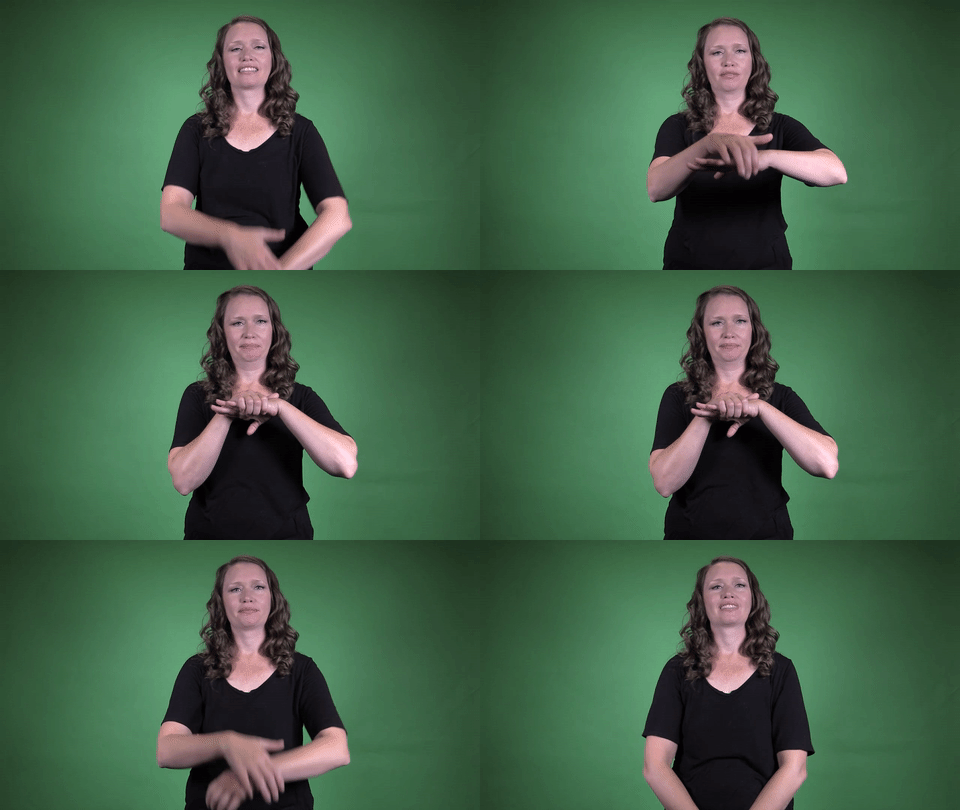
Definition: The language spoken in England.
Sign for ENGLISH in ASL
Practice Activities:
To begin practicing the sign for ENGLISH in ASL, start with isolated repetition. Stand in front of a mirror and form your dominant hand into a flat “O” shape. Place it over the back of your non-dominant hand, which is relaxed and palm-down, then gently pull the dominant hand upward while keeping contact. Repeat this motion slowly ten times to build muscle memory and become more comfortable with the movement.
Next, practice signing common phrases that include the sign for ENGLISH in ASL. Try combinations like “Do you speak English?”, “English class today,” or “I am learning English.” Sign these phrases slowly while focusing on facial expressions to match the tone. Record yourself, then review your signing to improve accuracy and fluidity.
Use flashcards to mix and match language and class signs to create short, two-word prompts such as “English teacher,” “English grammar,” or “English homework.” Sign each phrase while saying it aloud to reinforce vocabulary. A fun variation is to time yourself and see how many different phrases using English you can come up with in one minute.
Practice storytelling by describing a short scenario where English plays a role. For example, sign about going to an English class, reading an English book, or helping a friend understand English. This is a great way to apply the sign for ENGLISH in ASL in a natural context and strengthen narrative skills.
For paired practice, take turns with a partner asking and answering questions like “Which language do you prefer?” or “Is English easy or hard?” Focus on keeping the sign for ENGLISH in ASL clear and consistent in each exchange. Repeat with increasing speed and fluency to challenge your recall and sign production under conversational conditions.
Cultural Context:
The sign for ENGLISH in ASL carries cultural and historical meaning in the Deaf community. It’s more than just a translation of a spoken word; it represents the concept of the English language from a Deaf perspective. In American Sign Language, the sign for ENGLISH in ASL often involves the dominant hand grasping the back of the non-dominant hand, symbolizing a holding or clinging motion.
Throughout history, the sign for ENGLISH in ASL has also reflected the impact that English has had on Deaf education and communication. In many cases, the dominance of spoken English in mainstream education systems suppressed the natural use of ASL, which led to cultural loss and language deprivation for Deaf individuals. Because of this, the sign for ENGLISH in ASL can carry emotional and historical associations for signers, especially those who experienced oralist methods in school.
Culturally, using the correct sign for ENGLISH in ASL shows respect for the linguistic differences between American Sign Language and English. ASL is its own complete language with unique grammar, structure, and cultural identity. When people learn the sign for ENGLISH in ASL, they begin to understand the separation between the two languages and appreciate ASL as a valid standalone language.
In community interactions, the sign for ENGLISH in ASL is often used to indicate when someone is speaking or writing in English rather than signing in ASL. Deaf individuals might use this sign to clarify language preferences or switch between languages during a conversation. This highlights how bilingualism in ASL and English is common but also complex within the Deaf community.
The sign for ENGLISH in ASL is also crucial in educational settings. Deaf educators and interpreters use it to distinguish between instruction in English and teaching that includes ASL. This distinction is important when advocating for accessible education that honors visual learning and Deaf cultural values.
Many learners discover the sign for ENGLISH in ASL early in their studies. It helps them navigate communication choices and understand the expectations in different situations. New signers often use the sign when asking if someone wants to communicate in ASL or use English-based methods like Signed English or finger spelling.
Learning the sign for ENGLISH in ASL also reveals how closely language is tied to identity. For many in the Deaf community, being fluent in ASL, while also navigating English, is a crucial part of self-expression and empowerment. Using the sign for ENGLISH in ASL appropriately helps bridge cultural gaps between signers and non-signers.
The
Extended Definition:
The sign for English in ASL is an important piece of vocabulary for anyone learning American Sign Language. It helps to identify the English language and is often used when discussing communication preferences, languages, or education.
To produce the sign for English in ASL, your dominant hand grasps the back of your non-dominant hand, which is palm-down and extended in front of you. You then gently pull the dominant hand back toward your body, maintaining the grip. This movement mimics the idea of bringing something together or drawing it in, which symbolically represents the connection to language.
This gesture reflects more than just vocabulary. The sign for English in ASL represents the merging of culture, communication, and linguistic identity. In conversation, it may be used to ask if someone speaks English, understands English, or prefers communicating in English rather than ASL.
It’s common to see this sign used in classroom settings, interpreter introductions, or when meeting new people. Deaf individuals and interpreters may use it to clarify which language will be used during communication. This helps create access and ensures everyone is comfortable with the chosen language format.
Like many signs in ASL, the sign for English may have slight regional variations across different communities. Some Deaf people may use a slightly modified version or alter the motion subtly while maintaining the basic meaning. It is important to remain aware of these variations and adapt based on context and community setting.
When fingerspelling is not practical or takes too long, using the sign for English in ASL becomes a quicker and more natural way to refer to the English language. This is especially true in fluent ASL conversations, where clarity and efficiency go hand-in-hand.
New ASL learners are encouraged to practice this sign in front of a mirror or with a fluent signer to ensure the motion and positioning are accurate. Facial expressions are also a key part of ASL and should match the context in which the sign for English is being used.
It’s helpful to pair this sign with others such as ASL, Spanish, or interpret to build sentences and better express communication ideas. For example, you might combine signs to say I speak English or I need an English interpreter. This strengthens your ASL skills and builds conversational fluency.
Understanding the sign for English in ASL can also help break down communication barriers between Deaf and hearing individuals. When both parties are aware of language preferences from the beginning, interaction becomes easier, more respectful, and more inclusive.
In digital content or social media videos,
Synonyms: English, English language, English grammar, English vocabulary, English-speaking
Educational resources: Find related learning materials in our course bank!
Want more? Check out some of our popular learning activities on the homepage!
Need to look up a sign? Use our highly rated dictionary: https://aslinteractive.com/best-asl-dictionary/
Follow us on tiktok: https://www.tiktok.com/@aslinteractive. More social media links at the bottom of this page!
Long-tail Keywords: what is the ASL sign for English, how to sign English in American Sign Language, what does English look like in ASL
Categories:
tags: English in American Sign Language, Learn ASL English translations, English to ASL dictionary, How to sign English in ASL, Translate English words to ASL
Parameters
*Handshape*:
The handshape for the sign for ENGLISH in ASL involves using a flat dominant hand in the “A” handshape. The non-dominant hand is held palm-down and flat in front of the body. The dominant “A” hand wraps over the back of the non-dominant hand, resembling a clasping motion .
This handshape clearly conveys the concept when signing the sign for ENGLISH in ASL. It’s important to use a firm but gentle motion to ensure clarity and maintain proper form throughout the sign.
*Palm Orientation*:
The palm orientation for the sign for ENGLISH in ASL involves the dominant hand in a flat “5” shape being placed on the back of the non-dominant hand, which is also in a flat shape. The dominant palm faces downward while resting on the non-dominant hand.
During the motion, the dominant hand slightly pulls the non-dominant hand toward the body with a gentle grasp. The sign for ENGLISH in ASL relies on this interaction to communicate the concept clearly.
*Location*:
The sign for ENGLISH in ASL is performed near the middle of the chest. One hand, typically the dominant hand, grasps or cups over the back of the non-dominant hand, which remains stationary with the palm down. The movement pulls the dominant hand slightly inward toward the center of the chest area.
This location near the torso emphasizes the central importance of the sign for ENGLISH in ASL in communication. Keeping it at chest level allows for clear visibility and consistency in usage.
*Movement*:
To perform the sign for ENGLISH in ASL, start with your dominant hand in a flat “closed” 5 shape. Place it on top of the back of your non-dominant flat hand, which is also in a 5 shape and held palm-down in front of you.
Then, gently pull your dominant hand upward and slightly toward your body, as if drawing something in. The movement should look fluid and natural, suggesting connection or bringing together. The sign for ENGLISH in ASL conveys the idea of communication or uniting concepts through language. ️
*Non-Manual Signals*:
For the sign for ENGLISH in ASL, the facial expression is generally neutral or slightly inquisitive depending on the context. Eyebrows may raise slightly if asking about language use, or stay relaxed during statements.
The sign for ENGLISH in ASL can also be paired with a slight head tilt for emphasis, especially when comparing languages or highlighting language skills. Eye contact with the conversation partner helps maintain engagement during the expression.
*Prosody, Dominant/Non-Dominant Hand*:
The sign for ENGLISH in ASL uses the dominant hand to clasp over the back of the non-dominant hand, both in relaxed flat shapes. Typically, the non-dominant hand stays in place, palm down, while the dominant hand taps or gently clasps over it near the wrist area.
This motion captures the idea of connecting or bringing together, symbolizing communication. The sign for ENGLISH in ASL is commonly used in conversations to identify the language being spoken or translated.
Tips for Beginners:
When learning the sign for ENGLISH in ASL, one of the most important things to focus on is the hand placement and contact. The dominant hand closes into a flat “A” shape (knuckles down, thumb clenched along the side), and gently grabs or cups the back of the non-dominant hand, which is relaxed and palm down. This action happens near the palm area of the non-dominant hand and pulls inward slightly toward the signer. Make sure your movement is deliberate but gentle for clarity.
Many beginners confuse the sign for ENGLISH in ASL with similar signs like HELP or BRING because of the hand movements. To avoid this, pay close attention to the location on the body and the intended motion. ENGLISH uses a pulling-in action with both hands near each other, but not raised above the chest. The palms should not face forward and no upward motion is involved.
It helps to practice this sign in front of a mirror to ensure your positioning looks natural and matches fluent signers. Watching native ASL users sign the word in sentences can improve your sense of flow. Repeating the motion with purpose will help you gain muscle memory.
Don’t rush your progress. Focus on the rhythm and relaxed fluid motion rather than sharp or stiff movements. Overexaggerating or compressing the movement makes your sign unclear. Keep your facial expression neutral unless you’re adding emotional tone or context.
When using the sign for ENGLISH in ASL in conversation, be mindful of eye contact and the visual context. Since this is a common sign, fluency depends on combining accuracy with pacing and understanding. Practicing in actual dialogues or with a study buddy can increase your confidence and reinforce what it feels like to use it in real interactions.
Connections to Other topics:
The sign for ENGLISH in ASL creates a strong connection between language and culture. It is often used in contrast with signs for other languages like SPANISH, FRENCH, or ASL itself. This comparison helps reinforce cultural and linguistic identity, especially when discussing language use, bilingualism, or interpreting fields.
This sign also appears in compound signs such as ENGLISH CLASS or ENGLISH TEACHER. These combinations follow the typical ASL structure, with descriptors like CLASS or TEACHER added to clarify the setting or role. For example, to express ENGLISH CLASS, you might sign ENGLISH followed by the noun CLASS, aligning with ASL’s topic-comment style.
Understanding the sign for ENGLISH in ASL can also lead to clearer communication within educational contexts. Signs like ENGLISH ESSAY, ENGLISH TEST, or ENGLISH HOMEWORK are built from the root sign ENGLISH, illustrating how signs combine to express more specific ideas. These compounds are commonly used in academic environments and helpful for students and teachers who use ASL.
The sign shares a similar handshape and contact movement with other signs in the same semantic field, such as AMERICA or CULTURE. This similarity helps learners see visual patterns and reinforces conceptual grouping. Recognizing how these signs connect visually and contextually can improve both memory and fluency.
The use of the sign for ENGLISH in ASL also supports discussions around language acquisition, literacy, and translation. It appears in educational, social, and political contexts, such as LANGUAGE RIGHTS or ENGLISH FLUENT. These applications reflect how deeply language is tied to identity and accessibility in the Deaf community.
By learning the sign for ENGLISH in ASL, learners can expand their vocabulary and better understand language hierarchies and access in Deaf spaces. It also serves as a basic building block for expanding understanding into areas like bilingual education, Deaf history, and sociolinguistic discussions.
Summary:
The sign for ENGLISH in ASL is produced by placing the dominant hand in a modified “C” shape and wrapping it over the back of the non-dominant flat hand, which is palm-down. The dominant hand then pulls back slightly toward the body, symbolizing the idea of drawing toward oneself—commonly interpreted as a metaphor for grasping or acquiring the English language.
This sign is derived from the historical context in which English was forcibly imposed upon Deaf communities in the United States. Understanding the sign for ENGLISH in ASL includes recognizing its cultural dimensions and complex history, including oralism, language oppression, and linguistic assimilation.
Many Deaf individuals have a nuanced relationship with the English language, and this sign can sometimes carry social and emotional weight. It often signifies more than a simple language label—it connects to education systems, ideologies, and access to communication.
Grammatically, the sign for ENGLISH in ASL functions as a proper noun and is used in contexts referring to the language, English class, or reading/writing skills in English. It appears frequently in academic discussions, bilingual scenarios, and comparative language analysis between ASL and English.
The sign should not be confused with signs for BRITISH or UK, which differ regionally and semantically. While ENGLISH refers to the language itself, the sign must be distinguished from other culturally loaded or geographically specific references.
A key aspect of the sign’s formation is the use of space and direction. The movement backward toward the signer’s body metaphorically suggests the internalization or possession of the English language.
In historical terms, the sign evolved alongside educational mandates that often prioritized English over ASL. Deaf schools in the 19th and 20th centuries emphasized English literacy, often at the expense of natural signed languages.
The handshape and location are meaningful in ASL phonology. The use of the non-dominant hand as a base shows stability, while the dominant hand pulling back may emphasize control or possession of English.
The sign for ENGLISH in ASL is frequently used in bilingual discussions where both English and ASL are being considered. It often comes up in academic and linguistic discourse regarding translation and code-switching.
ASL linguistic studies often examine how native signers conceptualize English as a second language. These insights connect to larger discussions in applied linguistics and second-language acquisition theory.
In educational interpretations, the sign for ENGLISH in ASL may emphasize curriculum content, English grammar, or engagement with literature. Teachers often use it contextually alongside signs like WRITE, READ, or GRAMMAR.
This sign is often connected with fingerspelled elements. For example, when referring to “English class” or “English major,” the associated compound signs or fingerspelled descriptors enrich meaning.
On a cultural level, the dominance of English has had implications for Deaf identity and social justice. Thus, the sign for ENGLISH in ASL invokes critical conversations about language rights and accessibility.
The restricted use of ASL and forced reliance on English in earlier Deaf education systems led to linguistic deprivation for many Deaf children. This sign sometimes surfaces in these historical and modern narratives.
It’s essential to consider community attitudes when using or observing the sign for ENGLISH in ASL. Some may view it pragmatically, while others might feel linguistic conflict or historical tension.
In modern settings, the sign is frequently used in interpreting work, especially when interpreting between ASL and spoken or written English. This makes understanding the sign vital for professional interpreters.
The positioning and movement of the sign evoke meanings tied to understanding, grasping, or assimilating complex ideas. These symbolic overtones enrich its semiotic interpretation.
Many ASL users learn the sign for ENGLISH early in language acquisition because it is fundamental to identity, education, and communication. It’s usually taught alongside signs like SPANISH, FRENCH, and ASL.
While the sign does not resemble fingerspelling, it is often paired with written English to differentiate between languages in multilingual environments. Context dictates its exact usage.
The sign can be animated differently depending on emphasis. A quick, sharp pull might indicate urgency or academic focus, while a more neutral movement might simply suggest the English language.
In terms of sociolinguistics, use of the sign intersects with generational differences. Older signers may have different associations with the sign compared to younger signers raised in bilingual education programs.
The visual metaphor behind the sign points to deeper concepts about language ownership and transmission. These abstract ideas are valuable in cross-linguistic studies.
Learning the sign for ENGLISH in ASL provides insight into how signed languages borrow, abstract, and symbolize spoken concepts. This process is a key topic in applied linguistics research.
When describing the sign to beginners, it is helpful to compare it with related signs using similar movements—such as HELP or SUPPORT—to underscore movement mechanics.
In artistic ASL expression like poetry or storytelling, the sign for ENGLISH can convey deeper attitudes about language dominance, bilingualism
Want more? Check out some of our popular learning activities!
ASL Interactive Resources
ASLInteractive YouTube Channel
Follow us on tiktok: @aslinteractive.com
Follow us on Instagram: aslinteractive
Facebook page: aslinteractive
Facebook group: aslinteractive
LInkedIn: ASL Interactive LLC
Twitter: @ASL_interactive
*Some information on this page is AI-generated. AI can make mistakes. Please check the information.


Responses