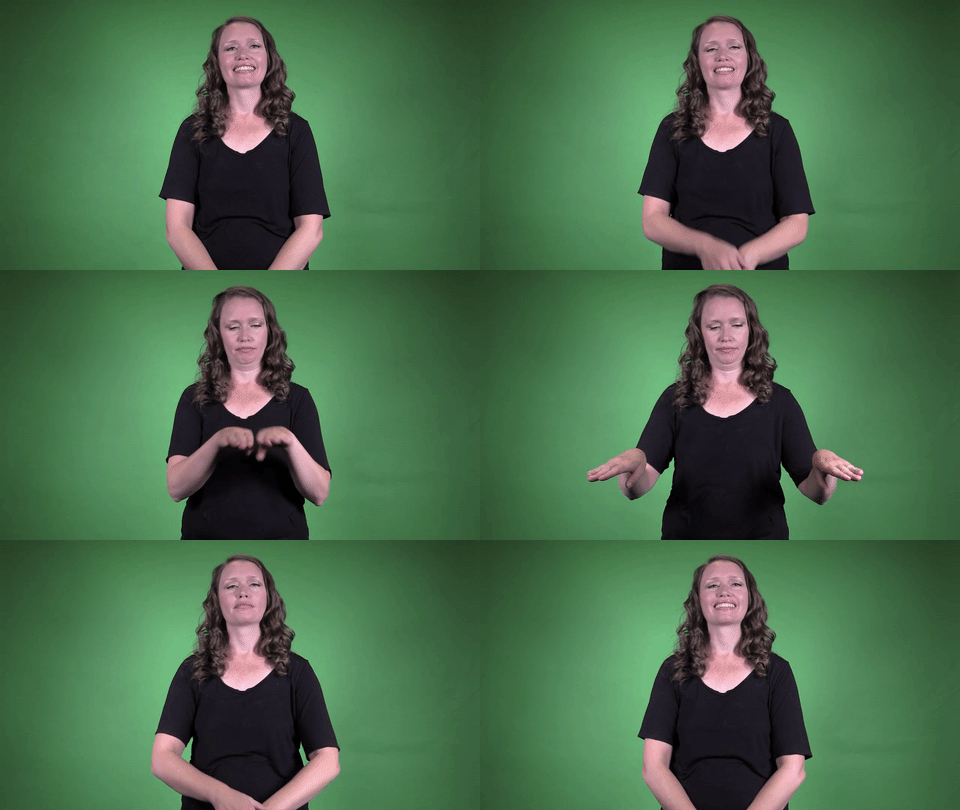
Definition: The lower surface of a room.
Sign for FLOOR in ASL
Practice Activities:
To begin practicing the sign for FLOOR in ASL, start by standing in front of a mirror and signing it repeatedly using proper handshape and movement. Focus on keeping your hands flat and parallel to each other as you move them apart horizontally, which clearly indicates the concept of the floor. Do this drill slowly at first, then pick up speed while maintaining accuracy.
Next, incorporate the sign for FLOOR in ASL into basic descriptive sentences. For example, sign: “The baby is sitting on the floor” or “I need to clean the floor.” Repeat each sentence several times using varied facial expressions to convey different tones, such as frustration, surprise, or satisfaction.
For partner practice, one person can describe a setting using signs and the other identifies the location of objects. For example, one might sign: “The book is on the table. The shoes are on the floor.” The partner could then point or draw the scene to demonstrate comprehension.
Storytelling is another great way to practice the sign for FLOOR in ASL. Create a short story that includes rooms, furniture, pets, or messy situations. Each time you mention where something is placed or what is happening on a surface, include the sign. You might tell a story about cleaning your room, dropping something on the floor, or your pet lying on the floor and refusing to get up.
Use picture cards or room photos and ask learners to describe them in ASL, ensuring they use the sign for FLOOR when relevant. Encourage them to use related vocabulary like “carpet,” “tile,” or “basement” and fingerspell when necessary.
Practice in real situations by identifying floor types in different locations such as classrooms, kitchens, or outdoors by signing them when you see them. This keeps use of the sign for FLOOR in ASL meaningful and grounded in daily contexts.
Cultural Context:
In American Sign Language, everyday words like floor carry more meaning than just their definitions. The sign for floor in ASL reflects not just the physical surface beneath your feet but also different cultural and contextual meanings within Deaf culture.
When using the sign for floor in ASL, it’s important to know how space and environment play a big role in communication. ASL visuals take spatial concepts seriously, and when describing interior spaces, the floor is an essential detail that helps set the scene. This visual nature of ASL helps enrich storytelling and daily dialogue.
The sign for floor in ASL often comes up in contexts involving homes, buildings, cleaning routines, and navigating within a space. Since ASL is a three-dimensional language, the physical act of signing uses the horizontal plane of the body or signing area to represent the actual plane of the floor. This helps the signer literally and symbolically place the floor within a conversation.
Understanding directional elements and classifier handshapes is also important when using the sign for floor in ASL. For example, it can work with classifiers to describe objects sitting on the floor or to show movement across the floor level. These visual grammar tools make it easier for ASL users to describe scenes in a way that makes sense visually and culturally.
In many Deaf households and community spaces, the use of signs like floor becomes second nature. Since most communication happens in signed form, references to location inside a house or building often require signs like floor. Whether someone is asking someone to clean the floor, sit on the floor, or go to a different floor of the building, this sign is used frequently in everyday conversations.
Culturally, the sign for floor in ASL plays a part in how Deaf people visually map out their environments. This emphasis on spatial orientation shapes how stories are told and how directions or instructions are understood. From children learning spatial awareness to adults giving instructions, this sign supports clear, concise, and culturally rich language use.
In Deaf schools and educational settings, learning signs that relate to one’s environment, like floor, helps students build practical vocabulary. The visual representation of a floor can also be expanded through ASL storytelling or narratives that focus on setting and space. This helps younger signers understand not just the literal meaning but also how to use the sign in different contexts.
The sign for floor in ASL is also part of the foundational vocabulary for interpreters. When interpreting real-time instructions or scene descriptions, conveying the concept of floor accurately plays a significant role in effective communication.
Extended Definition:
The sign for floor in ASL is an essential part of everyday vocabulary, especially when describing locations or giving directions. In American Sign Language, the concept of “floor” typically refers to a flat surface underfoot or a level within a building. This sign is useful when distinguishing between different stories in a structure, such as first floor, second floor, and so on.
To produce the sign for floor in ASL, both hands are usually used in a flat, horizontal position. The palms face down and move away from each other slightly in a smooth, straight motion. This movement represents the flat and level nature of a surface like a floor. It’s a clear and iconic gesture that visually matches the concept it represents.
When talking about places in a school, home, or public building, the sign for floor in ASL often comes up. For example, you may sign sentences like “My classroom is on the second floor” or “The bathroom is on the first floor.” This sign helps provide clarity when navigating spaces in different environments.
You may also encounter the sign for floor in ASL during emergency drills or while following evacuation procedures. Knowing how to express which floor to go to can be crucial in helping others move safely and effectively. Whether describing a basement level or the top floor of a tall building, this vocabulary word becomes highly practical.
Children and adults alike benefit from learning the sign for floor in ASL early in their language journey. Not only is it commonly used, but it also builds a foundation for other related location-based vocabulary like wall, ceiling, and room. These signs help users paint a complete picture when describing spaces.
The sign for floor in ASL is also relevant in classroom settings. Teachers use it to guide students in activities, get them into position, or signal transitions from one part of the room to another. It also becomes useful when organizing items or talking about where objects are located within a specific floor.
In storytelling or descriptive conversation, using the sign for floor in ASL helps establish spatial relations between people, items, and environments. It supports narrative strength and improves the listener’s understanding of where things are happening. The visual cue enhances clarity, especially in scenes involving multiple characters spread over different levels.
This sign can be adjusted slightly in context if you want to express different kinds of floors, like wooden floor, tile floor, or carpeted floor. Additional descriptive signs can accompany the base sign for more detail. These combinations help enrich communication and provide precise information.
Since ASL
Synonyms: ground, surface, level, base, foundation
Educational resources: Find related learning materials in our course bank!
Want more? Check out some of our popular learning activities on the homepage!
Need to look up a sign? Use our highly rated dictionary: https://aslinteractive.com/best-asl-dictionary/
Follow us on tiktok: https://www.tiktok.com/@aslinteractive. More social media links at the bottom of this page!
Long-tail Keywords: what is the sign for floor in ASL, how do you sign floor in ASL, ASL sign for floor meaning
Categories:
tags: ASL sign for floor, how to sign floor in ASL, American Sign Language floor sign, learn floor in ASL, floor meaning in ASL
Parameters
*Handshape*:
The handshape for the sign for FLOOR in ASL involves both hands in the flat “B” handshape, with fingers together and thumbs extended along the sides. The palms face downward and start together at the center, then move apart horizontally in a straight line, mimicking the flat surface of a floor.
This movement visually represents a floor dividing space, which helps reinforce the meaning of the sign for FLOOR in ASL . The handshape remains consistent during the motion to clearly depict the concept.
*Palm Orientation*:
For the sign for FLOOR in ASL, both hands are placed in front of the body at about waist level. The palms face downward and are parallel to the ground, resembling a flat surface.
Hands begin close together and then move apart sideways in a smooth motion. This palm orientation effectively conveys the flat and even quality of a floor, which reinforces the meaning of the sign for FLOOR in ASL .
*Location*:
The sign for FLOOR in ASL is produced in the neutral space in front of the torso. Both hands start in front of the body, roughly at waist level, palms facing down, fingers flat and touching side-by-side.
In the sign for FLOOR in ASL, the hands move apart sideways in a straight, horizontal line to indicate a flat surface. This location helps visually convey the concept of a level ground or floor surface.
*Movement*:
To form the sign for FLOOR in ASL, begin with both hands open and flat, palms facing down, placed in front of your body near chest level. Move your hands apart horizontally, sliding them away from each other in a straight line. This sweeping motion suggests the flat surface of a floor.
The sign for FLOOR in ASL uses a simple, clear gesture that visually conveys the concept of a flat horizontal surface. Facial expression remains neutral throughout the movement.
*Non-Manual Signals*:
The non-manual signals for the sign for FLOOR in ASL typically include a neutral or slightly inquisitive facial expression, depending on the context. Eyebrows are often relaxed, and the eyes follow the movement of the hands horizontally.
When using the sign for FLOOR in ASL, the head may slightly tilt forward or stay level to align with the plane being indicated. Lips stay neutral unless used in a questioning context, where a slight pursing might occur.
*Prosody, Dominant/Non-Dominant Hand*:
The sign for FLOOR in ASL uses both hands flat with palms facing downward. Your hands start together in front of your body, then move apart horizontally, indicating the idea of a flat surface or level.
In the sign for FLOOR in ASL, both hands are used symmetrically without dominance. This neutral hand use helps visually represent the evenness and expanse of a floor.
Tips for Beginners:
When learning the sign for FLOOR in ASL, focus on the precision of your hand placement and movement. Both hands should be flat, palms facing down, with fingers together. Start with your hands touching at the pinkies at the midsection, then move outwards in a straight horizontal line. This hand motion mimics the flat expanse of a floor, so it’s important to keep it clean and smooth for clarity.
Beginners often struggle with keeping their hands level and symmetrical during the sign. Practice in front of a mirror to ensure that both hands move evenly across the body. Avoid bending your elbows too much or moving your hands in a curve, as this can confuse the sign for FLOOR in ASL with other signs related to space or levels.
Consistency in size and speed is key. Don’t rush through the sign—fluidity and control are more important than speed for comprehension. A slow and deliberate motion will look more confident and be easier for others to understand. Remember to keep your facial expression neutral unless context suggests otherwise.
When using the sign for FLOOR in ASL in sentences, make sure it fits logically within the topic. For example, you might say “The book is on the floor” by signing “BOOK FLOOR ON.” Practice using the sign within short phrases to improve sentence fluidity.
To reinforce your learning, try identifying the floor in your surroundings and signing it as often as possible throughout your day . This repetition will build muscle memory and confidence in using the sign. Watching videos of native signers using the sign in conversational ASL can also give you insights into real-life application and pacing.
Stay patient and consistent—mastering the sign for FLOOR in ASL will become a natural part of your vocabulary with daily use.
Connections to Other topics:
The sign for FLOOR in ASL is closely connected to spatial and directional concepts within the language. It visually represents a flat surface and often forms the basis for more complex descriptions involving positioning, architecture, and room design. Learners use this sign when indicating levels, as in FLOOR v1 (e.g., first floor, second floor), especially in multi-story building contexts.
In compound signs, the sign for FLOOR in ASL appears in phrases like FLOOR PLAN and DANCE FLOOR. Incorporating it into such expressions helps reinforce how a single concept can interact with other signs to describe location and function. For example, in describing a ballroom, a signer might use the compound DANCE + FLOOR to specify the intended purpose of a space.
This sign also links to broader topics like housing, construction, and daily routines. In discussing household chores such as sweeping or mopping, the sign for FLOOR in ASL supports the narrative by grounding the action in a physical space. Similarly, classroom or workplace descriptions may use the sign to locate desks, furniture, or exits.
Spatial orientation is another important connection, as ASL is deeply rooted in visual-spatial grammar. Using the sign for FLOOR in ASL alongside signs for WALL, CEILING, or ROOF can help set a three-dimensional scene. This is especially useful when explaining room layouts, giving directions indoors, or describing accidents (e.g., falling on the floor).
Metaphorical uses can also arise, such as when using ASL to describe hierarchical structures or figurative “levels.” For instance, you might refer to someone’s job status as “entry level” while showing the FLOOR, emphasizing their position at the base of a career path. These creative contexts allow learners to explore how physical signs can extend into abstract ideas.
Summary:
The sign for FLOOR in ASL typically involves two flat, open B-hands placed together in front of the body, palms facing downward, and then moving them apart sideways in a straight horizontal line. This motion mirrors the concept of a flat surface spreading outward, visually representing the floor of a room or building. The imagery is clear and iconic, helping the viewer associate the physical space of a floor with the sign itself.
This sign belongs to a category of spatial and architectural signs that convey physical structures within a three-dimensional world. Much like signs for WALL, CEILING, or ROOF, the sign for FLOOR in ASL taps into visual-spatial grammar, which is deeply embedded into the structure of the language. ASL often relies on classifier constructions and topographical referencing to describe environments.
Grammatically, the sign for FLOOR in ASL functions primarily as a noun. It generally does not require modification for plural forms and can be contextualized to refer to various types of floors such as wood, tile, or carpet by either descriptive signs or classifiers. For example, to refer to a tile floor, a user might sign FLOOR and then add a modifier to convey the texture or material.
The sign can also interact with numerical indicators to reference building floors or levels. For example, signing THIRD followed by FLOOR indicates the third level in a building. Nevertheless, in this context, the FLOOR sign might sometimes be replaced altogether with a classifier or modified space usage to show levels more visually, rather than explicitly.
FLOOR also appears in compound signs and descriptive narratives. In storytelling, users may describe a scene taking place on a particular floor surface with accompanying classifiers to show substance or interaction—like someone sitting, slipping, or laying on the floor. This layered usage provides texture and depth to communication beyond simple identification.
In Deaf culture, spatial awareness and environmental referencing are central to conceptual clarity. The sign for FLOOR in ASL acts as a literal marker and a spatial cue, preparing the listener for understanding where actions occur. Given its link to environmental space, FLOOR can be part of educational ASL contexts when teaching children about rooms, housing, or safety.
Exploring the sign from a linguistic perspective, the symmetry in the hand arrangement and the outward movement underscores the horizontal plane. Iconicity is a hallmark of ASL signs, and FLOOR exemplifies this visual-meaning bond strongly. ASL relies on physical metaphor, and in this case, the metaphor evokes the visual of a flat ground stretching from a central point.
Applied linguistics reveals how spatial signs such as FLOOR are excellent examples of how language is embodied in cognition. For learners, recognizing the sign as iconic helps in retention, but understanding its use within the broader syntax of ASL enriches communication. Teachers often use this sign when establishing a visual-spatial framework for positioning or structure within classrooms.
In terms of related signs, FLOOR is often taught alongside CEILING, WALL, DOOR, WINDOW, and ROOM, forming part of a foundational architectural vocabulary. These signs are interconnected through space and boundaries, giving signers the tools to navigate description and placement. As walls define edges, and ceilings mark height, floors serve as the grounding element from which spatial relationships are charted.
Classifiers that correspond with the concept of FLOOR often involve flat surfaces (CL: B-hands) or depiction of an entity resting or moving along that floor. For example, showing a toy car moving across the floor might involve a Classifier 3 moving across the sign-space horizontally to simulate the car’s path across a surface.
Variations in the sign may arise slightly by region or context. In some dialects, the motion may be slower or more emphasized, depending on whether the signer is referring to a literal architectural feature or using metaphoric language. Despite minor differences, the base structure of the sign remains consistent across most ASL users.
Culturally, the sign for FLOOR in ASL enters metaphorical territory as well. Phrases like “rolling on the floor laughing” can be translated using elements including FLOOR, facial expressions, and classifiers to indicate movement and emotion. This bridges literal and figurative language and demonstrates how ASL manages visual metaphors.
Online ASL classes and numerous YouTube tutorials use the sign for FLOOR in ASL early in vocabulary sets. This is partially because it connects quickly to the learner’s environment and gives an immediate tactile and spatial association. Tutors may reinforce learning by asking students to sign “sit on the floor,” “clean the floor,” or “draw on the floor” to reinforce sign combinations.
Children’s stories translated into ASL frequently use the sign, especially in scenes where action occurs indoors. Books adapted into ASL videos incorporate FLOOR to describe where animals sleep, where children play, or where items fall. This reinforces the importance of grounding signs like FLOOR in the broader context of space and motion.
Technological applications like VR and classroom spatial simulations also utilize signs like FLOOR. In immersive ASL environments, referencing accurate floors, elevations,
Want more? Check out some of our popular learning activities!
ASL Interactive Resources
ASLInteractive YouTube Channel
Follow us on tiktok: @aslinteractive.com
Follow us on Instagram: aslinteractive
Facebook page: aslinteractive
Facebook group: aslinteractive
LInkedIn: ASL Interactive LLC
Twitter: @ASL_interactive
*Some information on this page is AI-generated. AI can make mistakes. Please check the information.


Responses