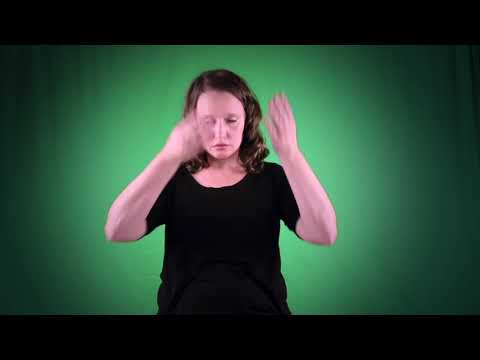
Definition: To put on clothes.
Sign for GET-DRESSED in ASL
Practice Activities:
To practice the sign for GET-DRESSED in ASL, start by signing it in front of a mirror so you can observe your hand movements and body posture. Repeat the sign slowly and then gradually increase your speed while maintaining accuracy. Use both dominant and non-dominant hand placements if needed, depending on your signing style.
Next, create simple sentences using the sign for GET-DRESSED in ASL. For example: I GET-DRESSED every morning at 7. Or: She GET-DRESSED before school. Practice these sentences in front of a friend or language partner, paying attention to facial expressions and appropriate pausing.
Use flashcards with images of different times of day or clothing items and create spontaneous sentences. When shown a picture of a person getting ready for work, sign a sentence like: DAD GET-DRESSED, THEN GO WORK. This will help build fluency and comfort using the sign in context.
Try storytelling activities where you describe a routine using the sign for GET-DRESSED in ASL. Begin with waking up in the morning and include signs like WAKE-UP, EAT, BRUSH-TEETH, and GET-DRESSED. This allows you to practice sequencing and narrative signing.
Engage in a role-play with a partner where one person pretends to ask questions such as: What time do you GET-DRESSED? or Why did you GET-DRESSED so fast today? The other person responds using the target sign in full sentences. This encourages conversational skills and responsiveness.
Watch online videos of native ASL signers using the sign for GET-DRESSED in ASL and mimic their pacing and movements. Pause and repeat along with them for accuracy. Consider recording yourself and comparing it to fluent signers to self-evaluate progress.
These activities will deepen your understanding, improve retention, and help you use the sign for GET-DRESSED in ASL confidently in various real-life contexts.
Cultural Context:
The sign for GET-DRESSED in ASL reflects the importance of daily routines within Deaf culture. Getting dressed is more than just putting on clothes—it involves preparation for interaction with the Deaf and signing community. The use of the sign for GET-DRESSED in ASL symbolizes readiness for social engagement and communication in visual languages.
In ASL, facial expressions and body movements often enhance the meaning of a sign. The sign for GET-DRESSED in ASL is no exception—it may show urgency, style, or mood depending on how it’s delivered. It incorporates expressive body language to add depth to the meaning being conveyed.
Clothing choices can carry cultural and personal meaning within the Deaf community. When someone uses the sign for GET-DRESSED in ASL, it can indicate not only a physical act but also emotional or symbolic readiness. This kind of visual communication helps create a richer context for everyday terms within the language.
The Deaf community values visual clarity, and signs like the one for GET-DRESSED in ASL support that. Instead of relying on spoken details, the sign conveys an action that is instantly understood. This makes it easier for those in the Deaf community to share routines, schedules, and social plans without confusion.
In some situations, modifying the sign for GET-DRESSED in ASL may indicate getting dressed in a particular way, such as dressing up formally or quickly changing clothes. These modifications help express context with precision, showing how flexible and expressive ASL can be.
Cultural norms in the Deaf community place a strong emphasis on eye contact and visual cues, which makes learning signs like the sign for GET-DRESSED in ASL crucial for effective communication. Not using the appropriate sign can result in confusion or disrupt the flow of conversation. Signing accurately builds trust and understanding in everyday exchanges.
Storytelling and daily vlogs are common in Deaf spaces, and the sign for GET-DRESSED in ASL is often part of such narratives. People use it to share stories about what they wore to events, how they prepared for work, or just their morning routine. These everyday signs show a different view of cultural expression and identity.
In visual media and performances such as Deaf theater or ASL poetry, signs like the sign for GET-DRESSED in ASL help build characters and show transitions. It’s not just a literal act—it can represent change, transformation, or entering a new social space. This layered use showcases
Extended Definition:
The sign for get-dressed in ASL is commonly used in everyday conversation to describe putting clothes on oneself. It represents an action that is both routine and essential, making it a frequent part of vocabulary for anyone learning American Sign Language. Mastering this sign helps learners communicate more fluently in common morning routines and daily activities.
To make the sign for get-dressed in ASL, both hands are used with flat palms and brush down the chest in an alternating motion, as if showing the act of putting clothing on the upper body. It’s a visually intuitive sign, resembling the action of donning garments. The motion begins at the shoulders and moves downward along the torso.
This sign can be used in various contexts, depending on the conversation. It often comes up when talking about getting ready for work, school, special events, or simply discussing the next steps in someone’s routine. The sign for get-dressed in ASL can also be part of instructions or requests, like “Hurry and get dressed” or “Did you get dressed yet?”
There are some variations based on regional usage or personal signing style, but the core motion of indicating the act of dressing remains consistent. This sign is related to other clothing-related signs, such as shirt, pants, shoes, and jacket, and it pairs well with signs like bathroom, brush-teeth, and eat when describing morning routines. Using the sign for get-dressed in ASL allows for more vivid and accurate storytelling.
In ASL grammar, this sign is typically used as part of a broader sentence structure that follows ASL syntax. For instance, a sentence may start with a time marker like “morning,” followed by “get-dressed,” and then other relevant information. Understanding how to use this sign within proper ASL grammar boosts fluency and makes communication smoother.
Children learn the sign for get-dressed in ASL early in their language development because it plays a key role in describing personal independence and daily life skills. It helps reinforce the concept of self-care and time awareness. Parents, educators, and caregivers frequently use this sign during routines to aid in language comprehension.
The sign can be modified slightly when teaching or learning with DeafBlind individuals by adjusting the pace and touch. In professional settings, understanding the sign for get-dressed in ASL is valuable for interpreters, teachers, and healthcare providers who support Deaf individuals. It allows for seamless interactions during discussions involving personal hygiene or schedules.
When paired with facial expressions and the correct body
Synonyms: dress oneself, put on clothes, get ready, suit up, wear
Educational resources: Find related learning materials in our course bank!
Want more? Check out some of our popular learning activities on the homepage!
Need to look up a sign? Use our highly rated dictionary: https://aslinteractive.com/best-asl-dictionary/
Follow us on tiktok: https://www.tiktok.com/@aslinteractive. More social media links at the bottom of this page!
Long-tail Keywords: what is the sign for get-dressed in ASL, how do you sign get-dressed in American Sign Language, learn the ASL sign for get-dressed
Categories:
tags: get dressed in sign language, ASL get dressed, how to sign get dressed, get dressed ASL tutorial, get dressed American Sign Language
Parameters
*Handshape*:
The handshape for the sign for GET-DRESSED in ASL uses open flat hands with fingers together and thumbs extended naturally. Both hands are in the “B” handshape, which is commonly used in ASL for clothing-related actions.
When performing the sign for GET-DRESSED in ASL, the palms face the torso and alternate brushing upward on the chest area as if putting on a shirt. This clear motion and distinct handshape make the meaning easily recognizable.
*Palm Orientation*:
In the sign for GET-DRESSED in ASL, both hands are positioned flat with palms facing inward toward the chest. The movement involves alternating small upward and downward swipes on the upper torso area, resembling the motion of putting on clothing.
Throughout the sign for GET-DRESSED in ASL, the palm orientation remains inward and relaxed, maintaining a consistent direction without rotation. This clear palm orientation reinforces the visual metaphor of dressing oneself.
*Location*:
The location for the sign for GET-DRESSED in ASL is centered on the chest area. Both open hands begin with palms facing the chest, approximately at the upper torso or center of the chest. The movement brushes the chest in alternating strokes, as if putting on a shirt or adjusting clothing.
Because the sign for GET-DRESSED in ASL involves both hands touching near the chest and upper torso, the symmetrical location reinforces the meaning visually. This upper body positioning is consistent with many clothing-related signs in American Sign Language.
*Movement*:
The sign for get-dressed in ASL uses both open hands with palms facing your chest. Begin by placing the fingertips on your upper chest, then alternate brushing each hand down the chest area a few times in a smooth, light motion.
This movement suggests the act of putting on clothing. The sign for get-dressed in ASL is commonly used when referring to one’s daily routine or preparing to go out.
*Non-Manual Signals*:
When performing the sign for GET-DRESSED in ASL, the facial expression should remain neutral or lightly pleasant, depending on the context. Slightly raised eyebrows can convey interest or a routine action, while a subtle nod may accompany the sign to show affirmation or intention.
The sign for GET-DRESSED in ASL typically does not require exaggerated emotion unless used in a dramatic or storytelling context. Keep eye contact with your conversation partner to maintain engagement and clarity.
*Prosody, Dominant/Non-Dominant Hand*:
The sign for GET-DRESSED in ASL uses both hands symmetrically. The dominant and non-dominant hands are open and move alternately from the chest outward in a brushing motion, as if indicating putting on a garment. This motion mimics the action of dressing oneself.
In the sign for GET-DRESSED in ASL, both hands are equally active, showing a balanced role without one being more dominant. The repeated outward strokes help convey the idea of putting clothes on, making the concept visually intuitive in ASL.
Tips for Beginners:
When learning the sign for GET-DRESSED in ASL, focus on smooth, controlled movements. The motion mimics putting on clothing, so your hands should move in a synchronized, upward and downward brushing pattern on your chest. Keep your fingers flat and palms facing inward to clearly represent the sign’s concept.
One helpful technique is to practice in front of a mirror. This way, you can make sure both hands are mirroring each other correctly and evenly. Inconsistent timing between your hands can make the sign unclear or confusing to native signers.
A common mistake is moving the hands too quickly or inconsistently. Don’t rush the movement—clarity is far more important than speed. Think about the action you’re portraying: dressing yourself calmly and with intention.
Another tip for beginners is to pay attention to facial expressions. While facial grammar isn’t extreme in the sign for GET-DRESSED in ASL, your expression still adds clarity and tone to your message. A neutral or slightly purposeful expression works best here.
Repetition helps with muscle memory. Break the sign down into parts and practice the hand motion slowly, building up speed as you gain confidence. Record yourself and compare it to fluent ASL signers to fine-tune your technique.
If you’re in a class or practice group, ask for feedback. Others can catch slight inconsistencies that you might not see. Authentic feedback helps ensure your sign for GET-DRESSED in ASL is not just accurate, but also natural-looking.
Be patient with yourself while learning. Every signer improves with time and repetition, so keep practicing until your movements feel automatic and controlled. With consistent effort and attention to detail, your sign for GET-DRESSED in ASL will become a confident and reliable part of your signing vocabulary. ✋
Connections to Other topics:
The sign for GET-DRESSED in ASL connects closely with other personal care and daily routine signs such as BATH, SHOWER, BRUSH-HAIR, and PUT-ON. These signs often fall under the category of actions performed on the body and typically utilize directional movement from the chest area outward, symbolizing something being applied or performed on oneself. This makes it easier for learners to remember that signs involving personal actions commonly include the chest as a point of reference.
Another connection to the sign for GET-DRESSED in ASL is with clothing-related vocabulary such as COAT, SHIRT, CLOTHES, and UNIFORM. These signs are often used in similar spatial areas around the upper torso and involve similar handshapes or repetitious movement, which helps reinforce patterns in learning. For instance, the sign for CLOTHES uses a brushing motion down the chest with open hands, reminiscent of GET-DRESSED’s movement.
The sign for GET-DRESSED in ASL can also be an important component in compound expressions like GET-DRESSED QUICK or GET-DRESSED FOR-WORK. These phrases incorporate modifiers or context-specific signs that update the intended meaning depending on situation. In narrative storytelling or everyday conversations, the sign is frequently paired with time indicators like MORNING or EVENING to place the dressing action within a daily schedule.
In teaching young children or beginners, the sign for GET-DRESSED in ASL can be linked with visual routines and classroom transition cues. For example, teachers might pair the sign with visuals or photos to signal it’s time to get ready for outdoor activities. This situational use makes vocabulary acquisition more practical and engaging.
Learners can also explore how the sign for GET-DRESSED in ASL changes subtly when adapted into related phrases like GET-READY or GET-CHANGED, emphasizing the flexibility and expressiveness of ASL morphology. Understanding these connections builds a deeper appreciation for how meaning is shaped by context and movement in sign language.
Summary:
The sign for GET-DRESSED in ASL typically involves both flat hands, palms facing inward, brushing down the chest in a sort of showing-off motion while alternating the movement. This symmetrical motion simulates the act of putting on clothes or highlighting the attire you already have on. It succinctly conveys the concept of dressing oneself.
The movement is smooth and deliberate, signifying the process of getting ready or becoming presentable. It sometimes incorporates a slight body shift to reflect the act of preparing for an occasion. Signing this includes facial expressions that may enhance the intention, especially if the sign is used for emphasis or storytelling.
The sign for GET-DRESSED in ASL can also reflect the cultural significance of self-presentation in Deaf culture. In everyday interactions, individuals place importance on appearance and social readiness, and this sign elegantly captures that value. The concept is not just about clothing but self-expression.
Grammatically, this sign serves as a verb and can appear in a variety of sentence structures. It may be modified slightly in context—for instance, when used with other time or activity markers, such as morning routines or preparation for an event. The sign is clear and always conveys action, which makes it vivid in fluent conversation.
ASL uses non-manual markers to infuse additional meaning into a sign. When signing GET-DRESSED, a look of determination, joy, or urgency may be included through facial expressions. This adds narrative richness and helps sharpen how the message is received.
Related signs include CLOTHES, SHIRT, PANTS, and DRESS, though each includes different handshapes and motions. Where GET-DRESSED involves an encompassing movement, clothing signs typically point to specific articles. This difference supports the semantic range of ASL and its layered meanings.
From a linguistic point of view, the sign for GET-DRESSED in ASL represents a complete visual metaphor. Instead of directly mimicking the physical act of putting on clothes, it abstracts the concept into recognizable motion. That mirrors how signed languages use iconicity alongside arbitrary signs.
Linguists have studied how this sign fits into broader verb classifications in ASL. It is a plain verb, not inherently directional, though it can be modified with role shift or context. Unlike directional or spatial verbs, it does not require a subject or object directionality.
The use of both hands working in alternation is notable in ASL verb construction, showing coordination and balance. This alternation is suggestive of mental planning—a cognitive connection to how Deaf signers view task processing in visual terms. Neurological studies even show bilateral motor activation during such symmetrical signs.
Sociolinguistic variation may affect how this sign is produced. In different regions or communities within the Deaf world, some signers may use subtler or more exaggerated motions. These variations offer rich insight into how regional lexicons form within American Sign Language.
Also, sign variants can appear depending on whether someone uses more Signed English influences or sticks to native ASL grammar. A person influenced by Signed English might sign “put-on-clothes” using more English word order, while native ASL signers go directly to a single conceptual sign. This distinction reflects language choice and linguistic identity.
The sign for GET-DRESSED in ASL is often taught early in sign language education due to its relevance in daily life contexts. It’s a core verb, useful in stories describing routines, role-plays about getting ready, or sequences of actions. Its utility makes it a highly retained vocabulary item for learners.
Educators and interpreters find the sign is very adaptable for visuals and practice drills. Within silent classroom environments, acting out sequences with this verb supports language fluency and conceptual clarity. It embodies action while providing intuitive access to meaning.
The sign aligns with themes of independence and self-sufficiency in many conversations. Children learn the sign to indicate they got ready by themselves, while adults may use it to talk about formal dress or readiness for an event. It becomes a building block for narrative structure.
In Deaf storytelling, the sign is often used in sequenced actions like waking up, taking a shower, and then getting dressed before leaving home. It functions as a stepping stone in time-telling structures unique to ASL. These sequences are important features of Deaf visual tradition.
From an applied linguistics angle, understanding this sign helps show how cognitively rich gesture-based languages are. Learners must integrate handshape, motion, spatial awareness, and facial cues to produce it accurately. That complex motor planning mirrors how deeply developed ASL grammar is.
Another critical connection is the conceptual metaphor theory. By using the chest as a canvas and motion as the painting brush, ASL transforms abstract concepts into visual-tactile experiences. Thus, signs like GET-DRESSED offer a tangible experience of time and preparation.
There’s a cultural richness surrounding appearance in Deaf community norms. Looking neat or organized is a silent message of respect in both social and professional settings. The everyday usage of the sign ties into those expectations and values
Want more? Check out some of our popular learning activities!
ASL Interactive Resources
ASLInteractive YouTube Channel
Follow us on tiktok: @aslinteractive.com
Follow us on Instagram: aslinteractive
Facebook page: aslinteractive
Facebook group: aslinteractive
LInkedIn: ASL Interactive LLC
Twitter: @ASL_interactive
*Some information on this page is AI-generated. AI can make mistakes. Please check the information.


Responses