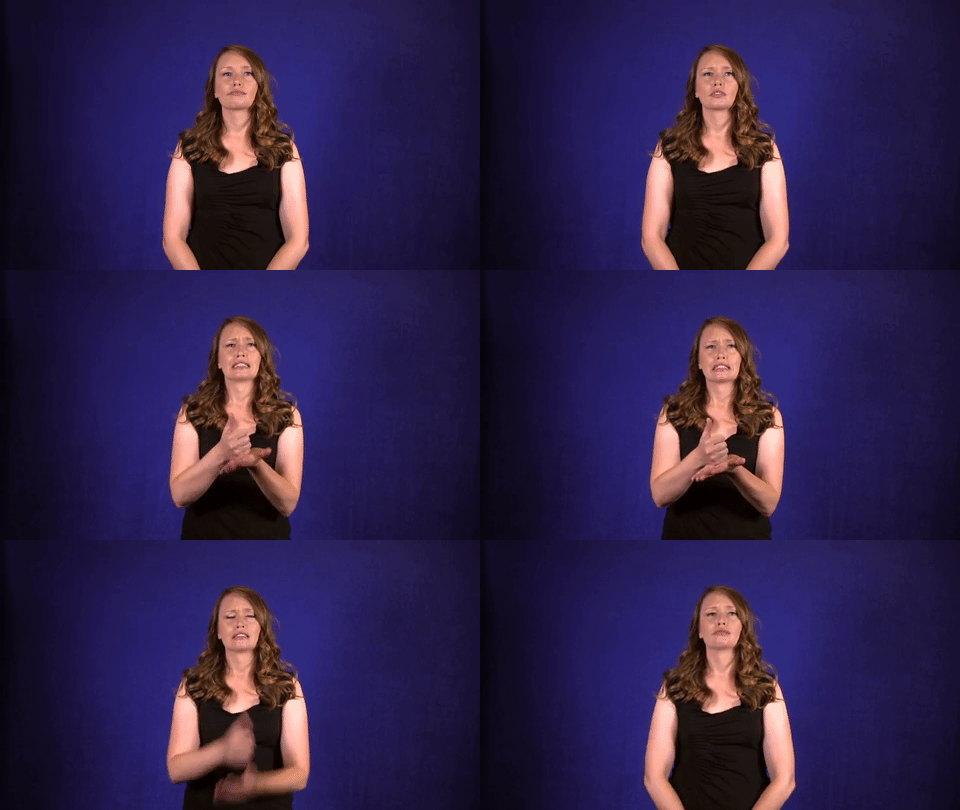
Definition: To assist.
Sign for HELP in ASL
Practice Activities:
To practice the sign for HELP in ASL, start by isolating the movement and handshape. Position your non-dominant hand flat, palm up, and place your dominant hand in an A-handshape on top of it. Practice lifting both hands together while maintaining the correct shape and motion. Repeat this slowly in front of a mirror to ensure accuracy.
Next, try using the sign for HELP in ASL in single-word repetition drills. Say the English word in your head or quietly and immediately follow it with the sign. Do this with increasing speed to build fluid motion. Try switching the direction of movement to indicate whether you’re offering help or asking for help.
Work the sign into simple sentences. Practice phrases like, “Can you help me?” or “I will help you.” Sign entire sentences silently and then say them out loud while signing to reinforce meaning. Try changing the subject and object to get comfortable with different sentence forms using the sign for HELP in ASL.
Storytelling is another effective activity. Create a short story or scenario where help is needed, like a lost pet or a flat tire. Sign the story, incorporating the sign for HELP in ASL naturally within the sequence of events. This builds fluency and routine usage in real-life contexts.
With a partner, take turns acting out scenes where one person needs help and the other offers it. Try settings like a school, grocery store, or emergency. Use facial expressions to support the tone and message while continuously using the sign in proper context. Roleplay different responses to “Can I help?” or “I don’t need help right now.”
End your practice by recording yourself signing these scenarios and play them back to observe consistency in movement and facial grammar.
Cultural Context:
The sign for HELP in ASL holds much more than a simple gesture—it reflects deep cultural values within the Deaf community. American Sign Language is not just about translating words from English, but about conveying meaning in a way that fits shared experiences and everyday life. When using the sign for HELP in ASL, the action represents connection, mutual support, and interdependence.
In Deaf culture, offering and receiving help is based on trust and respect. The sign for HELP in ASL reinforces this by showing how essential cooperation is in this community. It can be used both in formal settings, like asking for assistance at a school or workplace, and in casual conversations with friends or family.
The facial expression used with the sign for HELP in ASL is also significant. Expression adds clarity to emotion and intention, helping get across whether the help is urgent, casual, or polite. Learning how to sign HELP is about more than memorizing a handshape—it’s about understanding tone and intent through body language and facial cues.
HELP in ASL can be directed both ways—helping someone or asking to be helped. This dual nature is crucial in ASL since the direction of the sign shifts to show who is giving or receiving help. This directional aspect makes the sign flexible, contextual, and easier to integrate into fluid conversation.
In Deaf culture, mutual aid is seen as a collective responsibility, not as a burden. Using the sign for HELP in ASL regularly strengthens those community ties and shows awareness. Whether it’s helping someone across the street or assisting with a technical issue, this sign fits into daily interactions naturally.
ASL relies heavily on space and movement, and the sign for HELP in ASL plays a role in this visual organization. Its simplicity allows it to be learned quickly, which is helpful for both beginners and fluent signers interacting with learners. The ease of understanding HELP helps build communication bridges between Deaf and hearing individuals.
When non-signers or ASL beginners learn the sign for HELP in ASL, they begin to gain insight into a larger cultural perspective. The sign encourages questions and learning, leading to more inclusive conversations and environments. It’s often one of the first signs that instructors teach because of its universality and importance.
HELP is both an essential verb and an act of kindness within Deaf culture. Mastering the sign for HELP in ASL is the first step toward deeper communication, empathy, and equity. Including this sign in one’s ASL vocabulary opens the door to better interactions and clearer
Extended Definition:
The sign for help in ASL is a highly useful and versatile gesture in everyday communication. It allows signers to express the need for assistance in various situations, whether emotional, physical, or practical. Understanding how to use this sign can significantly enhance conversations and improve clarity when requesting or offering help.
To make the sign for help in ASL, start with one hand in a closed fist while the other hand forms a flat palm. Place the closed fist on the open palm and make a gentle upward movement, as if lifting the helping hand. This movement represents giving or receiving help and is directed from the person needing help to the one offering it. The facial expression should match the context—looking concerned, polite, or urgent, depending on the situation.
This sign can be modified slightly by incorporating directionality, making it clear who is helping whom. For example, moving the sign toward someone means offering help, while moving it toward yourself means asking for help. These nuances add a layer of meaning that enhances communication in ASL.
When using the sign for help in ASL, it’s also common to include contextual clues through facial expressions or additional signs. A worried or confused look can indicate the urgency of the need. Adding signs for specific situations, such as “lost,” “hurt,” or “stuck,” can help clarify the request further. These combinations make ASL especially effective in emergency situations or high-stress moments.
Learning the sign for help in ASL is one of the first steps for beginners because it’s frequently used and easy to remember. It is taught early in ASL courses and often used in schools, workplaces, and homes. It plays a key role in establishing supportive interactions and conveying care or concern.
Using the sign appropriately shows respect for Deaf culture and the value placed on communication and community support. In social situations, it can ease the way for more fluid conversations. It can also strengthen bonds between ASL users and help create an inclusive environment where everyone can communicate their needs clearly.
Parents and educators often teach the sign for help in ASL to young children as part of early language development. It’s useful not only for Deaf and hard-of-hearing children but also for those with speech or language delays. The simplicity of the motion makes it accessible to kids and easy for them to recall when needed.
In group settings or public spaces, knowing how to sign help can be crucial. Whether you’re in a crowded event, at school, or commuting, nonverbal assistance requests are sometimes more practical
Synonyms: assist, aid, support, guide, assist
Educational resources: Find related learning materials in our course bank!
Want more? Check out some of our popular learning activities on the homepage!
Need to look up a sign? Use our highly rated dictionary: https://aslinteractive.com/best-asl-dictionary/
Follow us on tiktok: https://www.tiktok.com/@aslinteractive. More social media links at the bottom of this page!
Long-tail Keywords: what is the sign for help in ASL, how do you sign help in ASL, ASL sign for help
Categories:
tags: ASL help signs, assistance in American Sign Language, helpful phrases in ASL, aid-related ASL vocabulary, guidance signs in ASL
Parameters
*Handshape*:
The dominant hand forms the thumbs-up handshape (an “A” hand with the thumb extended upward), which rests on the open palm of the non-dominant hand. This non-dominant hand stays flat and horizontal while the dominant hand moves slightly upward, as if offering assistance. The handshape in the sign for HELP in ASL represents the act of providing or receiving support.
This gesture reinforces the idea of aiding someone and supports the visual context of helping. The clear handshapes and motion help effectively convey the meaning behind the sign for HELP in ASL .
*Palm Orientation*:
The palm orientation for the sign for HELP in ASL involves the flat non-dominant hand held horizontally with the palm facing upward ️. The dominant hand, shaped like the letter “A,” is placed on the open palm, with its knuckles facing outward and the thumb pointing up, symbolizing assistance being offered.
When executing the sign for HELP in ASL, the hands move upward together as if lifting or offering help . This motion reinforces the concept of support, and the upward-facing palm emphasizes giving.
*Location*:
The sign for HELP in ASL is made at the center of the torso, just above the stomach area. It requires both hands and is typically signed in the neutral space in front of the chest.
When demonstrating the sign for HELP in ASL, the dominant hand forms the thumbs-up sign and is placed on the palm of the non-dominant hand. This movement stays within the mid-body area, making the location easy to see and understand.
*Movement*:
The sign for HELP in ASL is done by placing your dominant hand in an “A” handshape, resting on the upturned palm of your non-dominant hand. Then, both hands move upward together in a lifting motion in front of the body.
This upward movement symbolizes lifting or assisting. The direction can be modified to indicate who is helping whom. The sign for HELP in ASL is clear, practical, and often used in urgent or polite requests.
*Non-Manual Signals*:
When using the sign for HELP in ASL, the facial expression should reflect the level of urgency or emotion tied to the situation. For a polite offer, use raised eyebrows and a slight head tilt forward. In more urgent situations, eyebrows may furrow, and the mouth may show greater concern or emphasis . The sign for HELP in ASL becomes more meaningful and clear when paired with intentional non-manual signals that match the context.
*Prosody, Dominant/Non-Dominant Hand*:
The sign for HELP in ASL uses both hands. The dominant hand forms the letter “A” and is placed palm-up on top of the open, flat non-dominant hand, which is also held palm-up. The dominant hand then lifts slightly as if offering assistance.
This movement reflects the meaning of the sign for HELP in ASL. It is typically performed near the center of the body, and facial expressions reinforce the urgency or tone.
Tips for Beginners:
When learning the sign for HELP in ASL, it’s important to focus on hand shape, position, and directionality. One hand forms the flat base (non-dominant hand), palm facing up. The dominant hand makes an “A” shape and rests on the base hand. Then, both hands move upward slightly together. This motion implies the act of giving or offering help, so lifting the sign toward the person you’re addressing makes it personal.
To master the sign for HELP in ASL, practice directional movement early. This sign can be modified by adjusting the direction of motion. Moving it toward another person means “Can I help you?” Moving it toward yourself conveys “Help me.” Directional verbs like this can be challenging but are key for fluid ASL.
A common beginner mistake is forgetting the upward motion or not maintaining a clean “A” handshape. Keep the thumb positioned correctly and the fingers closed firmly. Another issue is not anchoring the sign on the flat hand, which can make the sign unclear or sloppy. ➕ Be intentional with each movement to ensure your message is understood.
If you’re not confident signing in complex sentences yet, remember that facial expressions and body language strengthen understanding. When using the sign for HELP in ASL, raise your eyebrows to convey a yes/no question like “Need help?” Over-exaggerated motions or a stiff body can disrupt the visual flow, so stay relaxed but deliberate.
Practice in front of a mirror or with a signing partner. Incorporate the sign into daily interactions—use it while offering help at home or asking for support at school. The more natural it feels, the easier it will be to recall in real situations. Understanding the sign for HELP in ASL opens doors to meaningful communication in critical moments.
sign for help in asl, how to sign help in american sign language, asl sign vocabulary help, directional sign for help in asl, offering help in sign language, asking for help in asl, help me sign asl, can I help you in sign language
Connections to Other topics:
The sign for HELP in ASL connects deeply with the concept of offering or requesting assistance, making it a foundational verb in everyday communication. It uses a directional verb structure, meaning the motion of the sign can change depending on who is offering help and who is receiving it. This feature aligns it with other directional verbs like GIVE, SEND, or SHOW, which also incorporate spatial referencing.
The movement in the sign for HELP in ASL allows for complex ideas to be expressed compactly. For example, moving the sign from yourself to another person indicates “I help you,” while reversing the direction conveys “you help me.” This mirrors other ASL signs like TELL or PAY, which also use directionality to clarify who is involved in the action.
This sign frequently appears in compound phrases and idiomatic expressions. For instance, combining HELP with ME (help-me) is often used for emphasis, especially when paired with facial expressions that show urgency or politeness. Another common combination is with PLEASE, forming expressions like “please help me” for polite requests, which aligns with ASL’s cultural emphasis on facial grammar and intent.
The sign for HELP in ASL also connects with modality and agency. It pairs well with signs like NEED or CAN’T, such as “can’t help” or “need help,” to express ability or urgency. These combinations highlight how verb signs interact in ASL grammar and contribute to nuanced meaning.
In educational or emergency contexts, the sign for HELP in ASL is often included early in vocabulary learning. It’s also a key part of emergency response signs, such as HELP-MEDIC or HELP-CALL, showing how it forms the basis for advanced or situation-specific vocabulary. This makes it a bridge sign into broader topics like healthcare, assistance services, and social interactions.
Summary:
The sign for HELP in ASL is both pragmatic and symbolic. It involves one hand forming the letter A, resting on the other open palm, then both moving upward together in a lifting motion. This illustrates the concept of someone giving assistance or lifting another up.
This sign is directional, meaning its movement changes based on who is helping whom. If you’re offering help, move the sign toward the other person. If you’re asking for help, direct the motion toward yourself.
In ASL grammar, the sign for HELP in ASL behaves as a verb that adapts with facial expressions and body orientation. Raising your eyebrows while signing it signals a yes/no question like “Do you need help?” Intensity and speed of the sign can emphasize urgency or willingness.
The non-manual signals associated with the sign influence its meaning greatly. Eyebrow raises and leaning forward demonstrate inquiry or concern. A firm facial expression can indicate command or urgency.
Culturally, the sign for HELP in ASL holds emotional and communal weight within the Deaf community. It reflects the values of mutual support and solidarity. The act of signing HELP is often a first step in connection and collaboration.
Whether used in emergencies or daily life, the sign symbolizes care, assistance, and empowerment. It reflects a philosophy where community members look after one another. In Deaf culture, asking for help does not imply weakness but encourages interdependence.
The sign connects linguistically to other related ideas like SUPPORT, JOIN, or LEND. Often in conversation, HELP flows naturally into signs for OFFER or NEED. These associations build on the visual metaphor of aid or cooperative effort.
Comparatively, HELP in English can be used broadly, but the sign in ASL incorporates more visual nuance. It is less abstract and more illustrative, with the physical motion echoing the semantic idea of aiding. ASL’s design offers clarity and intention in a way words sometimes fail to do.
In applied linguistics, the sign for HELP in ASL represents an iconic gesture that aligns closely with its meaning. The action of lifting something up correlates cognitively with aiding or uplifting. This reinforces ideas in cognitive linguistics that associate physicality with meaning.
From sociolinguistic perspectives, the way HELP is signed reflects regional and individual differences. Some signers use a slightly flatter A handshape or a more subtle motion. These variations are all mutually intelligible due to shared core components.
Children learning ASL often pick up the sign for HELP quickly due to its visual clarity and frequent usage. In early language development, HELP becomes a gateway sign that leads to more abstract requests. It empowers early expression of needs and concerns.
Interpreters often convey the depth behind the sign based on setting and context. For example, in legal, medical, or educational environments, HELP may carry layered meanings. Ensuring faithful and clear representation of the sign becomes vital in those spaces.
There are subtle changes in sign depending on formality or community norms. In storytelling or poetic expression, HELP can take on rhythmic or exaggerated forms. These artistic variations maintain its integrity while increasing emotional impact.
Within the grammar of ASL, HELP can function with modal verbs like CAN or MUST. The structure can reflect commands like “You must help” or conditional expressions like “If you need help.” Built-in grammatical support makes the concept flexible within discourse.
In therapeutic or classroom settings, the sign for HELP in ASL becomes an important behavioral tool. Teachers and counselors may use it to reinforce self-advocacy among young or neurodivergent students. It often anchors positive social interaction.
In conversations about social services, advocacy, or crisis, the sign is common. Deaf services and interpreters use it regularly in scenarios related to shelters, hospitals, or police. It becomes a life-saving bridge in some cases.
Digital communication has also adapted the sign’s meaning. In video relay services and virtual signing spaces, HELP retains its visibility and importance. It has translated well into technology-facilitated interactions.
When comparing to other signs, the sign for SUPPORT closely resembles HELP but involves slight changes in palm orientation or movement. Understanding these subtle differences is key to fluency. Each variant offers a slightly different connotation.
The emotional tone of HELP can be softened or intensified. Rounded motion with an empathetic face might suggest gentle assistance. A brisk, upward motion could express urgency or insistence, helping convey complex emotional states.
Some non-native signers might confuse HELP with OFFER due to visual similarity. Practice and context help refine these distinctions. Immersion and community feedback usually lead to greater mastery over time.
Research in embodiment and gesture studies points to the intuitive nature of HELP’s imagery. The human brain maps upward motion with support or elevation, which explains the sign’s cross-cultural resonance. It’s a gesture backed by both culture and cognition.
In Deaf-led activism or community town halls, the sign is frequently used in rallying calls. Signs like STAND-UP, HELP, and UNITE often appear in sequences
Want more? Check out some of our popular learning activities!
ASL Interactive Resources
ASLInteractive YouTube Channel
Follow us on tiktok: @aslinteractive.com
Follow us on Instagram: aslinteractive
Facebook page: aslinteractive
Facebook group: aslinteractive
LInkedIn: ASL Interactive LLC
Twitter: @ASL_interactive
*Some information on this page is AI-generated. AI can make mistakes. Please check the information.


Responses