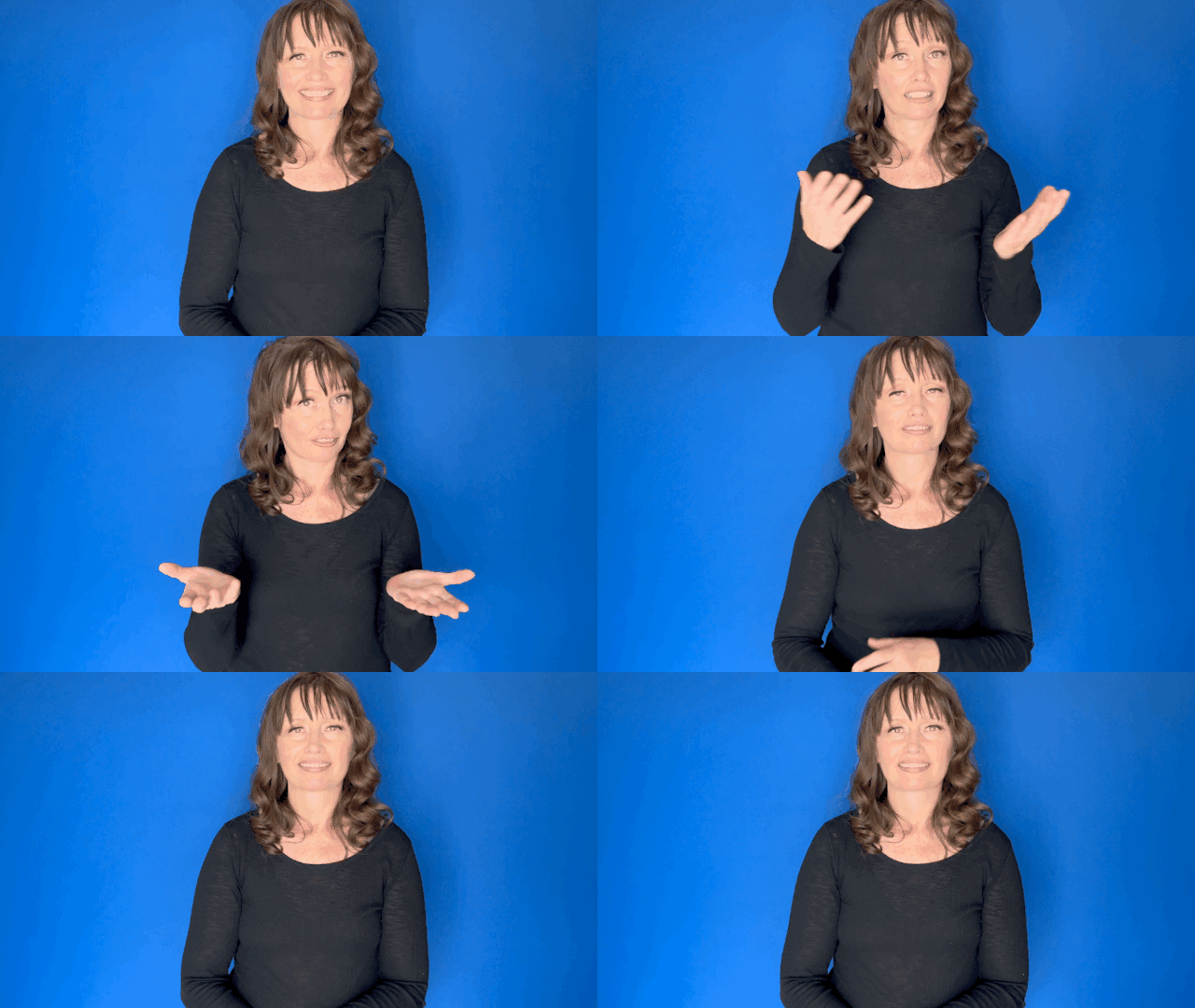
Definition: In this place.
Sign for HERE in ASL
Practice Activities:
To build confidence with the sign for HERE in ASL, start by practicing it in front of a mirror. Focus on the palm orientation and circular movement of the hands to ensure clarity. Repeat the sign several times in isolation until it feels smooth and accurate.
Next, place the sign for HERE in ASL within simple sentences. Use phrases such as “I am here,” “You stay here,” or “The book is here” to reinforce usage. Sign the full sentence slowly, emphasizing the positioning of HERE to support meaning and connection with other signs.
Create location-based prompts to incorporate the sign naturally. Point to different areas around the room or classroom and use the sign for HERE in ASL to describe where items or people are located. Say and sign sentences like “My backpack is here” or “We eat here” to make associations between vocabulary and place.
Partner activities are great for encouraging interaction. One partner can hide an object and tell their partner, “It is here,” pointing and signing to guide them. Switch roles to keep it fun and reinforce comprehension with repetition.
Storytelling is also a powerful method. Tell a short story using basic location references: “I went to the park. I sat here. My dog ran there and came back here.” Use HERE multiple times to draw attention to spatial language and how it supports the story structure.
In group practice, use a game where someone signs a sentence including HERE, and others guess what was described. For example, “The boy is here” while pointing near a specific spot in the room. This keeps practice engaging and builds knowledge of how to use the sign across different settings.
Daily practice using real-world examples will strengthen memory and help solidify the proper use of the sign for HERE in ASL.
Cultural Context:
In American Sign Language, understanding the sign for HERE in ASL goes beyond just the handshape. It reflects how the Deaf community communicates concepts related to location, presence, and immediacy. Since ASL is a visual language, showing that someone or something is here uses spatial awareness and often body language to clarify meaning.
The sign for HERE in ASL is typically produced using both hands in a palm-up, relaxed motion, moving slightly downward or in small circles. It’s often accompanied by appropriate facial expressions to reinforce the meaning, especially in conversations that focus on where someone is physically located. These facial cues are essential in ASL and carry as much meaning as the signs themselves.
In Deaf culture, the idea of being present is deeply valued. When you use the sign for HERE in ASL, you are not just pointing out a place. You’re indicating presence, attention, and availability, which shows respect during conversations. Making eye contact and using polite signing behaviors goes hand-in-hand with this concept.
The sign for HERE in ASL may also be adapted depending on the context. For instance, if someone is emphasizing closeness or urgency, the motion or intensity of the sign might change slightly—though the root handshape stays the same. People in the Deaf community rely on these subtle variations to express emotion and intent more clearly.
When teaching or learning the sign for HERE in ASL, it’s helpful to consider real-life examples from Deaf culture. Think about how a Deaf person might point to the ground or use body orientation to show where they are. These are natural ways the sign for HERE in ASL becomes part of storytelling, daily conversation, and even performances like Deaf poetry or theater.
Cultural etiquette plays a big role when signing in-person locations. For example, in Deaf events, if someone signs that they are HERE, it also implies that they are fully present and engaged. This makes the sign for HERE in ASL not just a physical indicator, but a social and cultural signal of attention and readiness to communicate.
Visual cues like gestures and space are valued deeply in ASL. When signing HERE, signers often use eye gaze and shoulder shifts to show exact spots. This kind of spatial referencing is what makes the sign for HERE in ASL so effective in face-to-face conversations or even in video calls through video relay services.
ASL learners often start with basic signs like the sign for HERE in ASL because it establishes foundational spatial awareness. This is especially important in ASL grammar,
Extended Definition:
The sign for HERE in ASL is commonly used in both casual and formal conversations to indicate presence or a specific location. In American Sign Language, spatial awareness and directional use of the body are key to expressing concepts like location, and the sign for HERE is no exception. It helps create context so others understand whether someone or something is present or nearby.
To make the sign for HERE in ASL, both hands are typically used. The palms are facing up, held in front of the body at a comfortable waist level. The hands gently move in small, circular motions or may lightly tap downward to imply a specific location directly beneath or in front of the signer. Facial expression and body position help reinforce the meaning.
This sign is often used in combination with other directional signs or when establishing location during a narrative. For example, if someone is showing where they are currently standing, they might say HERE while pointing to the space in front of them. It can also be used metaphorically to indicate presence in a conversation, like saying I am here emotionally or mentally.
Context is very important. The sign for HERE in ASL might shift slightly depending on the signer’s physical environment or the topic of conversation. The signer might adjust the location of the sign to align with other signs already established in the signing space. This adjustment makes the visual communication more precise and fluid.
The simplicity of the sign makes it a foundational element for beginner ASL learners. Learning how to correctly sign HERE in ASL not only helps with identifying location but also supports understanding of spatial grammar, which is crucial for fluency. It also sets the stage for understanding more advanced concepts that utilize the signing space.
It’s common to use the sign for HERE in ASL along with signs like NOW, TODAY, or SCHOOL to describe current events or locations. For example, combining HERE with SCHOOL can indicate that the person is presently at school. Alternatively, combining HERE with a question like WHO can prompt direct engagement, such as asking who’s present.
Emotional tone can be added through facial expression when using this sign. A questioning eyebrow raise can turn the sign into an inquiry, while a smile can provide confirmation or emphasis. In ASL, expressions are not just add-ons; they’re integral to the meaning of the sign.
When teaching this sign, it’s helpful to emphasize its flexibility and importance in daily ASL conversations. It is seen often in classroom settings, deaf community gatherings, and one-on-one communication. Kids learning sign language often pick it up
Synonyms: present, in this spot, at this location, right here, in this place
Educational resources: Find related learning materials in our course bank!
Want more? Check out some of our popular learning activities on the homepage!
Need to look up a sign? Use our highly rated dictionary: https://aslinteractive.com/best-asl-dictionary/
Follow us on tiktok: https://www.tiktok.com/@aslinteractive. More social media links at the bottom of this page!
Long-tail Keywords: what is the sign for here in ASL, how do you sign here in ASL, ASL sign for here
Categories:
tags: ASL location signs, ASL directional signs, basic ASL vocabulary, everyday ASL phrases, learning ASL online
Parameters
*Handshape*:
The handshape for the sign for HERE in ASL uses both hands in a relaxed flat handshape, like the number five handshape with fingers extended and together. Palms face upward and are held about shoulder-width apart in front of the torso.
When doing the sign for HERE in ASL, both hands make small alternating circular movements, staying relatively low and close to the body. The handshape remains consistent throughout the sign, emphasizing the meaning clearly.
*Palm Orientation*:
For the sign for HERE in ASL, both hands are typically held in front of the body at about waist level with the palms facing upward. The fingers are relaxed and slightly curved, creating an open handshape that resembles a gentle cup.
During the motion, the hands make small circles or stay relatively still, maintaining the upward palm orientation. This palm orientation helps convey the spatial emphasis of presence or location, which is central to the sign for HERE in ASL.
*Location*:
The sign for HERE in ASL is performed at the neutral space in front of the torso, slightly below chest level. Both hands are typically palm-up and motion in small, alternating circular movements to indicate presence or location.
Positioning is important in the sign for HERE in ASL because it reflects the concept of immediacy or presence. Keep the movements centered in the middle of the body to clearly convey the meaning.
*Movement*:
To perform the sign for HERE in ASL, use both hands with palms facing up and fingers relaxed. Position your hands about chest height, a few inches apart.
Make small, gentle circular movements with both hands at the same time, moving slightly forward and inward. This movement shows a sense of location or presence, which is key to the sign for HERE in ASL. Keep the motion smooth and subtle for clarity .
*Non-Manual Signals*:
When using the sign for HERE in ASL, the facial expression is generally neutral and calm, reflecting the straightforward meaning of the word. Your eyes should be directed slightly downward or toward the hand movement, depending on the context.
Because the sign for HERE in ASL deals with location or presence, your brows remain relaxed, without any raised or furrowed movement unless you’re emphasizing or questioning. Keep shoulders steady and posture relaxed for clarity.
*Prosody, Dominant/Non-Dominant Hand*:
The sign for HERE in ASL uses both hands, typically in a palm-up flat handshape. The dominant and non-dominant hands are held at chest level and slowly move in small outward circles, as if presenting the space in front of you.
This motion emphasizes location and presence. When using the sign for HERE in ASL, both hands remain relaxed and symmetrical, reinforcing the concept with visual clarity .
Tips for Beginners:
When learning the sign for HERE in ASL, start by keeping movements small and centered. This sign is typically made by holding both hands in front of you, palms up, and making small circles at waist level. It’s a gentle, minimal sign, so exaggerating the motion can make it look like a different word entirely. Practicing in front of a mirror helps ensure that your movements stay in the correct zone.
A common challenge with the sign for HERE in ASL is maintaining fluid, natural hand motion without being too dramatic. Avoid spreading your arms out or moving your hands in wide circles—these are not parts of the correct sign. Instead, tight, controlled circles with relaxed wrists communicate the concept clearly.
Pay close attention to facial expressions and eye contact when signing. Even though the sign for HERE in ASL is simple, confident non-manual signals enhance clarity. Keep your gaze at chest level or toward the person you’re communicating with—this centers the sign visually for your conversation partner.
Consistency is key to mastering the sign for HERE in ASL. Many beginners unintentionally switch up hand movements or drift from the proper location in signing space. Mark your hand position with visual cues at first if needed, but aim to internalize the correct space over time.
Don’t forget that this sign can vary slightly based on context. For emphasis, some signers will slightly pause or subtly repeat the sign. Watching fluent signers in videos or live conversations can help you recognize these natural variations and adapt comfortably.
Record yourself practicing the sign for HERE in ASL and compare to verified ASL instructional videos. This side-by-side comparison offers great insight into refining your form, motion, and timing. Keep practice daily and brief as you build muscle memory .
Connections to Other topics:
The sign for HERE in ASL is deeply rooted in concepts of spatial orientation and deixis, which refer to how language points to location, time, or identity depending on the speaker’s point of view. It aligns closely with signs like THERE, THIS, and THAT, all of which position subjects or objects within the signing space. ASL often depends on spatial agreement, so knowing how to sign HERE correctly is key to clear communication.
The sign for HERE in ASL can be used to develop more complex expressions involving surroundings or presence, such as STAY-HERE, WORK-HERE, or LIVE-HERE. These compounds allow signers to show both location and verb simultaneously, which increases efficiency and fluency. Semantic precision is often built around showing where something is happening, and this sign supports that clarity.
In narrative storytelling or giving directions, the sign for HERE in ASL offers a crucial anchor for building visual-spatial descriptions. For example, a signer may establish a location in the signing space, assign it the concept HERE, and then refer back to it through pointing or role-shifting. This is especially useful in conversations about place, such as explaining directions, giving a tour, or contrasting locales.
The concept of HERE can mirror English prepositional phrases but in signed discourse it forms the foundation for locative expressions. Signs like RIGHT-HERE and OVER-HERE provide nuanced versions based on proximity, which adds descriptive flexibility. These signs incorporate spatial referencing through palm orientation and location in signing space.
The sign for HERE in ASL also helps learners understand the embodied nature of the language. Rather than abstract constructs, concepts like HERE connect directly to the signer’s physical perspective. By mastering this, students gain insight into how ASL turns everyday ideas like location into visual-spatial grammar .
Summary:
The sign for HERE in ASL is simple in form yet rich in function. It demonstrates how spatial and directional elements are embedded in American Sign Language’s visual structure. This sign captures more than a location—it conveys relational context.
To make the sign for HERE in ASL, both hands are placed open, palms facing up, positioned in front of the body. They move in small, gentle circular motions or stay still, depending on the conversation’s intent and flow. This spatial motion subtly emphasizes presence and immediacy.
The sign can alternate slightly in style depending on regional or expressive needs. For instance, some signers may use a double movement of flat hands downward, hovering briefly. These variations preserve the semantic integrity of the word while allowing personal flair.
Using the sign for HERE in ASL is common in introductions, instructions, and spatial clarifications. When introducing a place or indicating someone’s exact spot, the sign marks the current space as relevant. Deaf culture often emphasizes directness, making this sign key to clarity.
This sign is frequently paired with other spatial signs such as THERE, RIGHT, LEFT, and NEAR. It helps establish a mental map in conversation. The dynamic use of space within ASL highlights its uniqueness compared to spoken languages.
Grammar in ASL relies heavily on context and visual cues. The sign for HERE in ASL can work independently or within classifiers, serving as both a statement and a directional cue. For instance, one might sign PERSON STAND HERE when giving instructions.
The sign is not limited to pointing at the ground. Depending on perspective and topic, a signer could use the sign higher or more outwardly to invoke philosophical or abstract “here-ness.” This flexibility mirrors the multidimensional grammar of ASL.
Children learning ASL often master the sign for HERE quickly because it reflects their physical surroundings. This connection between linguistic development and spatial reality fosters natural learning. It further supports the embodied cognition theory in linguistics.
In Deaf culture, emphasizing physical presence is important. Using the sign for HERE in ASL reaffirms where the signer or the subject stands. This has symbolic as well as practical aspects, reinforcing communal immersion and situated meaning.
Moreover, this sign overlaps often with ASL storytelling and theater. When describing scenes or settings in narrative contexts, the sign for HERE in ASL helps anchor the action. This adds coherence and spatial grounding to immersive signed performances.
From a phonological perspective, the palm orientation and movement of the sign are minimal. This makes it low-complexity but high-frequency, similar to common signs like YOU, ME, and NOW. Its simplicity boosts its cognitive accessibility.
Linguistically, the sign functions as a deictic term, one that directly points to elements of the shared context. Deixis in ASL includes gaze direction, point location, and hand placement—making signs like HERE crucial for natural conversation.
Applied linguistics connects this sign to the teaching of ASL as a second language. Because it’s centered on context, it helps learners grasp foundational concepts like eye contact, indexing, and referential space. It bridges physicality with meaning.
In signed poetry, the sign for HERE in ASL might be held slightly or repeated rhythmically for dramatic or emotional emphasis. Poets and performers use its basic form to delve into themes of presence, absence, and longing. It becomes more than just a point in space.
The sign plays a noticeable role in Deaf epistemology, the study of knowledge in Deaf contexts. Anchoring information to physical reality through signs like HERE supports mutual understanding. It reinforces environmental and social connectedness.
In bilingual settings, code-switching between ASL and spoken English often requires conceptual matching. English may use the word ‘here’ differently depending on syntax, while ASL relies on spatial reference. Interpreters balance these systems intuitively.
Metaphorical uses of the sign also exist. In philosophical or spiritual contexts, HERE could represent the present moment or existential being. The visual sign enriches these themes without needing additional explanation.
In group settings, the sign assists with orienting others. For example, at events or classroom environments, signing HERE while pointing to a location facilitates instruction. It removes confusion and refines movement expectations.
Comparing the sign for HERE in ASL with corresponding signs in other signed languages reveals fascinating contrasts. British Sign Language, for example, uses a distinct motion. These cross-linguistic differences reflect the cultural grounding of spatial lexicons.
In digital ASL communication, like video chats or social media content, the sign for HERE in ASL retains clarity due to its frontal position and minimal movement. This makes it especially useful in recorded content or live streams. It maintains interpretability.
Educators teaching ASL often use the sign early in lessons when explaining classroom logistics. Signing HERE while showing a chair or location lends physical memory to verbal instruction. Learners are more likely to remember through embodied reference.
In relation to the sign for THERE, the sign for HERE in
Want more? Check out some of our popular learning activities!
ASL Interactive Resources
ASLInteractive YouTube Channel
Follow us on tiktok: @aslinteractive.com
Follow us on Instagram: aslinteractive
Facebook page: aslinteractive
Facebook group: aslinteractive
LInkedIn: ASL Interactive LLC
Twitter: @ASL_interactive
*Some information on this page is AI-generated. AI can make mistakes. Please check the information.


Responses