Sign for MAKE in ASL | ️ ASL Dictionary

Definition: To create, produce, or construct.

Sign for MAKE in ASL

YouTube player

Practice Activities:

Cultural Context:

Practice Activities

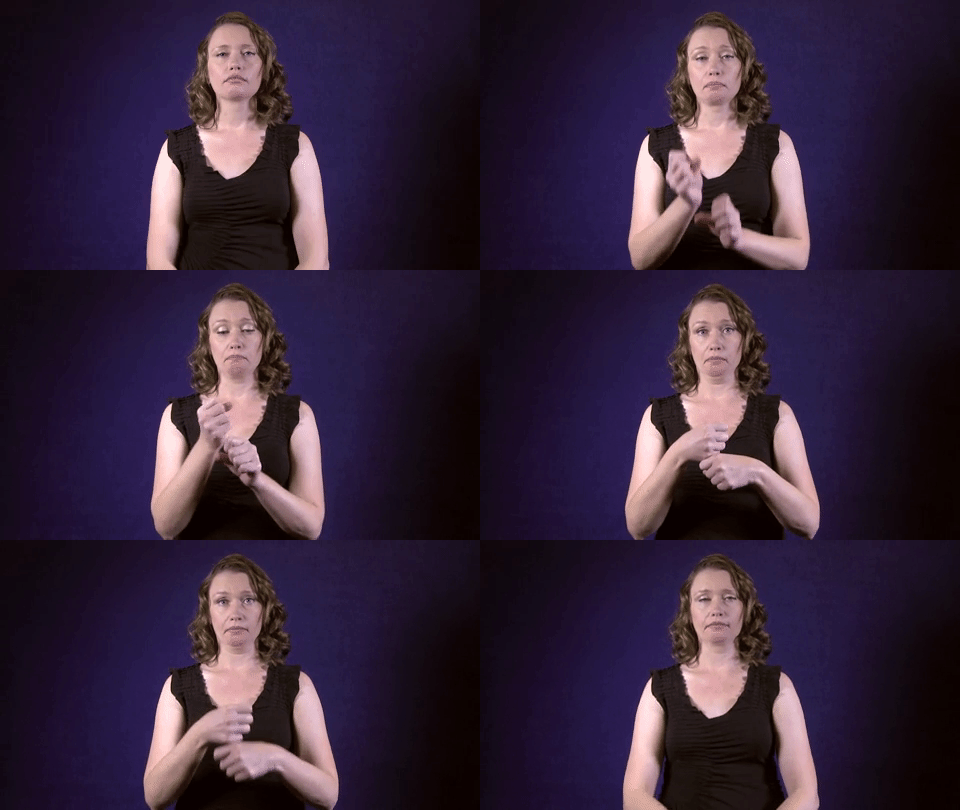
To master the sign for MAKE in ASL, consistent and focused practice is essential. Start by standing in front of a mirror to observe your handshape, palm orientation, and movement. The sign for MAKE in ASL involves a twisting motion of two fists stacked on top of each other—this precise motion is critical to conveying the correct meaning.

Record yourself signing so you can compare your version to native signers. Watching your own signing helps identify subtle errors in movement or positioning that may go unnoticed during live practice. Try to sign full sentences incorporating the sign for MAKE in ASL to develop fluency and improve contextual understanding.

Engage in real-time dialogues with peers or language partners. Whether you’re using video chat or in-person interaction, applying the sign for MAKE in ASL within everyday conversations strengthens retention. Practice creating sentences like “I MAKE coffee,” or “They MAKE dinner” to build real-world usage.

For advanced learners, drills that focus on speed and clarity are helpful. Try signing ASL gloss sentences quickly while maintaining accuracy. Repeating the sign for MAKE in ASL in various sentence structures, such as questions and imperatives, helps reinforce its versatility and grammatical placement.

SEO Cultural Context

The sign for MAKE in ASL carries cultural and linguistic significance within the Deaf community. It’s a fundamental verb used in countless interactions, from describing daily routines to expressing creative processes. Understanding when and how to use the sign for MAKE in ASL shows respect for Deaf cultural norms and conversational flow.

Within Deaf culture, clarity and efficiency in communication are highly valued. The sign for MAKE in ASL aligns with these values by offering a concise visual representation of the concept of creating or producing. It’s often used in both literal and abstract contexts, such as MAKE food or MAKE an effort.

Regional variations of the sign for MAKE in ASL exist, though they are minimal. In some areas, the motion may be slightly faster, or the wrist twist more pronounced. Exposure to different signing communities can help you recognize and adapt to these subtle shifts without confusion.

The sign is commonly used in educational settings, social conversations, and storytelling. Whether describing how something is made or expressing determination, the sign for MAKE in ASL is both versatile and culturally embedded. Using this sign correctly also demonstrates your growing fluency and cultural competence in ASL.

Extended Definition

The sign for MAKE in ASL is formed by placing one fist on top of the other, usually with the dominant hand on top. The hands then twist in opposite directions, typically with the top hand twisting away from the signer. This motion visually represents the act of combining or creating—capturing the essence of the English verb “make.”

This sign is a general verb, meaning it can be applied across various contexts. It can mean to create something physically, such as MAKE a sandwich, or metaphorically, such as MAKE a decision. Because of its broad use, the sign for MAKE in ASL often appears in compound structures and idiomatic expressions.

Some learners confuse the sign for MAKE in ASL with other similar signs like WORK or BUILD. While these signs also use fists or stacking motions, their movements and context differ. WORK involves tapping the wrists, while BUILD uses a different directional stacking motion. Paying close attention to movement and palm orientation helps avoid these common mix-ups.

The sign for MAKE in ASL can also vary slightly depending on the object or subject in the sentence. For example, when combined with facial expressions or body shifts, it may convey emphasis or emotional tone. Over time, fluent signers may even modify the sign slightly for poetic or expressive purposes, particularly in ASL storytelling and performance.

Tips for Beginners

If you’re just starting out, don’t worry if the sign for MAKE in ASL feels awkward at first. Like any new motor skill, it takes time and repetition to build muscle memory. Start slow and make sure your handshape is correct—both hands should form fists, and the twist should be deliberate, not rushed.

One common beginner mistake is not fully twisting the fists or reversing the direction. Watch native signers carefully or use video tutorials to get the motion right. Practicing in front of a mirror can help you compare your form to standard models and build confidence.

Another tip is to practice the sign for MAKE in ASL in short phrases rather than in isolation. This helps you understand how it fits into ASL grammar and sentence structure. Try combining it with signs like FOOD, HOUSE, or CAKE to create meaningful practice phrases.

Don’t be afraid to ask for feedback from more experienced signers. The Deaf community often appreciates learners who show genuine effort and open-mindedness. With patience and dedication, you’ll find that the sign for MAKE in ASL becomes second nature in your conversations.

Connections to Other Topics

The sign for MAKE in ASL is closely related to the sign for BUILD, which also involves stacking handshapes. However, BUILD uses open hands and a repeated upward movement, showing a more step-by-step process of creating something. Understanding both signs helps distinguish between general and specific forms of creation.

Another related sign is CREATE, which involves a C-handshape forming outward from the head. While MAKE and CREATE can sometimes be used interchangeably, CREATE often has a more artistic or imaginative connotation. Learning both signs expands your expressive range in ASL.

The sign for COOK is another useful connection. It uses a flipping motion of one flat hand over the other, symbolizing the act of cooking. Since MAKE is often used in cooking-related contexts, knowing both signs allows for more precise communication.

You’ll also encounter the sign for DO or DO-WHAT, which can sometimes overlap in meaning with MAKE, depending on context. Understanding when to use MAKE versus DO enhances your grammatical accuracy in ASL.

Finally, the sign for WORK is helpful to learn alongside MAKE. Both involve fist handshapes, but WORK uses a tapping motion instead of a twist. These subtle differences are important in conveying the right meaning, especially in professional or academic settings.

Lengthy Summary

The sign for MAKE in ASL is a foundational verb that plays a significant role in everyday communication. Whether you’re talking about making a sandwich, making a plan, or making a difference, this sign helps express a wide spectrum of human activity. Its form—two fists twisting—symbolizes the act of combining or producing, making it intuitive and visually clear.

Practicing the sign for MAKE in ASL through mirror work, recorded videos, and real-time dialogues builds confidence and accuracy. Advanced drills help refine your speed and fluidity, allowing you to use the sign naturally in conversation. Each practice method reinforces your muscle memory and deepens your understanding.

In terms of cultural context, the sign for MAKE in ASL reflects the Deaf community’s value on clear and efficient communication. It is widely used across regions with only minor variations, and its versatility makes it a powerful tool in both literal and metaphorical language. Using this sign appropriately shows respect for cultural norms and enhances your ability to connect with native signers.

Understanding the extended definition of the sign—including its differences from similar signs like WORK, BUILD, and DO—prevents common mistakes and strengthens your vocabulary. It also opens the door to learning related signs that expand your expressive capacity in ASL.

For beginners, the journey to mastering the sign for MAKE in ASL begins with patience and proper technique. Avoid rushing the movement or confusing it with other signs. Practice regularly, seek feedback, and immerse yourself in authentic ASL environments when possible.

The sign for MAKE in ASL connects to broader grammatical and thematic concepts, such as creation, work, food preparation, and artistic expression. Learning related signs like COOK, CREATE, and BUILD not only enhances your vocabulary but also helps you understand how ASL conveys complex ideas visually.

As you continue your ASL journey, keep practicing the sign for MAKE in ASL until it becomes a natural part of your signing. Use it in conversations, storytelling, and even in academic or professional settings. The more you use it, the more fluent and confident you’ll become. Keep signing, keep learning, and keep making progress every day!

Extended Definition:

Synonyms: create, build, construct, form, produce

Educational resources: Find related learning materials in our course bank!

Want more? Check out some of our popular learning activities on the homepage!

Need to look up a sign? Use our highly rated dictionary: https://aslinteractive.com/best-asl-dictionary/

Follow us on tiktok: https://www.tiktok.com/@aslinteractive. More social media links at the bottom of this page!

Long-tail Keywords: what is the sign for make in ASL, how do you sign make in ASL, ASL sign for make

Categories:

tags: ASL verbs, making and creating ASL, how to sign make, action signs in ASL, ASL vocabulary building

Tips for Beginners:

Connections to Other topics:

Summary:

Want more? Check out some of our popular learning activities!

ASL Interactive Resources

ASLInteractive YouTube Channel

Follow us on tiktok: @aslinteractive.com

Follow us on Instagram: aslinteractive

Facebook page: aslinteractive

Facebook group: aslinteractive

LInkedIn: ASL Interactive LLC

Twitter: @ASL_interactive

*Some information on this page is AI-generated. AI can make mistakes. Please check the information.


Responses