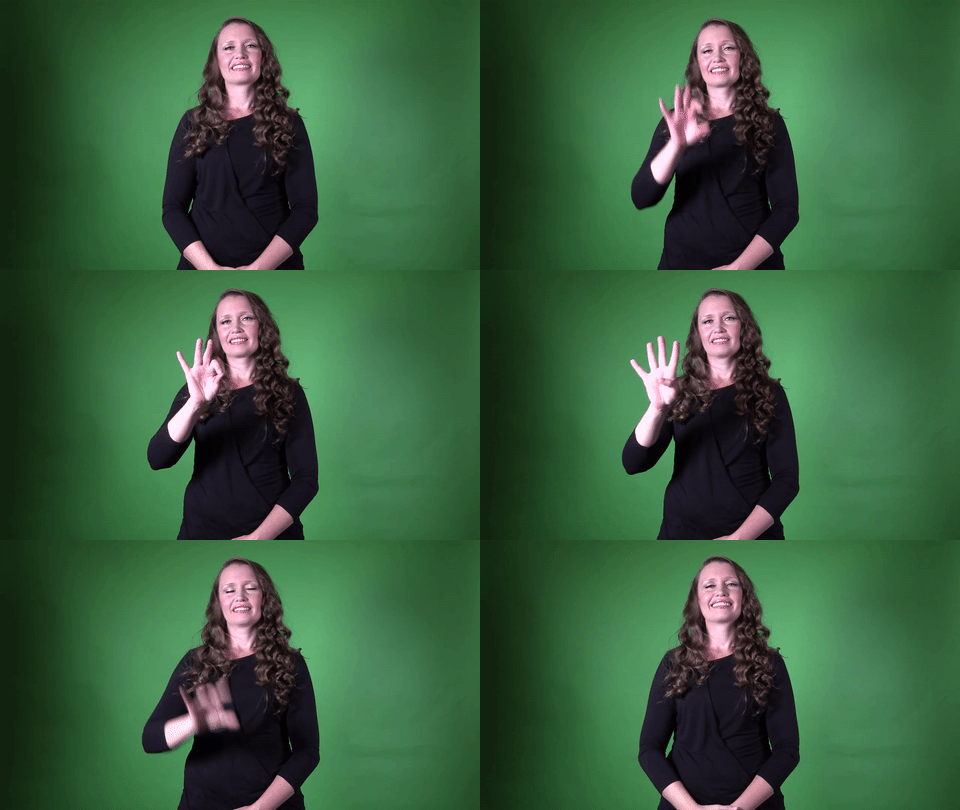
Sign for NINETY-FOUR in ASL | 🔢 ASL Dictionary

Definition: The number ninety-four

Sign for NINETY-FOUR in ASL 

YouTube player

Practice Activities:

Practicing the sign for ninety-four in ASL can help reinforce fluency with numbers. Start by signing it repeatedly in front of a mirror to ensure accuracy in handshape and movement. Slowly transition from signing ninety to ninety-four in a sequence to build muscle memory.

Try counting from ninety to one hundred, emphasizing the sign for ninety-four in ASL to improve recall. Use flashcards with written numbers and sign what you see. Reverse the activity by signing numbers while a partner writes them down to check for accuracy.

Incorporate the sign for ninety-four in ASL into real-life contexts. Practice signing someone’s age, a large quantity of items, or a street address that includes ninety-four. Create number-based trivia with a partner, asking questions like “How many years ago was 1930?” and responding in ASL.

Use storytelling to reinforce number concepts. Create a mini-story about a person who has ninety-four marbles or lives on 94th Street. Present the story in ASL while emphasizing accurate numerical signing. Watch ASL videos and pause when numbers appear, signing them yourself for reinforcement.

For partner activities, use a number relay game where one person signs a large number like ninety-four, and the other quickly repeats it. Play a memory game where numbers are signed in a sequence, and each participant builds on the previous sign. These activities increase fluency and confidence.

To further challenge yourself, incorporate speed drills with number sequences that include the sign for ninety-four in ASL. Time yourself signing a series of numbers in increasing and decreasing order. Consistent practice will help you sign numbers smoothly and naturally within conversations.

Cultural Context:

The sign for ninety-four in ASL follows the standard pattern for signing numbers in American Sign Language. It combines the signs for nine and four in a fluid motion, following the conventions used for two-digit numbers. This pattern makes it easier for signers to communicate large numbers efficiently.

Numbers play an important role in ASL, especially for dates, times, and quantities. The sign for ninety-four in ASL can be used when discussing historical events, financial figures, or even as an age reference. Because ASL is a visual language, the movement and handshape must be performed correctly to ensure clarity.

When signing numbers like ninety-four in ASL, it’s essential to maintain palm orientation and finger positioning. Some regions may have slight variations in number signs due to dialectical differences in ASL. However, most signers in the United States and Canada follow the same general number rules.

The sign for ninety-four in ASL is an example of how number signs are structured in a logical and visually distinct way. Learning number signs effectively can improve fluency and comprehension in everyday signing. Recognizing and practicing numerical signs strengthens communication in personal and professional settings.

Many learners find numbers challenging because they require precision and smooth transitions. The sign for ninety-four in ASL, like other number signs, should be practiced regularly to ensure accuracy. Mastering these signs builds confidence in conversations where numbers are frequently used.

Numbers are integral to ASL storytelling and daily conversation. Whether counting objects, stating an age, or discussing statistics, the sign for ninety-four in ASL is useful in many contexts. Consistency in signing numbers helps maintain clear communication between deaf and hearing individuals.

ASL follows a structured numbering system that allows signers to express concepts quickly and effectively. The sign for ninety-four in ASL demonstrates how the language prioritizes clarity and efficiency. Understanding number signs deepens a signer’s grasp of ASL’s structure and usage.

Fluent signers use number signs naturally in conversations, from casual chats to professional discussions. The sign for ninety-four in ASL appears in topics related to history, addresses, and numerical data. Frequent exposure to number signs helps learners recognize and reproduce them correctly.

Numbers like ninety-four in ASL are essential for discussing personal details such as birth years and dates. This makes learning numbers one of the key foundations for ASL proficiency. Practicing number signs consistently results in more fluid and natural communication.

Extended Definition:

The sign for ninety-four in ASL follows a common pattern used for signing numbers in American Sign Language. It is a combination of the signs for nine and four, flowing smoothly from one to the other. This helps maintain clarity while counting or referencing numbers in conversation.

When signing ninety-four in ASL, the handshape starts with the number nine. The thumb and index finger form an open circle while the other fingers remain extended. Then, the hand shifts to form the number four, with the thumb tucked in and the other four fingers extended.

This number sign is done with one hand, making it quick and efficient to produce. ASL uses a specific pattern for numbers in the nineties, where the hand transitions from one digit to the next. This makes signing numbers above ten easier while keeping signs visually distinct.

Learning the sign for ninety-four in ASL is essential for expressing prices, measurements, and ages. It is commonly used when discussing numbers in everyday conversations, especially in financial or academic settings. Knowing these number signs helps improve fluency in ASL.

Signing numbers correctly in ASL requires attention to handshape, palm orientation, and movement. The sign for ninety-four in ASL should be made clearly so it is easily understood by the listener. Practicing with a mirror or a fluent signer can help improve accuracy and confidence.

Numbers in ASL follow a logical and structured system. The sign for ninety-four in ASL follows a natural flow that makes it easy to remember once familiar with number patterns. Recognizing the similarities between different number signs can help reinforce learning.

ASL signs for numbers are often accompanied by facial expressions depending on context. When emphasizing the number ninety-four in ASL, a slight head nod or raised eyebrows can add clarity. Expressions play an important role in conveying meaning in ASL.

Using the correct palm orientation is crucial for signing numbers. The sign for ninety-four in ASL is typically done with the palm facing outward, following the standard numbering system in ASL. It’s important to maintain this orientation to avoid confusion with similar numbers.

As with many ASL signs, regional variations may exist. Some signers may use slight modifications in how they produce the sign for ninety-four in ASL based on their local signing community. However, the standard version remains widely understood across ASL users.

Fingerspelling is not typically used for numbers unless clarification is needed. Instead, the sign for ninety-four in AS

Synonyms: ninety-four, number ninety-four, number 94, the number 94, the number ninety-four

Educational resources: Find related learning materials in our course bank!

Want more? Check out some of our popular learning activities on the homepage!

Need to look up a sign? Use our highly rated dictionary: https://aslinteractive.com/best-asl-dictionary/

Follow us on tiktok: https://www.tiktok.com/@aslinteractive. More social media links at the bottom of this page!

Long-tail Keywords: What is the sign for Ninety-four in ASL, How do you sign Ninety-four in American Sign Language, Learn how to sign Ninety-four in ASL

Categories: Numbers – Basics, Numbers 91-100, cardinal numbers

tags: Numbers, Numbers 91-100, Math, Language Learning, Educational Content

Parameters

*Handshape*:

The sign for ninety-four in ASL uses a changing handshape. It begins with the “9” handshape, where the thumb and index finger form a small circle while the other fingers remain extended. Then, it transitions smoothly into the “4” handshape, with the thumb tucked against the palm and the four fingers extended. This fluid motion is a common pattern in number signs, making the sign for ninety-four in ASL both clear and efficient.

*Palm Orientation*:

The palm orientation for the sign for ninety-four in ASL begins with the dominant hand forming the number nine, with the palm facing outward. The fingers then transition smoothly into the number four, maintaining outward palm orientation. Throughout the motion, the palm should stay forward to ensure clarity, and finger positioning should remain distinct to differentiate each number accurately. This sign follows the standard structure for number transitions in ASL, keeping movements fluid.

*Location*:

The sign for ninety-four in ASL is made in the neutral space in front of the body, at chest level. The dominant hand begins in the “9” handshape, with the index finger and thumb touching while the other fingers remain extended. Then, it smoothly transitions into the “4” handshape, with the palm facing outward. The movement is fluid, ensuring clarity in expressing the number. ✅

*Movement*:

To produce the sign for ninety-four in ASL, begin with the number nine handshape, where the thumb and index finger form a circle while the remaining fingers are extended. Then, smoothly transition into the number four handshape, extending the four fingers while the thumb tucks in. The movement should be fluid, with a clear shift from the nine handshape to the four handshape without unnecessary pauses. Keep the hand in a neutral space at chest level, facing outward.

*Non-Manual Signals*:

Facial expressions for the sign for ninety-four in ASL are typically neutral, unless emphasizing quantity or specifying a context. If stressing the number, the eyebrows may raise slightly, and the mouth may form an “oh” shape. Maintaining a steady gaze and slight head nod can reinforce clarity. If signed in a questioning tone, raised eyebrows and a slight forward head tilt can indicate a request for confirmation or repetition.

*Prosody, Dominant/Non-Dominant Hand*:

The sign for NINETY-FOUR in ASL uses the dominant hand. Start with the number 9 handshape, with the index finger and thumb touching in an open “O” shape. Then smoothly transition into the number 4 handshape, spreading all four fingers while keeping the thumb tucked. The movement should be fluid, without a pause between the two numbers. Make sure the palm orientation stays forward, maintaining clear visibility for the viewer.

Tips for Beginners:

Mastering the sign for ninety-four in ASL requires fluid motion and clear hand positioning. Start by forming the number nine with your dominant hand, touching the tip of the thumb to the tip of the index finger while the other fingers remain extended. Then smoothly transition to the number four, extending all fingers except the thumb, which stays tucked against the palm.

A common mistake when signing the sign for ninety-four in ASL is moving too rigidly between numbers. Keep your hand relaxed to maintain a smooth flow from one digit to the next. Practicing in front of a mirror or recording yourself can help you identify and adjust any stiffness.

Finger positioning is crucial for clarity. Make sure the four is well-formed, with the fingers clearly separated instead of bunched together. If your fingers are too close, it might resemble a different number, potentially leading to confusion.

Pacing matters when executing the sign for ninety-four in ASL. If you go too fast, the transition can appear sloppy and hard to read. On the other hand, going too slow might make the sign feel unnatural. Find a balance that allows for both clarity and efficiency.

Context is essential when using numbers in ASL. Depending on the situation, numbers may be incorporated into age, quantity, or addresses. When conversing, watch how fluent signers transition between numbers smoothly and try to mimic their natural flow.

Consistent practice will build muscle memory. Try signing numbers up to ninety-four sequentially to reinforce transitions between numerals. Drills like this will make the sign feel second nature over time.

Watch out for regional variations, as some signers may use slightly different transitions for large numbers. If in doubt, ask a fluent ASL user for feedback to ensure you are using the most widely understood version.

Connections to Other topics:

The sign for ninety-four in ASL connects to the broader system of ASL number signs. The handshape and movement used in this number are similar to those of other numbers in the ninety range. By understanding the pattern used in signing numbers in ASL, learners can more easily recognize and produce numbers fluently. This also forms a foundation for higher-level numbers that build on the same pattern.

Cardinal numbers like the sign for ninety-four in ASL are often used in everyday contexts, such as stating a year, sharing an address, or providing a quantity. It connects directly to ordinal numbers, which indicate specific placement in a sequence, such as ninety-fourth. Many ordinal numbers in ASL are formed with a simple modification of the cardinal number, typically by adding a small twisting motion. This demonstrates how numerical concepts in ASL are interconnected and follow logical transformations.

Understanding the sign for ninety-four in ASL also helps with recognizing patterns in signing decades and percentages. For example, percentages such as ninety-four percent follow a similar sign structure but may incorporate a percent sign afterward. This structure is essential for discussing statistics, financial figures, and other numerical data. Familiarity with these number signs allows for greater ease in communication across various topics.

Numbers like the sign for ninety-four in ASL also play a role in telling time, discussing sports scores, and stating measurements. In topics such as mathematics and science, knowing number signs fluently allows for quick calculations and descriptions. Mastering these connections creates a strong numerical foundation, making it easier to communicate a wide range of numeric and quantitative information in ASL.

Summary:

The sign for ninety-four in ASL follows a numerical pattern used in American Sign Language for counting and quantifying. This sign is made using a combination of numerical handshapes, transitioning from one number to another within a single motion. Like other numbers in ASL, it is performed with a dominant hand, oriented in a way that ensures clarity and visibility.

To form the sign for ninety-four in ASL, start by shaping the dominant hand into the number nine. In ASL, the number nine is signed by extending the thumb and index finger while the other three fingers remain extended straight up. The tip of the index finger and thumb form a small circle, a distinguishing feature of this number.

From the number nine position, smoothly transition into the number four. The number four is formed by keeping the hand open with the palm facing outward, and extending the index, middle, ring, and pinky fingers while tucking the thumb across the palm. This shift from nine to four happens in one fluid motion to maintain efficiency and accuracy.

Numbers in ASL are highly dependent on context and regional variations. While the basic form of the sign for ninety-four in ASL remains the same across most signers, minor differences may appear due to dialectal changes across ASL communities. Some variations may emphasize a slight wrist movement during the transition between numbers.

ASL numbers are structured logically, allowing easy comprehension for signers accustomed to the language. The shift between the digits in ninety-four is a common numeric transition seen in ASL counting systems, maintaining a consistency that helps learners and fluent signers alike. Understanding this structure is essential for communicating large numbers efficiently.

When using the sign for ninety-four in ASL, understanding placement, movement, and palm orientation is crucial. The palm should typically face outward to ensure visual clarity. This visibility is especially important in fast-paced signing, where numerical signs must be quickly processed by the viewer.

Numbers in ASL are more than just gestures for counting; they serve vital roles in time, money, dates, and measurements. The sign for ninety-four in ASL may be used in various contexts, such as discussing ages, scores, statistics, or monetary values. Numerical literacy in ASL is crucial for effective communication.

Counting in ASL follows a decimal-based pattern, making number transitions intuitive once the pattern is understood. The ability to fluidly sign numbers like ninety-four is built upon mastering smaller numbers and their respective transitions. This emphasizes how ASL depends on visual communication through recognizable patterns.

Linguistically, ASL numbers carry both iconic and arbitrary elements. The numerical signs originate from finger positions that visually represent quantities, but they also function within a standardized system shared by signers. Learning the sign for ninety-four in ASL illustrates how signed languages create efficiency through standardized movements.

Within the Deaf community, numerical fluency in ASL fosters effective communication across educational, social, and professional spaces. Numbers are used regularly in storytelling, business, and everyday interactions. Mastering the sign for ninety-four in ASL is part of acquiring broader numerical competence in ASL.

In educational settings, ASL numbers are vital in teaching math concepts to Deaf students. Teachers use structured sequence patterns to reinforce understanding. When students learn the sign for ninety-four in ASL, they engage in mathematical reasoning that combines gesture-based learning with numerical understanding.

Numbers in ASL, including the sign for ninety-four in ASL, share linguistic connections with international sign languages. While some numerical systems resemble ASL, others differ significantly in formation and movement. This highlights linguistic diversity among signed languages.

Finger dexterity plays a key role in signing numbers in ASL. Smoothly transitioning between handshapes as in ninety-four requires fine motor control. Repeated practice with ASL numbers enhances fluidity, improving overall signing fluency and comprehension.

Beyond direct numerical use, ASL numbers appear in storytelling, poetry, and artistic performances. The visual nature of signing numbers adds an expressive dimension to ASL literature and performances. When the sign for ninety-four in ASL appears in an artistic context, it carries narrative weight.

Numerical classifiers in ASL offer enhanced ways to describe things like quantities, rankings, and categories. Understanding ASL numbers expands a signer’s ability to use classifiers more effectively. The sign for ninety-four in ASL may accompany descriptive classifiers for emphasis in certain contexts.

Numerical incorporation in sign languages also plays a role in name signs, addresses, and telephone numbers. People may use the sign for ninety-four in ASL while giving numerical identifiers. Rapidly signing numbers accurately is a key skill for real-life communication.

When fingerspelling large numbers, ASL follows a structured approach to ensure clarity. The sign for ninety-four in ASL follows a sequence that aligns with broader numerical structures in the language. This structured system ensures effective comprehension by both signers and viewers.

Numbers in ASL, including the

Want more? Check out some of our popular learning activities!

ASL Interactive Resources

ASLInteractive YouTube Channel

Follow us on tiktok: @aslinteractive.com

Follow us on Instagram: aslinteractive

Facebook page: aslinteractive

Facebook group: aslinteractive

LInkedIn: ASL Interactive LLC

Twitter: @ASL_interactive

*Some information on this page is AI-generated. AI can make mistakes. Please check the information.

Sign for 94 in ASL, Sign for NINETY-FOUR in ASL 

Responses