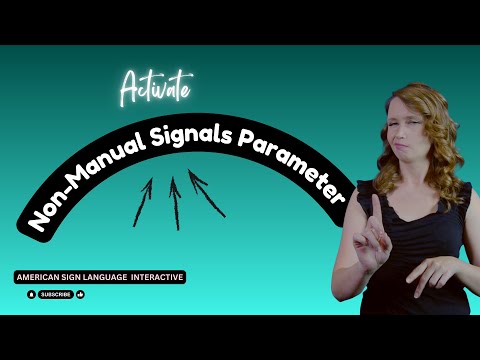
Definition: Facial expressions and body language used in ASL.
Sign for NON MANUAL SIGNALS in ASL
Practice Activities
Practicing the sign for NON MANUAL SIGNALS in ASL requires more than just hand movements. It involves full facial expressions, head tilts, eye gaze, and even shoulder shifts. Because this concept includes a wide range of facial grammar, learners should engage in exercises that isolate and emphasize these elements.
Start with mirror work. Stand in front of a mirror and practice the sign for NON MANUAL SIGNALS in ASL by focusing on your facial expressions. For example, exaggerate your eyebrows for yes/no questions or puff your cheeks for emphasis. This helps you see how your face communicates meaning and aligns with hand signs.
Use recorded signing to review your progress. Record yourself using the sign for NON MANUAL SIGNALS in ASL in different sentences. Play it back and compare your expression to native signers or instructors. Pay attention to the timing and coordination between facial expressions and hand signs.
Incorporate the sign in context. Practice short conversations or storytelling that require different non-manual signals like negation, questions, or rhetorical statements. This builds fluency and helps you understand the grammatical function of the sign for NON MANUAL SIGNALS in ASL.
Advanced drills can include interpreting signed videos without audio, focusing solely on facial expressions and body language. Try shadowing exercises where you mimic the signer’s non-manual signals in real time. These techniques improve your responsiveness and comprehension.
SEO Cultural Context
Understanding the sign for NON MANUAL SIGNALS in ASL is essential for grasping the depth of Deaf communication. Non-manual signals are integral to ASL grammar and are not optional add-ons. They convey tone, mood, and grammatical structure in a way that words alone cannot.
In Deaf culture, clarity and expressiveness are highly valued. The accurate use of non-manual signals shows respect for the language and its users. For example, raising your eyebrows while asking a yes/no question is not just helpful—it’s grammatically required.
Regional variations exist, particularly in the intensity and style of facial expressions. Some regions may use more subtle shifts, while others favor exaggerated movements. Being aware of these variations can help learners adapt when interacting with different signers.
Non-manual signals are used constantly in real-life situations. Whether someone is asking a rhetorical question, expressing emotion, or showing a condition, they rely on facial grammar. Mastering the sign for NON MANUAL SIGNALS in ASL is key to fully participating in Deaf conversations and storytelling.
Extended Definition
The sign for NON MANUAL SIGNALS in ASL is often expressed through a combination of signs that describe “facial expressions,” “body language,” or “non-manual markers.” You might see it signed as NON-MANUAL (with the NMM abbreviation fingerspelled or expressed through context) followed by SIGNALS or MARKERS. It’s not always a single, fixed sign but rather a conceptual phrase expressed clearly through context.
Non-manual signals include facial expressions, eyebrow movement, mouth morphemes, head tilts, and shoulder shifts. These elements function grammatically. For instance, raised eyebrows signal a yes/no question, while furrowed brows indicate a wh-question. Head movements can reflect conditional clauses or topic-comment structure.
Common errors with the sign for NON MANUAL SIGNALS in ASL include overusing or underusing facial expressions, using the wrong expression for the sentence type, or forgetting to coordinate them with manual signs. Timing is critical. The non-manual cue must happen simultaneously with the manual sign to convey the correct meaning.
Learners often confuse non-manual signals with mere emotional expression. While emotions can be shown through facial expressions, in ASL, non-manual signals serve specific grammatical roles. It’s important to distinguish between expressive emotion and grammatical necessity.
Tips for Beginners
Learning the sign for NON MANUAL SIGNALS in ASL can be both exciting and challenging. For beginners, the biggest hurdle is often remembering to use facial expressions consistently. It might feel awkward at first, especially if you come from a spoken language background where facial expressions are less grammatical.
Start small. Focus on mastering one type of non-manual signal at a time. For example, practice yes/no questions with raised eyebrows until it becomes second nature. Then move to wh-questions or negation.
Record yourself signing and compare your expressions to fluent signers. This feedback loop is invaluable for beginners working on the sign for NON MANUAL SIGNALS in ASL. Don’t worry about over-expressing at first; clarity is more important than subtlety in early learning stages.
One common mistake is separating the facial expression from the hand sign. Remember, in ASL, non-manual signals must align with the manual sign in timing and meaning. Practice signing full sentences to ensure synchronization.
Be patient and practice daily. Even five minutes of focused work on the sign for NON MANUAL SIGNALS in ASL can yield noticeable improvement over time. Celebrate small victories and stay motivated.
Connections to Other Topics
Understanding the sign for NON MANUAL SIGNALS in ASL connects directly with ASL sentence structure. Non-manual signals often mark grammatical boundaries such as topic-comment, conditionals, and negation. Learning these grammatical structures deepens your understanding of how ASL works as a language.
Facial expressions in ASL also relate closely to question types. For example, yes/no questions require raised eyebrows, while wh-questions need furrowed brows. This means the sign for NON MANUAL SIGNALS in ASL is essential for asking and understanding different types of questions.
Emotional expression is another related topic. While distinct from grammatical non-manual signals, emotions like surprise, anger, or joy often accompany and enhance a signed message. Knowing the difference between emotional expression and grammatical markers helps clarify your meaning.
The concept of classifiers in ASL also ties in. Many classifiers rely on head movement and facial expressions to provide spatial or descriptive information. Without proper non-manual signals, classifier use can become ambiguous or incorrect.
Finally, role shifting in ASL storytelling uses non-manual signals such as body lean, eye gaze, and facial changes to indicate a change in character or perspective. Mastery of the sign for NON MANUAL SIGNALS in ASL enables more effective and engaging storytelling.
Lengthy Summary
The sign for NON MANUAL SIGNALS in ASL represents a foundational concept that goes far beyond hand gestures. Non-manual signals like facial expressions, head tilts, eye gaze, and body posture are all essential elements that communicate grammar, emotion, and meaning. Without them, ASL would be incomplete.
From a cultural standpoint, using the sign for NON MANUAL SIGNALS in ASL correctly demonstrates respect for the linguistic richness of the Deaf community. These signals are not optional; they are required grammatical features that every ASL learner must master. Regional variations may influence how these signals are used, but the core principles remain consistent across signing communities.
The extended definition of the sign for NON MANUAL SIGNALS in ASL highlights the importance of synchronizing facial expressions with manual signs. Errors like mismatched timing or misused expressions can significantly alter meaning. Understanding this can help learners avoid common pitfalls and grow in fluency.
Beginners should approach the sign for NON MANUAL SIGNALS in ASL with patience and curiosity. Focused practice using mirrors, recordings, and contextual drills will build confidence and skill. It’s okay to exaggerate at first—clarity and communication are more important than subtlety in early stages.
This topic also connects to broader ASL concepts such as sentence structure, question formation, emotional expression, classifiers, and role shifting. Mastery of the sign for NON MANUAL SIGNALS in ASL enhances your overall fluency and deepens your understanding of how ASL functions as a visual-gestural language.
Keep practicing regularly, ask for feedback, and immerse yourself in authentic ASL environments whenever possible. The more you use the sign for NON MANUAL SIGNALS in ASL in real conversations, the more natural it will feel. Stay motivated and keep exploring the beauty and complexity of ASL!
Synonyms: facial expressions, head movements, body shifts, mouth movements, eye gaze
Educational resources: Find related learning materials in our course bank!
Want more? Check out some of our popular learning activities on the homepage!
Need to look up a sign? Use our highly rated dictionary: https://aslinteractive.com/best-asl-dictionary/
Follow us on tiktok: https://www.tiktok.com/@aslinteractive. More social media links at the bottom of this page!
Long-tail Keywords: what is the ASL sign for Non Manual Signals, how do you sign Non Manual Signals in ASL, examples of Non Manual Signals in American Sign Language
Categories:
tags: ASL grammar, non-manual markers, ASL facial expressions, American Sign Language syntax, ASL communication tips
Want more? Check out some of our popular learning activities!
ASL Interactive Resources
ASLInteractive YouTube Channel
Follow us on tiktok: @aslinteractive.com
Follow us on Instagram: aslinteractive
Facebook page: aslinteractive
Facebook group: aslinteractive
LInkedIn: ASL Interactive LLC
Twitter: @ASL_interactive
*Some information on this page is AI-generated. AI can make mistakes. Please check the information.


Responses