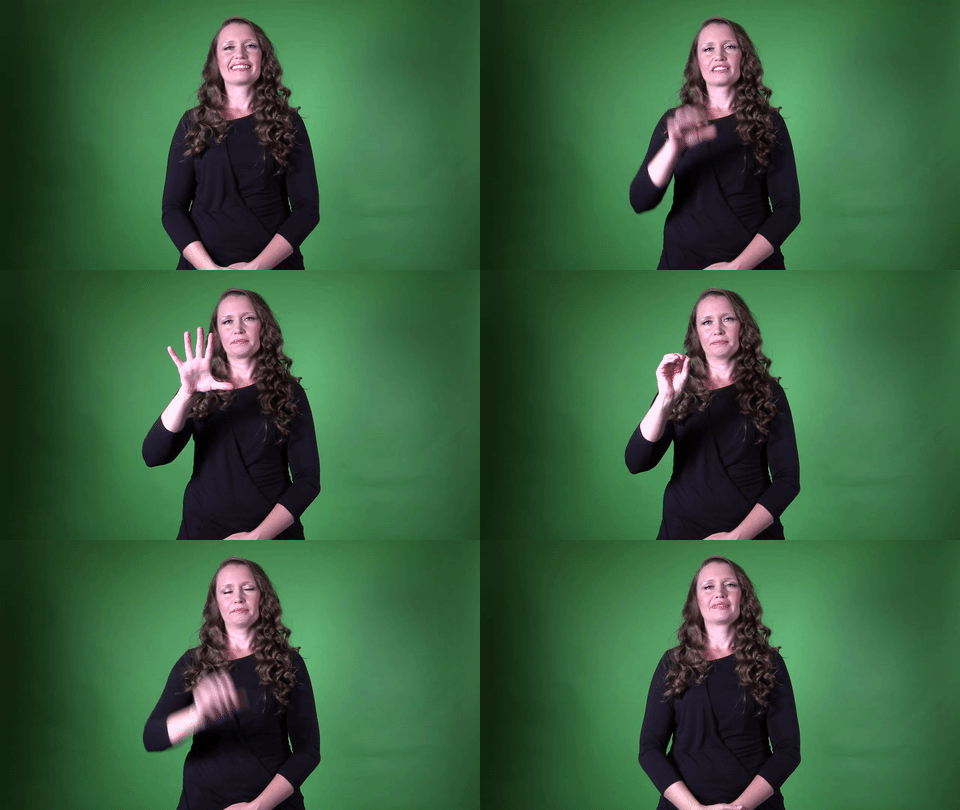
Sign for NUMBER 50 in ASL | 🔢 ASL Dictionary ️

Definition: Refers to the number fifty

Sign for NUMBER 50 in ASL 

YouTube player

Practice Activities:

Practice forming the sign for number 50 in ASL by starting with slow, deliberate movements. Try signing it five times in a row while focusing on hand shape and movement accuracy. Next, switch hands and attempt signing it with your non-dominant hand to build muscle memory.

Use the sign for number 50 in ASL in real-life context by counting aloud. Count from 40 to 60, making sure to use clear transitions between numbers. For an added challenge, count backwards from 60 to 40 while maintaining steady pacing.

Incorporate the sign into sentences to improve fluency. Try signing: “I have 50 books,” “The tickets cost 50 dollars,” or “There are 50 students in the class.” Practice these sentences in front of a mirror to check your clarity and facial expressions.

Engage in a storytelling activity that includes the sign for number 50 in ASL. Make up a short story about a person who finds 50 coins while walking in the park. As you narrate the story in ASL, use expressive signing to convey excitement and surprise.

Pair up with a friend and take turns quizzing each other with number-related questions. Ask, “How many states are in the U.S.?” or “What is 25 plus 25?” Your partner should answer using the correct ASL number signs. Switch roles after a few rounds.

Use flashcards with numbers written on them and randomly select one to sign. When you pick 50, sign it clearly and smoothly. For an extra challenge, time yourself and see how quickly you can sign multiple numbers in a row without mistakes.

Test your recognition skills by watching someone else sign different numbers, including the sign for number 50 in ASL. Write down each number as you see it to ensure comprehension. Review any signs that feel difficult.

Cultural Context:

The sign for number 50 in ASL is a common numerical sign used in American Sign Language. It follows a pattern similar to other number signs and is essential for counting, age, addresses, and other numerical references. Understanding the proper formation and movement of the sign for number 50 in ASL ensures clear and effective communication.

Numbers play an important role in ASL, and the sign for number 50 in ASL is used in various everyday situations. Whether discussing someone’s age, referring to quantities, or giving directions, knowing how to sign numbers correctly enhances fluency. Learning the sign for number 50 in ASL helps connect conversations that involve numerical values.

Deaf communities rely on number signs for sharing dates, phone numbers, and prices. Using the correct handshape when signing the sign for number 50 in ASL ensures accuracy and avoids confusion. ASL thrives on clarity, making it essential to master numerical signs along with vocabulary.

Counting in ASL follows a structured format, and the sign for number 50 in ASL fits within this numerical system. Knowing number signs improves signing speed and helps learners become more confident in their ASL communication. The sign for number 50 in ASL, like other numbers, contributes to a complete understanding of ASL structure.

Cultural context plays a key role in number signs, and the sign for number 50 in ASL is no exception. Deaf and hard-of-hearing individuals use numbers for academic settings, financial transactions, and scheduling. Familiarity with the sign for number 50 in ASL helps with daily interactions in the Deaf community.

In ASL, numbers are incorporated into storytelling, jokes, and personal narratives. The sign for number 50 in ASL might be used in age-related milestones, anniversaries, or historical events. Expressing numbers correctly allows for richer storytelling and culturally appropriate communication.

Many ASL learners find numbers challenging, but practicing the sign for number 50 in ASL alongside other numbers improves fluency. Using numerical signs regularly in conversations strengthens comprehension skills. Mastering the sign for number 50 in ASL builds a strong foundation in signing.

ASL has specific rules for signing numbers depending on context, and the sign for number 50 in ASL follows a recognized format. Understanding number variations and regional signing preferences can enhance communication. Learning the sign for number 50 in ASL correctly ensures effective interaction in different signing environments.

From classrooms to casual conversations, the

Extended Definition:

The sign for number 50 in ASL is a combination of two digits, five and zero, formed with one hand. It follows the standard pattern for signing numbers in American Sign Language, where each digit is represented visually. This sign is commonly used in various real-life situations, such as indicating age, counting, and discussing quantities.

To sign number 50 in ASL, start with the number five handshape, where all fingers are extended. Then smoothly transition to the zero handshape by bringing your fingers and thumb together to form an “O” shape. This movement should be fluid and clear to ensure proper understanding.

Numbers play a vital role in ASL communication, allowing for the expression of amounts, dates, and other numerical concepts. The sign for number 50 in ASL is part of the counting system that follows a logical progression from single digits to higher numbers. Mastering number signs helps improve overall fluency in American Sign Language.

Using the sign for number 50 in ASL can be helpful in conversations about prices, sports scores, or even addresses. In academic and professional settings, this number may appear in math discussions, statistics, and financial topics. Learning to sign numbers accurately ensures effective communication in both casual and formal environments.

When signing number 50 in ASL, it’s important to maintain a neutral facial expression unless context requires emphasis or emotion. In conversational ASL, numbers are often signed quickly, so clarity and precision are key. Practicing regularly will help build confidence and speed when using number signs in daily communication.

Students new to ASL may find it useful to practice counting from 1 to 100 to familiarize themselves with number signs. Paying attention to hand transitions, such as from five to zero, ensures smooth and natural signing. Many learners benefit from watching native signers demonstrate the sign for number 50 in ASL to understand proper movement and technique.

American Sign Language follows a consistent structure for numbers, but variations can exist depending on region or signing style. Some signers may incorporate slight modifications based on personal comfort or speed. However, the fundamental method for signing number 50 in ASL remains widely recognized and understood.

For those interested in advancing their ASL skills, practicing numbers beyond 50 can be beneficial. Learning number patterns, including multiples of ten, can aid in counting, money-related conversations, and time-telling. Understanding the structure of numbers in ASL enhances overall communication fluency and confidence.

By

Synonyms: fifty, number fifty, number 50, the number 50, the number fifty

Educational resources: Find related learning materials in our course bank!

Want more? Check out some of our popular learning activities on the homepage!

Need to look up a sign? Use our highly rated dictionary: https://aslinteractive.com/best-asl-dictionary/

Follow us on tiktok: https://www.tiktok.com/@aslinteractive. More social media links at the bottom of this page!

Long-tail Keywords: what is the sign for number 50 in ASL, how do you sign number 50 in ASL, learn the ASL sign for number 50

Categories: Numbers – Basics, Numbers 41-50, cardinal numbers

tags: Numbers 41-50, Numbers, Math, Educational, Language Learning

Parameters

*Handshape*:

The sign for NUMBER 50 in ASL uses a shifting handshape movement. Start with the number “5” handshape ✋, where the fingers are spread apart and extended. Then smoothly transition into the number “0” handshape, with the fingertips touching to form a circular shape. This change happens fluidly in one motion. The sign for NUMBER 50 in ASL requires precision to ensure clarity, especially when contrasted with similar number signs. Keep your movements sharp and well-defined.

*Palm Orientation*:

The palm orientation for the sign for NUMBER 50 in ASL begins with the hand facing forward, displaying the number five with fingers spread apart. The thumb and index finger then come together to form a zero, with the palm slightly shifting based on the movement. Throughout the motion, the palm remains mostly forward-facing, ensuring clarity. Proper palm orientation is crucial for accuracy when signing the sign for NUMBER 50 in ASL.

*Location*:

The sign for number 50 in ASL is produced in the neutral space in front of the body, typically at chest level. The dominant hand forms the number 5 shape with the palm facing outward, then transitions smoothly into the number 0 by bringing all the fingers together. This movement occurs in one fluid motion without drastic changes in position. The location remains within the signing space, ensuring clear visibility for the sign recipient.

*Movement*:

To produce the sign for number 50 in ASL, start by forming the number 5 handshape with your palm facing forward . Then, smoothly transition into a 0 handshape by bringing your fingertips together while keeping the thumb nearby. This movement should be fluid and repeated once for clarity. The sign for number 50 in ASL combines both handshapes in a controlled motion to distinguish it from other numbers.

*Non-Manual Signals*:

When signing the sign for NUMBER 50 in ASL, your facial expression should remain neutral unless emphasizing quantity. If clarifying or contrasting, slightly raise your eyebrows while signing. A slight head tilt can help indicate questioning, especially in a conversational context. If emphasizing or stressing the number, slightly purse your lips or nod your head. Keep eye contact with the person you are signing to for clarity and engagement.

*Prosody, Dominant/Non-Dominant Hand*:

The sign for NUMBER 50 in ASL uses the dominant hand. Begin by forming the number 5 with your fingers extended and spread apart ️. Then quickly transition to a 0 by bringing your fingertips and thumb together in an “O” shape . This motion should be fluid and repeated once to emphasize the number. The non-dominant hand is not used in this sign. Keep the movement clear and concise to ensure accuracy in expressing NUMBER 50.

Tips for Beginners:

When learning the sign for NUMBER 50 in ASL, focus on making clear movements with your dominant hand. The sign involves forming the number “5” and then transitioning smoothly into the number “0.” Ensure your fingers fully extend for “5” before curving them inward to create the “0” shape. Precision is key to avoid confusion with similar numbers.

A common mistake beginners make is not fully forming the “5” before transitioning to “0.” Rushing the motion can make the sign unclear or resemble a different number. Practice moving at a steady pace, ensuring both hand shapes are distinct. Filming yourself signing can help you catch any inconsistencies.

Finger dexterity is crucial for executing the sign for NUMBER 50 in ASL smoothly. Regularly stretching and strengthening your fingers can improve fluidity. Practice transitioning between “5” and “0” slowly at first, then gradually increase speed while maintaining accuracy. Watching experienced signers can also help refine your movements and hand positioning.

Pay attention to hand placement while signing. The sign should be at chest level, with the palm facing outward. Keeping your hand steady prevents unnecessary movement that may confuse viewers. If your fingers tend to flick too quickly, take a deep breath and focus on controlled motion.

When communicating, ensure your facial expression and overall body language match the context of your conversation. Numbers in ASL are often used in different scenarios, so clarity is essential. Signing in front of a mirror or practicing with a friend can build confidence. With consistent practice, your accuracy and fluidity with the sign for NUMBER 50 in ASL will improve over time.

Connections to Other topics:

The sign for NUMBER 50 in ASL connects to broader numerical concepts and handshape transformations used in number signs. It follows a pattern seen in other two-digit numbers in ASL, where the hand shifts between specific number handshapes. This transformation is consistent in other numbers ending in zero, such as 40, 60, and 70, reinforcing important number structure patterns in ASL. Recognizing this pattern can aid in learning higher numbers and improve fluency when signing sequences like ages, prices, or measurements.

Like other number-based signs, the sign for NUMBER 50 in ASL plays a role in larger mathematical discussions and financial exchanges. When discussing money, for example, it may appear alongside signs like DOLLAR, CENT, or TOTAL, reinforcing numerical competency in financial discussions. Additionally, it is frequently used in age-related contexts, appearing in sentences like “My father is 50 years old” or “The event will happen in 50 days.” These examples help signers grasp how numbers smoothly integrate into everyday conversations.

The sign for NUMBER 50 in ASL also connects to percentages and fractions, which rely on number signs in ASL. For example, “50 percent” commonly appears in discussions about statistics, sales, or discounts. Understanding these numerical expressions helps signers articulate precise values in both casual and professional settings. Mastering numerical signs also supports clearer communication in areas like sports scores, speed limits, and weight measurements.

Number signs, including NUMBER 50 in ASL, share similarities with certain quantifier signs in ASL. Signs like MANY, ALL, or FEW rely on specific handshapes that sometimes overlap with number-related signs. This understanding supports recognition of how ASL structures quantity and numerical values. The movement and transformation of number signs can also improve a signer’s awareness of ASL number incorporation in larger phrases and conversations.

Summary:

The sign for number 50 in ASL relies on the principles of numerical representation within signed language. ASL numbers follow a specific structure that allows for quick recognition by fluent signers. The way numbers are signed in ASL is distinct from spoken languages because it incorporates handshape variations and movement patterns.

To produce the sign for number 50 in ASL, you start with the number 5 handshape. The fingers are extended and spread apart, with the palm facing forward or slightly to the side. Then, the hand transitions into a 0 handshape by bringing the fingertips together to touch the thumb, forming a closed circle.

This motion from 5 to 0 is executed smoothly and with a controlled movement. It is essential to maintain clarity in the transition to avoid confusion with similar number signs. Fluent signers perform this motion with efficiency, making it an automatic and natural part of their numerical vocabulary.

Numbers in ASL are often categorized into cardinal and ordinal distinctions. The sign for number 50 in ASL is typically used within cardinal numbering, which means it represents the quantity 50 rather than a placement order. However, in contextual situations, number signs can take on ordinal meanings when combined with rank-oriented phrases.

ASL numbers exist within a larger framework of numerical handshapes that require dexterity and practice. Beginners often struggle with smooth transitions between numbers, particularly those involving open-to-closed hand movements like 50. Ensuring fluidity in movement is key to making the number clear and easily understood.

The number system in ASL follows a logical pattern that builds upon smaller number formations. Understanding this broader number system makes it easier to recognize and produce signs like the sign for number 50 in ASL. Mastering transitions between larger numbers enhances a signer’s overall fluency and ability to convey numerical information efficiently.

One important consideration in signing numbers is consistency in movement and hand positioning. If the fingers fail to close entirely for 0, it can resemble signs for numbers like 5 or 55, leading to unnecessary confusion. Proper muscle control and finger isolation are critical for maintaining accuracy.

Numbers play a crucial role in ASL conversations, appearing in various contexts such as counting, addresses, prices, and time-related discussions. The sign for number 50 in ASL may frequently arise in discussions of age, money, measurements, or sports scores. Numbers also feature prominently in academic and professional settings where precision is essential.

Beyond direct numerical use, numbers in ASL are also involved in coded language games or creative expressions in Deaf culture. Some signers use number-based phrases in storytelling or as shorthand for larger concepts. This showcases the flexibility of number signs and their integration into everyday language use.

The formation of 50 in ASL follows the logical pattern established for decades-based numbers. For example, 40, 60, and 70 share similar transitions where the hand moves from an open position to a closed shape. Maintaining rhythm and consistency enhances the clarity and effectiveness of numerical signing.

Hand dominance plays a crucial role in signing numbers accurately. Signers must always use their dominant hand for numerical signs while keeping their non-dominant hand still. This prevents miscommunication and ensures a standard approach to number signing.

ASL users are encouraged to practice number transitions in sequences to build muscle memory. Practicing numbers in groups, such as 40 through 60, helps reinforce the pattern used in signing 50. Frequent repetition makes the movement smoother and more natural.

In conversations, the sign for number 50 in ASL may be used alone or within longer sequences. It can appear in numerical sequences like 49, 50, 51, where fluidity in signing each number ensures clarity. Mastering these transitions allows signers to communicate numerical information quickly and effectively.

One challenge that some new signers face with 50 is ensuring that the transition to 0 is distinct. A sloppy transition can resemble the motion used for different numerical patterns. Ensuring a controlled closure of the fingers helps to maintain clarity in communication.

Finger dexterity plays a major role in signing numbers smoothly. Some learners struggle with finger positioning due to limited flexibility or lack of practice. Regular finger exercises can improve mobility and make numbers easier to sign over time.

Numbers in ASL are also used in classifiers, where numerical handshapes represent objects, people, or measurements. The number 50 may appear in contexts like distances, group sizes, or data presentations. Understanding how numbers integrate into classifiers expands the range of ASL usage.

For hearing individuals learning ASL, mastering number signs is one of the first steps toward fluency. The logical pattern of ASL numbers makes them relatively easy to learn but requires consistent practice. Being able to sign numbers quickly and correctly boosts confidence in overall communication.

Deaf culture emphasizes clear and precise numerical communication, as numbers often hold critical information. Whether in education, business, or casual conversation,

Want more? Check out some of our popular learning activities!

ASL Interactive Resources

ASLInteractive YouTube Channel

Follow us on tiktok: @aslinteractive.com

Follow us on Instagram: aslinteractive

Facebook page: aslinteractive

Facebook group: aslinteractive

LInkedIn: ASL Interactive LLC

Twitter: @ASL_interactive

*Some information on this page is AI-generated. AI can make mistakes. Please check the information.

Sign for 50 in ASL, Sign for FIFTY in ASL, Sign for NUMBER FIFTY in ASL, Sign for THE NUMBER FIFTY in ASL, Sign for THE NUMBER 50 in ASL, Sign for NUMBER 50 in ASL  

Responses