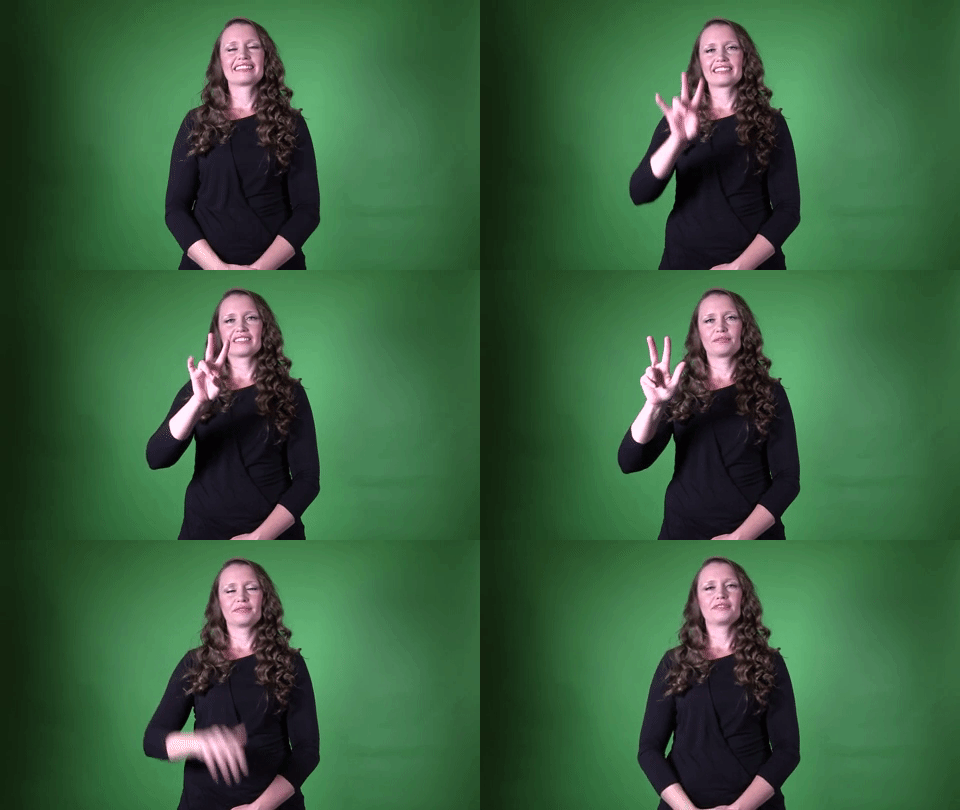
Definition: Refers to the number seventy-three
Sign for NUMBER 73 in ASL

Practice Activities:
To practice the sign for number 73 in ASL, start by isolating the movements. Hold up your dominant hand in a 7 shape, then smoothly transition into a 3. Repeat this motion multiple times in front of a mirror to ensure clarity.
Once comfortable, practice signing other numbers around 73 to improve fluency. Try counting from 70 to 75, making sure to articulate each transition clearly. Pay attention to the orientation of your hand as you move between the numbers.
Use the sign for number 73 in ASL in real-life contexts. Practice signing dollar amounts like 73 cents or 73 dollars. Try using it to express a year, such as “1973,” by signing 19 first, then smoothly transitioning to 73.
Work with a partner to sign and recognize different numbers. One person signs a number in the 70s while the other guesses. Switch roles to reinforce recognition. This helps build confidence in both receptive and expressive skills.
Create a short story or situation involving 73. For example, “I saw 73 birds in the sky,” or “My grandfather is 73 years old.” Sign the sentence clearly and fluidly, making sure the number fits smoothly within your signing structure.
Incorporate a speed drill to improve accuracy. Set a timer and try signing all numbers from 70 to 79 as quickly and clearly as possible. This builds muscle memory and confidence in signing numbers fluidly.
Watch videos of fluent signers using numbers and try to identify when they use the sign for number 73 in ASL. Mimic their handshapes and transitions to ensure natural movement. Practicing regularly will help reinforce confidence and accuracy in signing numbers.
Cultural Context:
The sign for number 73 in ASL is an important part of American Sign Language, used in various contexts such as math, age, addresses, and sports. Learning the sign for number 73 in ASL helps improve communication and fluency in both formal and casual conversations. Numbers in ASL follow specific patterns, and mastering them increases your confidence in signing.
In Deaf culture, using number signs correctly is essential for clear communication. The sign for number 73 in ASL follows a systematic structure, ensuring consistency across conversations. Native Deaf signers emphasize accuracy in number signs to avoid confusion, especially in settings like education, business, and daily interactions.
Sports scores often require quick and accurate number signing. The sign for number 73 in ASL might be used when discussing scores, statistics, or player numbers. Whether at a Deaf sporting event or discussing results in a classroom, knowing number signs facilitates a smooth discussion.
In educational settings, students frequently encounter the sign for number 73 in ASL when dealing with math problems, measurements, and historical topics. Teachers in Deaf schools ensure students learn number signs with correct handshapes and movements. Engaging in activities that include number signs helps reinforce retention and comprehension.
Historical discussions may include the sign for number 73 in ASL when referring to dates, addresses, or significant events. Using number signs properly allows seamless conversation when talking about history, timelines, or numerical references. For example, discussing the year ’73 would require accurate ASL number signing to avoid misunderstandings.
Addresses and phone numbers also incorporate the sign for number 73 in ASL when giving contact details. Being able to sign numbers clearly is crucial for Deaf individuals when exchanging personal information. Miscommunication in number signing can lead to errors, making it vital to practice precision.
Fluency in ASL includes mastering number signs like the sign for number 73 in ASL. Practicing number sequences ensures confidence in both professional and casual conversations. Learning through repetition and real-life scenarios greatly enhances number sign accuracy.
Using ASL effectively requires attention to facial expressions and hand movements. When signing the sign for number 73 in ASL, maintaining proper hand orientation is crucial. This not only conveys the number correctly but also ensures clarity for the viewer.
By understanding the sign for number 73 in ASL, signers improve their overall numerical fluency in ASL. Whether discussing statistics, historical events, or addresses, knowing how to sign numbers makes
Extended Definition:
The sign for number 73 in ASL is a combination of two distinct number signs, smoothly transitioning from one to the other. It follows the standard way of signing two-digit numbers in American Sign Language, maintaining clarity and fluidity. This sign is commonly used in counting, listing, and identifying numbers in conversation.
To form the sign for number 73 in ASL, begin by signing the number 7, where the thumb and ring finger touch while the other fingers remain extended. Then smoothly transition to the number 3 by holding up the thumb, index, and middle fingers. Proper handshape, palm orientation, and fluid motion between the two numbers ensure clear communication.
This number is often used in daily conversations, mathematics, addresses, and age references. In ASL, expressing numbers clearly is essential for accuracy in discussions, whether in classrooms, meetings, or casual settings. Keeping a steady rhythm while transitioning between numbers helps maintain fluent signing.
For beginners, the sign for number 73 in ASL may take some practice to maintain a smooth transition. Practicing in front of a mirror or recording yourself can help improve accuracy. Watching fluent ASL signers can also provide helpful visual examples for mastering the movement.
Knowing the sign for number 73 in ASL and other numerical signs enhances communication skills and comprehension. Numbers frequently appear in phone numbers, dates, and other aspects of daily life, making them an important component of signing. As with any ASL sign, ensuring proper hand positioning and movement prevents misunderstandings.
In ASL, number signs follow a logical structure that makes them easy to learn once familiar with the pattern. The combination of 7 and 3 follows the same numerical rules as other two-digit numbers. Mastering this numbering system allows for greater confidence when using numbers in conversation.
Using the sign for number 73 in ASL correctly helps improve fluency and understanding in signed communication. It also strengthens overall ASL proficiency, making conversations smoother and more efficient. Learning all numerical signs, including 73, is essential for anyone using ASL regularly.
Practicing numerical signs daily can enhance confidence and accuracy in signing conversations. Repetitions, drills, and interactive exercises help reinforce memorization of numbers, including 73. Building fluency with numbers allows for quick and effective communication in ASL.
Recognizing and using numerical signs like the sign for number 73 in ASL is an important part of developing ASL fluency. Numbers appear
Synonyms: seventy-three, number seventy-three, number 73, the number 73, the number seventy-three
Educational resources: Find related learning materials in our course bank!
Want more? Check out some of our popular learning activities on the homepage!
Need to look up a sign? Use our highly rated dictionary: https://aslinteractive.com/best-asl-dictionary/
Follow us on tiktok: https://www.tiktok.com/@aslinteractive. More social media links at the bottom of this page!
Long-tail Keywords: what is the sign for number seventy-three in ASL, how do you sign number seventy-three in ASL, number seventy-three in American Sign Language
Categories: Numbers – Basics, Numbers 71-80, cardinal numbers
tags: Numbers 71-75, Numbers, Language Learning, Mathematics, Education
Parameters
*Handshape*:
The sign for NUMBER 73 in ASL uses a fluid transition between two digit handshapes. It starts with the number 7 handshape, where the thumb and ring finger touch while the other fingers remain extended. Then, the hand smoothly shifts to the number 3 handshape, with the index, middle, and thumb extended while the ring and pinky fold down. This movement creates a clear representation of the number 73 in ASL.
*Palm Orientation*:
The palm orientation for the sign for number 73 in ASL starts with the dominant hand in a neutral position, facing outward. As the number transitions from 7 to 3, the palm slightly rotates to maintain fluidity. The fingers move smoothly between the two numbers while keeping an open-handed posture. Ensuring clarity in finger positioning and palm orientation helps enhance readability when signing the sign for number 73 in ASL.
*Location*:
The sign for number 73 in ASL is located in the neutral signing space in front of the body. The dominant hand moves slightly away from the center as the number changes from 7 to 3 in one smooth motion. The movement typically occurs at chest level, ensuring clear visibility. Keep the hand steady and fingers properly positioned to maintain accuracy and clarity in signing.
*Movement*:
To sign for number 73 in ASL, begin with the dominant hand in the number 7 handshape, palm facing out. Then, smoothly transition to the number 3 handshape by curling the thumb and touching it to the tip of the pinky while extending the index, middle, and ring fingers. The movement should be fluid with a slight bounce or flick, maintaining a natural rhythm to clearly differentiate the two numbers.
*Non-Manual Signals*:
When signing the sign for number 73 in ASL, maintain a neutral yet focused facial expression. Slightly raise your eyebrows if emphasizing or clarifying the number. Keep your head steady, but a slight forward tilt can indicate engagement. Relax your mouth but avoid unnecessary movements. Ensure consistent eye contact with your conversation partner, reinforcing clarity. Smooth and controlled hand movements will help convey the sign for number 73 in ASL correctly.
*Prosody, Dominant/Non-Dominant Hand*:
The sign for number 73 in ASL is produced using the dominant hand in a fluid twisting motion. Start with the hand in the number 7 formation—thumb and ring finger touching—then smoothly transition to the number 3 by extending the index, middle, and thumb while closing the ring and pinky. This movement should be natural and slightly outward, maintaining a steady wrist motion for clarity.
Non-dominant hand is not used in the sign for number 73 in ASL. The dominant hand remains in an active role, ensuring the shape and orientation shift smoothly. The motion is distinct yet subtle, emphasizing a seamless numerical transition. Keep the palm facing outward, and avoid exaggerated movements for proper execution.
Tips for Beginners:
When learning the sign for NUMBER 73 in ASL, focus on hand positioning and smooth motion. This number uses a twisting movement that combines a “7” handshape and shifts into a “3” handshape. Keep your dominant hand relaxed and fluid to avoid stiffness, which can make the sign look unnatural.
A common mistake beginners make while signing NUMBER 73 in ASL is exaggerating the movement too much. The twist between the “7” and “3” should be controlled rather than overly dramatic. Keep your wrist flexible but don’t overextend, or it may affect readability.
Finger positioning is crucial for clarity when forming the “7” and “3.” Ensure that your thumb and ring finger touch for the “7” and smoothly transition into the “3” where your thumb, index, and middle fingers stay extended. Rushing through the movement can make the numbers unclear, so practice transitioning between them slowly at first.
Consistency in direction and fluidity of motion helps in making the sign natural and easy to understand. If you’re struggling, try signing in front of a mirror or recording yourself. Watching back your sign can help you identify inconsistencies and make necessary adjustments.
Watching fluent signers can provide valuable insight into pacing and flow. Observe how native ASL users sign NUMBER 73 in ASL, paying attention to details like speed, finger positioning, and overall hand movement. Mimicking their approach while practicing will boost accuracy and confidence.
Hand dominance matters, so always sign numbers with your dominant hand to maintain clarity. If you’re left-handed, use your left hand, and if you’re right-handed, use your right. This consistency ensures smoother communication and avoids confusion in signing numbers fluently.
Regular practice will help integrate the sign naturally into your signing vocabulary. Repeating NUMBER 73 in ASL alongside other number signs will improve comfort and speed over time. Keep practicing daily to build confidence and accuracy.
Connections to Other topics:
The sign for NUMBER 73 in ASL follows the common pattern for signing two-digit numbers in the 70s series, where the hand transitions smoothly between the two digits. This movement connects to how other numbers in the 70s are formed, making it easier for learners to recognize patterns in ASL number production. Understanding the sign for NUMBER 73 in ASL also helps with comprehending numerical sequencing, which is useful in listing, counting, and giving addresses or phone numbers.
Numbers in ASL are frequently incorporated into time-related signs, making them crucial for discussing ages, dates, and quantities. The sign for NUMBER 73 in ASL might appear in discussions about historical events, sports statistics, or prices. ASL users also integrate numbers into classifiers to give further details about objects, distances, or amounts, allowing for a more visual, descriptive language.
Learning the sign for NUMBER 73 in ASL builds familiarity with number incorporation in other signs, such as years, percentages, and measurements. For instance, signing a date like 1973 would require understanding how to fluidly connect the numbers together. This knowledge also extends to financial contexts, where saying an amount like $73 requires modifying a number sign with the dollar sign.
Mastery of ASL numbers like NUMBER 73 is crucial when discussing scores, addresses, and statistics. In sports, jersey numbers often use this structure, reinforcing the necessity for smooth transitions between digits. Additionally, some number signs become part of unique expressions within Deaf culture, showcasing the interplay between numerical knowledge and conversational ASL.
Summary:
The sign for NUMBER 73 in ASL follows a distinct numerical handshape pattern. It begins with the dominant hand forming the number 7, with the index and middle fingers extended while the ring and pinky fingers remain folded against the palm. The thumb is also extended, creating the familiar seven-handshape used in American Sign Language number sequences.
As the hand transitions to complete the sign for NUMBER 73 in ASL, it smoothly shifts from the number 7 to the number 3. This involves folding the index and middle fingers down while extending the thumb, index, and middle fingers upward. The movement should be fluid and slightly downward, emphasizing the numerical shift without unnecessary exaggeration.
This sign belongs to the larger system of two-digit number signs in ASL. Each number from 67 to 98 follows a distinct twisting hand movement, ensuring clarity while signing. The natural motion of numeric signs in ASL makes it easier for fluent signers to convey numerical information quickly and efficiently.
Like most ASL number signs, the sign for NUMBER 73 in ASL requires proper palm orientation. The palm should face outward during the transition between the two numerical components. Keeping the movement consistent ensures ease of recognition, especially for those unfamiliar with number patterns in sign language.
Numbers play a crucial role in communication, both in spoken and signed languages. In the Deaf community, numerical literacy is essential for everyday interactions, including discussing time, money, age, addresses, and sports scores. The ability to sign numbers smoothly is a foundational skill for ASL users.
The sign for NUMBER 73 in ASL is not typically accompanied by additional facial expressions unless it appears in a specific context. For example, if expressing surprise or emphasis, a signer might raise their eyebrows or exaggerate their movement slightly. However, the numerical sign alone remains neutral and precise.
In ASL linguistics, numerical incorporation is a fascinating topic. Some number signs integrate seamlessly into other concepts, such as time-related signs like “3-WEEK” or “7-YEAR.” While the sign for NUMBER 73 in ASL remains a standalone figure, its placement in a sentence affects its meaning.
Number signs are also culturally significant within the Deaf community. Certain numbers may hold special associations, such as addresses for famous Deaf institutions or specific numerical references in sports. Learning number signs fluently enhances a signer’s ability to engage in deeper conversations without confusion.
Handshape accuracy is critical when signing numbers, particularly in rapid communication. Misforming a handshape could lead to misunderstandings, especially with similar-looking numbers like 73 and 72. Practice and repetition are key to mastering the sign for NUMBER 73 in ASL with clarity.
Movement fluency also plays a role in how the sign for NUMBER 73 in ASL is perceived. If signed too rigidly or hesitantly, it may confuse the viewer. A smooth transition from one digit to the next ensures the number is conveyed clearly within conversations.
Within Deaf education, number fluency is taught early. Schools for the Deaf emphasize numerical literacy through ASL, ensuring children can recognize and sign numbers accurately. Understanding numbers in ASL is just as important as learning to count vocally in spoken language.
Mathematics instruction in ASL also relies heavily on signing numbers. Teachers must clearly demonstrate numeric sequences, calculations, and formulas while maintaining visual clarity. The sign for NUMBER 73 in ASL is a small part of a larger system that allows mathematics to be effectively taught in sign language.
Different sign languages use different number systems, making cross-cultural signing interesting. While ASL has a well-established number system with clear patterns, other sign languages may use different methods for signing double-digit numbers. This diversity highlights the uniqueness of ASL’s numerical system.
The sign for NUMBER 73 in ASL is often used in addresses, prices, ages, and statistical information. In conversation, the speed at which someone signs numbers can vary depending on their signing fluency. A skilled ASL user can sign two-digit numbers rapidly while maintaining clarity.
In sports and entertainment, numbers are frequently signed for scores or participant numbers. Deaf athletes, referees, and spectators rely on numeric signs to communicate game scores effectively. The ability to fluidly sign numbers is particularly useful when relaying fast-paced game updates.
The evolution of number signs in ASL is an interesting aspect of language development. Earlier versions of numerical signs were sometimes bulkier or more exaggerated. Over time, ASL has streamlined its numerical signs to improve fluidity and efficiency.
Numbers often appear in ASL storytelling and creative expression. Deaf performers may use specific number signs to add rhythm to signed poems or narratives. The visual aspect of signed numbers allows for a unique form of artistic expression within the Deaf community.
Technology has influenced how numbers are signed in modern ASL conversations. With video calls and online communication, signers must ensure their number signs are clear even on
Want more? Check out some of our popular learning activities!
ASL Interactive Resources
ASLInteractive YouTube Channel
Follow us on tiktok: @aslinteractive.com
Follow us on Instagram: aslinteractive
Facebook page: aslinteractive
Facebook group: aslinteractive
LInkedIn: ASL Interactive LLC
Twitter: @ASL_interactive
*Some information on this page is AI-generated. AI can make mistakes. Please check the information.


Responses