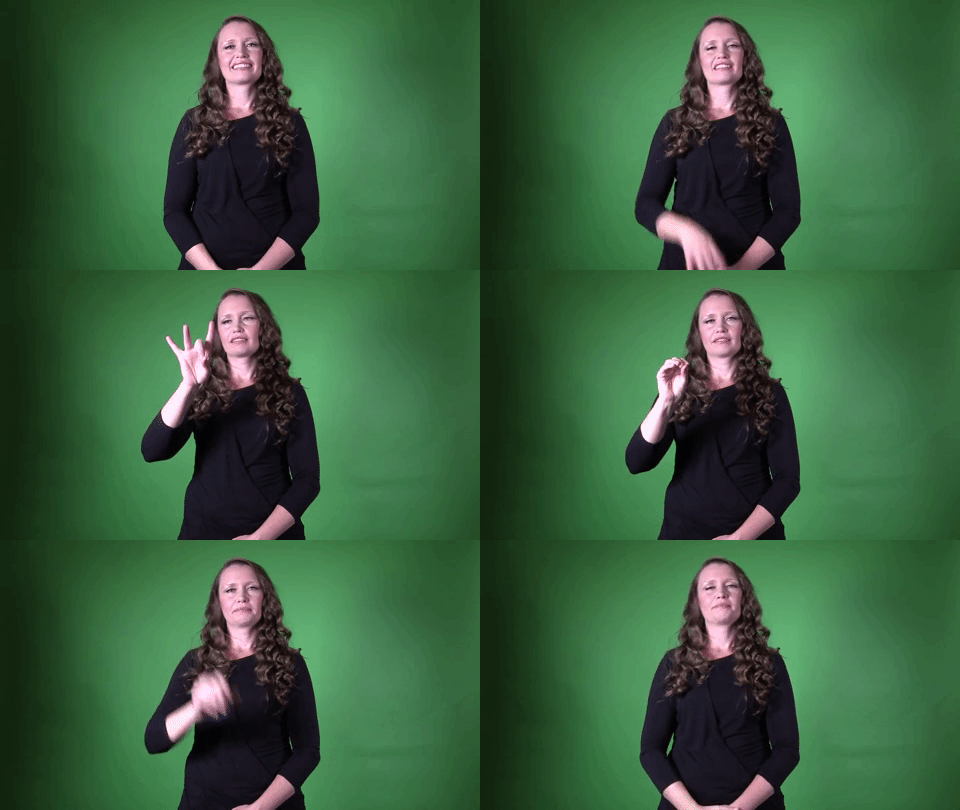
Definition: Refers to the number eighty
Sign for NUMBER 80 in ASL

Practice Activities:
Practicing the sign for number 80 in ASL can be fun and interactive with a variety of activities. Start by signing the number in isolation multiple times, focusing on handshape consistency and movement. Use a mirror or video recording to assess accuracy and fluidity.
Incorporate counting exercises by signing numbers leading up to 80, such as 70 through 80, to build fluency. Try signing a sequence of random numbers, ensuring that 80 appears frequently among them. Challenge yourself by increasing signing speed while maintaining clarity.
Engage in real-world applications by using the sign for number 80 in ASL in sentences. For example, sign “There are 80 chairs in the room” or “My grandfather is 80 years old.” Create a list of common contexts where 80 might be used, such as prices, years, and quantities, and practice them with a friend.
Use number games to reinforce the sign for number 80 in ASL. One person signs a number, and the other has to guess and say it aloud. You can also practice by picking numbers out of a hat and signing them in order, ensuring that 80 appears frequently.
For storytelling, create a short narrative that involves the number 80, such as “I found 80 pennies on the ground” or “She bought 80 balloons for the party.” Sign the story aloud and ask a partner to interpret the numbers you use.
Engage in group activities where numbers are signed in a sequence, and participants must continue the pattern. Use ASL bingo, where one participant signs a number, and others mark their cards accordingly. Including 80 frequently will reinforce recognition and recall.
Practice conversational scenarios like discussing birthdays or history dates where you naturally include the number 80. Signing within practical conversations ensures greater retention and comfort using the sign correctly.
Cultural Context:
The sign for number 80 in ASL is an essential part of American Sign Language, especially when discussing numbers in daily conversations. Knowing how to sign numbers correctly enhances communication and helps ensure clarity when talking about age, money, measurements, and more. Mastering the sign for number 80 in ASL also improves fluency, making signed conversations more natural.
In Deaf culture, numbers play a vital role in storytelling, education, and social interactions. The sign for number 80 in ASL is used in various contexts, from discussing prices to referring to dates and quantities. Understanding number signs helps both Deaf and hearing individuals communicate effectively in different situations.
ASL number signs, including the sign for number 80 in ASL, follow a logical pattern that makes learning them easier. By recognizing number patterns in ASL, signers can quickly count, express numerical values, and engage in conversations involving numbers. Practicing ASL numbers consistently improves speed and accuracy in fingerspelling and numerical expression.
Many ASL learners focus on mastering number signs early in their learning journey. The sign for number 80 in ASL is part of the standard number system used in classrooms, workplaces, and everyday interactions. Whether discussing a person’s age, a transaction amount, or a sports score, knowing how to sign 80 helps ensure smooth communication.
Numbers in ASL, such as the sign for number 80 in ASL, often incorporate handshape variations to indicate tens, hundreds, or thousands. The uniqueness of these number signs helps distinguish different values quickly and efficiently. By using the correct handshape, signers can accurately convey numerical information.
Deaf and hard-of-hearing individuals rely on ASL to navigate conversations involving numbers in social and professional settings. The sign for number 80 in ASL is frequently used in retail, banking, and educational environments. Proficiency in ASL numbers strengthens overall signing skills and enhances confidence in communication.
The sign for number 80 in ASL is useful when discussing historical events, business transactions, or mathematical concepts. ASL interpreters and students frequently practice number signs to ensure accuracy in translating numerical information. Learning and reviewing number signs regularly helps improve fluency and comprehension in ASL.
In sports and fitness discussions, ASL numbers, including the sign for number 80 in ASL, allow signers to communicate statistics, scores, and measurements. Athletes, coaches, and fans within the Deaf community use number signs to share game updates and performance metrics. A solid
Extended Definition:
The sign for number 80 in ASL is an important part of learning American Sign Language numbers. This numerical sign is commonly used in everyday conversations, especially when discussing quantities, addresses, prices, and years. Knowing how to correctly form and recognize the sign for number 80 in ASL helps improve overall communication skills.
To sign number 80 in ASL, start by forming the number 8 with your dominant hand. Then, transition smoothly into a zero, maintaining clarity in handshape and movement. The sign for number 80 in ASL follows the standard pattern of ASL numbering, making it easy to remember once you are familiar with the signs for 8 and 0.
ASL uses a visual and manual system to represent numbers, including cardinal and ordinal numbers. The sign for number 80 in ASL falls under the category of cardinal numbers, which are used to indicate quantity. Proper hand positioning and fluid motion are key to signing 80 accurately and ensuring clear communication.
Learning the sign for number 80 in ASL is useful in many real-life situations. It can come in handy when discussing money, dates, or even scoring in games and sports. Understanding how to sign numbers fluently, including 80, is essential for conversations involving numeric information.
Consistency in finger shapes and movement is important to avoid confusion. Since some numbers share similar hand shapes, it’s crucial to practice the sign for number 80 in ASL to distinguish it from others. Improving fluency with number signs increases comprehension and ensures effective communication.
Numbers in ASL follow a logical sequence, and practicing them in groups helps reinforce memorization. The sign for number 80 in ASL is part of a broader numerical system, making it easier to learn when practiced alongside other numbers. Developing confidence with ASL numbers allows users to communicate more naturally.
For those learning ASL, repetition and practice make a difference in mastering number signs. Watching videos, practicing in front of a mirror, and engaging in conversations using the sign for number 80 in ASL can help with retention. Over time, using ASL numbers becomes second nature, allowing for quick and accurate communication.
In deaf culture and ASL communication, numbers are frequently used in daily interactions. The sign for number 80 in ASL is valuable when expressing age, phone numbers, or large quantities. Mastery of number signs enhances expressive and receptive ASL skills, improving overall fluency.
Understanding ASL numbers
Synonyms: eighty, number eighty, number 80, the number 80, the number eighty
Educational resources: Find related learning materials in our course bank!
Want more? Check out some of our popular learning activities on the homepage!
Need to look up a sign? Use our highly rated dictionary: https://aslinteractive.com/best-asl-dictionary/
Follow us on tiktok: https://www.tiktok.com/@aslinteractive. More social media links at the bottom of this page!
Long-tail Keywords: what is the sign for number 80 in ASL, how do you sign number 80 in American Sign Language, ASL sign for number 80
Categories: Numbers – Basics, Numbers 71-80, cardinal numbers
tags: Numbers, Numbers 76-80, Numbers 76 78 79, Rocking Numbers, Language Learning
Parameters
*Handshape*:
The sign for NUMBER 80 in ASL uses the dominant hand, forming an “8” handshape with the thumb and middle finger touching. The movement involves transitioning from the “8” handshape to a relaxed “0” handshape, where the fingers and thumb come together in a circular shape. This sign is executed with a smooth motion, ensuring clarity. When signing the sign for NUMBER 80 in ASL, maintain a neutral facial expression and keep the hand at chest level for visibility.
*Palm Orientation*:
The palm orientation for the sign for number 80 in ASL starts with the dominant hand in an open “8” handshape, facing outward. As the sign progresses, the fingers and thumb close together to form a relaxed “0” shape. The motion should be fluid, with the palm facing slightly forward throughout the transition. Keep the movement natural, ensuring clarity when signing the number 80 in ASL.
*Location*:
The sign for number 80 in ASL is produced in the neutral space in front of the body, slightly above waist level. The movement primarily takes place at chest height, with the hand forming the number eight and then transitioning into a zero. This sign utilizes one hand and remains in the signing space without touching the body, allowing visibility and clarity when communicating the number.
*Movement*:
To produce the sign for number 80 in ASL, start with the dominant hand in the “8” handshape, with the thumb touching the middle finger. Then, smoothly transition the fingers into a “0” handshape by bringing the fingertips together. The movement should be fluid, with a slight bounce or shift to emphasize the number. This motion clearly represents the transition from eight to zero.
*Non-Manual Signals*:
When signing the sign for number 80 in ASL, the facial expression usually remains neutral unless context calls for emphasis. If counting or listing numbers, slight eyebrow raises can indicate clarification or confirmation. A subtle head nod may accompany the sign for number 80 in ASL when emphasizing accuracy or ensuring the viewer’s understanding. If used rhetorically, a slight tilt of the head or an inquisitive expression may be appropriate.
*Prosody, Dominant/Non-Dominant Hand*:
The sign for number 80 in ASL uses the dominant hand. Start with the number 8 handshape, where the thumb and middle finger touch while the other fingers stay extended. Then, transition smoothly into the number 0 handshape by bringing the tips of all fingers together to form a circle. This movement should be fluid and natural, as ASL numbers often follow a rhythmic motion pattern. The non-dominant hand remains inactive.
Tips for Beginners:
The sign for NUMBER 80 in ASL follows the pattern of numbers in the 80s series, transitioning from the “8” handshape to the “0” handshape. To sign it clearly, keep your hand steady and ensure the movement between the two numbers is fluid. The transition should be natural and not too abrupt.
Hand positioning is crucial for clarity when signing the sign for NUMBER 80 in ASL. The “8” handshape involves the thumb touching the middle finger, and the “0” handshape requires bringing all the fingers together to form an “O” shape. Make sure your fingers are well-formed, as sloppy handshapes can make your sign unclear.
Beginners often struggle with stiff transitions when moving from “8” to “0.” To avoid this, practice slowly and focus on smoothness. Try signing it in a mirror or recording yourself to check fluidity. Consistent repetition will help build muscle memory for a natural-looking sign.
Another common mistake is placing the sign too close to the body or at an unusual angle. Keep your hand in the standard signing area, usually around chest level. This ensures that the sign for NUMBER 80 in ASL is visible and correctly perceived by others.
Finger dexterity plays a significant role in signing numbers correctly. If transitioning between the handshapes feels difficult, warm up your fingers by stretching them before practice. Finger exercises can help strengthen movement control over time.
For better speed and accuracy, practice signing all of the 80s numbers in sequence. Doing so will reinforce your ability to transition between handshapes smoothly when using the sign for NUMBER 80 in ASL in different contexts.
Connections to Other topics:
The sign for number 80 in ASL connects to the broader system of ASL number signs, which follow specific handshape patterns. In ASL, multiples of ten have a distinct movement pattern where the initial digit transitions smoothly into a zero-handshape. This follows the same structure as numbers like 30, 40, and 90, reinforcing the importance of handshape changes when forming numerical concepts in ASL.
The sign for number 80 in ASL is also connected to larger numerical expressions and mathematical terms. When discussing percentages, years, or monetary values, this number may appear in compound signs such as “80 DOLLARS” or “80 PERCENT.” The ability to smoothly transition between numerical signs and associated concepts is key to fluency in ASL. Understanding how number signs integrate with common financial or statistical terms helps in diverse conversations.
Ordinal numbers and ranking can also involve the sign for number 80 in ASL when discussing events or placements. For instance, when indicating 80th place in a competition, a slight modification may involve incorporating a twist or fingerspelled clarification. Similar patterns apply when using numbers for lists, addresses, or historical references, contributing to a broader understanding of numerical use in ASL.
This sign also connects to broader discussions of age, time, and historical events. When describing someone who is 80 years old, the sign for number 80 in ASL precedes the sign for “YEAR.” Similarly, referencing a decade like “the 1980s” combines the number with signs indicating time periods. These variations allow for contextual adjustments while maintaining ASL grammar.
Summary:
The sign for NUMBER 80 in ASL follows a specific numerical pattern used consistently across multiple decade numbers. Like other numbers in this range, it involves an initial handshape change from the number 8 to a closed “O” handshape. This movement represents a natural flow in ASL’s numerical system, making it easy to remember and recognize.
To produce the sign for NUMBER 80 in ASL, start with the dominant hand in the “8” handshape, where the thumb and middle finger touch while the other fingers remain extended. Then, smoothly transition into the “O” handshape by drawing the fingers together in one motion. This movement maintains the pattern seen in ASL numbers ending in zero, allowing for consistency in numerical signs.
The transition between the “8” and “O” handshapes should be fluid and controlled, without excessive bouncing or hesitation. A smooth execution ensures clarity and prevents misunderstanding. ASL numbers rely on precise handshape changes to convey meaning efficiently, and this sign is no exception.
When signing NUMBER 80 in ASL, palm orientation is crucial. Typically, the palm faces outward toward the viewer during the initial “8” handshape formation. Some signers may modify this orientation slightly based on regional or personal variations, but clarity remains key in effective communication.
The movement pattern reinforces ASL’s numerical structure, as the zero-ending numbers generally follow a shift from a numerical handshape into an “O” handshape. This pattern is consistent across the decades (such as 20, 30, 40, and so on), reinforcing the systematic nature of ASL number signs. Understanding this pattern enhances overall fluency in ASL numeration.
Historically, ASL numerical signs have developed from natural hand configurations, ensuring ease of articulation. Spoken languages also demonstrate numerical patterns in pronunciation, and ASL parallels this linguistic feature with consistent movement shifts. This design makes it easier for signers to anticipate and produce numbers efficiently.
The sign for NUMBER 80 in ASL aligns with ASL’s grammatical rules, allowing it to be used flexibly in various contexts. It can be integrated into larger mathematical signs, addresses, prices, and ages without altering its form. This flexibility enhances ASL’s efficiency in conveying numerical information.
In educational contexts, instructors emphasize the importance of smooth transitions in numerical signing. For newer learners, practicing each decade number consecutively helps build confidence and precision. Mastering the sign for NUMBER 80 in ASL within the broader number system supports overall ASL fluency.
The number 80 holds different cultural meanings depending on context, such as historical references or symbolic associations. In general, signing numerical values in ASL follows a functional approach rather than a symbolic one. However, recognition of numerical patterns can contribute to a deeper appreciation of ASL’s systematic structure.
ASL’s numbering system is an essential element of its linguistic framework, directly relating to broader language components such as classifiers and quantifiers. The consistency in decade numbers demonstrates the efficiency of ASL’s numerical structure. Recognizing these patterns makes it easier to understand how ASL applies numerical representation in everyday conversation.
Mathematical concepts in ASL rely on precise number signs, and clear articulation of each decade number is essential in educational settings. Deaf educators often focus on reinforcing number transitions and ensuring accuracy when signing numerical values. The sign for NUMBER 80 in ASL fits within this pedagogical approach, helping students develop strong numerical fluency.
ASL linguistics studies explore how numerical patterns in signing reflect broader linguistic principles. The transition from “8” to “O” illustrates an efficient use of movement within the constraints of manual articulation. This efficiency supports ASL’s visual-spatial nature and demonstrates its structured approach to communication.
When signing large numbers, ASL users may incorporate NUMBER 80 in ASL within multi-digit sequences. For example, when signing years, monetary values, or statistical data, maintaining clarity in numerical signs ensures accurate comprehension. Mastering each decade number individually strengthens overall numerical communication.
Regional variations in ASL sometimes affect the execution of numerical signs, though the fundamental structure remains consistent. Some communities may emphasize a slightly different movement style, but core elements of the sign for NUMBER 80 in ASL remain intact. Exposure to different signing styles helps develop adaptability in communication.
In broader discussions of sign language structure, the organization of numerical signs demonstrates ASL’s ability to efficiently convey complex concepts. The consistency in decade numbers highlights ASL’s logical development over time. Recognizing this structure facilitates both learning and teaching ASL.
Applied linguistics examines how numerical systems in sign languages compare to spoken languages. In spoken English, numbers have clear phonetic patterns, just as ASL has defined movement sequences. The sign for NUMBER 80 in ASL exemplifies this parallel structure, demonstrating linguistic cohesion across different modalities.
Technology and digital communication increasingly incorporate ASL number signs in educational content and
Want more? Check out some of our popular learning activities!
ASL Interactive Resources
ASLInteractive YouTube Channel
Follow us on tiktok: @aslinteractive.com
Follow us on Instagram: aslinteractive
Facebook page: aslinteractive
Facebook group: aslinteractive
LInkedIn: ASL Interactive LLC
Twitter: @ASL_interactive
*Some information on this page is AI-generated. AI can make mistakes. Please check the information.


Responses