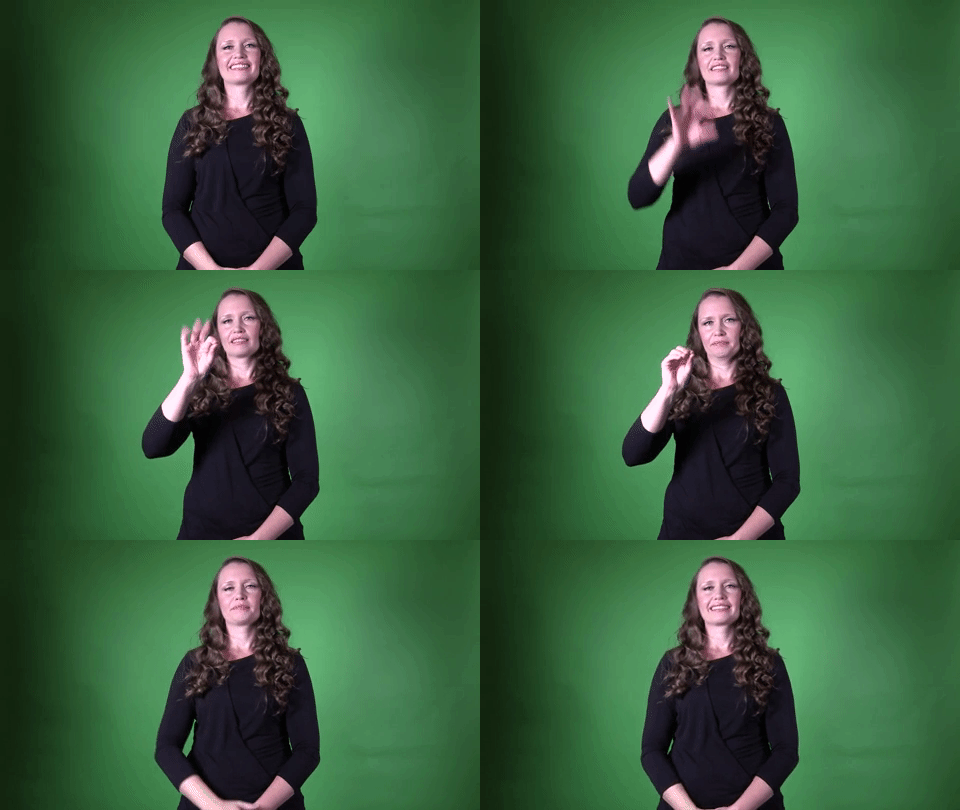
Definition: Refers to the number ninety
Sign for NUMBER 90 in ASL
Practice Activities:
Practice forming the sign for number 90 in ASL by repeatedly signing it in front of a mirror. Focus on the shape your hand makes and the movement between the 9 and 0. Say “ninety” aloud as you sign to reinforce the connection between the sign and its meaning.
Create a sequence of numbers leading up to the sign for number 90 in ASL. Start at 80 and count by twos or fives until you reach 90. This will help you transition smoothly into the final number, reinforcing your understanding of number patterns while practicing fluid signing.
Challenge yourself to sign various numbers at random, incorporating the sign for number 90 in ASL. Have a partner call out numbers for you to sign quickly. Switch roles and test your partner’s skills while improving your ability to recognize and produce numbers accurately.
Use the sign for number 90 in ASL in real-life contexts, such as talking about prices, temperatures, or ages. For example, describe a hot summer day: “The temperature outside is 90 degrees!” or discuss sports: “Our team scored 90 points in the game.” Adding real-world scenarios enhances retention and practical use.
Write a short story or scenario that includes the number 90. You could describe a fictional marathon where the runner reaches 90 miles or a store offering 90% discounts. Then sign your story aloud, emphasizing fluency and expressiveness while using the sign for number 90 in ASL naturally within your narrative.
Practice speed and accuracy by signing all the numbers from 80 to 100, ensuring smooth transitions to the sign for number 90 in ASL. Time yourself and try to improve your speed while maintaining clarity. Repetition and variation in practice will strengthen your confidence in using the sign naturally.
Cultural Context:
The sign for number 90 in ASL is part of the numbering system used by the Deaf community in everyday conversations, education, and commerce. Numbers in ASL follow specific patterns that differ from spoken language conventions. Mastering the sign for number 90 in ASL helps in discussing age, money, measurements, and more.
When expressing the sign for number 90 in ASL, hand shapes and movements are crucial for clarity. Just like spoken languages have pronunciation rules, ASL has visual grammar that affects how numbers are signed. Using the correct handshape ensures effective communication between signers.
Numbers play an important role in Deaf culture, especially in storytelling and historical references. The sign for number 90 in ASL may come up in discussions about historical events, anniversaries, or even addresses. Recognizing and using this sign correctly is essential for fluency in ASL.
ASL numbers are commonly used in education, especially when teaching math concepts in Deaf schools. The sign for number 90 in ASL helps students learn multiplication, percentages, and large numerical values. Understanding ASL numbering is crucial for academic success in mathematics and financial literacy.
Sports and competitions frequently require quick and clear number signs. When discussing scores, statistics, or player numbers, using the sign for number 90 in ASL ensures that information is conveyed accurately. Many referees and coaches in Deaf sports leagues rely on ASL number signs for communication.
In everyday life, numbers are used in phone numbers, addresses, prices, and ages. The sign for number 90 in ASL is useful for confirming information in stores, restaurants, and travel situations. Knowing ASL numbers improves independence and accessibility for Deaf individuals.
The development of ASL includes influences from French Sign Language and regional variations. While the sign for number 90 in ASL is generally consistent, some slight variations may exist based on location. Understanding these variations helps signers communicate effectively across different ASL communities.
Technology has made learning ASL more accessible, with online videos and digital resources available for everyone. The sign for number 90 in ASL can be easily learned through visual demonstrations and practice. Digital tools provide an opportunity for both Deaf and hearing individuals to expand their ASL knowledge.
ASL is a dynamic and evolving language, and number signs remain an essential part of everyday interactions. Learning the sign for number 90 in ASL enhances communication skills and deepens connections within the Deaf community. Practicing number
Extended Definition:
The sign for number 90 in ASL is an essential part of learning American Sign Language numbers. It follows the pattern of counting in ASL, using a handshape transition that is both fluid and visually distinct. Mastering this sign is helpful for communicating numbers in various contexts, such as age, math, or counting objects.
To form the sign for number 90 in ASL, start with the number 9 handshape, where the thumb and index finger form a circle while the other fingers remain extended. Then, smoothly transition into the number 0 handshape by bringing all fingers together into an “O” shape. This movement should be natural to maintain the rhythm of signing numbers in sequence.
Number signs in ASL are often used in everyday conversations, including talking about prices, addresses, or measurements. The sign for number 90 in ASL is particularly useful in discussions involving decades, making it important for describing years or age-related topics. Understanding this sign enhances overall fluency and ensures clear communication when dealing with large numbers.
Practicing the sign for number 90 in ASL along with other numbers helps build confidence in numerical expressions. It is beneficial to practice counting in ASL regularly to become comfortable with the transitions between numbers. Watching native signers and using ASL resources can improve proficiency in number-related signing.
In ASL, number signs rely on clear handshapes and smooth transitions to convey meaning effectively. The sign for number 90 in ASL is an example of this concept, requiring precision and fluid motion. Paying attention to hand positioning ensures that the sign is recognized correctly.
ASL numbers, including the sign for number 90 in ASL, share similarities in movement, making them easier to learn as a group. Recognizing patterns in ASL numbers aids in memorization and recall. With practice, signing numbers quickly and accurately becomes second nature.
Using the sign for number 90 in ASL in real conversations is a great way to reinforce learning. Engaging in ASL discussions with fluent signers helps improve signing speed and accuracy. Signing numbers clearly and confidently enhances overall ASL communication skills.
When learning ASL numbers, repetition and daily use are key to mastery. The sign for number 90 in ASL is no exception—practicing it alongside other multiple-digit numbers helps with fluency. Visualizing number sequences and signing them in context makes learning more effective.
Many ASL learners find it helpful to incorporate number
Synonyms: ninety, number ninety, number 90, the number 90, the number ninety
Educational resources: Find related learning materials in our course bank!
Want more? Check out some of our popular learning activities on the homepage!
Need to look up a sign? Use our highly rated dictionary: https://aslinteractive.com/best-asl-dictionary/
Follow us on tiktok: https://www.tiktok.com/@aslinteractive. More social media links at the bottom of this page!
Long-tail Keywords: what is the sign for number 90 in ASL, how do you sign number 90 in ASL, learn how to sign number 90 in American Sign Language
Categories: Numbers – Basics, Numbers 81-90, cardinal numbers
tags: Numbers, Numbers 81-90, Math, Language Learning, Educational Content, rocking numbers, 86, 87, 89 rocking numbers
Parameters
*Handshape*:
The sign for NUMBER 90 in ASL uses a combination of two distinct handshapes. It begins with the number 9 handshape, where the thumb and index finger form a circle while the remaining fingers extend outward. The movement transitions into the number 0 handshape, where all the fingers come together to form a closed, rounded shape. This fluid transformation visually represents the number and is commonly used in ASL for numerical expressions. ️
*Palm Orientation*:
The palm orientation for the sign for NUMBER 90 in ASL begins with the hand in the “9” handshape, where the thumb and index finger form a circle while the remaining fingers are extended. The palm typically faces outward or slightly to the side. As the sign transitions into “0,” the fingers come together to form a complete “0” shape, with the palm maintaining a similar outward-facing orientation.
*Location*:
The sign for number 90 in ASL is produced in the neutral space in front of the body, typically at chest level. The movement starts by forming the number 9 with the dominant hand, extending the thumb and index finger while keeping the other fingers curled. The hand then transitions smoothly into the number 0 by bringing the fingertips together to form an “O” shape. This sign remains within the signer’s personal signing space.
*Movement*:
To produce the sign for number 90 in ASL, start with the hand in the “9” handshape, where the thumb and index finger touch to form a circle, and the remaining fingers are extended. Then, smoothly transition into the “0” handshape, where all fingers and the thumb form a complete circle. The movement is fluid, ensuring a clear and distinct shift between the two handshapes. Keep the motion steady and controlled for accuracy.
*Non-Manual Signals*:
Facial expressions remain neutral or slightly focused when performing the sign for number 90 in ASL, as numbers typically do not require exaggerated non-manual markers. Eyebrows may remain relaxed, and eye contact should be maintained with the conversation partner to ensure clarity. A slight head nod or a small shift in focus can help indicate that the number is important or part of a sequence, especially when signing in a numerical context.
*Prosody, Dominant/Non-Dominant Hand*:
The sign for NUMBER 90 in ASL uses the dominant hand in a fluid movement. Start with the number 9 handshape, where the index finger and thumb touch while the other fingers remain extended. Then smoothly transition to the number 0 handshape by bringing the fingertips together. The motion should be natural and controlled . The non-dominant hand is not used in this sign. Keep the movements clear to ensure accurate communication of NUMBER 90 in ASL.
Tips for Beginners:
When learning the sign for NUMBER 90 in ASL, focus on creating a smooth transition between the numbers 9 and 0. Start with the number 9 handshape, where the tip of your thumb and index finger touch in a circular shape while the other fingers extend. Then move into the number 0 handshape by bringing all your fingers together into an “O” shape. Practicing the shift between these two handshapes will help build muscle memory and make the motion feel natural.
A common mistake when signing NUMBER 90 in ASL is not maintaining clear, distinct handshapes. If your 9 handshape is too loose, it may resemble a 6, causing confusion. Similarly, if the transition to 0 is rushed, it could look unclear. Keep your fingers positioned correctly and avoid unnecessary hand movement. Holding each number shape momentarily before transitioning is a great way to ensure clarity.
Another tip for signing NUMBER 90 in ASL is to keep your palm orientation consistent. When forming the numbers, it’s important that your palm faces slightly outward and not toward your body. This makes the sign easily readable to others. Practicing in front of a mirror or recording yourself can help you refine your movements and catch any errors.
Finger flexibility can be a challenge, especially for beginners who are not yet accustomed to number signs. If your fingers feel stiff, try stretching and warming up your hands before signing. Exercises like pressing your fingers together and spreading them apart can improve dexterity. The more you practice, the easier it will be to transition smoothly from 9 to 0.
In real-world ASL conversations, numbers are often signed quickly, but accuracy is more important than speed. When signing NUMBER 90 in ASL, prioritize forming each number correctly before working on speed. This will help ensure that others can clearly understand your signing without confusion.
Connections to Other topics:
The sign for NUMBER 90 in ASL is part of the broader system of numerical signs, which follow a consistent pattern in ASL number formation. The transition from 9 to 0 in this sign reflects the natural movement seen in other multiples of ten, such as 80 or 70. This pattern helps learners understand numerical consistency and assists in developing fluency when signing larger numbers.
The sign for NUMBER 90 in ASL is also commonly used in discussions about age, percentages, or years. For example, if someone is talking about events in the 1990s, they would combine this sign with the appropriate numerical structure. Similarly, percentages such as 90% use the same handshape, reinforcing how number signs in ASL maintain functional consistency across different contexts.
This sign connects to other numerical concepts in ASL, such as ordinal numbers or signs for decades. Ordinal numbers like 90th involve a slight twisting movement compared to the cardinal form. Additionally, when discussing decades, signing 90s typically involves signing 90 in a way that shows continuation, often incorporating the ending marker for pluralization in ASL.
The structure of NUMBER 90 in ASL shares similarities with other signs using the 9-handshape, making it easy to transition from related numerical signs. For example, learners who are familiar with signs like 19, 29, or 39 will recognize the same foundational movement pattern. Building familiarity with these number signs supports broader competency in ASL numeracy.
This sign is also useful in historical contexts, as the discussion of the 1890s or 1990s often arises in conversations. Knowing how to seamlessly transition between numbers and historical references ensures clear and effective communication. Mastering the sign for NUMBER 90 in ASL enhances numerical fluency and helps signers navigate discussions involving time, calculations, and statistics.
Summary:
The sign for NUMBER 90 in ASL follows a numerical pattern commonly seen in counting sequences. It begins with the handshape for the number 9, which involves the extended thumb and index finger forming a circular shape while the other fingers remain closed. The hand then transitions smoothly to the handshape for zero, which is formed by bringing the tips of the thumb and index finger together in an “O” shape while the remaining fingers stay relaxed and slightly curved.
This transition between 9 and 0 should be fluid to maintain the clarity of the sign. The movement typically happens in a single motion without an exaggerated pause. The palm orientation should remain forward, ensuring visibility and accuracy in communication.
The sign for NUMBER 90 in ASL is part of the larger numerical system in ASL, which builds on a logical and predictable pattern. Numbers in ASL rely on consistent handshapes and structured movements that allow for clear expression of quantities. Mastery of these numerical signs is essential for effective communication, especially in contexts involving measurements, age, financial transactions, and time.
In many sign languages, including ASL, numerical patterns follow a structured flow that makes it easier to convey large numbers without confusion. The transition from one digit to the next, especially in numbers like 90, must be executed smoothly to maintain the grammatical integrity of the numerical sequence. Unlike spoken languages, which rely on vocal changes, the numerical system in ASL depends on visual and kinetic clarity.
The sign for NUMBER 90 in ASL is closely linked to other numerical signs, particularly those ending in zero, such as 80 and 70. The slight variations in initial handshapes distinguish each sign, emphasizing the need for precise execution. In some cases, fingerspelling may be used for clarification, but for standard numerical use, the proper number signs are preferred.
Numbers in ASL may also carry cultural and contextual significance, influencing how they are signed in different settings. For example, when discussing a person’s age, the numerical sign may be expressed slightly differently, incorporating elements of the age-related signs. Similarly, numbers in financial transactions or exact counting situations require careful articulation to prevent misunderstandings.
ASL numbers, including 90, adhere to specific grammatical rules that dictate their use in various sentence structures. When used in counting, the movement and speed must be consistent. If the number is part of a larger sequence, such as in multiplication, division, or percentages, additional movements or classifiers may be incorporated to provide further clarity.
Linguistically, the formation of numbers in ASL reflects the spatial and visual nature of the language. Signed numbers exhibit systematic consistency that allows fluent signers to anticipate patterns and recognize numerical structures quickly. This predictability is a key feature of numerical expressions in ASL, making it an efficient system for handling quantitative information.
The sign for NUMBER 90 in ASL also demonstrates the importance of non-manual markers in ASL grammar. Although numbers themselves are primarily manual signs, facial expressions and head movements can provide context. For example, a slight tilt of the head or raised eyebrows may indicate a question regarding the number being signed.
In applied linguistics, understanding how numbers are conveyed in sign language enhances insights into the cognitive processing of numerical information. Research suggests that signers may develop a strengthened sense of spatial reasoning due to their reliance on visual-motor elements in numerical representation. The transition between handshapes, like those in the sign for NUMBER 90 in ASL, highlights this skill.
Broader themes related to ASL numbers include discussions around accessibility, education, and inclusion. Learning numerical systems in ASL is crucial for Deaf education and ensures equitable participation in mathematics, science, and commerce. The clarity of numerical signs can impact financial independence and professional communications in the Deaf and Hard of Hearing community.
Beyond strict numerical usage, the number 90 may also appear in specialized contexts such as historical dates, sports scores, and statistical data. When expressing a number in relation to years, such as “the 90s,” the sign for NUMBER 90 in ASL is often modified with contextual indications. These adaptations allow the language flexibility in describing different numerical applications.
ASL numerical signs, including 90, align with international trends in sign language studies, showing how visual-spatial languages construct numerical understanding. While variations in numerical representation exist among different sign languages, the core principles of consistency, handshape transitions, and visual clarity remain fundamental. Effective communication among signers relies on these shared conventions.
Technology and digital communication have also influenced how numbers like 90 are signed in virtual spaces. Video-based interpreting and social media platforms provide environments where numerical signs must be executed clearly for effective comprehension. The precision of ASL numerical signing ensures accessibility in digital and remote communication.
The historical development of ASL numbers provides insight into the evolution of signed languages. Early Deaf education methods incorporated varying numerical strategies, but modern ASL has standardized numerical
Want more? Check out some of our popular learning activities!
ASL Interactive Resources
ASLInteractive YouTube Channel
Follow us on tiktok: @aslinteractive.com
Follow us on Instagram: aslinteractive
Facebook page: aslinteractive
Facebook group: aslinteractive
LInkedIn: ASL Interactive LLC
Twitter: @ASL_interactive
*Some information on this page is AI-generated. AI can make mistakes. Please check the information.


Responses