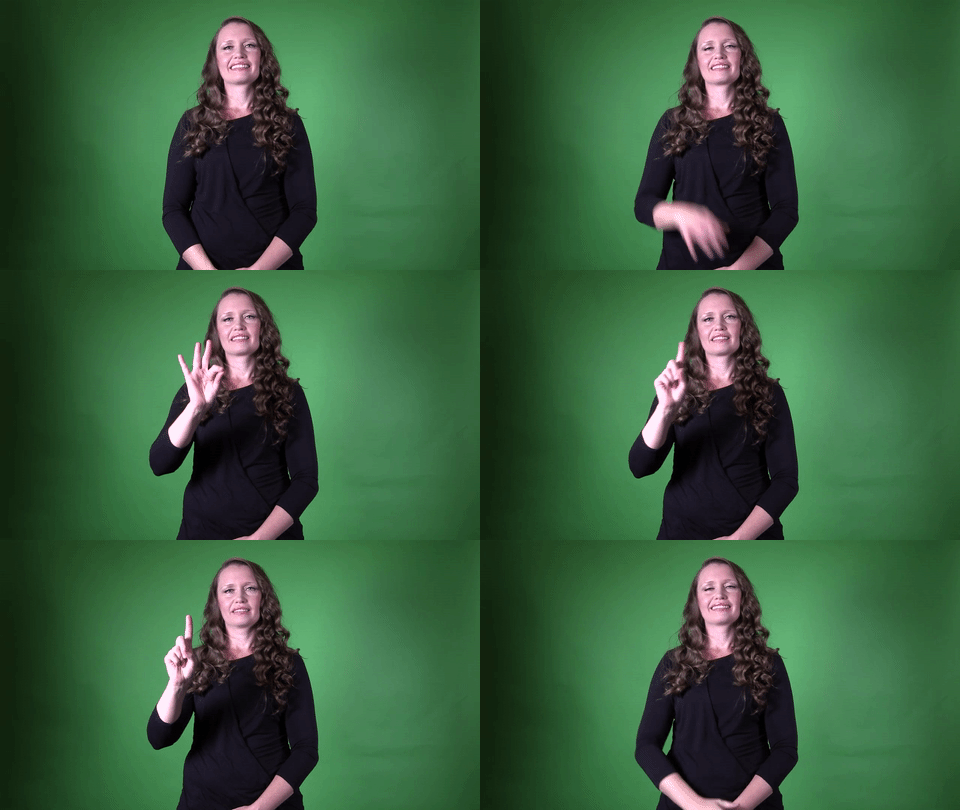
Definition: Refers to the number ninety-one
Sign for NUMBER 91 in ASL
Practice Activities:
Practicing the sign for number 91 in ASL begins with familiarizing yourself with the individual numbers 9 and 1. Start by signing 9, then smoothly transition to 1 without hesitating. Repeat this process slowly, then increase your speed to develop fluidity. Try signing other numbers in the 90s to reinforce the handshape changes.
Use number sequences to drill the sign for number 91 in ASL. Count aloud from 80 to 100 while signing each number, ensuring clarity and accuracy. Try mixing up the order and signing random numbers in the 90s to test your recall. Record yourself signing to check for errors or inconsistencies.
Practice by signing your birth year or important dates that include 91. Come up with at least five meaningful uses of 91, such as historical events or personal milestones, and sign them in full sentences. For example, “My grandfather was born in 1991” or “I have 91 cents in my pocket.” This helps integrate the number naturally into sentence structures.
Create a real-world application game using the sign for number 91 in ASL. Look for instances of 91 in daily life, such as prices, addresses, or sports statistics. Every time you see the number, stop and sign it to reinforce recognition. Pair up with a partner and quiz each other with different numbers, responding only in sign.
Engage in storytelling activities including the number 91. Create short narratives about someone celebrating their 91st birthday, a contest with 91 participants, or a road trip covering 91 miles. This allows you to see the number in logical contexts while practicing smooth number transitions. Write down a short summary and then sign it from memory.
Cultural Context:
The sign for number 91 in ASL is part of the structured numbering system in American Sign Language. ASL numbers follow a consistent pattern, making them easier to learn and use. The sign for number 91 in ASL follows this pattern by combining the digits nine and one in a smooth motion.
Numbers play an important role in ASL communication, especially in daily conversations and academic settings. The sign for number 91 in ASL can be used for counting, addresses, years, and financial transactions. Knowing ASL numbers ensures clear communication in both casual and formal interactions.
In Deaf culture, fluency in ASL numbers helps with accessibility and inclusion in conversations. The sign for number 91 in ASL is used in various contexts, from sports scores to identifying quantities. Mastery of ASL numbers enhances communication and strengthens the connection within the Deaf and signing communities.
When signing the sign for number 91 in ASL, hand positioning and movement matter. Each digit is signed in a continuous motion, reflecting ASL’s fluidity. Consistency in number signing is key to avoiding misunderstandings.
Learning ASL numbers, including the sign for number 91 in ASL, supports better communication in educational and professional settings. Teaching ASL numbers helps bridge gaps between Deaf and hearing individuals. Understanding numerical concepts in ASL fosters inclusivity and awareness of Deaf culture.
Historical influences have shaped modern ASL numbers, including the sign for number 91 in ASL. The development of ASL numbers follows a logical structure influenced by French Sign Language. This connection highlights ASL’s rich history and evolution.
ASL number signs, such as the sign for number 91 in ASL, play a role in storytelling and everyday exchanges. Expressing numbers accurately in ASL ensures clarity in relaying information. Using the correct number signs improves fluency and comprehension.
The sign for number 91 in ASL is useful beyond simple counting. It appears in discussions about dates, prices, and statistics. Being proficient in ASL numbers allows for confidence in communication across different scenarios.
ASL learners benefit from practicing numbers, including the sign for number 91 in ASL, to build fluency. Repetition and exposure to ASL numbers strengthen understanding. Frequent use of ASL numbers makes everyday communication smoother.
Watching native signers demonstrate the sign for number 91 in ASL helps improve accuracy. Observing fluent signers provides insight into natural signing techniques. Mim
Extended Definition:
The sign for number 91 in ASL is a combination of two numerical handshapes, flowing smoothly from one to the next. To sign it correctly, start with the number 9 handshape, then transition into the number 1 handshape. This movement should be fluid to maintain proper signing accuracy.
When signing the number 91 in ASL, it’s important to maintain clear hand positioning. The palm orientation may vary slightly depending on regional or stylistic differences. However, ensuring the correct digits are visible to the viewer helps improve readability.
Numbers in ASL follow specific patterns that make communication efficient. The sign for number 91 in ASL follows the typical structure for two-digit numbers. Mastering these transitions helps build confidence when signing larger numbers.
Consistency in signing numbers is crucial for clear ASL communication. The sign for number 91 in ASL should be performed at a steady pace without hesitation. Practicing numerical transitions enhances fluency in everyday conversations.
ASL numbers are used in various contexts, from counting to addressing specific quantities. The sign for number 91 in ASL may appear in discussions about age, prices, or other numerical references. Understanding number signs expands vocabulary and improves signing proficiency.
Finger dexterity plays a role in signing numbers accurately. The transition between the two digits in the sign for number 91 in ASL requires controlled movement. Regular practice strengthens muscle memory for smoother signs.
Numbers in ASL can be incorporated into larger discussions and sentences. The sign for number 91 in ASL may be combined with other words to convey dates, addresses, or measurements. Learning numerical structures in ASL enhances overall communication skills.
Some signs may vary slightly depending on the signing community. While the sign for number 91 in ASL remains generally consistent, minor variations can exist. Observing experienced signers and practicing regularly ensures proper execution.
Visual clarity is essential when signing numbers. The sign for number 91 in ASL should be performed in a way that others can easily recognize. Utilizing clear handshapes and transitions ensures effective communication.
Numbers are a fundamental part of ASL, appearing in daily conversations and formal settings. The sign for number 91 in ASL allows signers to express numerical information efficiently. Practicing numbers regularly helps build a strong ASL foundation.
Synonyms: ninety-one, number ninety-one, number 91, the number 91, the number ninety-one
Educational resources: Find related learning materials in our course bank!
Want more? Check out some of our popular learning activities on the homepage!
Need to look up a sign? Use our highly rated dictionary: https://aslinteractive.com/best-asl-dictionary/
Follow us on tiktok: https://www.tiktok.com/@aslinteractive. More social media links at the bottom of this page!
Long-tail Keywords: what is the sign for number 91 in ASL, how do you sign number 91 in ASL, learn how to sign number 91 in American Sign Language
Categories: Numbers – Basics, Numbers 91-100, cardinal numbers
tags: Numbers, Numbers 91-100, Math, Language Learning, Educational Content
Parameters
*Handshape*:
The sign for NUMBER 91 in ASL uses a two-part motion. It begins with the number 9, where the dominant hand forms an “F” handshape , with the thumb and index touching while the other fingers remain extended. Then, it transitions into the number 1, with the index finger pointing up and the remaining fingers curled into the palm. This smooth transition between the digits represents the number clearly in ASL.
*Palm Orientation*:
The palm orientation for the sign for NUMBER 91 in ASL begins with the dominant hand forming the number “9” with the palm facing outward. Then, the hand transitions into the number “1,” maintaining a consistent outward-facing direction. The wrist motion is smooth to ensure clarity. When signing the sign for NUMBER 91 in ASL, the fingers remain slightly curved during the “9” formation and straighten for the “1,” keeping all movements fluid and precise.
*Location*:
The sign for number 91 in ASL is produced in the neutral signing space in front of the chest. The dominant hand forms the number 9 handshape, with the thumb and index finger touching to create a circular shape, while the other fingers extend. Then, the hand transitions smoothly into the number 1 handshape, with the index finger pointing upward and other fingers curled into the palm. The motion should be fluid and natural.
*Movement*:
To produce the sign for number 91 in ASL, start with the number 9 handshape, where the thumb and index finger form a circle while the remaining fingers stay extended. Then, smoothly transition to the number 1 handshape by extending the index finger while the other fingers fold down. The movement is fluid, ensuring a natural transition between the two handshapes. This sequence clearly represents the sign for number 91 in ASL.
*Non-Manual Signals*:
Facial expressions remain neutral or slightly focused when signing the sign for number 91 in ASL. The eyebrows may be slightly furrowed if emphasizing accuracy, but for general use, the face stays relaxed. Eye gaze follows the movement of the dominant hand as it transitions between the digits. If clarifying or correcting, a quick head nod or slight head tilt may be used. The overall expression should be natural without exaggeration.
*Prosody, Dominant/Non-Dominant Hand*:
The sign for number 91 in ASL is produced using the dominant hand. Begin by forming the number 9 with the dominant hand, extending the thumb and index finger while curling the remaining fingers. Then, smoothly transition into the number 1 by extending only the index finger while tucking in the rest. This motion should appear fluid and natural, ensuring clarity in signing the sign for number 91 in ASL. Maintain a relaxed wrist and slight movement for visual emphasis.
Tips for Beginners:
Mastering the sign for NUMBER 91 in ASL requires comfort with both numerical signs and smooth transitions. This number combines the signs for “9” and “1,” so ensure that each digit is formed clearly and sequentially. Keep your hand steady and your palm facing outward to maintain visibility.
A common mistake when signing NUMBER 91 in ASL is rushing through the transition between “9” and “1,” which can blur the numbers together. To avoid this, give each digit a distinct and confident formation before smoothly shifting to the next. Practicing in front of a mirror or recording yourself can help refine your accuracy.
Finger placement is critical when forming the number “9.” The index finger and thumb should touch to create a circular shape while keeping the other three fingers extended. When shifting to “1,” extend only the index finger while smoothly lowering the thumb and remaining fingers. The transition should be fluid but deliberate.
Maintaining consistent hand positioning will help with clarity. The sign for NUMBER 91 in ASL should be done with minimal hand movement beyond the necessary transition. If your hand wobbles or rotates too much, it can make the sign unclear to viewers.
Practicing counting sequences that include 91 can reinforce muscle memory. Signing 90-91-92 in sequence helps develop fluency with number transitions. Watching fluent signers and mimicking their pacing and hand clarity will also improve your accuracy.
Confidence plays a big role in signing numbers correctly. If you hesitate, the motion may appear shaky. Practicing regularly and at a steady pace will build confidence, ensuring clear and understandable signing.
Connections to Other topics:
The sign for number 91 in ASL connects to the broader system of number signs, which are essential for expressing years, ages, and mathematical concepts. Numbers in ASL follow specific handshape rules and can change depending on the context. Because number 91 includes a transition from a “9” handshape to a “1” handshape, it demonstrates movement patterns that also appear in sequential counting and phone numbers.
Ordinal numbers, such as 91st, involve modifying the movement of the sign for number 91 in ASL by either twisting or changing movement direction. This pattern is consistent across ordinal signs like 1st, 2nd, and so on. Learning how to adapt numbers for different contexts is essential when discussing ranks, placements, or dated events.
Recognizing the pattern in signs like the sign for number 91 in ASL also helps with understanding numerical incorporation, used in concepts like “91 dollars” or “91 years old.” Many time-related signs incorporate numbers directly, eliminating the need for additional signs. This efficiency is common in ASL grammar and illustrates how numbers are embedded in broader linguistic structures.
Using number signs correctly is critical for clarity, especially in educational or professional settings. The sign for number 91 in ASL might be required when discussing historical dates or financial figures. Because ASL relies on non-manual markers, numbers can also be emphasized with facial expressions to indicate approximations or exact amounts, reflecting ASL’s unique visual nature.
Summary:
The sign for number 91 in ASL follows a structured pattern based on ASL numbering conventions. It consists of two distinct handshapes performed in sequence. The first digit, 9, is signed with the index finger and thumb forming an open circle while the remaining fingers extend outward.
The transition from 9 to 1 is fluid and emphasizes a natural movement. The handshape shifts directly from the 9 position to the 1 by extending the index finger while the thumb and other fingers fold down. This shift should be smooth to maintain clarity in communication.
ASL number signs, including the sign for number 91 in ASL, rely on specific movements and positioning. The numbers 90-99 often follow a consistent approach using the 9-handshape followed by the second digit. This structure aligns with ASL’s base-10 numbering system.
Hand dominance plays a role in forming the sign correctly. A right-handed signer will use their right hand, while a left-handed signer should use the left hand. Keeping the hand slightly forward in the signing space helps maintain visibility.
The sign for number 91 in ASL is commonly seen in contexts like addresses, sports scores, and historical dates. When expressing years, ASL typically divides four-digit numbers into pairs, so 1991 would be signed separately as 19 and then 91. This format helps maintain clarity.
When communicating large numbers, signers may incorporate pauses or facial expressions to separate concepts. The sign for number 91 in ASL may appear in financial discussions, such as when referencing prices, measurements, or statistics. In these cases, numerical precision is essential.
Numbers in ASL serve not only as counting tools but also as classifiers in certain contexts. Some signed numbers may take on additional meanings in idiomatic expressions. While 91 does not currently have a widely recognized symbolic interpretation, its components (9 and 1) could be part of larger numerical expressions.
Linguistically, ASL numbers showcase both lexicalized motion and consistent handshape usage. The transition between digits in the sign for number 91 in ASL demonstrates the language’s efficiency. The movement between consecutive numbers follows a rhythm that experienced signers develop over time.
ASL number signs differ slightly from English-written digits in how they are conveyed. Unlike spoken English, ASL numbers rely on visual contrast and movement rather than verbal inflection. This distinction highlights the importance of spatial awareness in signed communication.
Grammatically, ASL numbers can function within noun phrases, acting as descriptors for objects or quantities. This applies to the sign for number 91 in ASL when discussing numbered lists, rankings, or statistics. The number’s placement within a sentence influences its emphasis.
ASL numbering conventions vary slightly depending on geographical influences and instructional settings. Some signers develop habits based on regional variations in number formation. However, the core structure of the sign for number 91 in ASL remains consistent throughout the Deaf community.
Facial expressions often accompany numerical signs to clarify meaning. A slight nod or eyebrow movement may emphasize the number 91 in contexts requiring precision. This interplay between non-manual signals and hand movements strengthens ASL’s expressiveness.
When using the sign for number 91 in ASL within complex sentences, positioning within the signing space matters. Numbers appearing in a sequence are signed in a steady, flowing motion. Keeping the signing hand steady ensures visual cohesion.
The sign for number 91 in ASL intersects with applied linguistics theories on visual language acquisition. Learners often develop numeric fluency through repeated exposure. Practice with natural number transitions helps improve retention and motor skills.
Deaf education incorporates numeral signs early in instruction. Learning the sign for number 91 in ASL builds foundational numeric comprehension. These numbers contribute to broader mathematical discussions in ASL-based classrooms.
Technology and digital communication have influenced ASL number presentation. Video calls and online learning platforms allow for real-time ASL number demonstrations. Clarity in signing numbers like 91 remains crucial for accessibility among Deaf users.
Numerical signs in ASL can sometimes differ from those in other sign languages. While the sign for number 91 in ASL follows expected conventions, international signers may use alternative numbering systems. Cross-linguistic comparisons highlight the diversity of signed languages.
The historical evolution of ASL numbers has been shaped by Deaf educators and sign language researchers. Standardized teaching methods ensure consistency in numerical signs. The sign for number 91 in ASL retains its structural integrity across generations.
Cognitive research on signed languages reveals insights into number representation in the brain. Studies indicate that ASL users process numerical sequences visually rather than auditorily. This distinction reinforces ASL’s spatial and kinetic nature.
The use of the sign for number 91 in ASL exemplifies how numerical expressions adapt to specific contexts. Whether discussing years, scores, or quantities, 91 follows established ASL principles.
Want more? Check out some of our popular learning activities!
ASL Interactive Resources
ASLInteractive YouTube Channel
Follow us on tiktok: @aslinteractive.com
Follow us on Instagram: aslinteractive
Facebook page: aslinteractive
Facebook group: aslinteractive
LInkedIn: ASL Interactive LLC
Twitter: @ASL_interactive
*Some information on this page is AI-generated. AI can make mistakes. Please check the information.


Responses