Sign for NUMBER 93 in ASL | 🔢 ASL Dictionary

Definition: Refers to the number ninety-three

Sign for NUMBER 93 in ASL 

YouTube player

Practice Activities:

To practice the sign for number 93 in ASL, start by signing it in isolation several times, focusing on handshape and movement. Try saying the number aloud while signing to reinforce the connection between the visual and numerical concepts. Practice in front of a mirror to check for accuracy.

Next, integrate the sign for number 93 in ASL into simple counting exercises. Count from 90 to 95 to build number fluency. Challenge yourself to sign random numbers within the 90s range quickly and accurately.

Use the sign in context by incorporating it into real-life situations. For instance, sign the price of an item as 93 dollars or describe someone’s age as 93 years old. Create simple sentences like “My grandmother is 93” or “That house costs 93 thousand dollars” and sign them fluently.

For a partner activity, one person can sign different numbers between 90 and 100 while the other identifies and fingerspells each number back. Switch roles to strengthen recognition and production of the number signs. Practicing with a partner helps reinforce learning and improve recall speed.

A fun storytelling prompt is to describe a fictitious scenario where the number 93 is important. For example, tell a short story about a person who collected 93 seashells or a race where the winning time was 93 minutes. Incorporating storytelling helps meld vocabulary into meaningful context.

Try a speed practice game by setting a timer and signing all numbers from 90 to 100 within 10 seconds, ensuring that the sign for number 93 in ASL is executed clearly. This challenge improves fluency and confidence when signing numbers.

Cultural Context:

The sign for number 93 in ASL is an essential part of learning American Sign Language. Numbers play a crucial role in communication, allowing signers to share important details like addresses, ages, and quantities. Understanding how to sign numbers correctly ensures clarity in conversations.

Number signs in ASL follow a logical pattern, with slight variations depending on the number combination. The sign for number 93 in ASL follows the standard rules for signing two-digit numbers. Mastering these patterns helps build fluency and confidence in signing.

In Deaf culture, numbers are frequently used in daily interactions, from discussing prices to making plans. Knowing the sign for number 93 in ASL can be useful in various contexts, including sports, education, and storytelling. The ability to sign numbers quickly and accurately enhances communication.

ASL has a rich history influenced by French Sign Language and other signing systems. The sign for number 93 in ASL reflects the visual and spatial aspects of the language. Handshape, movement, and palm orientation all contribute to correct number formation.

Learning ASL numbers is especially important for students, interpreters, and anyone interacting with the Deaf community. The sign for number 93 in ASL may seem simple, but it is part of a broader numerical system that requires practice. Consistent exposure to numbers in ASL helps with retention and natural usage.

Cultural awareness is key when using numbers in ASL. Certain numbers hold significance in the Deaf community, including those related to historical events or Deaf organizations. While the sign for number 93 in ASL may not have specific cultural meaning, developing number fluency supports meaningful conversations.

American Sign Language is a visual language that relies on hand movements, facial expressions, and body positioning. When signing the number 93, it is important to maintain proper handshape and movement to ensure accuracy. Paying attention to these details enhances overall ASL proficiency.

ASL numbers are used in a variety of real-life situations. The sign for number 93 in ASL might come up in phone numbers, addresses, or price negotiations. Practicing ASL numbers regularly helps signers feel more comfortable in everyday interactions.

Fluency in ASL numbers allows for seamless and natural conversations. The sign for number 93 in ASL, along with other number signs, is a foundational skill in the language. Developing confidence in signing numbers improves communication and connection with the Deaf community.

Extended Definition:

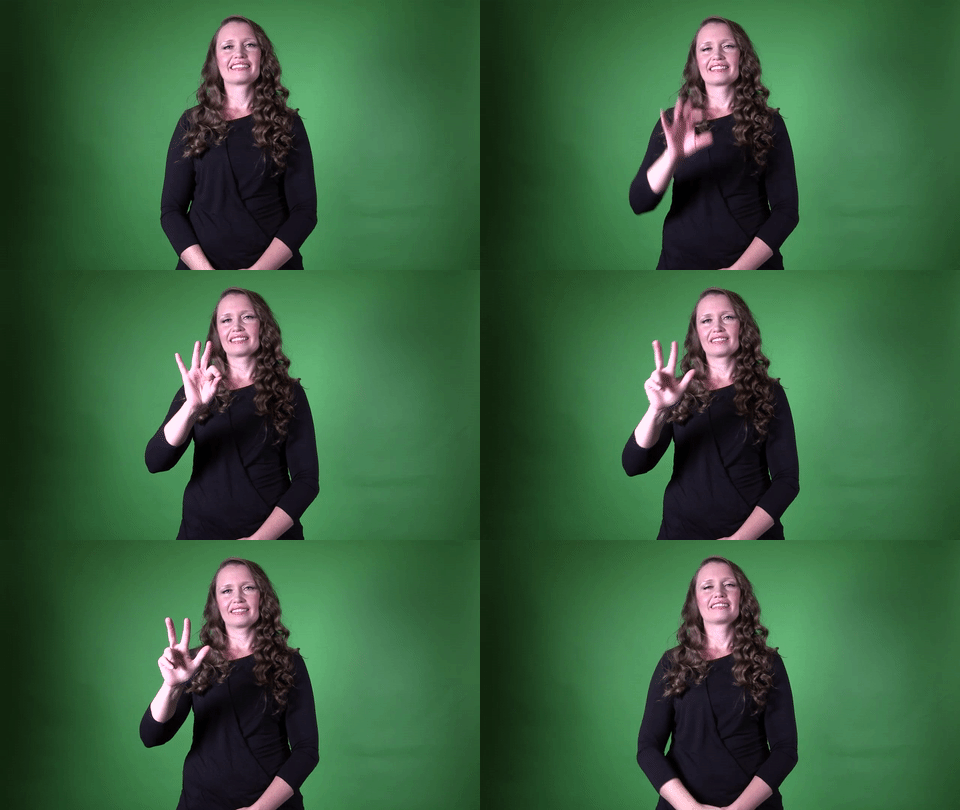
The sign for number 93 in ASL is made by combining the individual signs for 9 and 3 in a fluid motion. ASL numbers follow a systematic structure, making them easy to learn with practice. The number 93 is signed with one hand, using specific finger placements to clearly convey the intended number.

To sign number 93 in ASL, start by forming the number 9 with your dominant hand. This is done by touching the tip of your thumb to the tip of your index finger while keeping the other fingers extended. Then, transition smoothly into the sign for 3 by holding up the thumb, index, and middle fingers.

ASL numbers are an essential part of communication, helping express ages, dates, addresses, and other numerical information. Knowing how to sign number 93 in ASL ensures clear communication in a variety of settings. When learning numbers in ASL, finger movements should be precise to avoid confusion with similar signs.

The number system in ASL is influenced by movement and orientation, which is why practicing correct hand positioning is important. When using the sign for number 93 in ASL, the transition between digits should be fluid to maintain clarity. Facial expressions and slight shifts in movement can also enhance comprehension when signing numbers.

Signing numbers correctly is useful in everyday conversation, whether you’re discussing quantities, sports scores, or prices. Mastering the sign for number 93 in ASL contributes to overall fluency in American Sign Language. It’s important to practice frequently to build muscle memory and improve accuracy.

The sign for number 93 in ASL is part of the broader ASL numerical system, which extends beyond simple numbers to include number incorporation in other signs. Learning number signs improves general ASL skills by reinforcing finger dexterity and visual recognition. When signing 93, it’s helpful to keep a steady pace to maintain accuracy.

Numbers in ASL are used in both casual and formal settings, making them a crucial component of communication. Whether counting objects, talking about statistics, or giving personal information, knowing how to sign number 93 in ASL adds to meaningful interactions. Each number has a unique hand shape and movement, making consistent practice essential.

Watching experienced signers and using resources like ASL dictionaries can help with mastering number signs. To understand and correctly use number 93 in ASL, observe how fluent signers transition smoothly between numbers. Practicing in front of a mirror or recording yourself can help refine number signing

Synonyms: ninety-three, number ninety-three, number 93, the number 93, the number ninety-three

Educational resources: Find related learning materials in our course bank!

Want more? Check out some of our popular learning activities on the homepage!

Need to look up a sign? Use our highly rated dictionary: https://aslinteractive.com/best-asl-dictionary/

Follow us on tiktok: https://www.tiktok.com/@aslinteractive. More social media links at the bottom of this page!

Long-tail Keywords: what is the sign for number 93 in ASL, how do you sign number 93 in American Sign Language, learn how to sign number 93 in ASL

Categories: Numbers – Basics, Numbers 91-100, cardinal numbers

tags: Numbers, Numbers 91-100, Math, Language Learning, Educational Content

Parameters

*Handshape*:

The sign for NUMBER 93 in ASL uses two distinct handshapes to represent the digits 9 and 3. The dominant hand first forms the “9” handshape, with the index finger and thumb touching in a circle while the remaining fingers are extended. Then, the hand transitions smoothly to the “3” handshape, with the index, middle, and thumb extended. This number sign is performed with a wrist twist as the hand moves from the first digit to the second.

*Palm Orientation*:

The palm orientation for the sign for number 93 in ASL starts with the dominant hand facing outward while forming the number 9. The thumb and index finger create a circular shape, and the remaining fingers are extended. To transition to 3, the hand rotates slightly as the index, middle, and thumb extend while the other two fingers close. The movement is smooth, ensuring clarity when signing the number 93 in ASL.

*Location*:

The sign for number 93 in ASL takes place in the neutral signing space in front of the body. The dominant hand is used to form the number signs, beginning with the number 9, followed by a smooth transition into the number 3. The hand remains in the air at chest or shoulder level, ensuring visibility. Proper placement and fluid motion help maintain clarity when signing the number 93 in ASL.

*Movement*:

To produce the sign for number 93 in ASL, begin by forming the number 9 with your dominant hand, extending the thumb and index finger while keeping the other fingers curled. Then, smoothly transition into the number 3 by extending the thumb, index, and middle fingers while curling the ring and pinky fingers. This movement should be fluid, ensuring clarity when expressing the sign for number 93 in ASL. Keep your palm facing outward throughout.

*Non-Manual Signals*:

Facial expressions remain neutral or slightly focused when signing the sign for number 93 in ASL . Eyebrows stay relaxed, and the mouth remains in a natural position unless emphasizing the number for clarification. Head movement is minimal, though a slight nod may accompany the transition between digits. If emphasizing or clarifying the sign for number 93 in ASL, the signer might slightly raise their eyebrows or mouth the number subtly for additional context.

*Prosody, Dominant/Non-Dominant Hand*:

The sign for number 93 in ASL uses the dominant hand. Begin by forming the number 9, with the thumb and index finger touching in an open circle while the other fingers extend. Then smoothly transition into the number 3, extending the thumb, index, and middle fingers while tucking the ring and pinky fingers. This movement should be fluid, ensuring a clear distinction between the two numbers. Maintain a steady hand position at chest level for clarity.

Tips for Beginners:

When learning the sign for NUMBER 93 in ASL, it’s important to focus on handshape and movement. This sign follows the pattern used for signing two-digit numbers in ASL, where you transition smoothly between the digits 9 and 3. Ensure that both numbers are clearly articulated, with the number 9 formed by touching the tip of your thumb to the tip of your index finger while extending the rest of your fingers, and the number 3 shaped with your thumb, index, and middle fingers extended while the ring and pinky stay folded.

A common mistake when signing NUMBER 93 in ASL is blending the transition too quickly, making it unclear. Beginners sometimes fail to fully form each number, especially mispositioning their fingers on the 9 or not spreading the three fingers wide enough for 3. To keep your sign readable, practice forming each number individually before combining them to ensure clarity.

Finger dexterity is crucial when learning to sign NUMBER 93 in ASL. Start by practicing 9 and 3 separately in front of a mirror, ensuring you hold them clearly. Then, work on transitioning smoothly between the two. Avoid unnecessary hand twisting or repositioning that slows down the motion. The transition should be fluid but distinct.

Consistency in palm orientation is another key factor. The numbers in 93 should face outward, maintaining a natural rhythm. Some beginners accidentally change palm orientation midway, which can cause confusion. If unsure, watch native signers demonstrate the motion and mimic their flow.

Practice regularly to develop muscle memory for the sign for NUMBER 93 in ASL. The more you repeat it, the more natural it will feel. Incorporate it into conversations and number sequences to build confidence. With time and focus, your signing will become smooth and precise.

Connections to Other topics:

The sign for NUMBER 93 in ASL connects to the broader number system in ASL, which follows a unique movement pattern when forming two-digit numbers. Numbers in ASL rely on clear transitions between digits to maintain clarity. The number 93 follows the pattern where the first digit (9) transitions smoothly into the second digit (3), making it important to maintain consistent hand positioning throughout.

ASL numbers are commonly used in a variety of contexts, including age, time, addresses, and statistics. Understanding the sign for NUMBER 93 in ASL can help with counting, discussing years, or referring to numbered lists. In sports, numbers are used to refer to jersey numbers or scores. Recognizing number structures is essential when discussing historical events, such as mentioning significant dates like 1993 or referencing statistics in conversations.

There is also a connection between numbering and ordinal concepts in ASL. While cardinal numbers indicate quantity, ordinal numbers (such as 93rd place) require slightly different movements by incorporating a twisting motion. Additionally, numbers in ASL often appear in classifiers when representing groups of objects or people, such as “three people sitting” where the number integrates into a classifier handshape.

Numbers like 93 may also become a part of compound signs in contexts like phone numbers, addresses, and monetary amounts. When signing various numerical values, it’s essential to observe the fluid motion and proper palm orientation to avoid misinterpretation. Mastering the sign for NUMBER 93 in ASL reinforces broader numerical fluency, fostering clearer communication when expressing mathematical or quantity-related concepts.

Summary:

The sign for number 93 in ASL follows a structured numerical pattern relating to ASL number signs. ASL uses a distinct one-handed system for numbers 1-100, and signing larger two-digit numbers often combines the motions of individual digits. For the sign for number 93 in ASL, this means incorporating the signs for 9 and 3 in a fluid sequence.

The number 9 is formed by extending the thumb and index finger in a closed circular shape, while the remaining fingers stay extended but relaxed. The number 3 is signed by extending the thumb, index, and middle fingers while the ring and pinky fingers remain tucked down. When signing the sign for number 93 in ASL, the signer transitions smoothly from the number 9 handshape into the number 3 handshape without breaking visual clarity.

Hand orientation plays a key role in ensuring the sign remains clear and accurate. Both numbers face outward, and the transition should be fluid rather than abrupt. The signer’s palm typically faces the audience, keeping the movement visible for receptiveness and avoiding confusion.

ASL numbers above 10 can be directional, meaning that slight movement or spatial modification can change the meaning. In casual communication, the sign for number 93 in ASL may have a small bouncing motion to indicate the shift between digits. This motion helps differentiate the digits and maintain clarity.

Fluency in numerical expressions is vital in ASL to express quantities, dates, rankings, and addresses. The sign for number 93 in ASL is commonly encountered in contexts such as years, street numbers, or sports statistics. Mastery of number signs enhances overall sign fluidity and comprehension.

Cultural and linguistic studies of ASL reveal historical influences on number formation. The one-handed number system used in ASL evolved from French Sign Language (LSF). The adaptation of numbers in ASL has remained relatively consistent, following a logical formation pattern that blends efficiency with visual clarity.

Numerical literacy in ASL is foundational for mathematical instruction within Deaf education. The sign for number 93 in ASL aligns with other cardinal number formations, following an expected movement that makes number learning intuitive. Deaf educators emphasize number fluency from early childhood to facilitate numeracy skills among Deaf students.

Grammar in ASL uses number incorporation in various ways, influencing broader structuring within the language. The sign for number 93 in ASL is used as a quantifier, frequently appearing in answers to “how many” questions. It also integrates within classifier structures when describing grouped objects.

Variation in number signs can be influenced by regional dialects within the Deaf community. Although the sign for number 93 in ASL follows a standard form, slight differences in movement or hand positioning occur based on geographic influences. Understanding these regional variations supports effective communication across different ASL users.

Numbers in ASL are also important in storytelling and poetry. The sign for number 93 in ASL may appear in visual narratives or handshape poetry where numerical representation carries symbolic meaning. ASL poetry often creatively incorporates number signs among its expressive elements.

The influence of digital communication on ASL has impacted how numbers are used. With the rise of texting and video calls, number signs like the sign for number 93 in ASL are frequently exchanged in video messages. ASL users rely on number clarity for addressing, scheduling, and labeling items.

Linguistic studies highlight the phonological and morphological elements of ASL numbers. The phonology of the sign for number 93 in ASL includes handshape, movement, and orientation transitions. The morphology involves how number features integrate with other signs grammatically.

Comparing ASL numbers with numeric signs in other sign languages reveals notable differences. Some sign languages use two-handed systems, while ASL maintains its one-handed numerical framework. The sign for number 93 in ASL adheres to ASL conventions but differs from BSL or JSL number signs that employ alternative digit formations.

Memory and cognition research show that ASL number processing in the brain involves both visual-spatial and linguistic centers. Learning number sequences like the sign for number 93 in ASL strengthens overall ASL fluency. Cognitive studies suggest that strong number recognition in ASL facilitates mathematical reasoning in Deaf individuals.

Technology has influenced how numbers are displayed and used within ASL. The sign for number 93 in ASL can now be taught through digital applications designed for ASL learners. Online resources, video lessons, and interactive tools help learners refine numerical articulation in ASL.

Interpreters play a significant role in accurately conveying numbers in ASL-English settings. When interpreting the sign for number 93 in ASL, clarity and accuracy in handshape transition are crucial. Misinterpretation of numbers can lead to significant misunderstandings in contexts such as legal, medical, or financial discussions.

Fingerspelling is sometimes used for clarifying numbers when signs are misunderstood. In cases where

Want more? Check out some of our popular learning activities!

ASL Interactive Resources

ASLInteractive YouTube Channel

Follow us on tiktok: @aslinteractive.com

Follow us on Instagram: aslinteractive

Facebook page: aslinteractive

Facebook group: aslinteractive

LInkedIn: ASL Interactive LLC

Twitter: @ASL_interactive

*Some information on this page is AI-generated. AI can make mistakes. Please check the information.

Sign for 93 in ASL, Sign for NINETY-THREE in ASL, Sign for NUMBER NINETY-THREE in ASL, Sign for THE NUMBER NINETY-THREE in ASL, Sign for THE NUMBER 93 in ASL, Sign for NUMBER 93 in ASL 

Responses