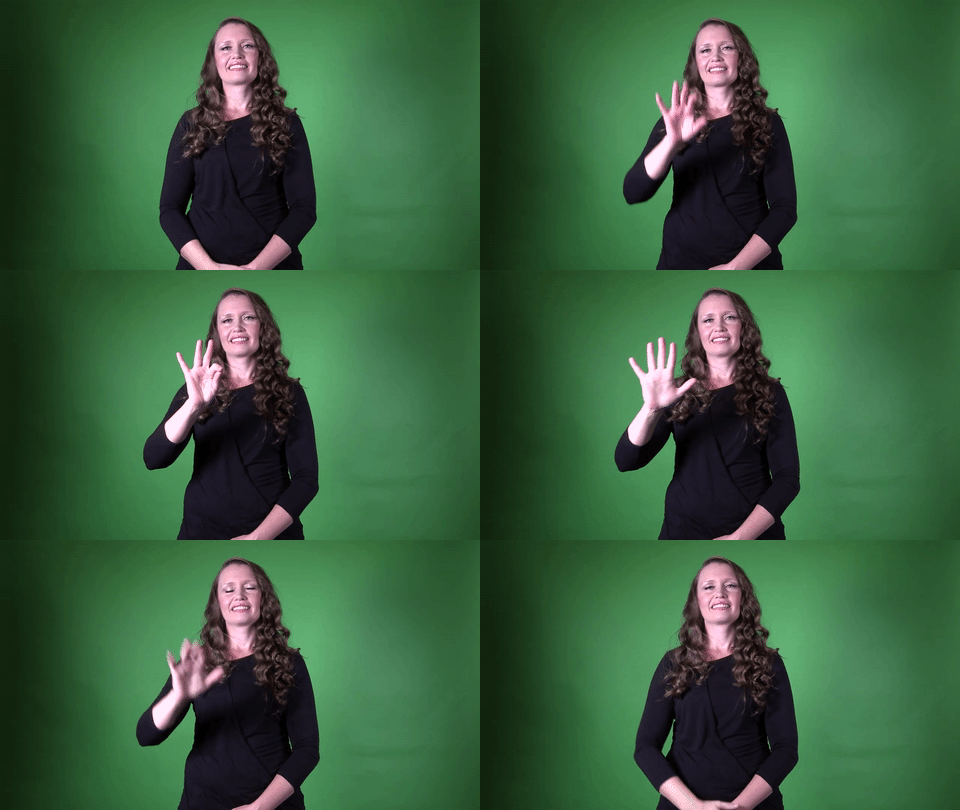
Sign for NUMBER 95 in ASL | 🔢 ASL Dictionary

Definition: Refers to the number ninety-five

Sign for NUMBER 95 in ASL 

YouTube player

Practice Activities:

Practicing the sign for number 95 in ASL begins with repetition. Start by signing the numbers 9 and 5 separately to ensure proper handshape and movement. Then, smoothly transition between the two to form 95 in one fluid motion. Repeat this multiple times in front of a mirror or with a partner to build confidence.

Next, incorporate the sign for number 95 in ASL into counting exercises. Count from 90 to 100, making sure to sign each number clearly. Then, practice counting backward from 100 to 90, paying close attention to the handshape transitions. This will strengthen muscle memory and improve fluency in signing numbers.

Use number games to reinforce recognition and signing. A partner or instructor can randomly display numbers, and you must sign them correctly. Reverse the roles by signing numbers for a partner to interpret. Another fun activity is writing down different numbers on slips of paper, drawing one randomly, and signing it.

Create real-world scenarios using the sign for number 95 in ASL. Imagine you’re discussing a price, an age, or a quantity that includes 95. Practice asking and answering questions such as “How much does this cost?” or “How old is that person?” Use contextual phrases to make the sign relevant in conversations.

Engage in storytelling exercises by incorporating numbers into a short narrative. Make up a story that involves 95 as a significant number, like “Yesterday, I saw 95 birds in the park” or “My grandmother is 95 years old.” Telling these brief stories will help reinforce familiarity and signing accuracy.

Challenge yourself with timed drills to improve speed and accuracy. Set a timer for one minute and sign as many numbers as possible, ensuring each is clear and distinct. Gradually increase your speed while maintaining correct handshapes and movements.

Cultural Context:

The sign for number 95 in ASL is part of the structured numerical system in American Sign Language. Numbers are an essential part of communication in ASL, helping to express quantities, prices, addresses, and more. The sign for number 95 follows the pattern of incorporating movement and handshape changes similar to other numbers in the 90s series.

ASL numbers reflect cultural influences, as deaf communities often use specific numerical patterns in daily life. The sign for number 95 in ASL is commonly used in contexts such as sports scores, years, and monetary values. Within the deaf community, numerical accuracy is crucial for clear communication in schooling, business, and daily interactions.

Learning ASL numbers, including the sign for number 95, increases fluency and helps with understanding more complex numerical sequences. Since ASL is a visual language, practicing numbers with proper handshapes and movements ensures clarity. The use of non-manual markers like facial expressions can also emphasize numerical meaning in different situations.

Deaf culture values efficiency in sign communication, and numbers play an important role in quick exchanges of information. The sign for number 95 in ASL, like other numbers, follows logical patterns that learners can grasp with practice. Mastering these patterns helps with conveying information smoothly in both casual and formal settings.

Numbers in ASL are not just about counting; they carry significance in dates, times, and personal identifiers. The sign for number 95 in ASL may be used when signing historical events, discussing ages, or referring to quantities. Understanding ASL numbers deepens cultural knowledge and strengthens connections within the signing community.

Different regions may have slight variations in how numbers are signed, influenced by local signing customs. However, the sign for number 95 in ASL generally follows standardized patterns used across the United States and Canada. Consistency in numerical signing ensures comprehension across diverse ASL users, whether native signers or learners.

Engaging with deaf signers is the best way to reinforce ASL number skills. Watching fluent signers demonstrate the sign for number 95 in ASL can improve accuracy and confidence. ASL teachers and deaf educators emphasize the importance of precision when signing numbers to avoid misunderstandings.

The sign for number 95 in ASL demonstrates the fluid and structured nature of numerical signs in American Sign Language. Learning and practicing this sign enhances overall ASL proficiency, supporting better communication within the deaf and signing communities.

Extended Definition:

The sign for number 95 in ASL is a combination of numeric handshapes and movement. It follows the standard pattern for signing numbers in American Sign Language, making it easy to learn once you understand the foundational concepts. This sign is commonly used in everyday communication, including counting, listing, and numerical references.

To create the sign for number 95 in ASL, start with the handshape for 9, then transition smoothly into the handshape for 5. The movement is subtle but essential for clarity and fluency. Like other two-digit numbers in ASL, this sign follows a rhythmic motion that helps maintain the integrity of the number sequence.

Numbers in ASL rely on proper handshapes and orientation to avoid confusion with similar numbers. The sign for number 95 in ASL ensures accuracy by maintaining distinct hand positions. Practicing this sign along with other numbers can help improve speed and confidence in signing.

Using the sign for number 95 in ASL is important when discussing quantities, addresses, or any numerical data. Whether in math, financial discussions, or everyday lists, having fluency in number signs enhances communication. ASL numbers are widely used in both formal and casual conversations.

There are variations in signing numbers depending on regional dialects or stylistic preferences. However, the sign for number 95 in ASL typically follows the most commonly accepted numeric structure. Watching native signers and practicing regularly will help in mastering the correct movements.

When learning the sign for number 95 in ASL, it helps to break down the formation of each digit. The transition between the numbers should be fluid, not abrupt. Signing with confidence and maintaining proper facial expressions can also improve overall clarity.

In ASL, number signs like 95 require precise hand placement and motion. Small adjustments in finger positioning can change the meaning of a number, so practicing accuracy is crucial. Using ASL videos or instructional materials can help reinforce correct usage.

Many learners find it helpful to practice number sequences to build confidence. Counting from 90 to 99 ensures better fluency when using the sign for number 95 in ASL. Repeating numerical sequences can develop muscle memory, making signing faster and more natural.

Children and adults alike can benefit from learning numbers fluently in ASL. Whether used in education, work settings, or daily conversations, knowing how to sign numbers correctly improves overall communication skills. The sign for number 95 in ASL is just one of

Synonyms: ninety-five, number ninety-five, number 95, the number 95, the number ninety-five

Educational resources: Find related learning materials in our course bank!

Want more? Check out some of our popular learning activities on the homepage!

Need to look up a sign? Use our highly rated dictionary: https://aslinteractive.com/best-asl-dictionary/

Follow us on tiktok: https://www.tiktok.com/@aslinteractive. More social media links at the bottom of this page!

Long-tail Keywords: what is the sign for 95 in ASL, how do you sign 95 in American Sign Language, learning the ASL sign for 95

Categories: Numbers – Basics, Numbers 91-100, cardinal numbers

tags: Numbers, Numbers 91-100, Math, Language Learning, Educational Content

Parameters

*Handshape*:

The sign for NUMBER 95 in ASL uses a changing handshape that blends elements of the number signs 9 and 5. The dominant hand starts with the “9” handshape, where the thumb and index finger touch to form an open circle, while the other fingers remain extended. It then transitions smoothly into the “5” handshape, where all fingers spread open and extend straight.

This movement helps distinguish the sign for NUMBER 95 in ASL from other numbers, ensuring clarity. The transition between handshapes is fluid, with the palm orientation generally facing forward or slightly outward. Precision in these handshapes is important to maintain the correct numerical representation.

*Palm Orientation*:

The sign for NUMBER 95 in ASL uses the dominant hand to form the numerals 9 and 5 in sequence. The palm starts facing outward when signing 9, with the thumb and index finger touching to form an open “O” shape. As the hand transitions to 5, the palm remains outward, fingers spread apart. Smoothly shift between the two numbers while maintaining clear hand positioning for accuracy.

*Location*:

The sign for number 95 in ASL is produced in the neutral space in front of the signer’s torso. The hand remains at chest level while transitioning between the numbers. Since ASL uses a specific number system, the motion is fluid from 9 to 5. There is no contact with the body, and the movement remains within the front space, ensuring visibility. Proper hand positioning is crucial for clarity.

*Movement*:

To perform the sign for number 95 in ASL, start by forming the number 9 with your dominant hand, where the thumb and index finger create a circle while the other fingers remain extended. Then, smoothly transition to the number 5 by spreading all fingers open. The movement is fluid, with a slight wrist rotation. This sign for number 95 in ASL should be executed naturally and rhythmically to ensure clarity.

*Non-Manual Signals*:

When signing the sign for NUMBER 95 in ASL, keep a neutral or slightly focused facial expression to maintain clarity. Your eyebrows should remain in a natural position unless emphasizing the number in a specific context. Eye contact is important, helping ensure the person you’re communicating with clearly understands the sign for NUMBER 95 in ASL. Mouth movements should stay minimal, avoiding unnecessary exaggeration.

*Prosody, Dominant/Non-Dominant Hand*:

The sign for number 95 in ASL uses the dominant hand, forming a “9” handshape (thumb and index finger touching, other fingers extended). The hand rotates slightly, transitioning into a “5” handshape (open palm with fingers spread). This smooth transition maintains clarity and fluidity. Non-dominant hand is not used. The sign for number 95 in ASL should be performed at a comfortable speed for accuracy. Adjust hand position to ensure visibility.

Tips for Beginners:

Mastering the sign for NUMBER 95 in ASL requires proficiency in forming and transitioning between the digits 9 and 5 with smooth motion. Begin by shaping your dominant hand into the number 9, with the index finger and thumb touching while the rest of your fingers remain extended. Then, transition smoothly to the number 5 by spreading all fingers apart, keeping your palm facing outward.

Consistency in hand positioning and finger clarity is key to signing numbers accurately. When forming the number 9, ensure that your index and thumb meet in a clear, visible circle. For the number 5, keep your fingers naturally extended but not rigid. Avoid curling your fingers inward or stiffening your hand, as this can impact readability.

A common mistake beginners make while signing the sign for NUMBER 95 in ASL is losing control of finger placement during the transition. To avoid this, practice each number individually before moving between them fluidly. Make sure your hand remains in an upright position, with smooth movement from 9 to 5 without hesitation.

Finger dexterity plays a significant role in signing numbers fluently. If you find it challenging to switch between 9 and 5, strengthen your finger control with exercises such as stretching and flexing your fingers. Additionally, practicing in front of a mirror can help you refine your movements and ensure accuracy when signing the sign for NUMBER 95 in ASL.

Consider practicing with a fluent ASL user or using a recording tool to assess your performance. Watching your own signing can help identify inconsistencies in hand shapes and transitions. The more repetition you incorporate into your practice, the smoother and more natural your number signing will become, ensuring clear communication.

Connections to Other topics:

The sign for NUMBER 95 in ASL connects to the broader system of number signs in ASL, particularly with numbers in the 90s series. Like other numbers in this range, it follows a standard pattern that includes a transition from one digit to the other. Understanding this pattern can make learning numbers easier since the movements for 91 through 99 have similar handshapes and motions.

The sign for NUMBER 95 in ASL is also linked to concepts of counting, sequencing, and numerical order. In conversations involving money, quantities, addresses, or years, recognizing the difference between individual numbers is crucial. Practicing with different contexts, such as signing monetary values (e.g., $95), can help reinforce number fluency in ASL.

Number signs in ASL are commonly incorporated into classifiers, which allow for describing groups of objects or specific quantities. The number 95, like other numerals, may be included in classifiers to indicate amounts of items, such as “95 books” or “95 people.” This is useful in storytelling, statistics, or explanations that require precise numerical details.

By learning the sign for NUMBER 95 in ASL, signers strengthen their overall numerical literacy in ASL, which connects to larger mathematical and measurement concepts. This can include percentages, fractions, and time-related contexts such as “95 minutes” or “95 percent.” Understanding these larger applications ensures effective communication across various academic or professional settings.

The fluency of signing numbers efficiently is also important for speed in everyday conversations. Since fingerspelling and number signs are often used interchangeably in certain scenarios, recognizing the patterns of numbers helps in quicker communication. Practicing the full set of 90s numbers ensures that signers can express values accurately and smoothly in ASL communication.

Summary:

The sign for number 95 in ASL is a combination of two sequential number signs: 9 and 5. Each digit is signed separately in one smooth motion, ensuring clarity in communication. The signer starts by forming the handshape for 9, then transitions fluidly to the handshape for 5.

When signing the number 9, the thumb and index finger touch at the tips, forming a small circle while the remaining fingers stay extended. After signing 9, the hand quickly shifts to the 5 handshape by fully extending all fingers, keeping them straight and slightly spread apart. This change happens smoothly to maintain the natural rhythm of numerical signing.

Numbers in ASL are an essential part of everyday communication, from basic counting to discussing dates, addresses, and measurements. The sign for number 95 in ASL follows the standard numerical structure of the language. Being able to sign numbers fluently is a key skill for conveying precise information.

The movement between the digits in a number like 95 requires dexterity and practice. When transitioning from 9 to 5, the signer should maintain fluid motion without hesitation. Many new learners focus on maintaining a smooth shift between handshapes while ensuring each numeral remains clearly identifiable.

Numbers play a large role in ASL grammar, differing from English-based numerical patterns. In ASL, numbers up to 99 are commonly signed with a single hand, making high-speed numerical expression efficient. The sign for number 95 in ASL follows this one-handed convention, reinforcing the importance of visual economy in ASL structure.

ASL numbers incorporate linguistic features such as palm orientation and movement direction. For 95, the palm generally faces outward to ensure clarity for the viewer. Some variations may occur based on regional differences or personal signing style, but the primary structure remains the same.

The use of numbers in ASL also extends to classifiers, time references, and quantifiers. The sign for number 95 in ASL can appear in contexts such as specifying a year, an amount, or an identifying mark. Understanding how to smoothly transition between number signs helps build fluency in broader numerical applications.

Number signs are sometimes influenced by adjacent linguistic elements within a sentence. The sign for number 95 in ASL should be produced with a consistent rhythm when listing items or counting. Proper hand positioning helps maintain readability, especially in fast-paced conversations.

Cognitive research highlights the importance of spatial processing when signing numbers. Since ASL relies on visual perception, properly forming 95 with distinct numerals minimizes ambiguity. In educational settings, signers develop numeric fluency by practicing sequential changes between handshapes.

Cultural aspects of signing numbers include their use in storytelling, history, and identification. The sign for number 95 in ASL might be used in historical references, sports statistics, or personal age descriptions. Recognizing how numbers contribute to cultural expression improves a signer’s comprehension of ASL’s broader communicative role.

In rapid signing, experienced users may slightly modify movement for efficiency. Speeding up the transition within the sign for number 95 in ASL while maintaining clarity exemplifies fluency. ASL’s dynamic nature allows slight adaptations while preserving meaning through visual contrast.

For fingerspelling-heavy environments, numerical accuracy is as important as spelling precision. The sign for number 95 in ASL benefits from consistent practice to ensure clarity in all signing situations. Misunderstandings can arise from unclear handshape transitions, making intentional articulation essential.

Mathematical and scientific applications within ASL depend on precise number articulation. The sign for number 95 in ASL could appear in technical discussions, coding systems, or formulaic representations. Consistency in numerical production ensures mutual understanding in these specialized fields.

Linguistic studies examine numeral incorporation in different sign languages worldwide. ASL’s number system, including the sign for number 95 in ASL, follows an efficient structure compared to multi-hand systems in some sign languages. This efficiency supports rapid numerical signing in daily conversations.

Sports and gaming contexts frequently require smooth number signing. The sign for number 95 in ASL may appear in scoring updates, player jersey numbers, or competitive rankings. Proficiency in number signs helps ensure seamless communication in these high-energy environments.

Technology influences ASL number use through digital communication and captioning. The sign for number 95 in ASL may be used in video content, live-streamed discussions, or educational tutorials. Visual media enhances accessibility for signers engaging with numeric concepts.

DeafBlind signers sometimes use tactile signing to represent numbers. The sign for number 95 in ASL may be adapted through touch-based methods when interacting with DeafBlind individuals. Adjustments in finger contact ensure recognition of numerical distinctions in these contexts.

Children learning ASL numbers practice repetition and hand strengthening exercises. Mastering the sign for number 95 in ASL enhances their ability to count, recognize patterns, and engage in

Want more? Check out some of our popular learning activities!

ASL Interactive Resources

ASLInteractive YouTube Channel

Follow us on tiktok: @aslinteractive.com

Follow us on Instagram: aslinteractive

Facebook page: aslinteractive

Facebook group: aslinteractive

LInkedIn: ASL Interactive LLC

Twitter: @ASL_interactive

*Some information on this page is AI-generated. AI can make mistakes. Please check the information.

Sign for 95 in ASL, Sign for NINETY-FIVE in ASL, Sign for NUMBER NINETY-FIVE in ASL, Sign for THE NUMBER NINETY-FIVE in ASL, Sign for THE NUMBER 95 in ASL, Sign for NUMBER 95 in ASL 

Responses