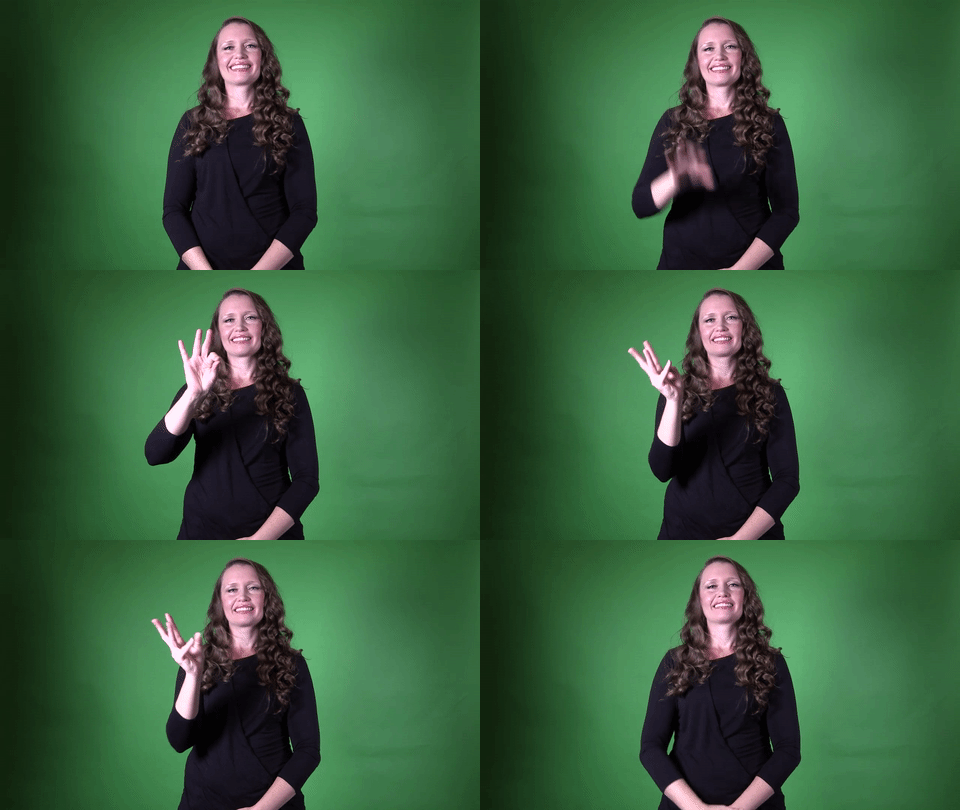
Sign for NUMBER 96 in ASL | 🔢 ASL Dictionary

Definition: Refers to the number ninety-six

Sign for NUMBER 96 in ASL 

YouTube player

Practice Activities:

To practice the sign for number 96 in ASL, begin by signing it in isolation multiple times, ensuring accuracy and fluency. Focus on transitioning smoothly between the numerals 9 and 6, paying close attention to handshape and movement. Try signing it with both hands and different speeds to develop comfort and precision.

Incorporate the sign for number 96 in ASL into counting exercises. Count by tens and add 96 at the end, or count backward from 100 to 90 while including 96. You can also try signing different numbers out of sequence and then inserting 96 to reinforce recognition.

Use the sign in real-life contexts by incorporating it into common sentences. Sign phrases like “I have 96 cents,” “My grandfather is 96 years old,” or “There are 96 students in the school.” Practice forming your own numerical sentences to improve fluency.

Engage in a storytelling activity where 96 plays a central role. Create a short story involving 96 objects, 96 minutes, or an event in the year 1996. Sign your story to a partner or in a mirror to refine clarity and expressive skills.

Pair up with a practice partner and quiz each other on numbers. One person fingerspells a random number, and the other signs it back. Include the sign for number 96 in ASL among other numbers to build quick recognition.

Use flashcards with different numerical values and sign each randomly chosen number. Write down numbers on slips of paper, pick one, and sign it. Set a timer and try to sign as many numbers, including 96, in a minute to increase speed and accuracy.

Challenge yourself by watching signed videos or conversations involving numbers. Whenever you see 96 signed, pause and replicate it to reinforce your learning. Engaging in number-based signing games and daily practice will ensure mastery of the sign for number 96 in ASL.

Cultural Context:

The sign for NUMBER 96 in ASL is part of the larger numerical system used in American Sign Language. Numbers are an essential aspect of communication, appearing in daily conversations, addresses, phone numbers, and financial transactions. Understanding how to sign numbers correctly ensures clear and effective communication in ASL.

The unique movement and handshape of the sign for NUMBER 96 in ASL follow the standard format for two-digit numerals. ASL numbers from 67 to 98 use a twisting motion that distinguishes them from single-digit numbers. Mastering this pattern will improve fluency when signing numbers in various contexts.

Deaf culture places significant value on numerical accuracy, especially when discussing important topics such as schedules, dates, and pricing. The sign for NUMBER 96 in ASL follows the logical and visual structure of ASL, making it easier for signers to recognize and use. Using precise number signs ensures that conversations remain clear without misunderstandings.

In ASL, number signs are commonly used in both formal and informal settings. Whether discussing sports scores, identification numbers, or classroom lessons, using the correct numbers is crucial. The sign for NUMBER 96 in ASL plays a role in creating smooth interactions in different situations.

Fingerspelling is not commonly used for numbers since ASL has a dedicated system for numerical expressions. Instead, using the proper movement and orientation of the hands ensures that numbers are easily understood. Learning the sign for NUMBER 96 in ASL is part of acquiring essential ASL numbering skills.

Technology and digital communication also rely heavily on numbers, making numerical fluency important in ASL conversations. Phone numbers, PIN codes, and online transactions often require clear number signs. The sign for NUMBER 96 in ASL contributes to a signer’s ability to communicate efficiently in different environments.

Teaching numbers in ASL often begins with single digits before moving on to more complex two-digit numbers. The sign for NUMBER 96 in ASL is introduced once learners are comfortable with number movements and palm orientations. Practice and repetition help reinforce number recognition in daily conversations.

ASL educators emphasize the importance of using facial expressions and non-manual markers for clarity when signing numbers. Different communication settings may require adjustments in signing style for numbers, including slow, deliberate movements or more rapid, natural executions. Signing the sign for NUMBER 96 in ASL appropriately ensures that the message is understood.

Sports, finance, and education are all areas where signing numbers fluently is essential.

Extended Definition:

The sign for number 96 in ASL is a two-handed number sign. It combines the individual number signs for 9 and 6 with a slight movement that follows ASL number formation patterns. This sign is commonly used when expressing the number in counting, addresses, and other numerical contexts.

To sign the number 96 in ASL, begin by forming the number 9 with your dominant hand, touching the tip of the thumb and index finger while extending the other fingers. Then, smoothly transition to the number 6 by shifting the fingertip connection to the pinky and thumb. This movement creates a clear representation of the number while maintaining ASL’s natural flow.

Numbers in ASL follow distinct patterns depending on their range. The sign for number 96 in ASL falls under the category of two-digit numbers, which require separate movements for each digit. Unlike some other number formations, this one does not involve twisting or hand repositioning beyond the number change.

The sign for number 96 in ASL is useful in various everyday situations. It might appear in discussions about ages, prices, street numbers, or historical dates. Finger-spelling is unnecessary for this number since ASL has a distinct, efficient way to sign it.

The consistency of ASL number signs helps maintain clarity in communication. By using the correct sign for number 96 in ASL, deaf and hard-of-hearing individuals can quickly understand and convey numerical information. This efficiency is essential for conversations that involve numerical accuracy.

When signing numbers, facial expressions and signing speed can provide additional meaning. The sign for number 96 in ASL can be emphasized with a slight pause or repetition in contexts where clarification is needed. Practicing this number along with others improves fluency and confidence in ASL.

Numbers play a vital role in ASL conversations, and mastering them ensures smoother communication. The sign for number 96 in ASL is a fundamental part of this system, making it an essential sign for learners to practice. Understanding how numbers flow together strengthens overall ASL proficiency.

Synonyms: ninety-six, number ninety-six, number 96, the number 96, the number ninety-six

Educational resources: Find related learning materials in our course bank!

Want more? Check out some of our popular learning activities on the homepage!

Need to look up a sign? Use our highly rated dictionary: https://aslinteractive.com/best-asl-dictionary/

Follow us on tiktok: https://www.tiktok.com/@aslinteractive. More social media links at the bottom of this page!

Long-tail Keywords: what is the sign for number 96 in ASL, how do you sign number 96 in ASL, learn how to sign number 96 in American Sign Language

Categories: Numbers – Basics, Numbers 91-100, cardinal numbers

tags: Numbers, Numbers 91-100, Math, Language Learning, Educational Content, 96 97 98 rocking numbers, rocking numbers

Parameters

*Handshape*:

The sign for NUMBER 96 in ASL uses a two-digit number formation. First, form the number 9 by extending the thumb and index finger while curling the remaining fingers inward. Then, smoothly transition to the number 6 by touching the pinky to the thumb while extending the other three fingers. The movement between the two numbers should be fluid and clear. This handshape helps differentiate the sign for NUMBER 96 in ASL from similar number signs.

*Palm Orientation*:

The sign for number 96 in ASL is formed using both hands, starting with the number 9 handshape and smoothly transitioning to the number 6 handshape. The palm orientation faces outward at the beginning and generally remains in the same direction throughout the motion. The twisting motion is subtle but clear, ensuring the number transformation is distinct. This makes the sign for number 96 in ASL easily distinguishable from similar number signs.

*Location*:

The sign for number 96 in ASL is produced in the neutral space in front of the torso. The dominant hand begins with the number 9 handshape, palm facing outward, then smoothly changes into the number 6 handshape. This fluid movement maintains a steady position in front of the signer’s body, ensuring visibility. The sign for number 96 in ASL should be done at chest level for clear recognition.

*Movement*:

To produce the sign for number 96 in ASL, start with the dominant hand in a “9” handshape, with the index finger and thumb forming a circle while the other fingers remain extended. Rotate the wrist slightly and transition smoothly into a “6” handshape by connecting the pinky and thumb while the other fingers stay extended. This movement should flow naturally without hesitation, ensuring clarity in expressing the number.

*Non-Manual Signals*:

Facial expression remains neutral or slightly focused when signing the sign for number 96 in ASL. The eyebrows should stay in a natural position unless emphasizing the number or using it in a specific context, such as a quiz or list. Eye gaze should follow conversational norms, maintaining engagement with the recipient. Mouth movements may be minimal, but slight mouthing of “ninety-six” can occur for clarity in numerical contexts.

*Prosody, Dominant/Non-Dominant Hand*:

For the sign for number 96 in ASL, use the dominant hand. Form the number 9 by extending the thumb and index finger while keeping the remaining fingers curled. Then smoothly transition into the number 6, touching the pinky to the thumb while keeping the other fingers extended. The movement is fluid, shifting from 9 to 6 in one motion. The non-dominant hand is not used in this sign.

Tips for Beginners:

When learning the sign for NUMBER 96 in ASL, focus on forming the numbers clearly and fluidly. The number 9 is formed by touching the tip of the thumb to the tip of the index finger while keeping the other fingers extended. Then, smoothly transition to the number 6 by touching the tip of the pinky finger to the thumb while the other fingers remain extended. Practicing the switch between these two handshapes will build muscle memory and improve speed.

One common mistake when signing NUMBER 96 in ASL is not fully forming each number before moving to the next. Ensure each number is distinct; otherwise, confusion can arise. Also, avoid moving too fast, as this can cause sloppy handshapes. Keep your movements crisp and deliberate to improve clarity.

Another pitfall is incorrect palm orientation. In ASL, numbers are typically signed with the palm facing outward when communicating with others. Keeping the palm facing inwards or sideways can make the numbers harder to recognize. Practicing in front of a mirror can help confirm that your palm faces forward correctly.

Consistency in hand positioning is key when signing NUMBER 96 in ASL. Keep your hands steady, and make smooth transitions between numbers without hesitation. If needed, break the movement down into two separate signs before practicing them together at a comfortable speed. Regular repetition will reinforce accuracy and confidence.

Finger dexterity plays an important role in signing numbers smoothly. Stretching and warming up your fingers before practicing can prevent stiffness, making the transition between 9 and 6 feel more natural. Over time, your hand muscles will adapt, and the sign will look more fluid. Keep practicing daily to build speed and accuracy.

Connections to Other topics:

The sign for number 96 in ASL connects to numerical patterns in sign language. It follows the standard structure for signing double-digit numbers in the 90s series, where the movement between digits is fluid and consistent. Understanding this sign helps reinforce patterns seen in numbers 90 through 99, aiding in quicker recognition and signing of large numbers.

Numbers in ASL are integral to various contexts, including age, time, quantity, and ranking. The sign for number 96 in ASL can be used in measurements, sports scores, or financial transactions, showing its usefulness in everyday conversations. Learning this number along with other 90s digits allows signers to become more fluent when discussing numerical sequences.

Ordinal numbers are another key connection, as they modify basic number signs by adding a twisting motion. While number signs like 96 are used for counting and stating values, ordinal numbers such as 96th require an additional movement. This distinction is important, especially in academic or ranking-based discussions.

The sign for number 96 in ASL also relates to years and historical events. Numbers are frequently used when discussing birth years, anniversaries, or historical references. Practicing this sign alongside other years improves fluency in discussing dates and timelines.

Additionally, number incorporation in ASL plays a role in classifiers and quantifiable concepts. Some signs integrate numbers directly, such as expressing a specific quantity of items. While 96 as a specific number might not be commonly incorporated, grasping similar numerical patterns strengthens comprehension of other ASL structures.

Mastering the sign for number 96 in ASL contributes to overall numerical fluency, supporting conversations that rely heavily on number sequences. Strengthening number-related vocabulary enables a signer to discuss broad topics, from statistics to everyday counting.

Summary:

The sign for NUMBER 96 in ASL follows the standard numerical pattern used in American Sign Language. It is formed using the dominant hand, beginning with the handshape for the number 9, which involves the thumb and index finger touching to make an open “O” shape while the remaining fingers stay extended. After briefly holding this position, the hand smoothly transitions into the handshape for the number 6, where the thumb and pinky finger touch while the other fingers remain extended.

This transition between the digits 9 and 6 mirrors the fluidity of numerical phonology in American Sign Language. The movement should be clear and deliberate, allowing the viewer to recognize both numbers in quick succession. The palm orientation typically faces outward, though palm orientation can sometimes shift slightly based on regional or personal variations.

Numbers in ASL follow logical structuring, making the sign for NUMBER 96 in ASL easy to recognize within sequences. This particular number falls within the group of two-digit numbers that require fluid transitions between individual digits without unnecessary pauses. Mastery of signing two-digit numbers, such as 96, contributes to overall fluency in numerical expressions.

Number signs in American Sign Language are essential for everyday communication, particularly in contexts like financial transactions, addressing, and sports scores. The sign for NUMBER 96 in ASL is also relevant in historical and cultural references, such as years, jersey numbers, and statistical data in signed discourse. Understanding clear number articulation enhances effective communication in both formal and informal ASL environments.

Numerical expressions in ASL adhere to a specific grammatical structure, placing emphasis on the sequential organization of digits. The sign for NUMBER 96 in ASL exemplifies how ASL conveys numerical meaning efficiently without unnecessary repetition. Since ASL relies on visual-spatial grammar, proper numerical clarity is indispensable in various communication settings.

Numbers in ASL must be presented with precision to avoid confusion, especially when interpreting addresses, phone numbers, or codes. The sign for NUMBER 96 in ASL emphasizes the importance of consistent handshape transitions in numerical sequences. Proper palm orientation and controlled movement ensure that the intended number is comprehensible to other signers.

In cultural contexts, numbers hold significance in storytelling, sports, and historical events. The sign for NUMBER 96 in ASL might appear in discussions regarding specific dates, achievements, or personal milestones. Proficiency in signing numbers accurately enhances participation in discussions where numerical references are essential.

Linguistically, numbers in ASL are structured uniquely, demonstrating ASL’s distinct organizational system independent of spoken languages. The sign for NUMBER 96 in ASL represents an instance of ASL’s number classification, reflecting the language’s rich linguistic framework. ASL numbers follow a natural progression, promoting ease of learning for both native signers and ASL students.

Within applied linguistics, ASL numbers play a role in mathematical education and numerical cognition for Deaf individuals. The sign for NUMBER 96 in ASL exemplifies how numbers in ASL are visually processed, showcasing the difference between spoken and signed numerical representations. Studies in ASL numerical processing provide insights into language acquisition and cognitive development.

Signed numbers also connect with broader themes in accessibility, education, and technology. The sign for NUMBER 96 in ASL is relevant in assistive technologies, where recognition and clarity of signed numbers support digital communication for the Deaf community. Number recognition software continues to improve, incorporating artificial intelligence to better interpret ASL number signs.

The sign for NUMBER 96 in ASL also reflects ASL’s adaptability in various professional fields, including finance, sports, and academic research. Deaf professionals rely on clear numerical signing for calculations, data representation, and statistical communication. Mastering number signs enhances accuracy in professions where precise data reporting is essential.

ASL’s number system differs from spoken languages by incorporating visual and kinesthetic elements to convey meaning. The sign for NUMBER 96 in ASL highlights how ASL transforms numerical data into accessible visual forms. This aligns with broader discussions on how signed languages represent quantitative information through spatial structuring.

Engagement with ASL numbers deepens overall sign language fluency, ensuring effective communication in multiple domains. The sign for NUMBER 96 in ASL reinforces how numerical fluency supports discussions spanning various topics, from daily life scenarios to academic discourse. Developing strong numerical signing skills contributes to comprehensive ASL proficiency.

Numbers in ASL also intersect with Deaf culture and community identity. The sign for NUMBER 96 in ASL may appear in team sports, personal identifiers, and culturally significant references. This reinforces the role of numbers as integral components of signed communication in various social settings.

The distinction between different numerical signs in ASL requires careful attention to ensure clarity. The sign for NUMBER 96 in ASL distinguishes itself from visually similar numbers through precise handshapes and controlled movements. Proper number articulation prevents misunderstandings, particularly in contexts where numerical specificity is essential.

ASL students often practice numerical sequences to refine their signing technique and improve recognition speed. The sign for NUMBER 96

Want more? Check out some of our popular learning activities!

ASL Interactive Resources

ASLInteractive YouTube Channel

Follow us on tiktok: @aslinteractive.com

Follow us on Instagram: aslinteractive

Facebook page: aslinteractive

Facebook group: aslinteractive

LInkedIn: ASL Interactive LLC

Twitter: @ASL_interactive

*Some information on this page is AI-generated. AI can make mistakes. Please check the information.

Sign for 96 in ASL, Sign for NINETY-SIX in ASL, Sign for NINETY-SIX in ASL, Sign for NUMBER NINETY-SIX in ASL, Sign for THE NUMBER NINETY-SIX in ASL, Sign for THE NUMBER 96 in ASL, Sign for NUMBER 96 in ASL 

Responses