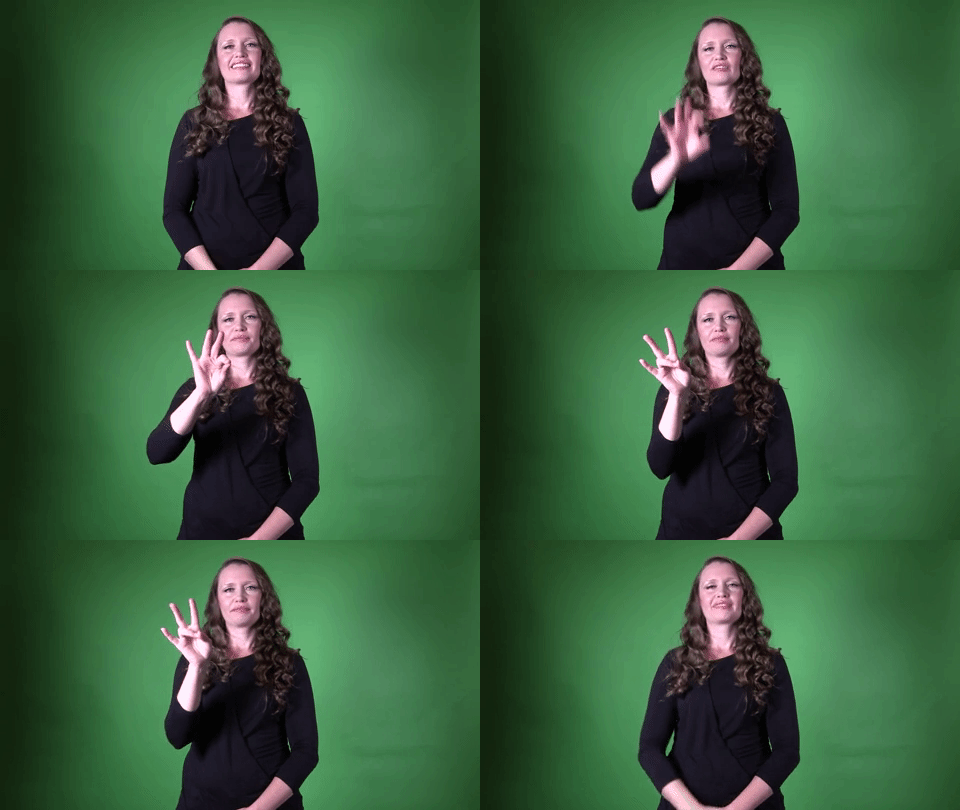
Sign for NUMBER 97 in ASL | 🔢 ASL Dictionary

Definition: Refers to the number ninety-seven

Sign for NUMBER 97 in ASL 

YouTube player

Practice Activities:

Practicing the sign for number 97 in ASL can help reinforce your finger dexterity and number fluency. Start by signing numbers 90 through 99 in sequence, paying close attention to how 97 transitions from the 9 to the 7. Repeat this exercise multiple times using both your dominant and non-dominant hands to improve coordination.

Try signing the number 97 while looking in a mirror to check the accuracy of your handshape and movement. Say the number aloud as you sign it to strengthen the connection between the visual sign and its spoken equivalent. Next, randomly sign numbers between 90 and 99 while mixing in 97 to ensure smooth production among similar numbers.

Incorporate the sign for number 97 in ASL into real-world settings. Practice signing prices such as “97 dollars” or “97 cents” to simulate shopping situations. Try signing sports scores, such as “The team scored 97 points,” to make it more interactive. Challenge yourself by signing today’s date if it includes 97, such as “September 7, 1997,” reinforcing number recognition skills.

For a storytelling activity, create a short narrative that includes the sign for number 97 in ASL. For example, tell a story about someone finding 97 seashells at the beach or having 97 books in their library. This exercise encourages you to use context and helps reinforce number recall within a meaningful structure.

Grab a partner and play a number-guessing game. One person signs a number between 90 and 99, and the other must identify it. Be sure to include 97 frequently to improve speed and accuracy. You can also practice spelling random numbers, including 97, to help enhance comprehension.

Cultural Context:

The sign for NUMBER 97 in ASL is an essential part of American Sign Language, especially in contexts where numbers play a critical role. From everyday conversations to academic settings, numbers help convey vital information. Knowing how to sign numbers correctly enhances communication and ensures clarity in discussions.

The ASL sign for NUMBER 97 combines specific hand movements that follow ASL number rules. This sign follows the pattern used for many two-digit numbers, making it easier to remember. Learning the sign for NUMBER 97 in ASL helps develop fluency in numeric expressions.

Numbers in ASL are crucial for counting, measurements, addresses, and other data-driven conversations. The sign for NUMBER 97 in ASL might be seen in discussions about sports scores, financial transactions, or historical dates. Being able to sign numbers accurately improves comprehension in both casual and formal interactions.

Number signs in ASL have cultural significance, reflecting the language’s unique structure and grammar. The sign for NUMBER 97 follows the rules that govern number formation in ASL, preserving consistency. Mastering these number signs helps signers communicate effectively in everyday life.

The use of numbers in ASL is not limited to math or financial transactions. The sign for NUMBER 97 in ASL is important in various fields, including education, business, and storytelling. Numbers help clarify details, ensuring accurate exchanges of information.

ASL numbers are a fundamental part of signed conversations. Using the sign for NUMBER 97 in ASL correctly demonstrates proficiency and improves overall signing skills. Consistent practice with number signs enhances confidence in using ASL in different situations.

In Deaf culture, accuracy in signing numbers is essential for clear communication. The sign for NUMBER 97 in ASL follows the natural flow of ASL number signs, making it intuitive for regular signers. Developing strong number-signing skills fosters better interactions in the Deaf and signing communities.

Learning numbers in ASL requires understanding handshapes, orientation, and movement. The sign for NUMBER 97 in ASL fits within the logical structure of ASL numbering, making it easier to recognize patterns. Once mastered, signing numbers becomes second nature in conversations.

The ability to sign numbers efficiently allows for seamless communication. The sign for NUMBER 97 in ASL is one of many key number signs that help bridge communication gaps. Practicing regularly leads to better retention and smoother conversations.

Using numbers correctly in ASL strengthens communication in various settings. The sign for NUMBER 97 in ASL is often used in everyday discussions, helping

Extended Definition:

The sign for number 97 in ASL is a manual representation of the number using American Sign Language. It follows the common pattern for signing double-digit numbers in ASL, incorporating handshape transitions. Knowing how to sign numbers correctly is important for clear communication in ASL.

To sign for number 97 in ASL, start with the handshape for the number 9 and smoothly transition to the handshape for 7. The movement should be fluid, without unnecessary pauses, to maintain natural ASL flow. Proper hand positioning and finger placement are essential to make the sign easily recognizable.

ASL numbers play a crucial role in everyday conversations, from giving addresses to stating ages and discussing quantities. The sign for number 97 in ASL is part of a broader numerical system that follows specific linguistic rules. Consistent practice with ASL numbers improves fluency and comprehension.

Different regions or signers may introduce variations in signing numbers, but the standard method remains widely understood. When learning the sign for number 97 in ASL, observe native signers or use reliable ASL dictionaries for accuracy. Watching video demonstrations can help reinforce proper hand movements.

Numbers in ASL require consistency in hand orientation and movement to avoid misinterpretation. When signing number 97, both handshape transitions should be executed smoothly for clarity. Practicing with a partner or in front of a mirror can help refine the sign.

Using ASL numbers correctly helps ensure effective communication in both casual and formal conversations. The sign for number 97 in ASL is commonly used in counting, numbering lists, and referring to dates or statistics. Mastering ASL numbers enhances overall signing proficiency.

For beginner signers, it’s helpful to start with single-digit numbers before progressing to double-digit numbers like 97. Understanding how number signs are structured makes larger numbers easier to grasp. The sign for number 97 in ASL follows a logical progression based on ASL numerical patterns.

Numbers in ASL often require slight wrist movements, but excessive motion can make signing unclear. Focusing on precision and minimizing unnecessary motion ensures that the sign for number 97 in ASL remains distinct. Watching fluent ASL users sign helps develop better control over movements.

American Sign Language has a unique structure that differs from spoken English, including how numbers are integrated. Learning how to sign number 97 in ASL contributes to overall signing accuracy. Using ASL numbers correctly adds to more natural and understandable conversations.

Understanding the

Synonyms: ninety-seven, number ninety-seven, number 97, the number 97, the number ninety-seven

Educational resources: Find related learning materials in our course bank!

Want more? Check out some of our popular learning activities on the homepage!

Need to look up a sign? Use our highly rated dictionary: https://aslinteractive.com/best-asl-dictionary/

Follow us on tiktok: https://www.tiktok.com/@aslinteractive. More social media links at the bottom of this page!

Long-tail Keywords: what is the sign for number 97 in ASL, how do you sign number 97 in American Sign Language, ASL sign for number 97

Categories: Numbers – Basics, Numbers 91-100, cardinal numbers

tags: Numbers, Numbers 91-100, Math, Language Learning, Educational Content, 96 97 98 rocking numbers, rocking numbers

Parameters

*Handshape*:

The sign for NUMBER 97 in ASL uses a shifting handshape that starts with the “9” hand, where the thumb and index finger form an open circle while the other three fingers extend upward. Then, it transitions to the “7” hand, in which the thumb touches the ring finger while the other fingers remain extended. This movement fluidly represents the number, maintaining clear visibility for effective communication.

When signing the sign for NUMBER 97 in ASL, ensure a smooth shift between the two handshapes. The motion is typically performed with the dominant hand, keeping a natural wrist movement to maintain clarity. This sign is part of the standard ASL numbering system, which relies on distinct finger configurations to convey numerical values accurately.

*Palm Orientation*:

The palm orientation for the sign for NUMBER 97 in ASL starts with the palm facing outward. As the hand moves, the orientation shifts slightly depending on the formation of the numbers within the sign. The motion involves transitioning between the number 9 and the number 7, which requires subtle changes in finger placement while maintaining a clear numerical distinction. Proper palm orientation ensures clarity when conveying the sign for NUMBER 97 in ASL.

*Location*:

The sign for number 97 in ASL is located in front of the dominant side of the body, typically at chest level. The hand starts in a palm-out position, forming the number 9 with the thumb and index finger touching while the other fingers extend. Then, the hand smoothly transitions to the number 7 by bringing the thumb and ring finger together while slightly twisting the wrist.

*Movement*:

To produce the sign for number 97 in ASL, begin by forming the number 9 with your dominant hand—touch the tip of your thumb to the tip of your index finger while the other fingers remain extended. Then, smoothly transition into the number 7 by extending the index and middle fingers while the ring finger touches the thumb. The movement should be fluid, as if rolling from 9 to 7 without pausing.

*Non-Manual Signals*:

When signing the sign for number 97 in ASL, maintain a neutral or slightly focused facial expression. Your eyebrows should remain relaxed since this is a numerical sign rather than a question or an emotional expression. Slight head movement can accompany the transition between digits, reinforcing clarity. Eye contact with the listener helps ensure accuracy, especially when signing multi-digit numbers. Keep your mouth neutral or slightly mouthing “ninety-seven” to support comprehension.

*Prosody, Dominant/Non-Dominant Hand*:

The sign for number 97 in ASL uses the dominant hand, forming a loose “9” handshape with the thumb and index finger extended while the remaining fingers are slightly curved. The wrist rotates slightly outward to transition from “9” to “7,” where the thumb touches the ring finger. This movement is fluid and natural, reflecting standard number formation in ASL. The non-dominant hand is not typically used in this sign. ️

Tips for Beginners:

When learning the sign for NUMBER 97 in ASL, focus on the smooth transition between the two digits. Start by forming the number 9 with your dominant hand, then effortlessly shift to the number 7. Ensure that your fingertips maintain clarity in shape to prevent confusion with similar numbers like 87 or 67.

Consistent hand positioning is vital for the sign for NUMBER 97 in ASL. Keep your palm facing forward or slightly to the side, depending on your signing style. Avoid twisting your wrist excessively, as this can make the transition between numbers less fluid. Practice in front of a mirror to monitor hand shape and ensure accuracy.

One common mistake beginners make is rushing the number transition. To avoid this, slow down and practice switching from 9 to 7 smoothly. Keep your fingers relaxed but precise, ensuring each number is clearly formed before moving to the next. Pay attention to finger placement to avoid accidental errors.

Finger dexterity plays a crucial role in fluent number signing. If you struggle with the sign for NUMBER 97 in ASL, try strengthening your fingers with simple exercises like finger stretches or number drills. Practicing different number combinations can also help build signing confidence.

When signing among others, maintain eye contact and use proper facial expressions. Numbers should be clear and visible to your audience, so make sure your hand is raised at chest or shoulder level. If unsure of your accuracy, ask a fluent signer or use online video resources for reference.

Repetition is key to mastering number signs. Incorporate the sign for NUMBER 97 in ASL into your daily practice to build muscle memory. The more you practice, the more natural and automatic your signing will become.

Connections to Other topics:

The sign for NUMBER 97 in ASL follows the numerical pattern used for expressing non-round two-digit numbers. It involves a combination of the handshape transitions for 9 and 7, which are commonly used in counting, dates, and identifiers like addresses or sports jerseys. This sign belongs to a larger system of number signs that include ordinal numbers, cardinal numbers, and number incorporation into other signs such as age and time.

Numbers like the sign for NUMBER 97 in ASL are vital for describing years, prices, and measurements. Since ASL relies on number signs for a range of topics, understanding numerical patterns helps when signing concepts like “97th” or “year 1997.” The same numerical pattern applies when signing decades or phone numbers, where a signer might break down digits for clarity.

Beyond standalone counting, number signs often incorporate into age-related signs like AGE-97, where the number integrates with the AGE sign. This form of number integration also appears in time expressions such as “97 minutes” or “97 dollars,” making number fluency essential for everyday ASL use. Numbers can even fuse into classifier structures for describing objects, amounts, or ranking positions.

Ordinal numbers such as “97th place” involve a slight modification to the basic sign for NUMBER 97 in ASL by incorporating a twisting motion that distinguishes it from the cardinal form. This is useful in contexts such as competitions, academic rankings, or event sequencing. Counting high numbers is also essential for finances, with cost listings, salaries, or financial negotiations often involving multi-digit figures.

Understanding the sign for NUMBER 97 in ASL reinforces the importance of numerical literacy in ASL communication. Many conversations require numbers for accuracy, from listing statistics to discussing historical years. Recognizing number handshape transitions improves fluency, ensuring that communication remains clear and precise in a variety of everyday contexts.

Summary:

The sign for number 97 in ASL follows the typical numbering pattern found within American Sign Language. It is formed using the dominant hand with the palm facing outward, transitioning from the number 9 to the number 7 in a fluid motion. This movement showcases the consistency of ASL number signs, which often rely on numerical handshapes and a slight rocking or twisting motion for differentiation.

Numbers in American Sign Language have specific structures that dictate their proper usage. The sign for number 97 in ASL maintains a rhythmic flow that aligns with other two-digit numbers in the 90s range. Understanding this structure helps signers quickly recognize and distinguish numbers without confusion.

The sequential movement of the sign for number 97 in ASL allows for rapid number visualization. ASL numbers above 10 generally incorporate small wrist movements to prevent misinterpretation. This fluid motion creates a visual distinction between numbers and enhances clarity in conversation.

The numbering system in ASL is visually intuitive, making numerical expressions efficient. The sign for number 97 in ASL follows the decimal structure commonly used in counting, dates, and addresses. Recognizing number patterns helps learners grasp larger numerical values seamlessly.

When signing the number 97, handshape consistency remains essential for clear communication. A relaxed but firm hand helps maintain proper finger positioning while transitioning from 9 to 7. Inaccurate finger placements may result in incorrect numbers being conveyed.

The sign for number 97 in ASL can appear in various mathematical and everyday contexts. It is often used for financial transactions, measurements, and statistics. Signers frequently incorporate numbers into conversation, making accuracy an important component of fluency.

In educational settings, number signs are fundamental in learning mathematics. The sign for number 97 in ASL plays a role in arithmetic discussions, percentages, and data representation. Mastering number signs enables Deaf students to engage in complex problem-solving tasks.

Cultural and regional variations sometimes influence the execution of signed numbers. While the sign for number 97 in ASL is widely recognized within the Deaf community in the United States, slight differences may occur in international sign languages. These variations highlight the diversity of visual linguistic expression.

Finger dexterity plays a significant role in effectively signing numerical values. The sign for number 97 in ASL requires smooth articulation to ensure clarity. Maintaining proper hand positioning enhances comprehension and prevents misinterpretation.

ASL grammar incorporates number signs naturally within sentence structures. The sign for number 97 in ASL may appear in phrases such as age, prices, or countdowns. Proper integration of numbers ensures smooth and coherent communication.

The efficiency of number signs in ASL reflects the language’s emphasis on visual space. The sign for number 97 in ASL demonstrates how well ASL conveys numerical concepts through consistent handshapes. This visual approach allows signers to communicate complex numerical details effectively.

In conversations about historical years or sports statistics, numerical signs become essential. The sign for number 97 in ASL is necessary when discussing notable events from the year 1997. Proper numerical usage enhances storytelling and historical references in ASL discourse.

Mathematical flexibility within ASL allows numbers to be expressed in different contexts. The sign for number 97 in ASL may be involved in equations, financial discussions, and other numeral-based exchanges. This adaptability allows ASL users to seamlessly integrate numerical data into conversation.

Speed and fluidity are essential for clear numerical communication. The sign for number 97 in ASL should maintain a natural pace to ensure clarity. Over-exaggeration or hesitation may lead to misunderstandings in signed conversations.

Expressiveness in ASL extends beyond words to include numbers. The sign for number 97 in ASL, like other numeric signs, contributes to the rich linguistic landscape of sign language. Emphasizing precision helps maintain sign integrity and prevents miscommunication.

ASL’s visual principles emphasize clarity and comprehensibility. The sign for number 97 in ASL adheres to these principles by maintaining a distinct handshape sequence. This visual consistency makes ASL numbers universally recognizable among signers.

Numbers are vital for conveying detailed information in ASL. The sign for number 97 in ASL supports various real-world applications, from listing quantities to confirming numerical accuracy. Understanding numerical placement enhances ASL fluency.

Numerical gestures in ASL demonstrate the efficiency of visual communication. The sign for number 97 in ASL, like other numeric gestures, embodies the language’s structured approach to counting and mathematics. This structured numerical representation simplifies complex numerical interactions.

In business and commerce, numerical accuracy is crucial. The sign for number 97 in ASL appears in contexts involving prices, transactions, and financial documentation. Fluency in numerical signs ensures effective communication in economic discussions.

The efficiency of signed numbers contributes to the overall expressiveness of ASL. The sign for number 97 in ASL visually represents quantitative values while maintaining ASL

Want more? Check out some of our popular learning activities!

ASL Interactive Resources

ASLInteractive YouTube Channel

Follow us on tiktok: @aslinteractive.com

Follow us on Instagram: aslinteractive

Facebook page: aslinteractive

Facebook group: aslinteractive

LInkedIn: ASL Interactive LLC

Twitter: @ASL_interactive

*Some information on this page is AI-generated. AI can make mistakes. Please check the information.

Sign for 97 in ASL, Sign for NINETY-SEVEN in ASL, Sign for NUMBER NINETY-SEVEN in ASL, Sign for THE NUMBER NINETY-SEVEN in ASL, Sign for THE NUMBER 97 in ASL, Sign for NUMBER 97 in ASL 

Responses