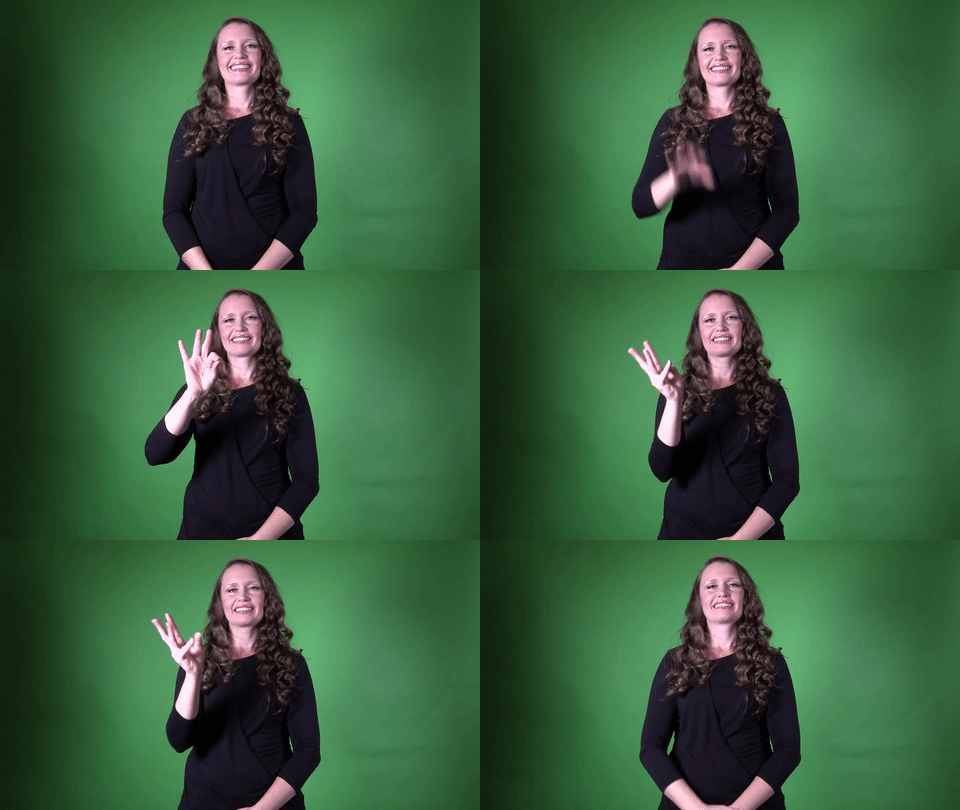
Sign for NUMBER NINETY-SIX in ASL | 🔢 ASL Dictionary

Definition: Refers to the number ninety-six

Sign for NUMBER NINETY-SIX in ASL 

YouTube player

Practice Activities:

Practicing the sign for number ninety-six in ASL starts with building comfort in forming the handshape correctly. Repeatedly sign the number while looking in a mirror to ensure accuracy. Try signing it slowly at first, then gradually increasing speed while maintaining clear movements.

Use number sequencing exercises to reinforce the sign. Count up from ninety-one to ninety-six and then back down. Mix it into a random number drill where you sign various numbers between one and one hundred to practice recognition.

Incorporate the sign for number ninety-six in ASL into real-life sentences. Try signing phrases like “There are ninety-six students in the class” or “I scored ninety-six on the test.” Challenge yourself by signing these sentences at different speeds.

Partner practice can be helpful. One person signs a number, and the other identifies it. Then, switch roles. Another option is using flashcards with numbers written on them, drawing a card, and signing the corresponding number quickly.

For a fun storytelling challenge, create a short narrative that includes the sign for number ninety-six in ASL. For example, “I saw ninety-six birds flying over the park” or “Ninety-six people attended the concert.” Sign your story to a friend or record it to check for accuracy.

Play number-based games, like bingo or number matching, to use the sign in a casual setting. Watching ASL videos that include large numbers can also improve recognition skills. Keep practicing regularly to build confidence with the sign in different contexts.

Cultural Context:

The sign for number ninety-six in ASL is part of the numerical system used in American Sign Language. Numbers play a crucial role in communication, from counting and math to expressing personal information like ages and addresses. The sign for number ninety-six in ASL follows the same pattern as other double-digit numbers, utilizing the dominant hand in a fluid motion.

Understanding the sign for number ninety-six in ASL helps in discussing topics that involve specific numbers, such as dates, measurements, and statistics. In Deaf culture, numbers are essential for storytelling, sports scores, and financial transactions. Mastering numbers like the sign for number ninety-six in ASL allows for clearer and more effective communication.

Numbers in ASL are often incorporated into everyday interactions, such as sharing phone numbers, money amounts, and game scores. The sign for number ninety-six in ASL is visually distinct, making it easy to recognize in conversation. Learning this sign contributes to fluency and helps build confidence in using ASL in various situations.

In educational settings, students learn the sign for number ninety-six in ASL as part of broader lessons on numbers and counting. Math concepts are taught using fingerspelling and number signs, reinforcing visual learning strategies. Deaf education emphasizes numerical fluency because numbers are crucial in academic success and daily life.

Using the sign for number ninety-six in ASL correctly ensures smooth interactions in meetings, classrooms, and social gatherings. Precision in signing numbers reduces misunderstandings and improves the flow of conversation. Becoming proficient in number signs enhances communication skills and supports meaningful dialogue in the Deaf community.

Technology and digital communication have made numerical accuracy even more important. The sign for number ninety-six in ASL is useful in video calls, recorded messages, and virtual learning environments. Accurate number signing helps bridge communication gaps in both personal and professional settings.

Cultural awareness is key when using numbers in ASL, as certain numbers carry cultural significance. While the sign for number ninety-six in ASL is primarily neutral, numbers can have meanings related to history, traditions, or superstitions. Understanding these cultural elements deepens appreciation for ASL and its expressive capabilities.

Mastering the sign for number ninety-six in ASL, along with other numbers, builds confidence in using ASL fluently. Numbers are a foundational part of language development, and consistent practice improves signing speed and clarity. A strong grasp of numerical signs makes interactions smoother and more engaging.

Extended Definition:

The sign for number ninety-six in ASL is formed using two distinct handshapes that transition smoothly from one to the other. The movement and positioning of the fingers reflect the numerical structure of 96, following ASL’s unique approach to expressing numbers visually. Mastering this sign helps improve fluency and ensures clarity when discussing numbers in conversation.

When signing the number ninety-six in ASL, start with the number nine handshape, where the index finger and thumb form a circle while the other fingers remain extended. Then transition to the six handshape by switching the circle to the pinky and thumb while the other fingers stay raised. The movement should be fluid, making the change seamless to maintain the rhythm of numerical sequences.

Numbers play a crucial role in ASL, appearing in various contexts like counting, time, measurements, and addresses. The sign for number ninety-six in ASL is particularly useful when discussing prices, statistics, or referencing years. Practicing number sequences helps strengthen signing skills and improves accuracy in everyday conversations.

Facial expressions and hand positioning add clarity when signing numbers in ASL. Slight variations in speed and emphasis can help distinguish numbers, especially in fast-paced dialogue. Keeping the palm orientation consistent ensures the sign remains recognizable to fellow signers.

American Sign Language follows a logical structure for numbers, making it easy to learn patterns like ninety-six. Familiarity with numerical signs boosts confidence in communication, whether signing age, quantities, or mathematical concepts. Consistent practice helps reinforce memory and builds automaticity when signing numbers.

The sign for number ninety-six in ASL is part of the number system used by deaf and hard-of-hearing individuals across North America. Understanding number signs contributes to effective bilingual communication for ASL users and those learning the language. Whether in educational settings, social interactions, or professional environments, signing numbers accurately enhances comprehension.

Using the correct handshape for the number ninety-six in ASL ensures clear and accurate communication. Watching experienced signers and practicing with videos can help beginners master this number’s transition smoothly. Learning ASL numbers strengthens overall proficiency and supports deeper engagement with the language.

Teaching children the sign for number ninety-six in ASL can help them build early numeracy skills while learning a new language. For adults, mastering number signs is useful for work, shopping, and general conversations. Incorporating ASL numbers into daily interactions promotes inclusivity and accessibility.

Numerical signs like ninety-six are essential for deaf culture and communication,

Synonyms: ninety-six, number ninety-six, number 96, the number 96, the number ninety-six

Educational resources: Find related learning materials in our course bank!

Want more? Check out some of our popular learning activities on the homepage!

Need to look up a sign? Use our highly rated dictionary: https://aslinteractive.com/best-asl-dictionary/

Follow us on tiktok: https://www.tiktok.com/@aslinteractive. More social media links at the bottom of this page!

Long-tail Keywords: what is the sign for number ninety-six in ASL, how to sign number ninety-six in American Sign Language, how do you sign number ninety-six in ASL

Categories: Numbers – Basics, Numbers 91-100, cardinal numbers

tags: Numbers, Numbers 91-100, Math, Language Learning, Educational Content, 96 97 98 rocking numbers, rocking numbers

Parameters

*Handshape*:

The sign for NUMBER NINETY-SIX in ASL uses a shifting handshape to represent the numerical value. Begin with the “9” handshape, where the index finger and thumb form a small circle while the remaining three fingers extend upward. Then, smoothly transition into the “6” handshape by touching the pinky and thumb together while the other fingers remain extended. This movement clearly differentiates the two numbers in the sign for NUMBER NINETY-SIX in ASL.

*Palm Orientation*:

The palm orientation for the sign for NUMBER NINETY-SIX in ASL starts with the palm facing outward. The fingers form the shape of the number nine and then smoothly transition into the number six. Throughout the movement, the palm remains generally forward, ensuring clarity in the sign for NUMBER NINETY-SIX in ASL. There should be a fluid, controlled motion between the numbers to maintain accuracy and readability.

*Location*:

The sign for number ninety-six in ASL is produced in the neutral space in front of the body. The dominant hand forms the number nine with the palm facing outward, then smoothly transitions into the number six. This movement happens at chest level, maintaining a steady handshape change. The signing area stays close to the center of the signer’s body, ensuring clear visibility.

*Movement*:

To make the sign for number ninety-six in ASL, begin with the number nine handshape, where the thumb touches the index fingertip while the other fingers remain extended. Then smoothly transition into the number six handshape by bringing the pinky fingertip to touch the thumb while the remaining fingers stay extended. The movement should be fluid and natural, with a slight wrist rotation as you change from one number to the next.

*Non-Manual Signals*:

When signing the sign for NUMBER NINETY-SIX in ASL, the face should remain neutral or slightly focused, especially in formal contexts. If emphasizing the number for clarity, slightly raise the eyebrows and maintain steady eye contact. A small head nod can reinforce the numerical value. If used in casual conversation, a natural, relaxed facial expression is best. Avoid exaggerated mouth movements unless clarifying or emphasizing the number.

*Prosody, Dominant/Non-Dominant Hand*:

The sign for NUMBER NINETY-SIX in ASL uses the dominant hand in a loose “9” handshape, where the index finger and thumb are extended and curved slightly while the other fingers remain folded. The movement shifts to a “6” handshape by bringing the pinky and thumb together while the other fingers stay folded. The transition between the two numbers is fluid, with a slight wrist rotation, maintaining a controlled and even pace. ✋

Tips for Beginners:

The sign for NUMBER NINETY-SIX in ASL is a combination of the numbers 9 and 6 in a fluid twist of the wrist. This movement should be smooth and natural, transitioning from the 9 handshape to the 6 handshape in a circular motion. Beginners should take their time to practice the wrist rotation to ensure it looks seamless rather than choppy.

A common mistake when signing the number is not fully forming the 9 and 6 handshapes correctly. The 9 is made by touching the tips of the thumb and index finger, while the remaining fingers extend outward. The 6 is done by touching the tip of the pinky to the thumb while extending the other fingers. Make sure your fingers are clearly positioned so the number is not confused with similar-looking digits.

Accuracy in the wrist movement is critical for clarity. If your transition between 9 and 6 is too rigid, it may look unnatural or be misinterpreted. Practicing in front of a mirror or recording yourself can help perfect the fluid motion. Watching fluent signers can also help refine the correct execution of the transition.

Hand positioning is also key. Keep your dominant hand at chest level and ensure that the palm is facing outward while signing. If the palm orientation is incorrect, the number may be misread. If possible, compare your sign with that of a skilled signer to improve accuracy.

Repetition is key to mastering the sign for NUMBER NINETY-SIX in ASL. Consistently practicing the number sequence will improve muscle memory and confidence. Try incorporating it into daily use by counting objects or practicing with a signing partner. With enough repetition and attention to detail, the sign will become second nature.

Connections to Other topics:

The sign for number ninety-six in ASL connects to the larger system of number signs, particularly in how it follows the pattern used for multiples of ten combined with single digits. ASL numbers from ninety to ninety-nine all follow a similar handshape pattern, making it easier for learners to recognize and use them fluently. This consistency helps with understanding number sequences and smoothly transitioning between different numbers in signed communication.

Learning the sign for number ninety-six in ASL also builds a foundation for discussing numerical concepts such as percentages, rankings, and monetary values. For example, numbers in ASL can be used in sports scores, age descriptions, and years when discussing historical events or personal milestones. These applications make numbers a crucial component of ASL fluency in everyday conversations.

Additionally, number incorporation in ASL is relevant when signing phone numbers, addresses, and times, where clarity is key. Understanding numbers like ninety-six helps reinforce the handshapes needed for other numeric signs and enhances precision in signing. The movement and repetition used in number signs can also help develop muscle memory, improving overall dexterity when fingerspelling or signing complex phrases.

ASL number signs, including the sign for number ninety-six in ASL, are closely related to ordinal numbers and classifiers representing numerical quantities. In contexts like education or business, numbers are frequently used to indicate rankings, percentages, or data points. Recognizing patterns in number formation makes it easier to transition to expressing larger numerical values, reinforcing a signer’s ability to convey detailed information effectively.

Summary:

The sign for NUMBER NINETY-SIX in ASL follows a numerical pattern commonly used in American Sign Language. It is part of the series of number signs that incorporate distinct handshapes to show cardinal numbers. This particular sign transitions smoothly between two handshapes to indicate the specific value.

To sign NUMBER NINETY-SIX in ASL, begin by forming the number nine handshape. This means extending the thumb and index finger to touch at the tips, while the remaining fingers stay extended. Next, smoothly transition into the six handshape, where the thumb and pinky finger touch while the other three fingers remain extended.

The motion of transitioning between nine and six is fluid and continuous. This transition emphasizes the base-ten counting system adopted in ASL’s numerical framework. Maintaining a consistent palm orientation—often outward—ensures clarity when signing NUMBER NINETY-SIX in ASL.

Numbers in ASL are integral to communication, appearing in contexts like counting, addresses, pricing, and dates. The sign for NUMBER NINETY-SIX in ASL follows the established structure of two-digit numbers from ninety onward. It reinforces the unique way ASL visually represents quantities.

Linguistically, ASL numbers incorporate aspect markers such as repetition or signing speed, influencing meaning. Fast, sharp transitions may indicate emphasis, while a slower movement may suggest clarification. Such variations contribute to ASL’s expressiveness.

ASL numbering incorporates principles of morphology, with numbers above ten often blending distinct handshapes fluidly. This efficiency in structure makes the sign for NUMBER NINETY-SIX in ASL easily recognizable when signed correctly. Precision in transitions is crucial.

A key characteristic of ASL numbers is their simultaneous morphology, where the movement and shape come together to form meaning. This differs from spoken languages, which rely on sequential phonemes. The concurrent elements create a visually distinct and efficient signing system.

The sign for NUMBER NINETY-SIX in ASL follows an established numerical shift pattern. Understanding this shift can help signers quickly grasp adjacent numbers. Practicing the transitions between high numbers improves fluency in numerical ASL expressions.

Signing clarity is vital, as similar handshapes may cause confusion. The nine and six handshapes have distinct tactile differences in finger positioning. When signing in fast-paced conversations, ensuring accuracy in transitions is essential to avoid misunderstandings.

In educational settings, ASL numbers are often taught with structured drills to develop accuracy. Teachers emphasize finger dexterity to make number signing clear. Learning proper orientation and transition techniques helps build strong signing skills.

Culturally, signed numbers hold importance within Deaf communities, influencing everyday interactions. The sign for NUMBER NINETY-SIX in ASL is used in various real-life applications, including age, financial amounts, and sports statistics. Numbers play a key role in signed storytelling and historical recounting.

Sports events often require rapid numerical communication, where clarity in signing numbers like ninety-six is critical. Referees, coaches, and players use ASL number signs for game scores and statistics. Knowing how to sign numbers correctly ensures effective communication in these settings.

In financial contexts, numerical clarity is crucial when discussing prices, banking, and contracts. The sign for NUMBER NINETY-SIX in ASL may be used when dealing with transactions or salary amounts. Precision in numeric communication helps reduce misunderstandings in professional environments.

Time-telling in ASL uses numerical incorporation, though ninety-six does not directly relate to standard time values. However, in digital age communication, large numbers frequently appear in technology-related discussions. Understanding numerical structures strengthens overall ASL literacy.

The linguistic structure of ASL numbers supports efficient visual accessibility. Signers develop strong recognition patterns for numerical sequences, making comprehension nearly instantaneous. Reinforcing numerical fluency helps signers navigate math-based and everyday conversations smoothly.

Non-manual markers can accompany number signs for emphasis or context. Slight head nods, brow movements, or other expressions may reinforce a number’s significance. These subtle additions clarify meaning beyond simple hand movements.

Comparing ASL numbering to other signed languages reveals variations in number structuring. Different sign languages may use alternate movements or handshapes. While the sign for NUMBER NINETY-SIX in ASL adheres to ASL conventions, its equivalent may differ elsewhere.

In multilingual signing communities, understanding ASL numerical structure can aid cross-communication with other signed languages. The efficiency of ASL number signs makes them adaptable in international signing contexts. Recognizing number patterns helps bridge signing variations.

Technological advancements have increased the need for numerical ASL clarity. With video calls and digital learning, clear number signs like ninety-six ensure accurate virtual communication. Adapting signing style for screen clarity is an emerging trend.

Recognizing common errors in number signing improves accuracy. Some signers may unintentionally reverse handshapes, altering the intended number. Awareness of proper formation prevents

Want more? Check out some of our popular learning activities!

ASL Interactive Resources

ASLInteractive YouTube Channel

Follow us on tiktok: @aslinteractive.com

Follow us on Instagram: aslinteractive

Facebook page: aslinteractive

Facebook group: aslinteractive

LInkedIn: ASL Interactive LLC

Twitter: @ASL_interactive

*Some information on this page is AI-generated. AI can make mistakes. Please check the information.

Sign for 96 in ASL, Sign for NINETY-SIX in ASL, Sign for NINETY-SIX in ASL, Sign for NUMBER NINETY-SIX in ASL 

Responses