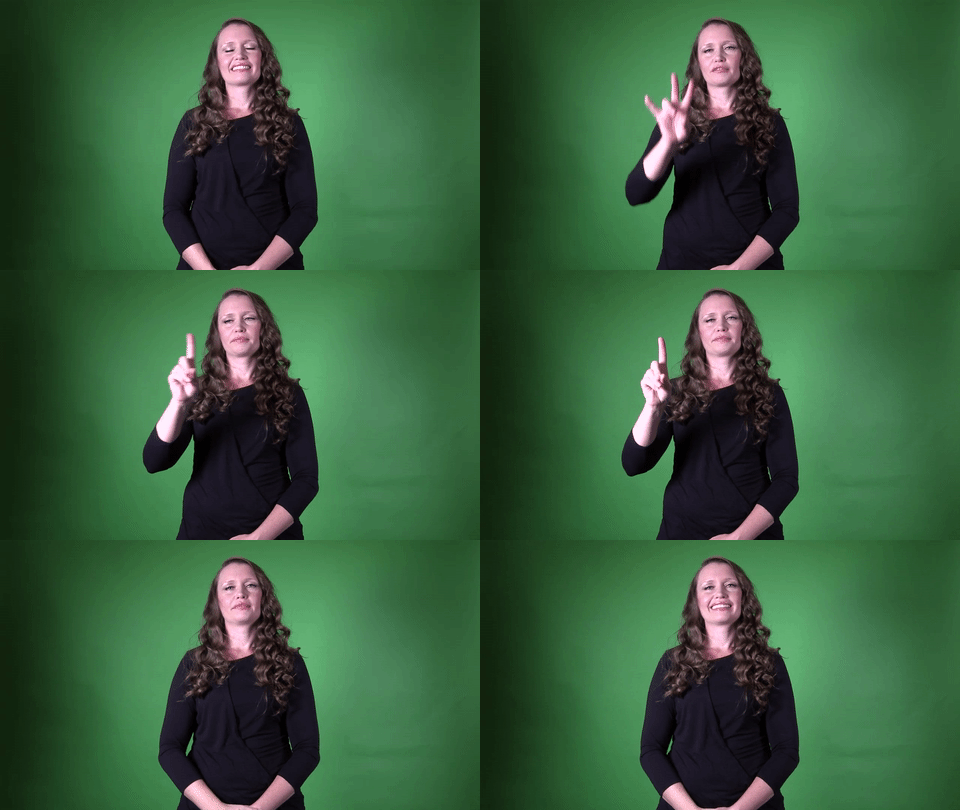
Definition: Refers to the number seventy-one
Sign for NUMBER SEVENTY-ONE in ASL

Practice Activities:
Start by practicing the sign for number seventy-one in ASL in isolation. Hold your dominant hand in a neutral position, then smoothly transition from the number seven to the number one. Repeat this movement multiple times to build muscle memory. Try signing it at different speeds while maintaining accuracy.
Use the sign for number seventy-one in ASL within a sequence. Count from sixty-five to seventy-five, making sure to pause slightly on seventy-one. Then, try counting backward from eighty to seventy, inserting seventy-one naturally. This helps reinforce the number’s placement in a broader context.
Practice recognizing the sign for number seventy-one in ASL by watching a partner or a video and identifying when it appears. You can also practice receptive skills by having a friend sign different numbers while you write them down. Reverse the roles and test each other’s comprehension.
Incorporate the sign into a sentence. For example, sign “My grandmother is seventy-one years old” or “There are seventy-one students in my school.” Practice signing these phrases smoothly without hesitation. Try adding facial expressions to enhance the sentence’s meaning.
Create a mini-story using the sign for number seventy-one in ASL. Imagine talking about a seventy-one-year-old person who loves adventure, a book with seventy-one pages, or a competition where someone finishes in seventy-first place. Tell the story with facial expressions and extra details to make it engaging.
Play a number guessing game with a partner. One person signs a number between seventy and eighty while the other guesses what it is. If they get it right, switch roles. This game builds both expressive and receptive skills using the sign.
Use the sign for number seventy-one in ASL when discussing dates, addresses, or quantities in everyday conversation. Try incorporating it when talking about history, sports scores, or percentages. Making it part of natural conversation helps solidify your learning.
Cultural Context:
The sign for number seventy-one in ASL is an important part of counting in American Sign Language. Numbers play a crucial role in daily communication, whether you are discussing prices, addresses, or quantities. Understanding the sign for number seventy-one in ASL helps improve fluency and ensures clear communication.
In Deaf culture, using numbers correctly is essential for conversations about time, dates, and measurements. The sign for number seventy-one in ASL follows the unique patterns of ASL number signs, which may differ from English numerical concepts. Learning ASL numbers helps users navigate both casual and formal settings with ease.
Many ASL numbers, including the sign for number seventy-one in ASL, involve specific handshapes and movements. These signs are consistent across the Deaf community, allowing for universal understanding. Mastering these number signs is key to effective communication in ASL.
The sign for number seventy-one in ASL can be easily learned with practice and repetition. Many ASL learners focus on number signs early in their studies to build confidence. Flawless number signing helps avoid miscommunication, especially in important discussions.
ASL relies on visual and spatial language, and numbers, including the sign for number seventy-one in ASL, are structured to be both efficient and expressive. Precision in number signs ensures that concepts such as addresses, prices, and statistics are conveyed accurately. Proper use of number signs reflects fluency and respect for Deaf culture.
When using the sign for number seventy-one in ASL, it’s important to follow ASL grammatical rules. Unlike spoken language, ASL incorporates facial expressions and context along with hand movements. This ensures that numbers are clearly understood in various situations.
The history of ASL numbers, including the sign for number seventy-one in ASL, traces back to early sign language development. Over time, ASL has evolved, incorporating standardized number signs widely recognized today. Learning the history of ASL numbers helps add depth to language comprehension.
ASL number signs, including the sign for number seventy-one in ASL, are often used in education and business. Teachers, interpreters, and students frequently use number signs for lessons, meetings, and presentations. Mastering numbers enhances overall ASL proficiency.
Technology has made learning the sign for number seventy-one in ASL more accessible. Video tutorials, apps, and online resources help learners perfect their number signs. Engaging with native ASL users also improves accuracy and fluency.
Using the sign for number seventy-one in ASL correctly demonstrates respect
Extended Definition:
The sign for number seventy-one in ASL is a combination of movements that represent the numerals seven and one. American Sign Language uses a unique way to express numbers, relying on handshape, movement, and palm orientation. Learning how to correctly form this number ensures clear and effective communication.
To sign number seventy-one in ASL, start with the handshape for seven. Your palm faces outward, and the thumb touches the ring finger. Then transition to the handshape for one by extending the index finger while keeping the rest of the fingers folded.
Hand movement and orientation matter when signing correctly. Some variations may exist based on regional usage, but the core structure remains the same. Consistency in hand placement helps avoid confusion when signing numbers in conversation.
Numbers in ASL are often signed in sequence for clarity. The sign for number seventy-one in ASL follows the standard numbering system used in everyday communication. Knowing how to sign both individual digits and full numbers helps improve fluency.
Number signs are useful in many contexts, from discussing prices to giving addresses or counting. The sign for number seventy-one in ASL may be used in classrooms, business settings, or casual conversations. Mastering numerical signs allows for smoother interactions in both formal and informal situations.
Practicing the sign in a mirror or with a language partner helps reinforce proper formation. Watching fluent signers can also improve accuracy. Repetition ensures that the transition between seven and one is smooth and natural.
Like all numbers in American Sign Language, this sign follows a pattern that simplifies counting. The sign for number seventy-one in ASL fits into a logical system used throughout the language. Once learned, it becomes second nature in regular conversation.
Using ASL numbers correctly helps avoid miscommunication. Clear signing ensures that others understand the intended number without confusion. Proper handshape and movement make numerical signs easier to recognize in different contexts.
For those learning ASL, mastering numbers is an essential step. The sign for number seventy-one in ASL is just one of many important number signs to know. Expanding sign language vocabulary helps improve overall proficiency and confidence in signing.
Synonyms: seventy-one, number seventy-one, number 71, the number 71, the number seventy-one
Educational resources: Find related learning materials in our course bank!
Want more? Check out some of our popular learning activities on the homepage!
Need to look up a sign? Use our highly rated dictionary: https://aslinteractive.com/best-asl-dictionary/
Follow us on tiktok: https://www.tiktok.com/@aslinteractive. More social media links at the bottom of this page!
Long-tail Keywords: what is the sign for number seventy-one in ASL, how do you sign number seventy-one in ASL, learn number seventy-one in American Sign Language
Categories: Numbers – Basics, Numbers 71-80, cardinal numbers
tags: Numbers 71-75, Numbers, Language Learning, Mathematics, Education
Parameters
*Handshape*:
The sign for NUMBER SEVENTY-ONE in ASL uses a shifting handshape. The dominant hand starts in a “7” handshape, with the thumb and ring finger touching while the index, middle, and pinky fingers remain extended. Then, the hand smoothly transitions to a “1” handshape by straightening the index finger and folding in the remaining fingers.
The movement is fluid, ensuring a natural transition between numbers. The palm orientation typically faces outward, maintaining clarity in the sign. This handshape change is essential in the sign for NUMBER SEVENTY-ONE in ASL, providing an efficient way to represent the number visually.
*Palm Orientation*:
The palm orientation for the sign for number seventy-one in ASL starts with the palm facing outward . The fingers transition from forming a “7” shape to a “1” with a smooth motion, maintaining consistent palm orientation. This ensures clarity and maintains the natural flow of the number sequence in ASL. Keep the movement controlled, allowing the hand to remain steady while signing the sign for number seventy-one in ASL.
*Location*:
The sign for number seventy-one in ASL is produced in the neutral signing space in front of the chest. The dominant hand forms the number seven, with the thumb and ring finger touching, then transitions smoothly into the number one by extending the index finger while the other fingers fold down. The movement is typically fluid, ensuring a natural numerical transition. Hand placement stays within a comfortable range for clear visibility.
*Movement*:
To make the sign for number seventy-one in ASL, begin with the number seven by extending the index and middle fingers while keeping the ring and pinky fingers folded down, with the thumb touching the ring finger. Then, transition smoothly into the number one by retracting the middle finger, leaving only the index finger extended. This movement should be fluid, with the hand remaining in a neutral space in front of the body.
*Non-Manual Signals*:
When signing the sign for number seventy-one in ASL, maintain a neutral or slightly attentive facial expression. If emphasizing or clarifying the number, slightly raise your eyebrows and lean forward. Keep your eyes focused on the hand movement to ensure clarity. Avoid exaggerated mouth movements; instead, keep the lips relaxed or slightly parted as you articulate the number naturally. Maintain steady eye contact when signing the sign for number seventy-one in ASL to enhance communication.
*Prosody, Dominant/Non-Dominant Hand*:
The sign for NUMBER SEVENTY-ONE in ASL is produced using the dominant hand, forming the number “7” with the index and middle fingers extended while the ring and pinky fingers remain folded. The thumb touches the tip of the ring finger. The hand then smoothly transitions into the number “1” by retracting the middle finger and extending only the index finger. This movement should be fluid and natural, with fingers changing position in a single motion. ✋
Tips for Beginners:
When learning the sign for number seventy-one in ASL, focus on maintaining a smooth transition between the two digits. This sign is part of the number system in ASL, which often follows a consistent pattern for numbers in the 70s. Keep your hand steady and clearly form the digits 7 and 1 in sequence to ensure accuracy.
A common mistake beginners make when signing the number seventy-one in ASL is rushing the movement, which can make the numbers unclear. Take your time forming the number 7 correctly with the index and middle fingers extended and the thumb contacting the ring finger. Then smoothly transition to the number 1 with only the index finger extended.
Accuracy in handshape is essential. Ensure that your fingers are properly positioned and not curling or shifting during the transition. Practicing in front of a mirror can help strengthen muscle memory, making the sign for number seventy-one in ASL more natural over time.
Finger movement must be fluid but distinct. Avoid jerky transitions, which can make the numbers difficult to recognize. Watching native signers or using video resources can refine your understanding of how the sign for number seventy-one in ASL should look and feel in real conversations.
Context is also important. Depending on the situation, number signs may be incorporated into larger sentences or concepts. Repeating the motions multiple times at a comfortable speed will improve clarity and confidence in using the sign for number seventy-one in ASL.
Connections to Other topics:
The sign for number seventy-one in ASL connects to larger number patterns in American Sign Language. ASL follows a consistent structure for signing numbers, especially in the 60s, 70s, 80s, and 90s, where the transition between digits follows a similar movement pattern. Learning the sign for number seventy-one in ASL can make it easier to recognize and understand related numbers, such as seventy-two or seventy-three, because they follow the same rhythm of movement.
This sign also relates to number incorporation in ASL, where numbers are embedded into certain signs for efficiency. For example, in concepts like age or ranking, numbers are often integrated into movements rather than signed separately. Mastering the sign for number seventy-one in ASL helps reinforce this numerical fluency, making it easier to understand larger numerical systems in ASL.
Ordinal numbers connect to cardinal numbers in ASL, meaning numbers like seventy-first would follow a slightly modified movement to indicate an order rather than a quantity. This adjustment demonstrates how numbers in ASL are adaptable, emphasizing contextual meaning. Learning these variations can help signers communicate effectively in real-world scenarios, such as listing numbers in a sequence or referencing numbered locations.
Additionally, numbers are often paired with classifiers or quantifiers in ASL, making numerical signs critical in describing groups and amounts. The sign for number seventy-one in ASL can be used when discussing large statistics, money, or group counts. Recognizing how numbers integrate into different aspects of ASL enhances comprehension and overall fluency in both casual and formal ASL conversations.
Summary:
The sign for number seventy-one in ASL follows the standard numbering system used for compound numbers in American Sign Language. It is formed by transitioning smoothly from the number seven to the number one in a single fluid motion. This transition helps maintain clarity and efficiency in visual communication.
When performing the sign for number seventy-one in ASL, the dominant hand is used. The number seven is signed first, with the palm facing outward and the ring finger and thumb touching. Without pausing, the hand shifts to form a one, extending only the index finger while the other fingers close into a fist.
The sign for number seventy-one in ASL emphasizes fluidity, as choppy or segmented motion could reduce comprehension. A clear, continuous movement ensures that the handshape transition is natural. This maintains visual intelligibility, helping the sign blend seamlessly within signed discourse.
Numbers in ASL reflect an organized numerical system, incorporating base-ten principles while maintaining visually distinct movements. The sign for number seventy-one in ASL fits into this system, adhering to expected patterns for number sequences. Consistency in number formation aids both new learners and experienced signers in understanding numerical concepts.
Like other two-digit numbers in ASL, seventy-one relies on a strong understanding of handshapes. Since ASL is a visual-spatial language, signs like seventy-one must be precise to prevent confusion with similar numbers. Slight handshape errors could lead to misunderstandings, especially when discussing quantities, addresses, or statistics.
The structure of the sign for number seventy-one in ASL showcases the efficiency of ASL’s numerical system. Rather than adding extra gestures, ASL numbers prioritize simplicity and natural transition. This ensures that signers can communicate sequences quickly without unnecessary complexity.
Numbers in ASL also have variations depending on context, including casual and formal signing styles. In some rapid conversations, numbers may be signed with slight modifications for simplicity. The sign for number seventy-one in ASL retains its core shape but may be executed with varied slanting or speed according to the signer’s preference.
ASL numbers often follow a rhythmic pattern when counting. Seventy-one follows this expected rhythm, ensuring that signed numbers remain easily recognizable. This particularly benefits interpreters, educators, and professionals who use numerical data frequently.
Classifiers in ASL often work alongside numbers to describe various concepts. The sign for number seventy-one in ASL can be paired with classifiers to specify objects, quantities, or locations. This approach expands the expressiveness of ASL, allowing signers to convey detailed numerical information.
The sign for number seventy-one in ASL is important in educational settings where numbers are frequently taught and reinforced. ASL students begin by learning foundational numbers before advancing to multi-digit sequences. Mastering seventy-one strengthens numerical literacy in sign language users.
ASL number signs have historical roots, evolving with language development over time. The distinct movement for seventy-one reflects ASL’s structured approach to numbers. This progression highlights the natural linguistic growth of signed communication over generations.
Numerical fluency in ASL is crucial for various real-world applications, from banking to everyday transactions. The sign for number seventy-one in ASL is used in contexts such as counting money, identifying years, and expressing quantities. This reinforces the practical necessity of learning ASL numbers accurately.
Numbers in ASL also play a role in cultural and linguistic studies, as they differ from spoken language numerals. The arrangement of ASL’s numerical system sheds light on how signed languages encode mathematical ideas. Understanding the sign for number seventy-one in ASL provides insight into the broader field of signed linguistics.
Signed numbers support accessibility, ensuring that deaf and hard-of-hearing individuals have equal access to numerical concepts. The sign for number seventy-one in ASL, like other numbers, is integral to inclusive communication. This is significant in education, the workplace, and other professional interactions.
Mathematics in deaf education includes the rigorous teaching of signed numbers. The sign for number seventy-one in ASL serves as an example of how numerical concepts are visually structured. Recognizing patterns in signed numbers promotes mathematical comprehension in ASL users.
Fingerspelling and numerical signs share similarities in structure and movement. While fingerspelling individual letters requires clear articulation, numbers like seventy-one involve smooth, predefined transitions. Comparing these elements highlights the precision required in ASL for accurate communication.
The numerical system in ASL reflects broader linguistic principles found in global signed languages. While the sign for number seventy-one in ASL adheres to a specific structure, other signed languages may have slight variations. This demonstrates how language evolves based on community preferences and usage.
Numbers in ASL are also used in storytelling, games, and everyday conversations. The sign for number seventy-one in ASL might appear in contexts such as sports scores or historical references. This shows the intersection of numeracy and cultural expression in sign language.
Misunderstanding certain numbers in
Want more? Check out some of our popular learning activities!
ASL Interactive Resources
ASLInteractive YouTube Channel
Follow us on tiktok: @aslinteractive.com
Follow us on Instagram: aslinteractive
Facebook page: aslinteractive
Facebook group: aslinteractive
LInkedIn: ASL Interactive LLC
Twitter: @ASL_interactive
*Some information on this page is AI-generated. AI can make mistakes. Please check the information.


Responses