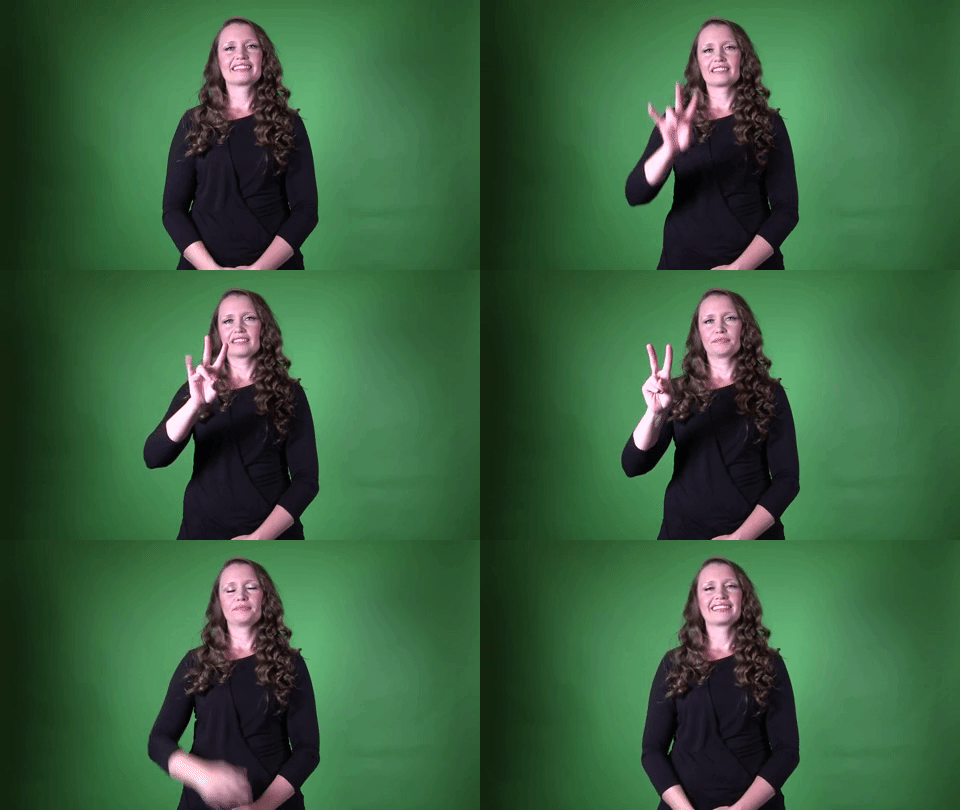
Definition: Refers to the number seventy-two
Sign for NUMBER SEVENTY-TWO in ASL

Practice Activities:
Practicing the sign for number seventy-two in ASL can help develop fluency with number combinations. Start by signing the number repeatedly while looking in a mirror to ensure proper handshape and movement. Try signing other two-digit numbers, such as seventy-three or sixty-two, to build confidence in switching between numbers smoothly.
Use the sign for number seventy-two in ASL in real-world contexts by practicing phone numbers, addresses, or prices where the number appears. For example, pretend to order an item that costs seventy-two dollars or give an address that includes seventy-two. This helps reinforce number fluency while making it meaningful.
Challenge yourself with speed drills by signing the numbers from seventy to seventy-five quickly. Then, mix them randomly by having a partner say a number aloud while you sign it back. You can also play a number recognition game where a partner signs a number and you voice it or write it down.
Incorporate the sign for number seventy-two in ASL into storytelling. Create a short story involving a scenario where the number is important, such as a countdown, a sports jersey number, or an age. You can also describe a fictional lottery ticket with seventy-two as one of the numbers.
For a conversational activity, ask and answer questions using the number seventy-two. Examples include “How many books are on the shelf?” or “How old is the grandfather in the story?” Respond using the correct number while maintaining fluidity in ASL sentence structure. Try these exercises with a friend to improve accuracy and comprehension.
Cultural Context:
The sign for number seventy-two in ASL is an essential part of expressing numerical values in American Sign Language. Numbers are frequently used in daily life, from telling ages to giving addresses and phone numbers. Knowing the sign for number seventy-two in ASL helps improve communication in various contexts.
In Deaf culture, numbers play a significant role in conversations, storytelling, and even name signs. The sign for number seventy-two in ASL follows the standard number structure used in signing. Mastering numerical signs is crucial for fluency and accurate communication within the Deaf community.
Educational settings often require students to know numbers for math, science, and everyday classroom interactions. Learning the sign for number seventy-two in ASL can help students, teachers, and interpreters communicate effectively. Whether in a classroom, workplace, or casual setting, number signs help facilitate smooth interactions.
The sign for number seventy-two in ASL is useful in financial transactions, giving directions, and discussing statistics. Many professions require the use of number signs daily, such as banking, retail, and healthcare. Understanding this number sign ensures clear and precise communication in these fields.
Technology, sports, and social media also rely on numerical signs for scores, dates, and various forms of data. The sign for number seventy-two in ASL allows for quick and clear exchanges of numerical information. This is especially important in online videos, where captions or sign language are crucial for accessibility.
Deaf athletes and fans use numerical signs to discuss player statistics, scores, and records. Being able to sign numbers fluently enhances engagement in conversations around sports. Knowing the sign for number seventy-two in ASL is beneficial for discussing team stats and game results.
Phone numbers, addresses, and prices often include larger numbers that require precise signing. Clarity in signing numbers avoids misunderstandings, especially in important situations like emergencies or official transactions. The sign for number seventy-two in ASL ensures accurate number communication in any situation.
Sign language interpreters must be proficient in all number signs to provide effective translations. The ability to sign numbers correctly, including the sign for number seventy-two in ASL, is essential for professional accuracy. Whether interpreting a lecture, presentation, or event, correct number signing maintains clear communication.
Using the sign for number seventy-two in ASL in everyday conversations enhances fluency and confidence. Practicing numbers regularly helps signers improve their speed and accuracy. Strong numerical skills contribute to overall ASL mastery and effective communication in diverse settings.
Extended Definition:
The sign for number seventy-two in ASL is a combination of the numbers seven and two, following the standard number pattern in American Sign Language. When signing number seventy-two in ASL, the dominant hand forms the number seven, then transitions smoothly into the number two. This movement should be fluid and clear to ensure proper understanding.
Number seventy-two in ASL is commonly used in various contexts, such as counting, giving addresses, stating ages, or sharing numerical information. ASL users rely on clear handshape transitions to ensure accuracy when communicating numbers. Learning the sign for number seventy-two in ASL is useful for everyday conversations that involve listing or referencing numbers.
When signing number seventy-two in ASL, the orientation of the palm is important for clarity. Typically, ASL numbers below 100 are signed with the palm facing outward, but sometimes palm orientation can vary depending on region or signer preference. Practicing the sign for number seventy-two in ASL will help improve fluency and confidence when using numbers in conversation.
Numbers play a key role in American Sign Language, and mastering them can significantly enhance communication skills. Understanding how to sign number seventy-two in ASL ensures smoother interactions in discussions involving numerical figures. Whether in casual conversations or formal settings, correctly signing numbers is an essential skill for ASL users.
For those learning ASL, repetition and practice are key to mastering numbers like seventy-two. Watching experienced signers and using ASL resources can help improve accuracy. The more often learners use number seventy-two in ASL, the more natural and effortless it becomes.
Different number patterns in ASL follow predictable structures, making it easier to learn similar numbers. Once confident with number seventy-two in ASL, users will find it simpler to sign other numbers in the same range. Developing proficiency with ASL numbers contributes to greater confidence in signing overall.
For those teaching ASL, breaking down the movement for number seventy-two in ASL can help students grasp it more easily. Demonstrating the transition between seven and two multiple times aids in retention. Encouraging students to practice frequently will help reinforce the sign’s accuracy.
Watching ASL videos and using interactive learning tools can enhance understanding of how to sign number seventy-two in ASL. Seeing real-life usage in conversations can clarify handshape transitions and reinforce correct techniques. Engaging with native signers can also provide valuable feedback on accuracy.
No matter the context, knowing the correct way to sign number seventy-two in AS
Synonyms: seventy-two, number seventy-two, number 72, the number 72, the number seventy-two
Educational resources: Find related learning materials in our course bank!
Want more? Check out some of our popular learning activities on the homepage!
Need to look up a sign? Use our highly rated dictionary: https://aslinteractive.com/best-asl-dictionary/
Follow us on tiktok: https://www.tiktok.com/@aslinteractive. More social media links at the bottom of this page!
Long-tail Keywords: what is the sign for number seventy-two in ASL, how do you sign number seventy-two in ASL, learn to sign number seventy-two in American Sign Language
Categories: Numbers – Basics, Numbers 71-80, cardinal numbers
tags: Numbers 71-75, Numbers, Language Learning, Mathematics, Education
Parameters
*Handshape*:
The sign for NUMBER SEVENTY-TWO in ASL uses a shifting number handshape. It begins with the “7” handshape, where the thumb and ring finger touch while the other fingers extend. The hand then transitions smoothly into the “2” handshape, where only the index and middle fingers remain extended. This movement is fluid and natural, maintaining clarity while counting. Facial expressions and movement help emphasize accuracy when signing numbers like NUMBER SEVENTY-TWO in ASL.
*Palm Orientation*:
The palm orientation for the sign for NUMBER SEVENTY-TWO in ASL starts with the palm facing outward. The hand transitions from a “7” shape to a “2” shape while maintaining the same orientation. The movement is quick and fluid, ensuring clarity when signing numbers. Proper hand positioning is essential to accurately convey NUMBER SEVENTY-TWO in ASL without confusion. Adjusting the angle slightly can help with visibility depending on the signing space.
*Location*:
The sign for number seventy-two in ASL is made at the neutral signing space in front of the body, at about chest level. The dominant hand forms the number seven before shifting directly into the number two in a fluid motion. This movement typically happens with the palm facing outward, ensuring clarity and visibility for the viewer.
*Movement*:
To make the sign for number seventy-two in ASL, start with the number 7 handshape, where the thumb and ring finger touch while the other fingers are extended. Then, transition smoothly to the number 2 handshape by extending the index and middle fingers while the other fingers close into the palm. This movement should be fluid, with a slight bounce when changing from 7 to 2. Keep the palm facing forward throughout the sign for clarity. ✋
*Non-Manual Signals*:
When performing the sign for NUMBER SEVENTY-TWO in ASL, maintain a neutral or slightly focused facial expression to ensure clarity. Your eyebrows should remain relaxed unless emphasizing or asking a question about the number. A small head nod or slight tilt can add natural flow, reinforcing the meaning of NUMBER SEVENTY-TWO without confusion. Keep eye contact with your conversation partner to maintain engagement and clarity.
*Prosody, Dominant/Non-Dominant Hand*:
The sign for number seventy-two in ASL uses the dominant hand. Start by forming the number 7 with your hand, with the thumb and ring finger touching and the remaining fingers extended. Then, smoothly transition into the number 2 by extending the index and middle fingers while folding the thumb, ring, and pinky. The movement should be fluid, maintaining a slight bounce or twist to show the transition between the two numbers. Make sure your palm orientation remains forward throughout the motion.
Tips for Beginners:
When learning the sign for number seventy-two in ASL, it’s essential to practice fluid movement between the two numbers. The sign involves transitioning from the number seventy to the number two, requiring flexibility in your fingers. Keep your dominant hand steady and relaxed to ensure a clear and natural motion.
One common mistake beginners make when signing the number seventy-two is hesitating between the digits. If the transition is choppy or exaggerated, it may cause confusion or appear unnatural. Focus on maintaining a smooth motion while ensuring both numbers are clearly shown.
Hand orientation should remain consistent throughout the sign for number seventy-two in ASL. The palm orientation for seventy and two should match, usually facing outward or slightly to the side. Watch for finger positioning to avoid miscommunication or accidental handshapes.
Practice signing multiple double-digit numbers to build confidence and improve recall. Numbers in the seventies follow a similar pattern, so becoming comfortable with one will help with others. Repeating the movement in front of a mirror can help refine accuracy and fluidity.
In real-life conversations, signing numbers naturally and in tempo with speech or signing speed is important. If you hesitate or second-guess, it can disrupt the flow and make the number harder to understand. Confidence and repetition will help reinforce correct movement for the sign for number seventy-two in ASL.
If you find yourself struggling, break the sign down into the individual numbers first, then gradually work on connecting them smoothly. Watching native signers and practicing along with videos will help reinforce muscle memory. Consistency is key, so daily practice will improve your ease and accuracy.
Connections to Other topics:
The sign for number seventy-two in ASL follows the common number pattern for 70s, which relates to broader number systems in ASL. Like other two-digit numbers, it uses a fluid motion between the digits, reinforcing the general rule of combining numerals in a natural handshape transition. Understanding the sign for number seventy-two in ASL helps learners grasp similar numerical structures, such as seventy-three or seventy-four, which follow the same movement principles.
Numbers in ASL connect to various topics, such as counting, measurements, and dates, making them essential in everyday signing. The sign for number seventy-two in ASL may appear in discussions about age, money, addresses, and statistical data. Because numbers are widely used in educational and professional settings, proper movement and clarity are crucial to avoid misinterpretation.
The pattern in signing seventy-two also connects to concepts like sports scores, historical references, and rankings. For example, a score of 72 in a game or an event that took place in the year 1972 would require understanding how to sign the numerals clearly. When paired with time-related terms, the sign for number seventy-two in ASL can indicate a length of time, such as “seventy-two hours” for a three-day period.
Some compound expressions use numbers as part of specific terms, including legal codes or specific identifiers in addresses and names. For instance, highway numbers, room numbers, or model numbers may require smooth transitions between the digits to ensure clarity. Mastering these numerical patterns allows for better communication in both casual and professional conversations, reinforcing the importance of fluency in ASL numbers.
Summary:
The sign for number seventy-two in ASL follows the standard pattern used for number formations between 67 and 98. This group of numbers requires a specific hand movement that incorporates a slight wrist twist or bounce. The numbers are signed in a fluid motion, transitioning smoothly between the digits.
To produce the sign for number seventy-two in ASL, start by forming the number seven with your dominant hand. Extend the index and middle fingers while touching the tip of your thumb to the pad of your ring finger. Then, transition smoothly to the number two by extending the index and middle fingers without the thumb connection.
The motion from seventy to two can involve a slight twisting movement of the wrist. This rotation is a natural part of number signing in ASL and makes the transition clearer to viewers. Consistency in the movement and clarity of finger placement help ensure accuracy in recognition.
ASL numbers from 67 to 98 often incorporate a specific pivot or rocking motion. Some signers use a slight outward rotation, while others prefer an inward flick. Learning and practicing both variations can help with comprehension across different ASL users.
Numbers in ASL are an essential component of communication. The sign for number seventy-two in ASL holds importance in contexts such as counting, addresses, money, and measurements. Mastering number signs is essential for fluent ASL conversation.
In ASL storytelling, numbers are often signed with expressive facial movements to add meaning. For instance, the sign for number seventy-two in ASL might be emphasized differently depending on whether it represents an age, a score, or an amount. Context plays an essential role in conveying meaning.
When signing seventy-two in casual conversation, signers may add slight variations in speed and emphasis. These subtle changes can indicate importance, urgency, or contrast. This adaptability makes ASL numbers highly efficient in conveying information.
The linguistic elements of ASL numbers connect to broader ASL grammar rules. The structure of numbering follows a logical progression that aligns with ASL syntax. Understanding these patterns improves one’s ability to sign quickly and correctly.
The evolution of number signs in ASL has been shaped by interaction with Deaf communities. Some older signers may use slightly different transitions between numbers. These variations highlight the dynamic and evolving nature of ASL.
Using numbers effectively in ASL requires attention to handshape, wrist motion, and pacing. Smooth transitions enhance fluency and ensure clarity for the viewer. The sign for number seventy-two in ASL benefits from practiced fluidity.
Number signs are commonly used in ASL interpreting and education. Interpreters must ensure precise number transitions, especially in fields such as business and academics. Misinterpreting numbers can lead to confusion or errors in communication.
ASL learners often struggle with the quick transitions required for multi-digit numbers. Practicing with slow, deliberate movements helps build muscle memory. Over time, the speed and fluidity improve, making numbers easier to understand and produce.
There is a cultural significance to ASL numbers in storytelling, games, and historical references. The sign for number seventy-two in ASL may appear in personal narratives, historical discussions, or sports-related conversations. Numbers carry meaning beyond their numerical value.
Different fingerspelling techniques can influence how numbers appear in ASL. While number seventy-two is a numerical sign, its integration into fingerspelled sequences must be seamless. This ensures that numbers are recognized clearly within a greater context.
Facial expressions often accompany numbers to add emphasis or emotion. A slight eyebrow raise can indicate curiosity or surprise. These non-manual signals are just as essential as hand movements in conveying meaning.
Educators often use specific drills to help students master number signs. Drilling sequences like seventy to seventy-nine enables learners to see the consistent hand pattern. Repetition builds confidence in fluid sign transitions.
The sign for number seventy-two in ASL can appear in financial contexts, such as discussing prices or numbers in banking. It is also useful in measurements, weather reports, and distance-related discussions. Knowing how to sign numbers accurately is practical and necessary.
Numbers also appear frequently in sports and academic settings. In a classroom, an instructor might sign number seventy-two when referring to test scores or statistics. In sports, it may indicate a team score or a player’s jersey number.
Deaf athletes and fans rely on clear number signing for communication. Signing player numbers quickly and accurately is crucial during fast-paced sports events. The sign for number seventy-two in ASL can be an essential part of relaying scores or player statistics.
In storytelling, historical events often include numbers. A Deaf historian discussing a significant event from 1972 might include the sign for seventy-two in an expressive way. These moments show how numerical signs contribute to broader narratives.
The efficiency of ASL number systems lies in their consistency. Once a signer learns the hand configurations and transitions, signing numbers becomes second nature. The framework of number movements follows predictable
Want more? Check out some of our popular learning activities!
ASL Interactive Resources
ASLInteractive YouTube Channel
Follow us on tiktok: @aslinteractive.com
Follow us on Instagram: aslinteractive
Facebook page: aslinteractive
Facebook group: aslinteractive
LInkedIn: ASL Interactive LLC
Twitter: @ASL_interactive
*Some information on this page is AI-generated. AI can make mistakes. Please check the information.


Responses