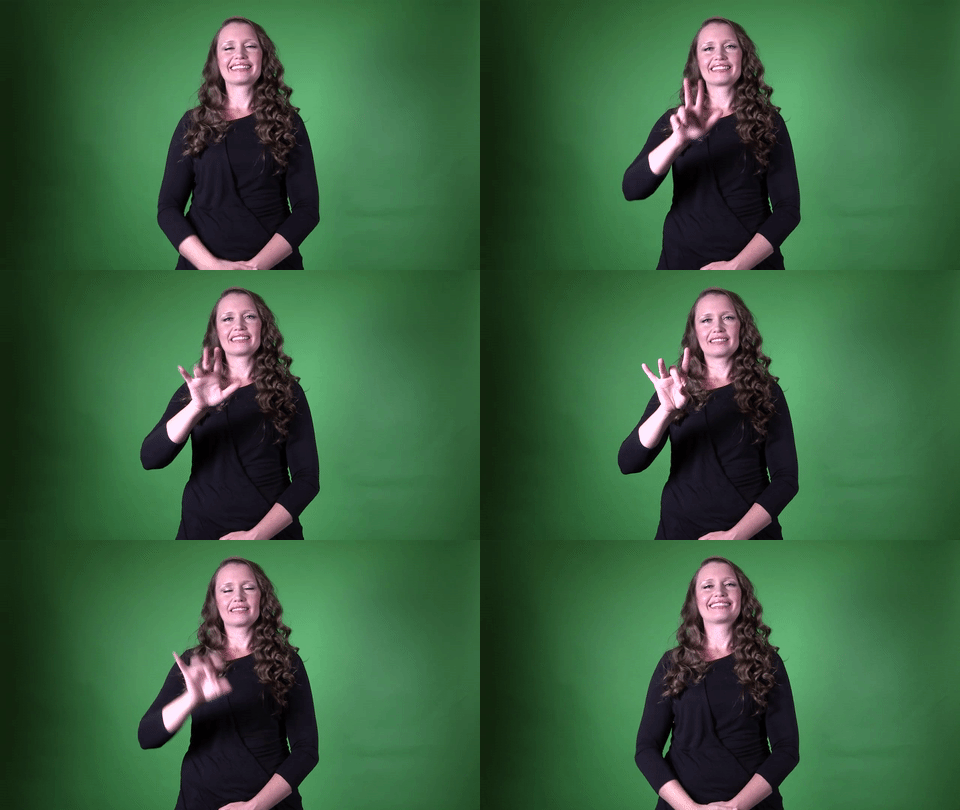
Sign for NUMBER THIRTY-EIGHT in ASL | 🔢 ASL Dictionary

Definition: Refers to the number thirty-eight

Sign for NUMBER THIRTY-EIGHT in ASL 

YouTube player

Practice Activities:

Practicing the sign for number thirty-eight in ASL can be engaging with a variety of activities. Start by isolating the sign and practicing it repeatedly, switching between slow and fast motions to develop fluency. Use a mirror or record yourself to check for accuracy in hand movement and transitions.

Incorporate the sign for number thirty-eight in ASL into counting exercises. Count from thirty to forty while signing each number, making sure to transition smoothly between them. Challenge yourself by numbering random objects and signing the corresponding numbers. For additional practice, set a timer and sign as many numbers in the thirty range as possible within a minute.

Use the sign for number thirty-eight in ASL in real-life contexts. For example, find the number thirty-eight on a clock, calendar, or price tag and sign it out loud. Write a list of numerical facts that include thirty-eight, such as “There are thirty-eight students in my class” or “The book has thirty-eight chapters,” and sign them.

Try partner activities by quizzing each other with number recognition. One person signs a number, and the other states it verbally. Reverse the roles for additional practice. Play a number-guessing game where one partner signs multiple numbers randomly, and the other identifies which one was thirty-eight.

For storytelling, create a short scenario where the number thirty-eight is relevant, such as talking about an event with thirty-eight guests or finding an apartment numbered thirty-eight. Sign the full story while emphasizing clear number transitions. Practicing these activities will help reinforce memory and fluency with the number signs.

Cultural Context:

American Sign Language is a visual language that reflects cultural values and communication styles unique to the Deaf community. The sign for number thirty-eight in ASL follows a logical pattern based on number formation rules in sign language. Understanding the structure of ASL numbers helps signers develop fluency and communicate efficiently.

The sign for number thirty-eight in ASL is part of a broader numbering system that combines handshape, movement, and palm orientation. Numbers in ASL are deeply ingrained in daily communication, used for addresses, dates, prices, and more. Learning the correct production of numbers enhances both expressive and receptive ASL skills.

Deaf culture values clear and precise signing, making numbers an essential aspect of communication. The sign for number thirty-eight in ASL follows a sequential pattern that is intuitive once familiar with ASL number rules. Mastering these patterns helps signers engage naturally in conversations.

ASL numbers reflect a rhythm that differs from spoken languages, creating a fluid and efficient way to convey information. The sign for number thirty-eight in ASL follows established number-signing conventions that maintain consistency in communication. This structure allows for quick recognition and understanding between signers.

Numbers play a role in storytelling, education, and technology within the Deaf community. The sign for number thirty-eight in ASL is not just a way to indicate a numerical value but also a tool for interaction. ASL users rely on numbers in daily conversations, from discussing ages to sharing phone numbers.

Learning the sign for number thirty-eight in ASL helps bridge communication gaps between Deaf and hearing individuals. It reinforces the importance of visual language and non-verbal expression in effective interactions. ASL numbers contribute to the richness and accessibility of the language.

Numbers in ASL are dynamic and may vary slightly based on regional or generational differences. The sign for number thirty-eight in ASL follows a general standard but may exhibit subtle variations among different signers. Exposure to multiple signers enhances the ability to recognize and produce numbers accurately.

Many ASL learners find numbers challenging at first, but consistent practice leads to mastery. The sign for number thirty-eight in ASL becomes easier to remember through repetition and real-life usage. Watching fluent ASL users sign numbers can improve recognition and signing speed.

Technology has expanded the accessibility of ASL number learning, providing videos and digital resources for learners. The sign for number thirty-eight in ASL can be easily studied through online dictionaries and instructional content. Engaging with Deaf sign

Extended Definition:

The sign for number thirty-eight in ASL is a combination of two distinct number signs. It starts with the number three handshape, then transitions smoothly into the number eight handshape. This movement makes the sign fluid and easy to recognize.

In ASL, number signs follow specific handshape rules to maintain clarity and consistency. The sign for number thirty-eight in ASL is performed with one hand, adjusting from one numeral to the next in a quick motion. This pattern aligns with how numbers in the thirties are typically formed in American Sign Language.

Hand positioning is crucial in signing numbers correctly. The palm faces outward when producing the sign for number thirty-eight in ASL. Each digit is articulated clearly so there is no confusion between similar numbers.

Context matters when signing numbers in ASL. The sign for number thirty-eight in ASL may appear in discussions about age, sports scores, math problems, or addresses. Accuracy is important, especially when communicating numbers in rapid conversation.

Finger dexterity plays a role in signing numbers smoothly. Beginners might need some practice to transition seamlessly between the number three and number eight handshapes. Repeating the sign for number thirty-eight in ASL a few times can help improve fluency.

Numbers in ASL are sometimes influenced by regional variations or signing speed. While the sign for number thirty-eight in ASL follows a standard structure, individual signers might exhibit slight differences in hand movement or finger transitions. Despite this, the general formation remains the same.

Using facial expressions can enhance communication when signing numbers. While the sign for number thirty-eight in ASL itself is straightforward, expressions may accompany it for emphasis or clarification. Non-manual markers can help convey the importance of the number in conversation.

Practicing ASL numbers in sequence can help with memorization. The sign for number thirty-eight in ASL fits within the broader pattern of numerical signs, making it easier to remember when practiced alongside other numbers. Counting from thirty to forty can reinforce smooth transitions.

ASL learners can benefit from video demonstrations. Watching an experienced signer perform the sign for number thirty-eight in ASL can clarify proper handshape positioning. Observing live demonstrations or recorded lessons ensures accuracy.

Understanding numbers in ASL is essential for everyday communication. The sign for number thirty-eight in ASL is just one example of how numerical signs follow logical transitions. Learning the complete ASL number system enhances fluency and confidence.

Synonyms: thirty-eight, number thirty-eight, number 38, the number 38, the number thirty-eight

Educational resources: Find related learning materials in our course bank!

Want more? Check out some of our popular learning activities on the homepage!

Need to look up a sign? Use our highly rated dictionary: https://aslinteractive.com/best-asl-dictionary/

Follow us on tiktok: https://www.tiktok.com/@aslinteractive. More social media links at the bottom of this page!

Long-tail Keywords: what is the sign for number thirty-eight in ASL, how do you sign number thirty-eight in ASL, learn how to sign number thirty-eight in American Sign Language

Categories: Numbers – Basics, Numbers 31-40, cardinal numbers

tags: Numbers 31-40, Numbers, Math, Educational, Language Learning

Parameters

*Handshape*:

The sign for NUMBER THIRTY-EIGHT in ASL uses a fluid transition between the digits 3 and 8. Start with the number 3 handshape, where the index, middle, and thumb are extended while the ring and pinky fingers remain folded. Then, smoothly shift to the number 8 handshape by bringing the middle finger to touch the thumb, with the index, ring, and pinky extended. This motion is subtle yet essential for clarity.

*Palm Orientation*:

The palm orientation for the sign for NUMBER THIRTY-EIGHT in ASL begins with the palm facing outward while forming the number three. As the transition to eight happens, the palm maintains a forward-facing position, allowing clear visibility of each numeral. Smooth movement between the digits ensures clarity and accuracy when signing the sign for NUMBER THIRTY-EIGHT in ASL. Proper orientation helps maintain natural positioning and ease of readability.

*Location*:

The sign for NUMBER THIRTY-EIGHT in ASL is produced in the neutral space in front of the body, typically at chest level. The hand remains within the signing space, ensuring visibility and clarity. Because numbers are directional, maintaining hand positioning at chest level helps with fluidity when signing sequential numbers. The sign for NUMBER THIRTY-EIGHT in ASL may slightly shift depending on context, but it generally remains in front of the torso.

*Movement*:

To sign for number thirty-eight in ASL, start with the number three handshape, with the index, middle, and thumb extended while the ring and pinky fingers are curled in. Quickly transition to the number eight handshape by folding the middle finger down to touch the thumb while the index remains extended and the other fingers stay curled. The movement is fluid, with a slight bouncing motion between the two handshapes, ensuring clarity and accuracy.

*Non-Manual Signals*:

Facial expression remains neutral or slightly focused as you form the sign for number thirty-eight in ASL. Eyebrows may relax naturally without being raised or furrowed, as this is a straightforward numerical concept. Mouth movement is minimal, though some signers may slightly articulate the number silently for clarity. Head movement remains steady, without tilting or nodding, unless emphasizing or clarifying the sign for number thirty-eight in ASL within a conversation.

*Prosody, Dominant/Non-Dominant Hand*:

The sign for number thirty-eight in ASL is produced with the dominant hand. Begin by forming the number three (index, middle, and thumb extended) and transition smoothly into the number eight (middle touching thumb). The movement should be fluid, with a slight bounce between the two numeral shapes. The non-dominant hand is not used. Maintain a steady handshape transition to ensure clarity when signing the number thirty-eight.

Tips for Beginners:

Mastering the sign for number thirty-eight in ASL requires fluid hand movement and clear number transitions. This sign is formed using the dominant hand, starting with the number three and smoothly transitioning into the number eight. Keep your fingers relaxed but controlled to maintain accuracy in the movement. Practicing slow and deliberate transitions at first will help build muscle memory.

One common challenge is making the shift between three and eight too stiff or jerky. Beginners often rush the movement, making it harder to recognize. Focus on keeping your fingers steady as you smoothly move from one number to the next. Watching yourself in a mirror or recording your hand movements can help pinpoint areas that need refinement.

Hand positioning is crucial when learning the sign for number thirty-eight in ASL. Keep your dominant hand in a neutral space, slightly in front of your shoulder. Ensure your palm orientation remains consistent as you transition between the two numbers. Avoid twisting your wrist excessively, as this can make the sign harder to understand.

Finger dexterity plays a big role in making number signs clear. If you struggle forming the number eight quickly, practice isolating your thumb and middle finger from the others. Strengthening individual finger control can make transitioning smoother. Repeating finger exercises daily can improve speed and fluidity.

Since numbers are often used in sequences, practice them alongside other numbers to improve recognition. Try signing thirty-eight with other similar numbers like thirty-seven and thirty-nine to reinforce pattern recognition. This will build confidence in counting and help prevent hesitation. Watching fluent signers and mimicking their technique can also lead to more natural movement. With regular practice, the sign for number thirty-eight in ASL will become second nature.

Connections to Other topics:

The sign for number thirty-eight in ASL is part of a broader numerical system that follows a consistent pattern in handshapes and movements. ASL numbers from 30 onward often incorporate a slight flicking or repeated movement of the fingers, distinguishing them from lower numbers. This system helps in efficiently conveying numerical values without excessive hand movement, an important aspect of ASL’s visual efficiency.

Numbers in ASL play a significant role in dates, ages, addresses, and mathematical concepts. The sign for number thirty-eight in ASL is commonly used in financial contexts, such as stating prices or payments, as well as in sports statistics and countdowns. Since ASL includes both cardinal and ordinal numbers, understanding when to modify the number’s movement for ranking (as in “thirty-eighth place”) is essential.

Numbers frequently appear in compound signs when discussing topics like percentages, fractions, or time-related expressions. For example, a phrase like “38 dollars” would combine the sign for number thirty-eight in ASL with the sign for “dollars.” Similarly, when telling time, combining a number with the sign for “minute” or “hour” follows a structured pattern. Recognizing these compounds enhances fluency and speed in communication.

Another significant connection is the use of numbers in classifiers for describing quantities or arrangements of objects. The sign for number thirty-eight in ASL could be incorporated into a classifier phrase when listing items or identifying numbered locations. This highlights how numerical signs are integrated into broader ASL grammatical structures. Additionally, in storytelling or casual conversation, numbers may be emphasized with facial expressions to convey surprise or importance.

Summary:

The sign for number thirty-eight in ASL is a numerical sign that blends two distinct hand positions. It starts with the number three handshape, represented by the index, middle, and thumb extended, while the ring and pinky fingers stay curled. The hand then transitions smoothly into the number eight, where the thumb and middle finger come together in a pinching motion while the other fingers remain extended.

This sign is part of the broader system of ASL number signs, which follow specific patterns and rules. Numbers in ASL are conveyed using particular handshapes and movements, often reflecting a logical and intuitive structure. The transition between three and eight in this case maintains fluidity, showcasing the efficiency of numerical representation in ASL.

ASL numbers can be classified into cardinal, ordinal, and specialized numeric signs used in contexts like sports, time, or money. The sign for number thirty-eight in ASL falls under the general category of cardinal numbers, used to indicate exact quantities. Unlike ordinal numbers, which use modifications like twisting movements, cardinal numbers are simply presented with a neutral forward-facing palm orientation.

The hand orientation for the sign is typically palm forward, which ensures clarity while signing. Maintaining the correct orientation is essential to avoid misinterpretation since different orientations can change the meaning in ASL. This consistency makes numerical signing visually distinctive and easy to recognize.

Hand dominance plays a role in signing numbers, including the sign for number thirty-eight in ASL. Right-handed individuals typically sign with their right hand, while left-handed signers use their left. Following the dominant-hand rule ensures fluidity and prevents confusion in communication.

Numbers in ASL follow a structured progression, making them efficient to learn. The sign for number thirty-eight in ASL adheres to the standard pattern of merging separate digits into one motion. This progression helps signers quickly recognize, produce, and understand numbers, even in fast-paced conversations.

ASL incorporates numerical incorporation techniques, where certain signs contain embedded numbers. The sign for number thirty-eight in ASL functions within this system by allowing signers to directly convey specific numerical information. This technique enhances efficiency and reduces the need for additional explanatory signs.

The sign for number thirty-eight in ASL can be used in many real-world contexts. It may appear in discussions about prices, ages, quantities, or other numerical data. The ability to sign numbers fluently is crucial for full communication access in both everyday and technical conversations.

Cultural significance surrounds ASL numbers because they are intrinsic to Deaf identity and everyday interactions. The sign for number thirty-eight in ASL is part of an extensive framework that allows fluent signers to navigate numerical data. ASL users develop a numeric fluency akin to verbal counting in spoken languages, reinforcing ASL’s richness as a complete language.

Numerical consistency in ASL makes learning and recall easier. When numbers consistently follow a systemic pattern, signers can quickly move through sequences without hesitation. The sign for number thirty-eight in ASL seamlessly fits this framework by maintaining logical finger transitions.

Fingerspelling is sometimes combined with numbers in ASL when necessary, especially for technical terminology. While the sign for number thirty-eight in ASL is straightforward, numbers occasionally appear alongside fingerspelled content for clarity in names or specific contexts. This integration showcases ASL’s ability to adapt numerical elements in different linguistic environments.

The structure of the sign connects to linguistic economy in ASL. The smooth transition from three to eight allows for a quick yet clear representation of the number. This efficiency highlights how ASL operates with visually optimized mechanisms for rapid and accurate communication.

The sign for number thirty-eight in ASL aligns with principles of applied linguistics, which examine how communication systems optimize information exchange. ASL’s numerical signs prioritize visual clarity, motor efficiency, and recognizability. These principles ensure accurate and swift comprehension among ASL users.

Numerical signs hold educational significance within Deaf education. Learning signed numbers, including the sign for number thirty-eight in ASL, is essential for mathematical literacy among Deaf students. Proper instruction on ASL numbers enables better engagement in academic and real-world problem-solving.

Deaf communities integrate numbers daily in conversations, storytelling, and academic contexts. The sign for number thirty-eight in ASL is one of many numerical elements contributing to the fluidity of communication. ASL users quickly internalize number movements, making them second nature in signed interactions.

Variations in number signs exist across different ASL dialects or regional adaptations. While the sign for number thirty-eight in ASL follows a standardized form, some communities might display slight variations in speed or emphasis. These minor regional differences reflect natural linguistic evolution within ASL.

Number signs in ASL emphasize the importance of clear signing space. The sign for number thirty-eight in ASL, like other numbers, should be performed within a comfortable, visible range to maintain clarity. Keeping numbers within a natural signing space enhances comprehension and prevents visual confusion.

ASL numbers often integrate into larger signed statements. The sign

Want more? Check out some of our popular learning activities!

ASL Interactive Resources

ASLInteractive YouTube Channel

Follow us on tiktok: @aslinteractive.com

Follow us on Instagram: aslinteractive

Facebook page: aslinteractive

Facebook group: aslinteractive

LInkedIn: ASL Interactive LLC

Twitter: @ASL_interactive

*Some information on this page is AI-generated. AI can make mistakes. Please check the information.

Sign for 38 in ASL, Sign for NUMBER 38 in ASL, Sign for THE NUMBER THIRTY-EIGHT in ASL, Sign for THE NUMBER 38 in ASL, Sign for NUMBER THIRTY-EIGHT in ASL 

Responses