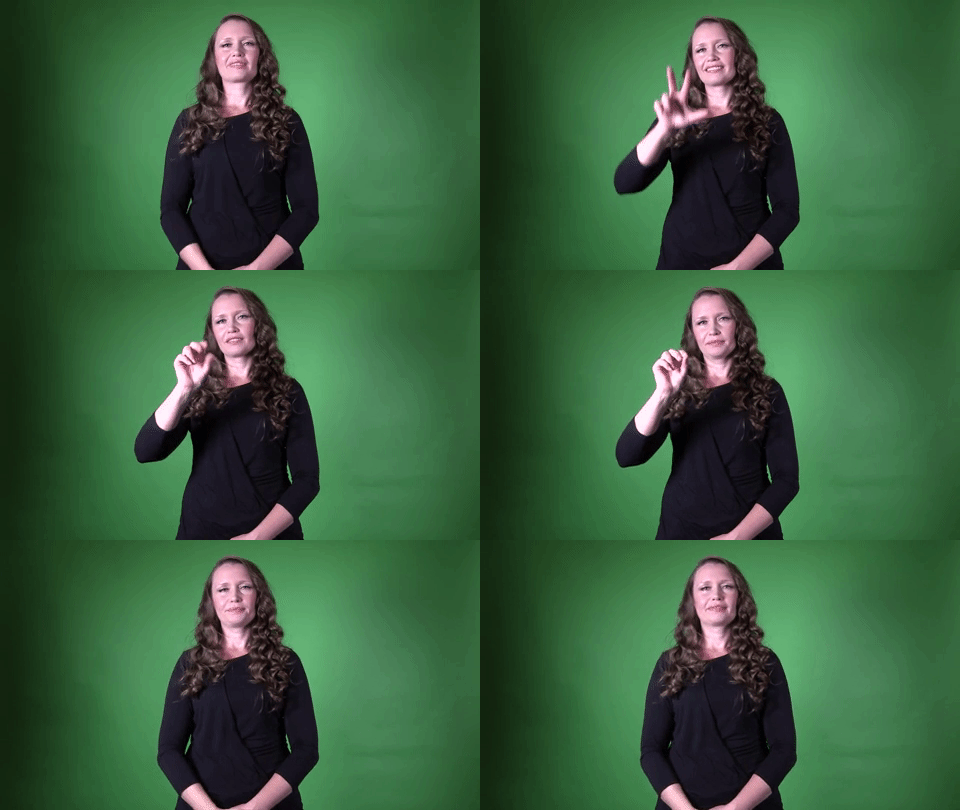
Sign for NUMBER THIRTY in ASL | 🔢 ASL Dictionary

Definition: Refers to the number thirty

Sign for NUMBER THIRTY in ASL 

YouTube player

Practice Activities:

Practicing the sign for number thirty in ASL can help with both number fluency and handshape mastery. Begin by practicing the sign in isolation, ensuring the handshape forms clearly. Repeat the sign multiple times, focusing on smooth transitions between the digits. Try signing it slowly at first, then increase your speed as you gain confidence.

Use the sign for number thirty in ASL in a counting exercise. Count by tens, starting from ten and progressing to thirty, forty, and beyond. Mix up the numbers to challenge yourself, such as jumping between twenty and thirty or comparing thirty with thirteen. This will help reinforce recognition and differentiation between similar-looking numbers.

Incorporate the sign for number thirty in ASL into daily activities. For example, when looking at calendars, sign the date if it includes thirty. Practice stating someone’s age using thirty when appropriate or use it while talking about prices, such as “That costs thirty dollars.” Connecting the sign to real-world contexts can reinforce learning.

Engage in a partner activity where one person signs a number, and the other identifies it by writing it down or fingerspelling it. Another option is a speed drill where a partner randomly shows a number, and the other quickly signs it back. Practicing in pairs can boost confidence and accuracy.

Create a short story or scenario using the sign for number thirty in ASL. For example, describe a trip where you traveled thirty miles or a game where you scored thirty points. Telling stories with real-life applications makes using numbers in ASL feel more natural and engaging.

Cultural Context:

The sign for number thirty in ASL is commonly used in everyday conversations, especially when discussing age, dates, and quantities. In American Sign Language, numbers play a crucial role in communication, and number thirty is an essential part of numerical fluency. Mastering number signs helps improve clarity in both casual and formal discussions.

Within the Deaf community, numbers are frequently incorporated into storytelling, education, and cultural exchanges. The sign for number thirty in ASL is used in many contexts, from counting to marking milestones like birthdays or anniversaries. Understanding and using number signs correctly enhances communication and prevents potential misunderstandings.

When signing the numbers from one to thirty, it’s important to maintain consistent handshape and movement. The sign for number thirty in ASL follows the standard numerical pattern seen in higher numbers. Precise handshapes and movements ensure that the meaning is conveyed accurately.

Numbers in ASL are often used in financial discussions, travel plans, and sports scores. The sign for number thirty in ASL can come up when talking about prices, addresses, or even game scores in sports. Knowing how to sign thirty correctly adds efficiency to conversations.

Different regions and Deaf communities may have slight variations in number signing, but the sign for number thirty in ASL remains largely consistent. Learning standardized number signs helps foster better understanding between ASL users. Whether signing casually with friends or formally in educational settings, having a strong grasp of numbers is valuable.

ASL numbers also appear in academic and professional settings, including classroom lectures and business meetings. The sign for number thirty in ASL is useful when discussing scores, statistics, or calendar dates. Practicing numerical signs helps build confidence in both receptive and expressive signing skills.

Because numbers are a foundational part of ASL, they are often introduced early in ASL learning. The sign for number thirty in ASL is one of many that learners must master to communicate effectively. Repetition and real-life application help reinforce number signs and improve fluency.

Using correct handshapes and finger movements when signing thirty ensures clarity and prevents confusion with similar numbers. The sign for number thirty in ASL follows logical patterns that make learning ASL numbers easier with practice. Observing fluent signers and practicing regularly can enhance proficiency.

Whether discussing historical events, financial matters, or sports statistics, the sign for number thirty in ASL is an essential tool for communication. Numbers are frequently used in various aspects of life, making it vital to learn them accurately.

Extended Definition:

The sign for number thirty in ASL is an essential part of learning American Sign Language numbers. It is commonly used in everyday conversations, especially when discussing age, time, money, or quantities. Understanding this sign helps improve numerical communication in ASL.

To form the sign for number thirty in ASL, start with your dominant hand showing the number three. Then bring your thumb and index finger together while keeping the middle finger extended. This handshape resembles the movement pattern used for multiples of ten in ASL.

ASL numbers follow a logical pattern that makes them easy to remember. The sign for number thirty in ASL follows the typical pattern of numbers in the tens series. Mastering these signs helps with counting, phone numbers, and dates.

Knowing how to sign thirty correctly ensures better communication with Deaf and hard of hearing individuals. Accuracy in ASL numbers is important to avoid miscommunication. Practicing consistently will make fingerspelling and numerical signs feel more natural.

Numbers in ASL are unique because they blend handshapes and movements efficiently. The sign for number thirty in ASL is part of a structured system that makes numerical concepts clear and visually distinct. Learning number signs like this builds confidence in signing fluently.

When signing large numbers, understanding the sign for number thirty in ASL is fundamental. Combining this sign with others allows for forming complex numbers. Using the correct handshape and movement makes conversations smoother in ASL.

Signing numbers quickly and accurately is a valuable skill in ASL. The sign for number thirty in ASL fits into the broader context of numerical expressions. This is useful in educational settings, financial discussions, and everyday conversations.

Fingerspelling and number signs are key components of American Sign Language. Recognizing the sign for number thirty in ASL helps learners become more proficient. Numbers are frequently used in ASL for math, counting people, and giving directions.

Learning and practicing the sign for number thirty in ASL supports overall fluency. It is important to observe native signers and mimic their handshapes accurately. Watching ASL videos and practicing with others can reinforce proper signing technique.

The structure of ASL numbers is straightforward once the patterns are understood. Mastering the sign for number thirty in ASL is a step toward learning more complex signing structures. Incorporating number signs into daily signing practice improves recall and natural usage.

ASL learners benefit from repetition and real-life practice. Using the sign for number thirty in

Synonyms: thirty, number thirty, number 30, the number 30, the number thirty

Educational resources: Find related learning materials in our course bank!

Want more? Check out some of our popular learning activities on the homepage!

Need to look up a sign? Use our highly rated dictionary: https://aslinteractive.com/best-asl-dictionary/

Follow us on tiktok: https://www.tiktok.com/@aslinteractive. More social media links at the bottom of this page!

Long-tail Keywords: what is the sign for Number thirty in ASL, how do you sign Number thirty in ASL, learn how to sign Number thirty in American Sign Language

Categories: Numbers – Basics, Numbers 21-30, cardinal numbers

tags: Numbers 21-30, Numbers, Math, Language Learning, Educational

Parameters

*Handshape*:

The sign for NUMBER THIRTY in ASL uses the digits “3” and “0” in a fluid motion. Start with the dominant hand in the “3” handshape, with the index, middle, and thumb extended while the ring and pinky remain curled. Transition smoothly into the “0” handshape by bringing the thumb and index together while the other fingers fold down. This movement clearly represents the numerical value. Ensuring a smooth transition between the handshapes improves clarity and accuracy.

*Palm Orientation*:

The sign for NUMBER THIRTY in ASL starts with the dominant hand forming the number “3” with the palm facing outward ✋. The thumb and index finger quickly move together to touch, resembling the shape of a “0,” while the middle finger remains extended. This motion is repeated once or twice in a smooth, controlled movement. The palm maintains a forward position, ensuring clear visibility of the handshape transition.

*Location*:

The sign for number thirty in ASL takes place in the neutral signing space, in front of the chest. The dominant hand forms the number three and then smoothly transitions to a zero by bringing the thumb and index finger together. This movement keeps the hand slightly in front of the body at chest level, ensuring clear visibility. The sign for number thirty in ASL should be fluid to maintain natural counting rhythm.

*Movement*:

To make the sign for number thirty in ASL, start by forming the number three with your dominant hand, extending the index, middle finger, and thumb while keeping the ring and pinky fingers folded. Then, bring the middle finger and thumb together while the index remains extended, forming a quick tapping motion. This movement should be smooth and fluid, clearly transitioning between the two handshapes to represent the number accurately.

*Non-Manual Signals*:

Facial expressions remain neutral or slightly focused when performing the sign for NUMBER THIRTY in ASL. Eyebrows may remain relaxed unless adding emphasis, such as when clarifying a quantity. Lip posture is generally neutral, though slight mouthing of “thirty” may occur naturally. Head movement is minimal, though small nods may be present when confirming the numerical value. Maintaining eye contact with the conversational partner ensures clarity during the sign for NUMBER THIRTY in ASL.

*Prosody, Dominant/Non-Dominant Hand*:

The sign for NUMBER THIRTY in ASL uses the dominant hand, forming the number “3” with the index, middle, and thumb extended while the ring and pinky fingers remain folded. The hand moves slightly as the index and middle fingers come together with the thumb to form a closed “0” shape. This motion repeats once, smoothly transitioning between the “3” and “0” handshapes.

Tips for Beginners:

Mastering the sign for NUMBER THIRTY in ASL requires a smooth hand transition and attention to finger positioning. This number uses a repeated motion, so consistency is key. Keep your hand relaxed to avoid stiffness, which can make the movement look awkward.

One common mistake beginners make when signing the sign for NUMBER THIRTY in ASL is not fully forming the correct handshape. Make sure your thumb and index finger touch briefly to create a clear “3” before transitioning smoothly into the “0” shape. Rushing through the sign can make it unclear, so focus on even pacing.

Finger and wrist flexibility play a big role in making the sign for NUMBER THIRTY in ASL appear natural. Try warming up your fingers if they feel stiff, especially if you’re new to signing numbers. Practicing in front of a mirror can help you check if your handshapes are accurate and easily recognizable.

Another challenge with the sign for NUMBER THIRTY in ASL is maintaining clarity at different speeds. When signing quickly, be mindful not to clip the transition between the numbers. Keep your motions controlled and deliberate without exaggerating the movement too much.

For real-life communication, observe how fluent signers perform the sign for NUMBER THIRTY in ASL. Watching ASL videos or practicing with a signing partner can help you develop speed and clarity. The more you practice, the more confident and natural your signing will become.

Connections to Other topics:

The sign for number thirty in ASL connects to the broader system of number signs in American Sign Language. It follows the pattern for multiples of ten, using a combination of the digits three and zero in a fluid motion. This structure mirrors the signs for other numbers like twenty, forty, and fifty, making it easier to learn number sequences.

Number signs in ASL share common formation rules, especially in cardinal and ordinal variations. The sign for number thirty in ASL is used in counting, financial terms, and age references. It also appears in time-related expressions, such as “thirty minutes” or “thirty days,” connecting it to concepts of duration and scheduling.

Numbers in ASL are essential in mathematical discussions, statistics, and measurements. The sign for number thirty in ASL can be used when discussing measurements such as “thirty inches” or “thirty pounds.” This makes it valuable for conversations in education, sports, cooking, and health-related topics.

Multiples of ten are often grouped with signs that indicate broader numerical categories, such as percentages and prices. The sign for number thirty in ASL may be used in contexts like “thirty percent” or “thirty dollars,” making it important in business, commerce, and everyday transactions. Understanding number patterns strengthens a signer’s ability to discuss money, calculations, and comparisons.

Ordinal versions of numbers can sometimes modify numerical signs, as seen when referring to a “thirtieth anniversary” or a “thirtieth place finish.” The structure of these ordinal forms builds upon the base number while incorporating slight shifts in movement or additional sign elements. Learning number signs like the sign for number thirty in ASL enhances fluency in describing rankings, events, and historical dates.

Summary:

The sign for number thirty in ASL is formed by using the dominant hand. The hand starts in a “3” shape, with the index, middle finger, and thumb extended while the ring and pinky fingers remain closed. The movement involves bringing the tips of the thumb and middle finger together while the index finger remains extended, mimicking the numerical representation of thirty.

This sign is a combination of the digits three and zero, reflecting the numerical structure in English. Unlike spoken languages where numbers are vocalized in sequence, ASL uses a system of handshapes that visually represent quantities. The sign for number thirty in ASL maintains clarity by incorporating both numeral components into one motion.

Number signs in ASL often follow a logical progression, making it easier for learners to remember sequences. The number thirty follows this pattern, as it visually builds upon the concept of lower-numbered signs. By understanding the foundational pattern for number signs, signers can efficiently produce and recognize numerical expressions in everyday conversations.

ASL number signs can vary slightly depending on context and regional usage. Some signers may produce the sign for number thirty in ASL with a subtle variation in motion or positioning. However, the majority of signers adhere to the common form taught in ASL learning environments.

The sign for number thirty in ASL is frequently used in various contexts, such as discussing age, money, or measurements. Numerical communication is crucial in everyday signing, especially in fields like education, finance, and sports. Because numbers are essential to conveying quantitative information, mastering signs like number thirty enhances fluency.

Numbers in ASL rely on visual principles rather than phonetics, making them distinctly different from spoken numerical systems. The manual production of the sign for number thirty in ASL exemplifies ASL’s structure in expressing numerical concepts. Unlike spoken language, where intonation may emphasize different numbers, ASL relies on clear, deliberate movements.

Cultural significance plays a role in number usage in ASL. In Deaf communities, numbers are common in storytelling, education, and daily interactions. The sign for number thirty in ASL is not just a gesture but a part of the larger numerical system used for accessibility and communication.

ASL-users often encounter number-related signs early in their learning journey because they are fundamental to practical communication. Counting, measuring, or discussing time all involve numbers, making them essential signs to master. The sign for number thirty in ASL is a key part of expressing numeric relationships in daily discussions.

In educational settings, number signs help structure instructions and tasks. Teachers frequently use signs like number thirty in ASL to guide students through math problems and concepts. This visual and kinesthetic approach supports comprehension in Deaf and hard-of-hearing learners.

The structure of ASL numbers, including number thirty, aligns with broader linguistic rules within the language. Signed numbers follow a sequential pattern that reflects their spoken counterparts. The fluidity of ASL’s numerical system ensures that native signers and learners can easily grasp number-related signs.

Grammatically, ASL numbers can be signed independently or incorporated into broader expressions. When using the sign for number thirty in ASL, context determines how it functions within a conversation. In some cases, number signs blend into larger phrases, such as when stating dates or prices.

The motion used in the sign for number thirty in ASL is consistent with other numbers in the thirty range. By analyzing patterns in the numbering system, signers can recognize the consistency in sign formations. The repetition of number-related signs supports comprehension and fluency.

Signers may encounter slight variations when signing numbers depending on speed and emphasis. In casual conversations, the sign for number thirty in ASL may be produced more quickly. However, in formal explanations or slow-paced communication, the sign might be more exaggerated for clarity.

Applied linguistics suggests that numerical signs help bridge language barriers by offering a universal system of representation. The sign for number thirty in ASL fits into this larger framework of visual language structures. Recognizing number patterns benefits both learners and native signers in maintaining consistency and understanding.

In everyday interactions, numerical signs enhance efficiency. The sign for number thirty in ASL eliminates the need for fingerspelling, providing a faster way to express numbers. This efficiency is especially useful in fast-paced contexts like sporting events or financial discussions.

Many ASL signs originate from natural hand movements that correspond to real-world objects or concepts. The structure of the number system in ASL follows this principle, with each number reflecting a logical sequence. The sign for number thirty in ASL is part of this structured numerical representation.

Deaf culture includes the frequent use of number-related conversations in various aspects of life. Whether discussing birthdays, finances, or measurements, signs like number thirty in ASL contribute to clear communication. This reinforces the importance of numerical fluency in ASL.

Technology and digital communication have further emphasized the importance of numerical understanding in ASL

Want more? Check out some of our popular learning activities!

ASL Interactive Resources

ASLInteractive YouTube Channel

Follow us on tiktok: @aslinteractive.com

Follow us on Instagram: aslinteractive

Facebook page: aslinteractive

Facebook group: aslinteractive

LInkedIn: ASL Interactive LLC

Twitter: @ASL_interactive

*Some information on this page is AI-generated. AI can make mistakes. Please check the information.

Sign for NUMBER 30 in ASL, Sign for THE NUMBER 30 in ASL, Sign for THE NUMBER THIRTY in ASL, Sign for NUMBER THIRTY in ASL 

Responses