Sign for NUMBERS 1 THRU 10 in ASL | ASL Dictionary

Definition: The sequence of numbers from 1 to 10.

Sign for NUMBERS 1 THRU 10 in ASL

YouTube player

Practice Activities

Practicing the sign for NUMBERS 1 THRU 10 in ASL involves more than just memorizing handshapes. Begin with mirror work to ensure your palm orientation and finger positioning are correct. Numbers 1 through 5 are typically signed with the palm facing inward, while numbers 6 through 10 face outward. Use a mirror to check that you are not flipping the direction, which is a common beginner mistake.

Record yourself signing the sign for NUMBERS 1 THRU 10 in ASL in sequence. Watching your recordings helps identify errors in transitions, speed, and clarity. Try varying your pace, starting slow and gradually increasing speed as you gain confidence. This video feedback is valuable for long-term improvement.

Incorporate the sign for NUMBERS 1 THRU 10 in ASL into real-life conversations. Try counting objects around your house, like books, utensils, or steps. This contextual use builds fluency and reinforces memory. You can also challenge yourself by using numbers in storytelling or daily routines, such as giving someone your phone number or talking about time.

Advanced learners can drill number signs by incorporating them into fingerspelling practice, number games, and dialogues. Try signing phone numbers, ages, or dates quickly and clearly. Another drill is reverse sequencing—signing from 10 down to 1—which builds agility and control.

SEO Cultural Context

The sign for NUMBERS 1 THRU 10 in ASL plays an essential role in daily life within the Deaf community. Numbers are used constantly in conversation—when giving addresses, telling time, discussing age, or sharing phone numbers. Mastering these foundational number signs is key to effective communication in ASL.

Culturally, the use of number signs in ASL follows specific norms. For instance, numbers 1 through 5 are signed with the palm facing inward when used in isolation, especially in the Eastern U.S. However, in some regional dialects or when used in certain phrases, this orientation may shift. Understanding these small but meaningful differences enhances cultural fluency.

In Deaf culture, clarity and visual precision are highly valued. The sign for NUMBERS 1 THRU 10 in ASL must be executed cleanly and at an appropriate pace. Rushing or slurring the transitions can lead to misunderstandings. Signing numbers clearly shows respect for your conversation partner and reflects your commitment to accurate communication.

Extended Definition

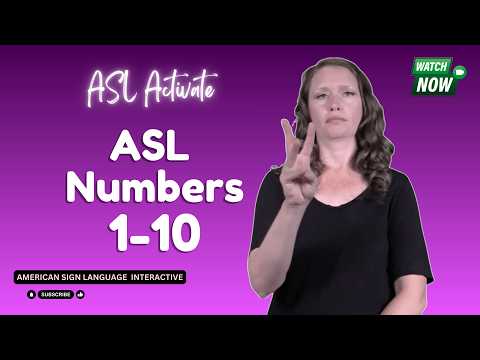
The sign for NUMBERS 1 THRU 10 in ASL includes a series of individual number signs, each with its own handshape and orientation. For numbers 1 through 5, the palm typically faces the signer, with fingers extended corresponding to the number. For example, the sign for “1” shows the index finger pointed upward with the palm in, while “5” shows all fingers extended, palm in.

From 6 through 9, the palm faces outward, and the thumb touches each finger in sequence. For instance, “6” is made by touching the pinky to the thumb, “7” uses the ring finger, and so on. “10” is signed by making a fist and shaking it slightly side to side, resembling a thumbs-up in motion.

Common errors with the sign for NUMBERS 1 THRU 10 in ASL include incorrect palm orientation and unclear finger extension. Beginners often confuse 6 and 9 due to similar handshapes. Also, rushing the signs can cause blending or miscommunication. It’s important to focus on precision and muscle control.

The number signs are also foundational for larger numbers and mathematical concepts. Learning them well enables smoother transitions into more complex signs such as 11–20, time, money, and ordinal numbers. The sign for NUMBERS 1 THRU 10 in ASL underpins a wide range of numerical expressions in the language.

Tips for Beginners

If you’re just starting to learn the sign for NUMBERS 1 THRU 10 in ASL, start slow and be patient with yourself. Begin by practicing each number individually, making sure your handshape is accurate and your palm orientation matches the standard form. Take your time to ensure that your fingers are not stiff or tense.

A common mistake is signing numbers 1 through 5 with the palm facing out—this is the convention in other sign languages, but not in ASL. Remember that context matters. Practice the numbers in isolation and in sequences to build confidence.

Use flashcards and visual aids to reinforce memory. Watching videos of native signers can also help you internalize the correct form and rhythm of the sign for NUMBERS 1 THRU 10 in ASL. Don’t be afraid to repeat signs multiple times—repetition builds muscle memory and fluency.

Stay motivated by setting small goals. For example, aim to master two numbers per day, and gradually build up. Celebrate small victories, like being able to count to 10 smoothly or use numbers in a short dialogue. Enjoy the process—it’s a rewarding journey.

Connections to Other Topics

Learning the sign for NUMBERS 1 THRU 10 in ASL opens the door to many related signs and concepts. One important connection is to age. Being able to sign numbers is essential for expressing how old someone is. For example, to sign “I am 5 years old,” you need to combine the number 5 with the sign for “age.”

Another related topic is time. Telling time in ASL requires a solid grasp of numbers 1 through 12 for hours, and beyond for minutes. The sign for NUMBERS 1 THRU 10 in ASL is often the starting point for learning time-related signs like “o’clock” or “quarter past.”

Ordinal numbers, such as “first” or “second,” also build from the foundational numbers. These signs often involve a slight twist or movement from the basic number sign to indicate sequence or order.

Phone numbers and addresses are common real-life uses of the sign for NUMBERS 1 THRU 10 in ASL. These long strings of numbers require clarity and rhythm, making foundational number knowledge essential.

Finally, math and counting concepts are frequently used in educational settings. If you’re planning to work with Deaf children or in an academic environment, being fluent in number signs is a must. It allows you to count, do basic arithmetic, and support numeracy in ASL.

Lengthy Summary

Mastering the sign for NUMBERS 1 THRU 10 in ASL is one of the most crucial steps in building a strong foundation in American Sign Language. These basic signs are used in everyday conversation, including telling age, sharing phone numbers, describing time, and counting objects. Without them, it’s nearly impossible to communicate fully in ASL.

The sign for NUMBERS 1 THRU 10 in ASL requires attention to detail, especially in palm orientation and handshape. Numbers 1 through 5 typically face inward, while 6 through 9 turn outward. Each number has a distinct and consistent form that learners must practice until it becomes second nature. “10” introduces a dynamic movement, setting the stage for more complex number signs to follow.

Understanding the cultural norms surrounding number signs is equally important. Deaf culture places a high value on clarity and visual accuracy. Signing numbers correctly not only improves communication but also signals cultural respect and linguistic fluency. Regional variations may slightly influence how numbers are signed, so remaining open to differences is part of becoming a well-rounded signer.

For beginners, learning the sign for NUMBERS 1 THRU 10 in ASL can feel challenging at first, but with consistent practice, it becomes manageable and even enjoyable. Start by using mirrors and recordings to fine-tune your form. Incorporate numbers into real-life contexts and gradually increase the complexity of your practice routines.

This set of signs also connects with several key areas in ASL. From learning to express age and time to signing phone numbers and addresses, the sign for NUMBERS 1 THRU 10 in ASL is a gateway to broader communication. It also lays the groundwork for learning ordinal numbers, advanced counting, and mathematical concepts.

Incorporate these signs into your daily life as much as possible. Count items, practice with friends, or challenge yourself with speed drills. The more you use the sign for NUMBERS 1 THRU 10 in ASL, the more natural and fluent you’ll become in your ASL journey.

Keep practicing, stay curious, and enjoy each step of learning ASL. Your hard work will pay off, and soon you’ll be signing with confidence and clarity. Let the numbers lead the way to deeper fluency and connection in the world of American Sign Language

Synonyms: 1: one, single, unit, solo, lone
2: two, pair, duo, double, couple
3: three, triple, trio, triad, treble
4: four, quartet, quadruple, quaternary, tetrad
5: five, quintet, quintuple, pentad, fiver
6: six, sextet, sextuple, half a dozen, hexad
7: seven, septet, septuple, heptad, sevenfold
8: eight, octet, octuple, octad, eightfold
9: nine, nonet, nonuple, ennead, ninefold
10: ten, decade, decuple, tenfold, tenth

Educational resources: Find related learning materials in our course bank!

Want more? Check out some of our popular learning activities on the homepage!

Need to look up a sign? Use our highly rated dictionary: https://aslinteractive.com/best-asl-dictionary/

Follow us on tiktok: https://www.tiktok.com/@aslinteractive. More social media links at the bottom of this page!

Long-tail Keywords: what is the sign for numbers 1 through 10 in ASL, how do you sign numbers 1 through 10 in American Sign Language, ASL numbers 1 to 10 explained

Categories:

tags: numbers in ASL, counting in ASL, ASL basics, beginner ASL vocabulary, ASL numbers and math

Want more? Check out some of our popular learning activities!

ASL Interactive Resources

ASLInteractive YouTube Channel

Follow us on tiktok: @aslinteractive.com

Follow us on Instagram: aslinteractive

Facebook page: aslinteractive

Facebook group: aslinteractive

LInkedIn: ASL Interactive LLC

Twitter: @ASL_interactive

*Some information on this page is AI-generated. AI can make mistakes. Please check the information.


Responses