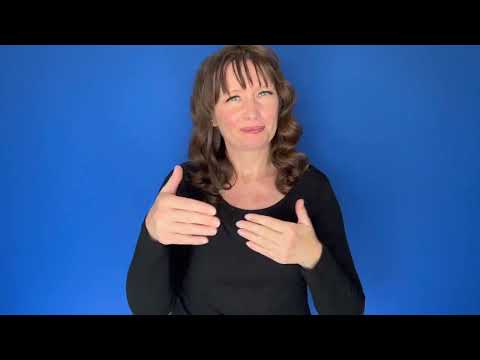
Definition: A room or place for young children (variant 2).
Sign for NUSERY 2 in ASL
Practice Activities
To truly master the sign for NURSERY 2 in ASL, consistent practice is essential. Start by standing in front of a mirror to observe your handshape, palm orientation, and facial expressions. Mirror work helps you fine-tune your accuracy and builds confidence in producing the sign naturally.
Recording yourself while signing the sign for NURSERY 2 in ASL is another valuable method. Watch your recordings to check for clarity and fluidity, and compare your signing to native signers or trusted ASL dictionaries. This technique helps you self-correct and track progress over time.
Incorporate the sign into contextual practice. Use the sign for NURSERY 2 in ASL in full sentences like “My baby is in the nursery” or “I work in a nursery.” This builds fluency and helps you understand grammatical placement in ASL structure.
For advanced learners, try alternating between related signs such as DAYCARE, INFANT, and ROOM to improve speed and clarity. You can also practice fingerspelling “nursery” before using the sign to reinforce vocabulary retention and spelling recognition.
Role-playing real-life situations is a fun and effective way to internalize the sign for NURSERY 2 in ASL. Pretend you’re giving someone a tour of a school or hospital and describe where the nursery is located. This practical use cements the sign into your long-term memory.
SEO Cultural Context
Understanding the cultural background of the sign for NURSERY 2 in ASL enriches your learning experience. In Deaf culture, signing is more than a translation—it reflects community norms, values, and shared experiences. The sign for NURSERY 2 in ASL reflects how Deaf people refer to early childhood spaces such as a baby’s room at home, a childcare room in a hospital, or a preschool classroom.
While the sign may vary slightly by region, it generally involves a combination of concepts like BABY and ROOM. Some signers may emphasize the caregiving aspect of the nursery, while others may focus on its physical location. These subtle variations are accepted within the Deaf community and highlight the flexibility of ASL.
Context matters greatly. The sign for NURSERY 2 in ASL is commonly used in parenting discussions, hospital settings, and educational environments. For example, Deaf parents may use it when talking to their children or communicating with daycare staff. Professionals such as Deaf educators or interpreters may also frequently use this sign in their work.
Deaf culture places high value on visual clarity and conceptual accuracy. When using the sign for NURSERY 2 in ASL, it’s important to match your facial expression to the situation, whether you’re expressing concern, happiness, or giving directions. Culturally appropriate signing enhances understanding and respect within the community.
Extended Definition
The sign for NURSERY 2 in ASL typically combines the sign for BABY—where you cradle your arms as if holding a baby—with the sign for ROOM or PLACE, depending on context. This combination visually conveys the meaning of a space designated for infants or young children. The sign may be modified slightly based on the type of nursery being referenced, such as a hospital nursery versus a church nursery.
Some learners mistakenly use only the sign for BABY to refer to a nursery, which can cause confusion. While BABY is part of the concept, it does not fully convey the idea of a physical space or designated environment. Always include the ROOM or AREA classifier to complete the meaning.
There can also be confusion with similar signs like DAYCARE or PRESCHOOL. While these signs are related, they are not interchangeable. The sign for NURSERY 2 in ASL specifically refers to a space for care or rest, usually for infants or very young children, rather than an educational setting for toddlers.
It’s important to note that the sign for NURSERY 2 in ASL is conceptually based, not a direct word-for-word translation. ASL often relies on classifiers and conceptual grouping, so understanding the function of the nursery helps in choosing the most appropriate sign.
Tips for Beginners
If you’re just starting to learn the sign for NURSERY 2 in ASL, don’t worry—you’re not alone. Many beginners find it helpful to break the sign down into its component parts. Start by mastering the sign for BABY, followed by ROOM or PLACE, and then practice combining them smoothly.
A common mistake is rushing through the sign or using incorrect handshapes. Take your time to ensure your hands are positioned correctly, and use a mirror to check your form. Clarity is more important than speed when you’re first learning the sign for NURSERY 2 in ASL.
Another helpful tip is to watch videos of native signers. Observe how they transition between signs and use facial expressions to add context. Mimicking these natural movements will help you become more fluent and expressive.
Don’t be afraid to ask for feedback. If you know a Deaf person or ASL instructor, ask them to watch your signing and offer corrections. Practicing in a supportive environment builds both skill and confidence.
Finally, set small, achievable goals. For example, commit to using the sign for NURSERY 2 in ASL in three different sentences each day. Small steps like these lead to big improvements over time.
Connections to Other Topics
Learning the sign for NURSERY 2 in ASL opens the door to many related vocabulary signs. One closely connected sign is BABY, which forms the foundational part of the nursery concept. Mastering this basic sign is crucial for interpreting or expressing anything related to young children.
Another related sign is ROOM, which is often used in combination with BABY to indicate a nursery. ROOM is a highly versatile sign used in many contexts, so learning it strengthens your overall ASL vocabulary.
The sign for DAYCARE also connects to the sign for NURSERY 2 in ASL. While different in usage, both signs relate to childcare environments. Understanding the distinctions between them helps in choosing the most accurate sign based on context.
PRESCHOOL is another sign that shares a conceptual link. Though it refers to an educational setting rather than a care-focused space, it’s often discussed alongside nursery environments in conversations about early childhood.
Lastly, the classifier signs for PLACES or AREAS are useful to learn. These classifiers allow you to describe specific rooms or locations, such as a nursery attached to a hospital ward or a room in a home. Using these classifiers in combination with the sign for NURSERY 2 in ASL enhances your descriptive ability in ASL.
Lengthy Summary
The sign for NURSERY 2 in ASL is a rich and multi-layered concept that combines key signs like BABY and ROOM to convey the idea of a space dedicated to infant care. Whether you’re talking about a hospital nursery, a home baby room, or a church childcare space, this sign helps communicate clearly within the Deaf community. It’s a concept-based sign that varies slightly by region and context but remains grounded in visual clarity and conceptual integrity.
Practicing the sign through mirror work, recordings, and contextual usage helps reinforce your learning and builds your fluency. Understanding the cultural context of the sign for NURSERY 2 in ASL deepens your appreciation for how language and culture intertwine in the Deaf community. It also helps you avoid common beginner mistakes, such as using only the sign for BABY without indicating the space element.
By connecting this sign to related vocabulary like DAYCARE, PRESCHOOL, and ROOM, you expand your ASL toolkit and become more versatile in your conversations. These connections enhance your ability to communicate effectively about a range of early childhood environments.
For beginners, patience and consistency are key. The sign for NURSERY 2 in ASL may seem complex at first, but breaking it down into smaller parts and practicing regularly will lead to mastery. Remember to incorporate facial expressions and use the sign in real-life contexts to make your signing more natural and expressive.
Language is a journey, and every new sign learned brings you one step closer to fluency. Keep practicing the sign for NURSERY 2 in ASL with intention and curiosity. Your commitment to learning not only improves your signing skills but also builds bridges within the Deaf community. Keep signing, keep growing!
Synonyms: I didn’t understand your request clearly. Could you please clarify what “nusery 2” refers to or provide more context so I can provide the right synonyms for it? Thank you!
Educational resources: Find related learning materials in our course bank!
Want more? Check out some of our popular learning activities on the homepage!
Need to look up a sign? Use our highly rated dictionary: https://aslinteractive.com/best-asl-dictionary/
Follow us on tiktok: https://www.tiktok.com/@aslinteractive. More social media links at the bottom of this page!
Long-tail Keywords: what is the sign for nursery in ASL, how do you sign nursery in ASL, ASL sign for nursery
Categories:
tags: ASL for toddlers, beginner ASL vocabulary, ASL nursery signs, baby sign language basics, early childhood ASL
Want more? Check out some of our popular learning activities!
ASL Interactive Resources
ASLInteractive YouTube Channel
Follow us on tiktok: @aslinteractive.com
Follow us on Instagram: aslinteractive
Facebook page: aslinteractive
Facebook group: aslinteractive
LInkedIn: ASL Interactive LLC
Twitter: @ASL_interactive
*Some information on this page is AI-generated. AI can make mistakes. Please check the information.


Responses