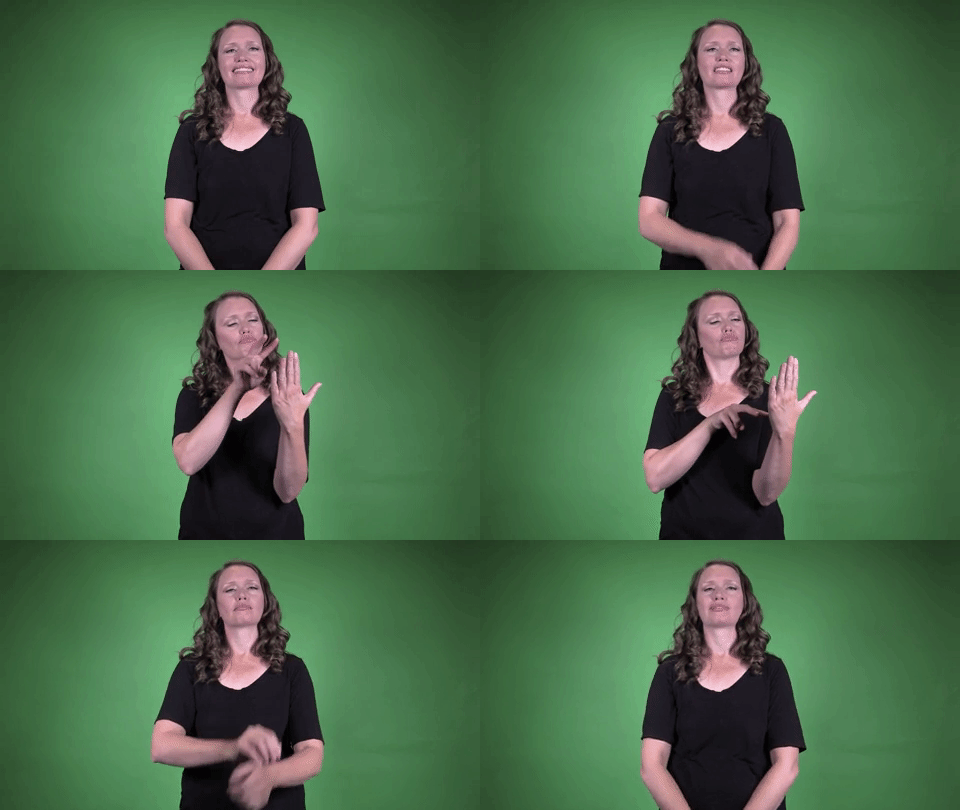
Sign for READ in ASL | ASL Dictionary

Definition: To look at and comprehend the meaning of written or printed matter. Sign for READ in ASL
YouTube player

Practice Activities

To master the sign for READ in ASL, start by practicing in front of a mirror. This will help you see your handshape, movements, and facial expressions clearly. Pay special attention to the dominant hand forming a “V” shape (as if it’s the eyes) and moving down the non-dominant palm, which represents a page or surface. Recording yourself signing the word in different contexts is another valuable tool. Play back your video to spot inconsistencies in movement or positioning. Compare your sign for READ in ASL with videos from reliable ASL resources to refine your technique. Use contextual signing by incorporating the sign into full sentences. For example, sign phrases like “I like to read books” or “He is reading a newspaper.” Switching between isolated sign practice and full-sentence usage builds fluency and helps you remember the sign more effectively. Advance to interactive drills with peers or tutors. Try receptive practice, where someone signs a sentence to you, and you identify when the sign for READ in ASL appears. Conversely, produce expressive drills where you describe a reading activity using the correct sign within a full ASL sentence structure. To deepen your retention, label reading materials around your home and sign the word each time you interact with them. Whether it’s a novel, a cereal box, or a phone screen, these real-world connections make the sign for READ in ASL more meaningful and automatic.

SEO Cultural Context

The sign for READ in ASL is deeply rooted in the Deaf community’s emphasis on literacy and visual learning. Reading is not only a key academic skill but also a vital part of daily life in Deaf culture, where written English often complements ASL communication. Deaf culture values language access, and reading is often a bridge between ASL and written English. The sign for READ in ASL reflects this connection by visually representing the act of the eyes scanning a page. The movement of the dominant “V” hand over the non-dominant palm mimics the way eyes move across lines of text. Regional variations may appear in how the movement is performed—some signers use a straight vertical motion, while others might add a slight zigzag to show scanning. These differences are acceptable, and both are easily understood within the Deaf community. In real-life situations, the sign for READ in ASL is used in educational settings, social conversations, news sharing, and storytelling. Whether discussing a favorite book or giving classroom instructions, this sign appears frequently and is essential for full participation in ASL discourse. Understanding the sign’s cultural context also means appreciating that Deaf children are often encouraged to read early and frequently. Teachers and parents in Deaf households use the sign for READ in ASL as part of daily routines to foster a love of learning and language.

Extended Definition

The sign for READ in ASL involves both hands. The non-dominant hand is held vertically, palm facing inward, representing a page or text. The dominant hand forms a “V” shape, symbolizing the reader’s eyes. The V-hand moves down the palm in a straight or slightly wavy line, indicating the motion of reading. This sign is part of a family of signs involving literacy and learning. For example, the sign for WRITE in ASL uses a different handshape and movement but also involves the non-dominant hand as a surface. Understanding the contrast between these signs helps clarify their meanings. A common error is confusing the direction of movement or using the wrong handshape. Some beginners might use a flat hand instead of a “V” for the eyes, which can change the meaning. It’s also important to keep the movement smooth and purposeful—jerky or rushed signing can make the sign less clear. Another sign that learners sometimes confuse with READ is LOOK-AT. While both use the “V” handshape, LOOK-AT is directed outward toward an object, not down on the palm. Paying close attention to context and spatial orientation helps distinguish these signs. The sign for READ in ASL can also be modified slightly in storytelling or poetic contexts to show different types of reading—like reading quickly, scanning, or reading deeply. These expressive variations are part of the rich visual grammar of ASL.

Tips for Beginners

When learning the sign for READ in ASL, don’t worry about being perfect right away. Focus on getting the basic handshape and movement correct. Use a mirror or video feedback to compare your sign with native signers. One common mistake is reversing the dominant and non-dominant hands. Always use your dominant hand to form the “V” shape, and your non-dominant hand as the page. Practicing this consistently will prevent confusion later on. New learners sometimes move the “V” hand too quickly or too far from the palm. Keep the movement close and deliberate. You want it to appear as if your fingers are truly scanning the page. Take your time and practice slowly. Speed will come with repetition. The sign for READ in ASL is used often in conversation, so you’ll have plenty of opportunities to master it over time. Finally, don’t isolate your learning. Try to practice with others or join ASL study groups online or in your community. Seeing how others use the sign for READ in ASL in full sentences will boost your confidence and comprehension.

Connections to Other Topics

The sign for READ in ASL is closely related to the sign for BOOK. Both involve the concept of written language, and they are often used together in phrases like “read a book” or “book reading.” Practicing these signs together builds thematic vocabulary. Another related sign is LEARN. While LEARN involves a different hand movement (moving information from the palm to the forehead), both signs are used in educational contexts and often appear in classroom discussions. WRITE is another sign that connects directly to READ. These two represent the input and output of language in written form. Understanding both helps learners discuss tasks like reading assignments or writing reports in ASL. The sign for STUDENT also pairs well with READ. In ASL, a student is someone who learns or studies, often involving reading. Practicing these signs together helps build sentences about school and learning. Finally, the sign for SCHOOL is a foundational concept that connects with READ. Whether discussing school subjects, reading times, or homework, these signs often appear together. Building fluency with this set of signs enhances your ability to communicate about academic life in ASL.

Lengthy Summary

The sign for READ in ASL is more than just a vocabulary word—it’s a visual representation of how Deaf culture values literacy, education, and language access. It features a “V” handshape to represent the eyes scanning the palm of the other hand, which acts like a page. This simple but powerful sign is used every day in conversations about books, school, news, and more. Practicing the sign for READ in ASL through various methods—mirror work, video recording, contextual usage, and advanced drills—helps you build both confidence and accuracy. Whether you’re signing alone or with others, integrating this sign into full sentences will reinforce your understanding and fluency. From a cultural perspective, this sign reflects the importance of reading and visual learning in the Deaf community. It’s used in homes, classrooms, and storytelling sessions, each time reinforcing the connection between ASL and written English. Regional variations add flavor to the sign, but the core meaning remains universally understood. Beginners can take comfort knowing that common mistakes—like incorrect handshape or reversed hands—are easy to fix with consistent practice. Watching skilled signers and engaging in community learning opportunities will help you refine your signing and avoid errors. The sign for READ in ASL also connects to a broader web of related vocabulary, including BOOK, WRITE, LEARN, STUDENT, and SCHOOL. Learning these together enhances your ability to express complex thoughts and participate in educational conversations. By mastering the sign for READ in ASL, you’re not only learning a useful word—you’re stepping into a world where visual language opens doors to knowledge, connection, and culture. Keep practicing, stay curious, and use every opportunity to sign with clarity and purpose. Your journey in ASL is just beginning—keep those hands moving and your eyes open! Synonyms: view, comprehend, peruse, decipher, scan Educational resources: Find related learning materials in our course bank! Want more? Check out some of our popular learning activities on the homepage! Need to look up a sign? Use our highly rated dictionary: https://aslinteractive.com/best-asl-dictionary/ Follow us on tiktok: https://www.tiktok.com/@aslinteractive. More social media links at the bottom of this page! Long-tail Keywords: what is the sign for read in ASL, how do you sign read in ASL, read in American Sign Language Categories: tags: reading signs, ASL education, learning to read in ASL, American Sign Language vocabulary, literacy in ASL

Want more? Check out some of our popular learning activities!

ASL Interactive Resources

ASLInteractive YouTube Channel

Follow us on tiktok: @aslinteractive.com

Follow us on Instagram: aslinteractive

Facebook page: aslinteractive

Facebook group: aslinteractive

LInkedIn: ASL Interactive LLC

Twitter: @ASL_interactive

*Some information on this page is AI-generated. AI can make mistakes. Please check the information.  

Responses