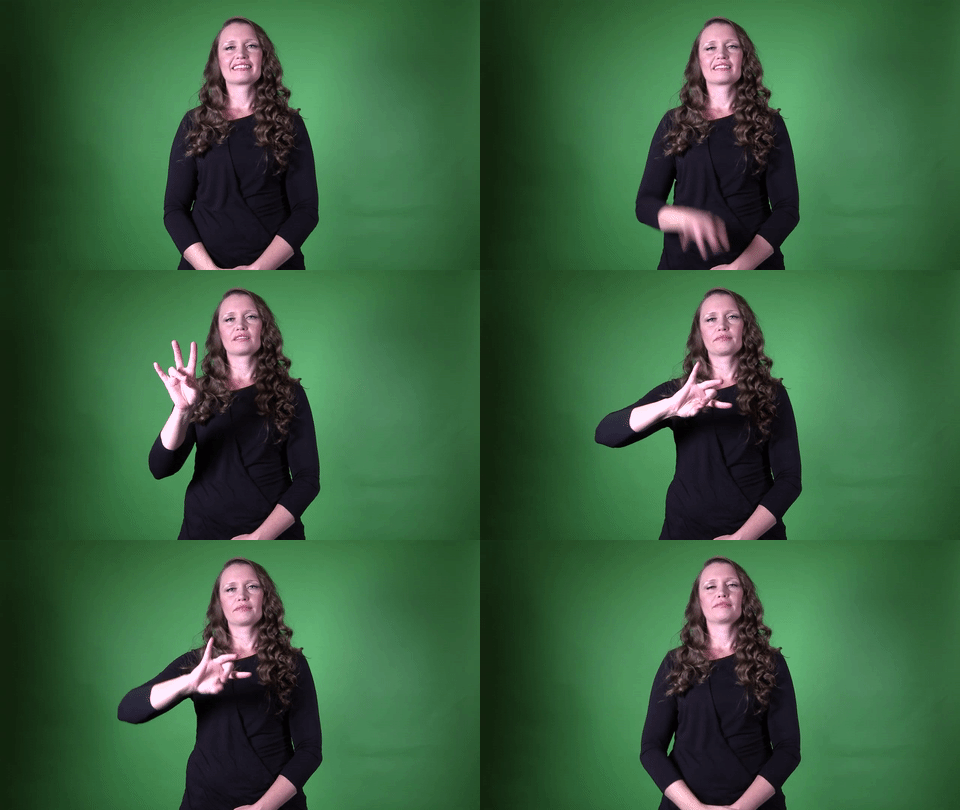
Sign for SEVENTY-EIGHT in ASL | 🔢 ASL Dictionary

Definition: The number seventy-eight

Sign for SEVENTY-EIGHT in ASL

YouTube player

Practice Activities:

To practice the sign for seventy-eight in ASL, begin by signing it slowly and carefully multiple times in front of a mirror. Observe your handshape transitions and ensure fluidity between the numbers. Try signing it with both your dominant and non-dominant hand to build coordination, even though only the dominant hand is typically used in number signs.

Use the sign for seventy-eight in ASL in real-world contexts. Count aloud from seventy to eighty, emphasizing seventy-eight each time. Create a list of numbers that include seventy-eight and sign them randomly, challenging yourself to recognize and produce the correct number quickly.

Practice incorporating the sign into simple sentences such as “My grandmother is seventy-eight years old” or “The book costs seventy-eight dollars.” Write down five different sentences involving seventy-eight and sign them in front of a partner or record yourself to check accuracy.

Engage in a storytelling activity where seventy-eight is a key number. For example, tell a short story about a person who buys seventy-eight balloons or a student who answers seventy-eight questions on a test. Challenge a partner to watch and respond with a sentence using seventy-eight.

Play a number guessing game with a partner where one person signs a number and the other must guess what it is. Include seventy-eight frequently to reinforce its recognition. Mix it with other similar numbers like seventy-seven and seventy-nine to sharpen precision.

For an advanced activity, explore signing math problems that include seventy-eight, such as “seventy-eight plus twenty-two equals one hundred.” Practicing numbers within equations helps reinforce fluency. Pair with a partner and take turns asking and answering math-related questions using ASL.

Cultural Context:

The sign for seventy-eight in ASL follows the common pattern for ASL number signs. It combines the number seven and the number eight in a smooth, fluid motion. This natural transition makes it easy to recognize and understand in signed conversations.

Numbers in ASL, including the sign for seventy-eight in ASL, are an essential part of everyday communication. They are used for giving ages, addresses, prices, and many other daily interactions. Understanding ASL numbers helps improve fluency and makes signing conversations more natural.

When signing seventy-eight in ASL, facial expressions and hand transitions play a role in clear communication. The movement should be fluid to maintain the visual clarity of the number. Proper positioning of the hand ensures that the sign is easy to recognize.

ASL numbers, including seventy-eight, are often used in various cultural and community settings. Deaf sports teams, events, and classrooms frequently use numbers for scores, dates, and lessons. Mastering number signs enhances overall ASL comprehension and engagement.

Different regions or signers may have slight variations in the way they sign seventy-eight in ASL. Some may sign the transition quickly, while others adopt a slightly slower movement for clarity. Exposure to different signing styles helps improve comprehension and adaptability.

Signed numbers like seventy-eight are also useful when discussing statistics, measurements, and identification numbers. In professional settings, ASL users rely on accurate number signs for sharing important details. Learning and using them correctly enhances effective communication in all aspects of life.

The sign for seventy-eight in ASL is part of the broader system of ASL numerical sequences. Becoming skilled in ASL numbers allows signers to engage in conversations about dates, addresses, and events without confusion. Learning the correct formation of number signs supports overall fluency.

When learning to sign seventy-eight in ASL, consistency in handshape and movement is key. Watching native ASL users sign numbers can be helpful for mastering the transitions. Practicing regularly will make signing natural and effortless.

Numbers in ASL, including the sign for seventy-eight, are an important part of the language’s visual nature. They follow patterns that make them easy to learn and use in different contexts. Recognizing number signs quickly improves overall ASL proficiency.

The sign for seventy-eight in ASL is useful in personal, educational, and professional interactions. Whether discussing prices, ages, or addresses, this number sign appears in many everyday conversations. Becoming fluent in ASL numbers helps ensure clear

Extended Definition:

The sign for seventy-eight in ASL follows the standard pattern for forming numbers in American Sign Language. It is a combination of the signs for seventy and eight, made in a smooth transition. This number sign is commonly used in conversations related to age, money, measurements, and counting.

When signing seventy-eight in ASL, begin with the handshape for the number seventy. This involves making the number seven with the fingers and then smoothly transitioning to the handshape for eight. Maintaining a fluid motion helps ensure clarity and natural expression.

Handshape and movement are key when producing the sign for seventy-eight in ASL. The seven is formed by touching the thumb to the ring finger, followed by shifting the hand into the eight shape, where the thumb touches the middle finger. Practicing the transition between these two numbers can help with fluidity and accuracy.

Facial expressions and context play an important role when using the sign for seventy-eight in ASL. When referring to an amount of money, a slight head movement or a facial expression may help clarify meaning. In mathematical discussions, signing at a steady pace can improve understanding.

The sign for seventy-eight in ASL is commonly used in daily conversations, especially when discussing quantities or numerical values. Whether talking about seventy-eight dollars, seventy-eight years, or seventy-eight items, ensuring the sign is clear and accurate helps effective communication. Many numbers in ASL follow this combination pattern, making memorization easier.

ASL numbers are an essential part of communication for counting, pricing, and sharing important details. Numbers like seventy-eight are frequently used by students, professionals, and interpreters in various settings. Using correct handshapes and movements ensures that the sign is understood properly.

In ASL, consistency in signing numbers is important for comprehension. The sign for seventy-eight in ASL should be practiced with attention to clarity and movement. Watching experienced signers and using repetition can help improve fluency with number signs.

Learning to sign numbers, including seventy-eight in ASL, builds confidence in using American Sign Language effectively. Memorizing the number sequences for seventy through seventy-nine makes counting easier. Becoming comfortable with transitions between numbers enhances overall signing skills.

Whether in casual conversations or formal interactions, the sign for seventy-eight in ASL is useful in many contexts. Practicing the number sequences in ASL helps develop accuracy and ease. Using facial expressions and maintaining fluid movements adds to clear communication.

Synonyms: seventy-eight, number seventy-eight, number 78, the number 78, the number seventy-eight

Educational resources: Find related learning materials in our course bank!

Want more? Check out some of our popular learning activities on the homepage!

Need to look up a sign? Use our highly rated dictionary: https://aslinteractive.com/best-asl-dictionary/

Follow us on tiktok: https://www.tiktok.com/@aslinteractive. More social media links at the bottom of this page!

Long-tail Keywords: what is the sign for seventy-eight in ASL, how do you sign seventy-eight in American Sign Language, ASL sign for seventy-eight

Categories: Numbers – Basics, Numbers 71-80, cardinal numbers

tags: Numbers, Numbers 76-80, Numbers 76 78 79, Rocking Numbers, Language Learning

Parameters

*Handshape*:

The sign for seventy-eight in ASL uses a changing handshape. It begins with the number 7 handshape, where the index and middle fingers extend while the thumb touches the ring finger. The hand transitions smoothly into the number 8 handshape, curling the thumb and middle finger together. This fluid movement ensures clarity and accuracy when signing the sign for seventy-eight in ASL, making it easily recognizable in conversation.

*Palm Orientation*:

The palm orientation for the sign for seventy-eight in ASL starts with the dominant hand facing outward with the number seven formed. The palm remains forward while transitioning smoothly to the number eight. The movement should be fluid, maintaining a consistent palm orientation throughout. The hand stays relaxed with fingers slightly curved as the transition between the two numbers occurs. This helps keep the sign for seventy-eight in ASL clear and easy to recognize.

*Location*:

The sign for seventy-eight in ASL is made in the neutral signing space, typically in front of the torso. The dominant hand begins by forming the number seven with the palm facing outward, then smoothly transitions into the number eight. This movement is fluid, ensuring clarity while maintaining the natural flow of numbers in ASL. The sign for seventy-eight in ASL should be performed with relaxed fingers and a steady hand for accuracy.

*Movement*:

To produce the sign for seventy-eight in ASL, start with the number seven by extending the index and middle fingers while touching the thumb to the ring finger. Then smoothly transition into the number eight by forming an “8” handshape, where the thumb and middle finger make contact. This movement should be fluid and natural, maintaining a steady position in front of the body. Keep a relaxed posture and ensure clear hand transitions for accuracy.

*Non-Manual Signals*:

When using the sign for seventy-eight in ASL, maintain a neutral or slightly focused facial expression to ensure clarity. If expressing emphasis or clarification, slightly raise your eyebrows . Keep your mouth relaxed or slightly form the number as spoken in English, depending on the context. Eye gaze should remain directed toward the signing space or the conversation partner for engagement. Avoid excessive head movements to maintain the fluency of the sign.

*Prosody, Dominant/Non-Dominant Hand*:

The sign for seventy-eight in ASL is produced using the dominant hand. Start with the number 7, where the index and middle fingers form a “V” while the thumb extends outward. Then, smoothly transition to the number 8 by curling the thumb and middle finger together while the other fingers remain extended. The hand remains in a stationary or slightly forward-moving position. Facial expressions remain neutral unless emphasizing quantity. ✋

Tips for Beginners:

When learning the sign for SEVENTY-EIGHT in ASL, focus on smooth number transitions. This sign is a combination of SEVENTY and EIGHT, requiring a clear and accurate shift between handshapes. Begin by forming the SEVEN handshape, with the thumb and ring finger touching. Then transition smoothly into the EIGHT handshape by shifting the contact so the thumb touches the middle finger.

Hand stability is key when practicing the sign for SEVENTY-EIGHT in ASL. Try to avoid unnecessary movement or bouncing between the two numbers—each transition should be fluid and controlled. Keep your wrist steady and focus on moving only the necessary fingers to maintain clarity. If you feel stiffness, relax your hand and practice slowly before increasing your speed.

A common mistake when signing SEVENTY-EIGHT is mixing up fingers during the transition. Beginners may rush and accidentally revert to the wrong number before fully forming the eight. Practicing in front of a mirror or recording yourself can help identify any errors. If you struggle with maintaining accuracy, break the sign into two separate motions and then gradually blend them.

Context matters when using the sign for SEVENTY-EIGHT in ASL. Number signs can sometimes look similar, so ensure you use deliberate movements and a confident handshape. If the number still feels awkward, try practicing other 70-series numbers, such as seventy-five or seventy-nine, to build familiarity. Repetition is key to mastering number transitions.

Finger dexterity plays a significant role in signing numbers accurately. If your fingers feel tight or uncoordinated, warm up with gentle hand stretches before practicing. Strengthening your fine motor control will improve the accuracy and speed of your number signs. With patience and consistency, the sign for SEVENTY-EIGHT in ASL will become second nature.

Connections to Other topics:

The sign for seventy-eight in ASL follows a common numbering pattern used for two-digit numbers in the 70s. This connection to other two-digit numbers helps learners recognize similar hand transitions in signs like seventy-six, seventy-seven, and seventy-nine. Understanding these structured patterns builds a strong foundation for signing numbers fluently and accurately in conversation.

Numbers in ASL are deeply connected to other concepts, such as age, money, and time. The sign for seventy-eight in ASL could appear in contexts like discussing a person’s age, a price amount, or even a historical event that took place in 1978. Learning how numbers integrate into everyday conversations ensures clear communication and avoids confusion when conveying numerical information.

Ordinal numbers also connect with cardinal numbers like seventy-eight. While cardinal numbers refer to quantity, ordinals such as seventy-eighth involve ranking or order. These forms are frequently used in competitions, addresses, and sequences of events, making them essential for discussions that require specific positioning or ordering.

Numbers frequently combine with classifiers or quantity signs in ASL. If someone is referencing a group of seventy-eight people or objects, the signer may pair the number with a classifier that provides more context. Classifiers help clarify meaning beyond just numerical value, ensuring that the visual-spatial aspects of ASL remain cohesive.

Signed numbers are also central in mathematical discussions, banking, and measurements. The sign for seventy-eight in ASL might appear when signing percentage figures or measurements in a science or business setting. Mastery of numbers in ASL enables more natural conversations in financial, academic, and statistical discussions, reinforcing the versatility of numerical signs.

Summary:

The sign for seventy-eight in ASL follows a pattern commonly seen in numbers between sixty and ninety-nine. It involves a smooth transition from one numeral handshape to another. This movement is key to efficiency and fluency in numerical ASL communication.

To form the sign for seventy-eight in ASL, begin with the hand in the “7” handshape. The thumb and ring finger make contact while the other fingers remain slightly extended. Then, transition into the “8” handshape by bringing the middle finger and thumb together while slightly retracting the other fingers.

The transition between these two handshapes should be fluid. Maintaining smoothness in the transition ensures clarity for the viewer. Slight pauses or hesitations in the movement can cause confusion, particularly for numbers with similar structures.

Numbers in ASL have subtle variations based on regional accents or signer preference. Some signers might execute the transition more sharply, while others allow for a more rounded shift between digits. Regardless, clarity should be prioritized over speed to ensure the number is comprehensible.

The sign for seventy-eight in ASL falls within the larger numerical system of signed numbers. In common usage, it appears in addresses, statistics, monetary amounts, and measurements. Signers should be aware of context so they can clearly convey whether they are discussing a quantity, price, or identifying number.

Cultural context can impact how numbers are used in ASL. In everyday conversations, numbers often appear rapidly, relying on not only the handshapes but also the signer’s facial expressions or topic framing. For example, a poker dealer signing seventy-eight would likely use a precise, deliberate movement to avoid ambiguity.

In educational or interpreting settings, ensuring clear numerical comprehension is essential. An interpreter might need to sign seventy-eight distinctly when conveying dates, test scores, or legal information. In cases requiring extreme precision, fingerspelling the number might also be used for added clarity.

Linguistically, number signs in ASL exhibit morphological consistency. The transition movement from seventy to eight follows the same principle that governs other compound number signs, where each morpheme maintains its distinct meaning while blending into the unit. ASL numbers, similar to other signs, involve both manual and non-manual markers, depending on emphasis and usage.

Grammatically, numbers in ASL sometimes require adjustments depending on sentence structure. The sign for seventy-eight in ASL might be repeated or slightly modified when used in lists, comparisons, or emphasis. When enumerating items, the number may be accompanied by a pointing motion or a classifier for specificity.

Numerical signs serve as a fundamental part of broader ASL communication. The use of numbers like seventy-eight extends to financial transactions, birthdays, sports statistics, and other practical applications. Many advanced ASL users develop a style that allows for rapid number production while maintaining readability.

Context also determines whether a signer uses a single sign for seventy-eight or separates the digits explicitly. For example, phone numbers are often presented digit by digit rather than through the standard numerical transition. Conversely, statistics or retail transactions often favor the compound number sign form.

The handshapes used in the sign for seventy-eight in ASL are part of the standard number system. However, they also appear in other commonly used signs. The “7” handshape frequently occurs in ranking signs, percentages, and military designations. The “8” handshape appears in signs like “favorite” and “important,” demonstrating its versatility in ASL lexicon.

In fast-paced conversations, ASL users often execute numerical signs with slight modifications. This can include faster transitions or smaller movements to accommodate the flow of conversation. While this approach improves efficiency, excessive abbreviation may result in misunderstandings for newer signers or those unfamiliar with a particular signer’s style.

ASL numbers follow specific phonological rules that ensure clarity and consistency. Each number follows a prescribed set of handshapes and locations to maintain visual comprehensibility. The combination used in the sign for seventy-eight in ASL adheres to this standardized framework, ensuring that ASL remains an efficient visual language.

Facial expressions and contextual cues often accompany numerical signs. A signer conveying a high score or a significant statistic may use raised eyebrows or a slight head nod when signing seventy-eight. These non-manual markers serve as an equivalent to vocal emphasis in spoken language.

Deaf culture places high value on clarity and efficiency in signed communication. Numerical precision often plays a crucial role in storytelling, historical accounts, and even jokes within the Deaf community. Whether discussing ages, dollar amounts, or years, signers strive for accuracy to keep narratives understandable and engaging.

Many ASL learners initially struggle with rapidly forming numerical transitions. Hand dexterity and muscle memory play an essential role in mastering fluid number signs. Practicing the transition between seventy and eight repeatedly can enhance comfort and speed in execution.

Advanced ASL users may develop unique stylistic variations when signing numbers.

Want more? Check out some of our popular learning activities!

ASL Interactive Resources

ASLInteractive YouTube Channel

Follow us on tiktok: @aslinteractive.com

Follow us on Instagram: aslinteractive

Facebook page: aslinteractive

Facebook group: aslinteractive

LInkedIn: ASL Interactive LLC

Twitter: @ASL_interactive

*Some information on this page is AI-generated. AI can make mistakes. Please check the information.

Sign for THE NUMBER SEVENTY-EIGHT in ASL, Sign for 78 in ASL, Sign for NUMBER SEVENTY-EIGHT in ASL, Sign for SEVENTY-EIGHT in ASL

Responses