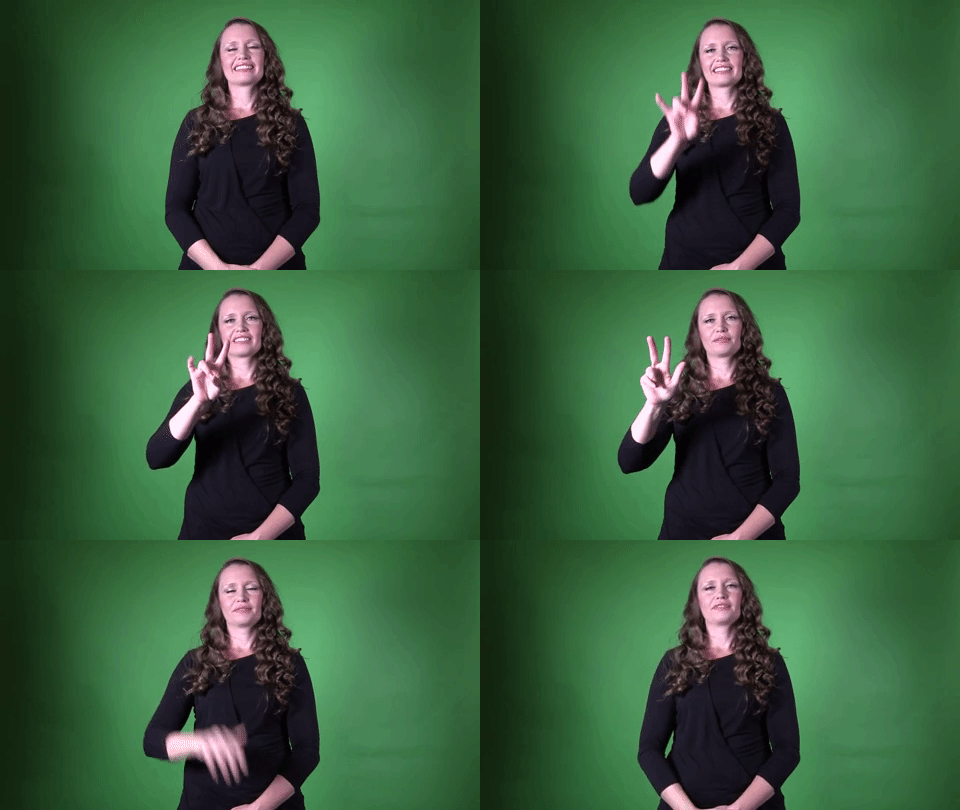
Sign for SEVENTY-THREE in ASL | 🔢 ASL Dictionary

Definition: The number seventy-three

Sign for SEVENTY-THREE in ASL 

YouTube player

Practice Activities:

To practice the sign for seventy-three in ASL, start by signing the numbers in sequence from seventy to seventy-five, making sure to maintain fluid motion between each. Focus on proper handshape and smooth transitions to reinforce muscle memory. Repeating this sequence will help solidify recognition and production of seventy-three accurately.

Use a mirror or a video recording to check your sign for seventy-three in ASL. Observe your hand movements, making sure your transitions between the numerals are clear and distinct. Compare your signing with ASL resources or a fluent signer to ensure accuracy.

Practice using seventy-three in counting exercises. Count aloud while signing numbers from one to one hundred, pausing at seventy-three to emphasize it. Try counting backward from one hundred, ensuring precision when signing each digit.

Incorporate seventy-three into real-world scenarios. Imagine you are discussing someone’s age, the price of an item, or a street address. For example, you could sign: “My grandfather is seventy-three years old” or “That costs seventy-three dollars.” These exercises help reinforce number recognition in conversation.

Engage in a partner activity where one person says a random number between seventy and seventy-nine, while the other signs the correct number. This back-and-forth practice improves speed and accuracy in identifying and signing numbers quickly.

Create a short story incorporating seventy-three. For example, describe a person who has lived for seventy-three years or talk about someone collecting seventy-three items. Telling a story while incorporating the number helps improve fluency and recall.

Play a number recognition game with a group. One person signs a number while others guess it, ensuring everyone gets experience both signing and recognizing seventy-three among other numbers. Repeating this exercise strengthens visual and expressive skills in ASL numbering.

Cultural Context:

The sign for seventy-three in ASL follows a common pattern used in American Sign Language for numbers in the seventy range. This number is signed using a fluid movement of the hand, combining the digits seven and three in a way that makes it clearly identifiable. Learning the sign for seventy-three in ASL helps improve number comprehension and recognition in everyday communication.

Numbers play a vital role in ASL, just as they do in spoken languages. The sign for seventy-three in ASL is part of a structured system that allows for efficient communication of numerical values. Mastering these number signs allows Deaf and hard-of-hearing individuals to share dates, ages, prices, and more with ease.

While fingerspelling is often used for words, number signs have their own unique movements that make them distinct. The sign for seventy-three in ASL has a rhythmic transformation between the numbers seven and three, which makes it visually clear. Understanding the proper handshape and movement ensures clarity when using numerical signs in conversation.

Numbers in ASL carry cultural significance within the Deaf community. The sign for seventy-three in ASL may come up in discussions about years, statistics, or personal experiences. Whether discussing historical events or everyday transactions, knowing this sign enhances fluency and comprehension.

Consistent practice is essential to mastering ASL numbers. The sign for seventy-three in ASL, like other numbers, requires precise hand positioning and movement. Watching fluent signers and engaging in real conversations can reinforce understanding and confidence in using this and other numerical signs.

ASL number signs are designed to be intuitive and efficient. The sign for seventy-three in ASL fits into a numeric pattern that makes learning and recall easier. Once you learn the numbering system, signing larger numbers becomes second nature.

Communicating numbers accurately is important in many settings. The sign for seventy-three in ASL may be used in classroom settings, business transactions, or casual chats. Being able to sign numbers correctly ensures clear and effective communication when discussing quantities or values.

Technology and digital communication have made ASL more accessible than ever. The sign for seventy-three in ASL can be reinforced through online videos, ASL courses, and digital dictionaries. The growing presence of ASL resources helps more people become comfortable using numerical signs.

ASL is a living language that continues to evolve. While the sign for seventy-three in ASL remains consistent, teaching methods and accessibility of resources have improved over time. More people are learning ASL, bridging

Extended Definition:

the sign for seventy-three in asl is a two-digit number sign that follows the standard number pattern in American Sign Language. It combines the signs for seven and three in a fluid motion, making it easy to recognize and use in conversations. This number sign is essential when discussing age, quantities, addresses, or financial figures.

to sign seventy-three in asl, start by forming the number seven with your dominant hand. The thumb and ring finger touch while the other fingers extend. Then smoothly transition into the number three, where your thumb, index, and middle fingers stay up while the rest fold down. This movement should be fluid to maintain clarity and accuracy.

mastering the sign for seventy-three in asl is beneficial for both beginners and fluent ASL users. Numbers are a fundamental part of communication, used in daily interactions like telling time, giving measurements, or discussing dates. Practicing number signs helps improve signing speed and comprehension.

in conversations, signing numbers correctly ensures clear communication. When using the sign for seventy-three in asl, maintaining eye contact and using natural facial expressions can enhance understanding. Context is also key, as number signs may have different implications based on the discussion.

variations in signing styles may exist due to regional differences or personal signing preferences. While the standard form is widely understood, some signers may slightly modify their gestures. Observing native signers and engaging in ASL communities can help reinforce proper usage.

learning the sign for seventy-three in asl is an important step in expanding your ASL vocabulary. Whether you’re engaging in academic settings, professional environments, or casual conversations, knowing how to sign numbers correctly improves overall communication. Regular practice and exposure to ASL can help make number signs second nature.

Synonyms: seventy-three, number seventy-three, number 73, the number 73, the number seventy-three

Educational resources: Find related learning materials in our course bank!

Want more? Check out some of our popular learning activities on the homepage!

Need to look up a sign? Use our highly rated dictionary: https://aslinteractive.com/best-asl-dictionary/

Follow us on tiktok: https://www.tiktok.com/@aslinteractive. More social media links at the bottom of this page!

Long-tail Keywords: what is the sign for seventy-three in asl, how do you sign seventy-three in asl, seventy-three in american sign language

Categories: Numbers – Basics, Numbers 71-80, cardinal numbers

tags: Numbers 71-75, Numbers, Language Learning, Mathematics, Education

Parameters

*Handshape*:

The sign for seventy-three in ASL uses a changing handshape. Begin by forming the number seven with your dominant hand, where the index and middle fingers are extended, and the thumb touches the ring finger. Then, transition smoothly into the number three by extending the thumb, index, and middle fingers while the ring and pinky fingers curl down. This movement helps clearly distinguish the numbers in sequence. Make sure the motion is fluid for accuracy.

*Palm Orientation*:

The palm orientation for the sign for seventy-three in ASL starts with the palm facing outward. As the hand transitions between the numbers seven and three, the orientation remains forward, ensuring visibility. The movement is smooth, with the fingers shifting naturally from the seven-handshape to the three-handshape while maintaining a consistent outward-facing direction. Proper palm orientation ensures clarity and accuracy when signing the sign for seventy-three in ASL.

*Location*:

The sign for seventy-three in ASL is produced in the neutral space in front of the body, slightly above waist level. The dominant hand forms a “7” with the palm facing out and then transitions smoothly into a “3” without moving too far from its original location. This movement happens in a single, fluid motion. The hand remains comfortably in front of the signer, ensuring visibility for clear communication.

*Movement*:

To produce the sign for seventy-three in ASL, begin with an open “7” handshape, where the thumb and ring finger touch. Then, smoothly transition to a “3” handshape by extending the index, middle, and thumb while curling in the ring and pinky fingers. The movement is fluid, with a slight wrist movement to emphasize the transition. Keep the motion controlled and clear for proper recognition.

*Non-Manual Signals*:

Facial expressions remain neutral or slightly focused when signing the sign for seventy-three in ASL, ensuring clarity. Eyebrows may lower slightly if emphasizing or confirming the number. Mouth movements are minimal, but some may mouth “seventy-three” for added reinforcement. Maintain relaxed posture and natural eye contact to ensure engagement and fluidity. Positive or negative affect can be added depending on context, such as raised eyebrows for a question or a slight nod to confirm understanding.

*Prosody, Dominant/Non-Dominant Hand*:

The sign for seventy-three in ASL uses the dominant hand, forming the number seven ( with the index and middle fingers extended) followed by the number three ( with the thumb, index, and middle fingers extended). The motion involves a smooth transition between the two numbers, maintaining palm orientation outward. The non-dominant hand is not used in this sign. Facial expressions remain neutral as the numbers shift fluidly from seven to three.

Tips for Beginners:

The sign for SEVENTY-THREE in ASL is a combination of numerical handshapes that transition smoothly between the digits. To form the sign, begin with the number 70 handshape—extend your index, middle, and ring fingers while keeping your pinky and thumb together. Then, transition smoothly into the number 3 handshape by extending your index, middle, and thumb while curling the ring and pinky fingers into the palm. The movement between the two numbers should be fluid and natural.

When learning the sign for SEVENTY-THREE in ASL, focus on keeping your hand position steady and in a comfortable signing space—slightly in front of your dominant shoulder. Avoid excessive movement or exaggerated transitions between handshapes, as this can cause confusion. A smooth change from 70 to 3 makes the sign clear and easy to recognize. It helps to practice in front of a mirror to ensure the shift is clean and precise.

A common challenge is maintaining the correct finger positioning when transitioning from 70 to 3. Some beginners accidentally move too quickly, causing fingers to slip into incorrect positions. Slow down and practice each number separately before blending them together. Another pitfall is signing too close to the body or too far away. Keep your hand at a comfortable distance where others can clearly see the movement.

For better retention, practice the sign for SEVENTY-THREE in ASL along with other numbers in the 70s to build fluency. Try signing sequences like 71 through 75 for smoother hand transitions. Watching native signers and mimicking their technique can also refine your accuracy. The more you practice, the more natural and effortless your signing will become. Keep your fingers relaxed, and don’t rush the movements—clarity is more important than speed.

Connections to Other topics:

The sign for seventy-three in ASL follows the number pattern used for other two-digit numbers in the seventy series. This number is part of the broader numerical system in ASL, where the palm orientation and movement create consistency across numerical signs. Many two-digit numbers in ASL have a natural flow from one handshape to the next, making them easier to learn as a group.

Understanding the sign for seventy-three in ASL helps solidify knowledge of number transitions and handshape variations. The movement pattern used for this number appears in other numerical sequences, reinforcing fluency in signing numbers quickly and clearly. This also connects to time-related numbers such as years, addresses, and phone numbers, where clarity and smooth transitions are essential.

Numbers in ASL often relate to mathematical concepts, age, money, and quantity, making their mastery crucial for daily communication. Practicing the sign for seventy-three in ASL alongside related numbers can help with conversations about calculations, statistics, and measurements. These skills are also useful when sharing information about historical years, sports scores, or large quantities in various contexts.

Beyond numbers, signing seventy-three accurately reinforces handshape transitions that support overall dexterity. Many numerical signs share similarities with other signs in ASL, such as those for ranking, counting, or discussing percentages. This also connects to fingerspelling, where smooth hand movements are essential for clarity and comprehension.

In conversations, numbers like seventy-three often appear in addresses, prices, and dates, making them an important part of daily signing. Learning this sign contributes to a broader understanding of ASL numerical patterns, making it easier to use numbers fluidly in different contexts. Practicing these number signs helps build confidence in both casual and detailed discussions where numerical accuracy is important.

Summary:

The sign for seventy-three in ASL is part of the unique pattern used for signing numbers in the seventy series. It follows the conventional movement of ASL number signs, incorporating handshape changes that denote the specific value. This movement is essential for clarity and to differentiate it from other numbers in the same range.

To form the sign for seventy-three in ASL, begin with the number “7” handshape, where the thumb and ring finger touch while the rest of the fingers remain extended. Then transition smoothly into the “3” handshape, with the thumb, index, and middle fingers extended while the ring and pinky fingers fold down. This change emphasizes the distinction between the digits while maintaining the flow of the sign.

The movement between the two handshapes should be fluid. Quick transitions help maintain the rhythmic pattern of sequential number signing in ASL. Numbers in the seventy series often follow a pattern where the first digit transforms into the second in a single movement.

ASL numbers reflect the visual-spatial nature of the language. The sign for seventy-three in ASL exhibits the efficiency of numeric signing, minimizing redundant movement while ensuring accuracy. The decreasing numerical signs (70–79) are particularly important for counting and listing items clearly.

Expressing the sign for seventy-three in ASL correctly requires proper palm orientation. The palm generally faces outward to ensure visibility for the receiver. Consistency in orientation across number sequences prevents misinterpretation.

Numbers play a significant role in ASL grammar, affecting quantification and specificity. The sign for seventy-three in ASL is commonly used in counting, dates, prices, and addresses. It may also appear in athletic scores, statistics, and mathematical references.

ASL has a systematic approach to numbers, and higher numbers often follow the patterns established by lower ones. The transition between digits in seventy-three mirrors the logic found in 23, 43, or 53. This makes learning larger numbers more intuitive for students of ASL.

The efficient structuring of numerical signs in ASL makes communication effective for both Deaf and hearing users. The sign for seventy-three in ASL, like other numbers, allows for rapid exchange of numerical information. This is particularly useful in educational and financial contexts.

Culturally, ASL numbers are deeply ingrained in everyday communication within Deaf communities. Expressing numbers clearly is vital for meetings, lectures, and social conversations. The sign for seventy-three in ASL is part of a larger numeric system that facilitates smooth communication.

When teaching ASL numbers, instructors emphasize the importance of smooth transitions. Students learning the sign for seventy-three in ASL must practice maintaining fluidity. Hesitation or stiff movements can disrupt understanding.

The linguistic structure of ASL numbers is a topic of interest in applied linguistics. The numerical system in ASL exhibits handshape economy, reducing unnecessary complexity. The sign for seventy-three in ASL demonstrates how ASL follows principles of visual efficiency.

Understanding the numerical system in ASL helps students recognize patterns quickly. The sign for seventy-three in ASL serves as an example of how larger numbers are built from basic numerical units. This reinforces logical structuring in ASL learning.

Numerical fluency in ASL is just as critical as fluency in everyday words. The ability to sign numbers rapidly and accurately enhances overall communication. The sign for seventy-three in ASL plays a role in fostering precise numerical articulation.

Signs for multi-digit numbers rely on automaticity in handshape recognition. Mastering individual number signs makes learning larger numbers simpler. Consistently practicing the sign for seventy-three in ASL aids in solidifying numerical skills.

Sports events, cash transactions, and date references often require fast number signing. The sign for seventy-three in ASL is just one of many signs that facilitate these interactions. Clarity and speed are essential for effective numerical exchanges.

In professional environments, numerical signing is crucial for relaying statistics and data. The sign for seventy-three in ASL may be used in areas such as business, education, and science. Consistency in signing ensures accuracy in formal settings.

Numbers are frequently fingerspelled when special emphasis is needed. Although the sign for seventy-three in ASL is distinct, some may choose to spell it for added clarification. This technique appears in formal writing or presentations.

Different signing styles exist depending on a signer’s background or region. While the sign for seventy-three in ASL follows a standard pattern, minor variations may occur. Regional differences in signing, though rare for numbers, are always worth noting.

ASL number signs are typically used without additional facial expressions. However, non-manual markers can indicate quantity emphasis. The sign for seventy-three in ASL may be emphasized with a head nod or slight eyebrow movement.

Number signs must be clear and unambiguous, especially when communicating precise data. The sign for seventy-three in ASL benefits from careful hand positioning.

Want more? Check out some of our popular learning activities!

ASL Interactive Resources

ASLInteractive YouTube Channel

Follow us on tiktok: @aslinteractive.com

Follow us on Instagram: aslinteractive

Facebook page: aslinteractive

Facebook group: aslinteractive

LInkedIn: ASL Interactive LLC

Twitter: @ASL_interactive

*Some information on this page is AI-generated. AI can make mistakes. Please check the information.

Sign for THE NUMBER 73 in ASL, Sign for NUMBER 73 in ASL, Sign for THE NUMBER SEVENTY-THREE in ASL, Sign for NUMBER SEVENTY-THREE in ASL, Sign for SEVENTY-THREE in ASL 

Responses