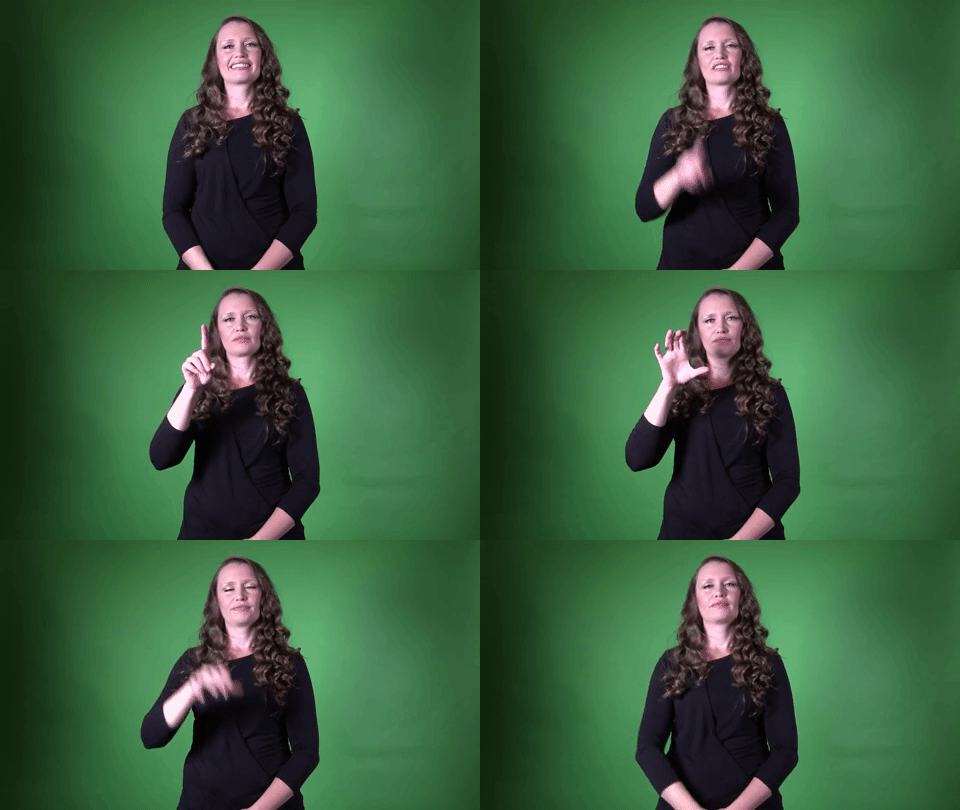
Definition: Refers to the number one hundred
Sign for THE NUMBER 100 in ASL
Practice Activities:
To practice the sign for the number 100 in ASL, start by signing it slowly and clearly in front of a mirror. Pay attention to finger positioning and movement. Repeat the sign multiple times to build muscle memory and ensure fluency.
Try incorporating the sign for the number 100 in ASL into counting exercises. Count by hundreds starting from 100 to 1000, signing each number clearly. You can also practice by signing random hundred-based numbers, such as 100, 300, 700, and 900, alternating the order to challenge yourself.
Create example sentences using the sign for the number 100 in ASL. For instance, sign phrases like “I have 100 dollars,” “The school has 100 students,” or “He ran 100 miles.” Practice signing these sentences slowly at first, then increase speed as you become more comfortable.
Engage in partner activities by asking a friend to quiz you on numbers involving 100. Have them show you a written number, and you must sign it correctly. You can also reverse the roles, where you sign a number and they write it down or say it aloud to verify accuracy.
Use storytelling to include the sign for the number 100 in ASL. Create a short story that involves 100 in some way, such as “I went to the store and bought 100 apples” or “The building is 100 years old.” Sign the story smoothly, ensuring proper number placement.
Incorporate the sign for the number 100 in ASL into daily life. When checking the price of items or counting out loud, sign 100 whenever it appears. This will help reinforce understanding and improve recall. Practice regularly to build confidence and ensure accuracy in real conversations.
Cultural Context:
The sign for the number 100 in ASL is an essential part of American Sign Language numbering. It is commonly used in daily conversations, education, and financial transactions. Understanding the sign for the number 100 in ASL helps deaf and hard-of-hearing individuals communicate numerical values clearly.
Numbers are fundamental in ASL, and the sign for the number 100 in ASL follows a structured pattern. Learning this sign is useful for discussing money, measurements, and mathematics. It is also frequently used in historical dates, sports scores, and large quantities.
The ASL numbering system has a logical flow based on handshape and movement. The sign for the number 100 in ASL incorporates the transition between the number 1 and the concept of 100. Mastering this sign ensures effective communication in both formal and informal settings.
In educational settings, the sign for the number 100 in ASL is crucial for teaching math concepts. Teachers, interpreters, and students frequently use this sign for counting and calculations. Knowing this sign makes it easier to understand larger numbers and numerical patterns.
Cultural context plays an important role in ASL, especially with numbers. The sign for the number 100 in ASL is widely recognized and used in everyday conversations. It is often seen in discussions about achievements, milestones, and financial transactions.
In Deaf culture, using accurate number signs is important for clear communication. The sign for the number 100 in ASL appears in discussions about school grades, business transactions, and sports. Fluency in ASL numbers, including 100, strengthens overall communication skills.
American Sign Language relies on consistency and clarity when signing numbers. The sign for the number 100 in ASL follows a standard format that aligns with ASL number rules. Practicing this sign helps build confidence in using ASL for various situations.
Many people learning ASL focus on mastering number signs early. The sign for the number 100 in ASL is one of the milestones in numerical fluency. It is useful in daily communication, shopping, and discussing statistics.
ASL learners benefit from practicing numbers in context. The sign for the number 100 in ASL can be combined with other numbers to express larger values. Understanding this sign helps with interpreting signs in news reports, presentations, and classroom discussions.
Knowing the sign for the number 100 in ASL enhances overall language skills. It allows for more precise communication in professional and social environments. Practicing
Extended Definition:
The sign for the number 100 in ASL is an essential part of learning American Sign Language numbers. Understanding how to sign numbers correctly helps with communication in everyday conversations, math, and financial discussions. Whether you are counting, discussing prices, or teaching numbers, knowing how to sign 100 accurately is useful.
To sign the number 100 in ASL, start by forming the number 1 with your dominant hand, using your index finger. Then, transition into the handshape for 0, which resembles an “O” shape. The movement is smooth and fluid, ensuring clarity and accuracy.
Numbers play a crucial role in ASL, and the sign for the number 100 in ASL follows a logical pattern used for signing hundreds. This pattern makes it easier to learn larger numbers once you understand the base signs. Practicing frequently helps reinforce the motion and handshape.
Recognizing the number signs in ASL is important for both new learners and fluent signers. The sign for the number 100 in ASL is commonly used in various situations, such as discussing age, money, and measurements. Clear and correct signing ensures effective communication in any context.
Learning ASL numbers improves overall signing skills, and understanding the sign for the number 100 in ASL is a great step toward mastering larger numbers. Consistent practice and watching fluent signers can help with learning accuracy. With time, signing numbers will become second nature.
Using correct facial expressions and maintaining fluid hand movements enhances the clarity of signing. The sign for the number 100 in ASL should be performed with confidence and attention to detail. Watching ASL videos or practicing with a fluent signer can improve technique.
Signing numbers efficiently allows for faster and clearer communication. The sign for the number 100 in ASL is foundational for discussing large quantities or values in conversations. Mastering number signs makes it easier to express numerical concepts effortlessly.
American Sign Language relies on precise handshapes and movements to convey meaning. The sign for the number 100 in ASL fits into a structured number system that makes counting and math discussions more accessible. Learning ASL numbers supports broader language development.
Understanding the sign for the number 100 in ASL can help in both casual and professional settings. From school environments to workplace discussions, accurately signing numbers enhances communication. Practicing signing numbers daily builds confidence and fluency.
Expanding ASL vocabulary by learning numbers strengthens overall signing skills. The sign for the number
Synonyms: century, one hundred, 100, hundred percent, 1 hundred
Educational resources: Find related learning materials in our course bank!
Want more? Check out some of our popular learning activities on the homepage!
Need to look up a sign? Use our highly rated dictionary: https://aslinteractive.com/best-asl-dictionary/
Follow us on tiktok: https://www.tiktok.com/@aslinteractive. More social media links at the bottom of this page!
Long-tail Keywords: what is the sign for the number 100 in ASL, how do you sign the number 100 in ASL, what does the number 100 look like in ASL
Categories: Numbers – Basics, Numbers 91-100, cardinal numbers
tags: Numbers, Numbers 91-100, Math, Language Learning, Educational Content
Parameters
*Handshape*:
The sign for the number 100 in ASL starts with the “1” handshape, where the index finger is extended, and the other fingers are curled into the palm. The thumb rests lightly against the side of the hand. The movement transitions into the “C” handshape, curving the index finger and thumb while the other fingers remain slightly bent. This fluid motion represents the number 100 visually. The sign for the number 100 in ASL is performed with one hand in a smooth motion.
*Palm Orientation*:
The palm orientation for the sign for the number 100 in ASL begins with the palm facing forward as the number 1 is formed using the index finger. As the number transitions to 100, the hand moves slightly while forming a “C” shape with the fingers curling inward. The movement is fluid, with the palm shifting slightly to accommodate the formation of the “C” handshape, keeping the motion natural and clear. ✋
*Location*:
The sign for the number 100 in ASL is produced in the neutral space in front of the body. The dominant hand starts in the 1-handshape, with the index finger extended while the other fingers remain folded down. The hand then transitions into a C-handshape, moving slightly in a downward arc. This sign for the number 100 in ASL is commonly used to represent the numerical value and is signed with a smooth motion.
*Movement*:
To sign for the number 100 in ASL, start with the number 1 handshape, extending the index finger while keeping the other fingers curled into the palm. Move the hand slightly forward, then smoothly transition into a “C” handshape by curling the index finger into the thumb, forming the numeral 100. The motion should be fluid and natural, ensuring clarity in communication when using the sign for the number 100 in ASL.
*Non-Manual Signals*:
When signing the number, maintain a neutral yet focused facial expression to ensure clarity. Slightly raise your eyebrows if emphasizing or questioning the value. Your mouth may naturally form the word “hundred” as you sign for the number 100 in ASL.
If conveying certainty, keep a steady gaze and a composed expression. When using the sign for the number 100 in ASL expressively, subtle head movements may add emphasis to indicate importance, surprise, or confirmation.
*Prosody, Dominant/Non-Dominant Hand*:
The sign for the number 100 in ASL uses the dominant hand. Start with the number 1 handshape (index finger extended) and then transition into the C handshape. The movement is a slight arc, changing from the index finger pointing upward to forming the C shape. This transition represents the numerical concept smoothly. The non-dominant hand is not used in this sign. Make sure the motion is fluid to ensure clarity.
Tips for Beginners:
When learning the sign for the number 100 in ASL, start by becoming comfortable with the basic number signs, especially 1 and 0. The sign for the number 100 in ASL typically involves forming the number 1 with your dominant hand and transitioning into a C handshape or a modified 0. Ensure that the movement is smooth and not overly exaggerated to maintain fluency.
Hand positioning is crucial when signing the number 100 in ASL. Keep your palm facing forward when showing the number 1, then smoothly curve your fingers into a C shape. The transition should be natural and not abrupt. Practicing in front of a mirror or recording yourself can help with accuracy.
A common mistake is stiff or exaggerated movements, which can make the sign for the number 100 in ASL look unnatural. Keep your hand relaxed and allow the transition from 1 to C to flow easily. Another issue to avoid is incorrect palm orientation—your palm should face forward for “1” rather than inward.
Context matters when signing numbers in ASL. When signing the number 100 in ASL in a sentence, ensure that your facial expressions and body language align with the meaning. If you’re talking about money, you may modify the placement slightly for clarity. Consistent practice with different numerical contexts will improve comprehension.
Repetition and real-world practice will help reinforce the sign for the number 100 in ASL. Try incorporating it into daily conversations and number drills. Watching fluent signers use numbers in conversation can also improve understanding. The more you practice, the more naturally the sign will come to you.
Connections to Other topics:
The sign for the number 100 in ASL connects to the broader system of number signs, which follow specific patterns in handshapes and movement. The way numbers are signed in ASL depends on their placement within a sentence, their context, and any associated classifiers. The sign for the number 100 in ASL follows a pattern similar to other round numbers like 200 or 500, where the handshape transitions smoothly to indicate numerical value.
Understanding the sign for the number 100 in ASL also helps with larger numerical concepts such as 1,000 and 10,000. Many higher numbers use a combination of base numbers like 1, 10, or 100 with a shifting or repeated movement to indicate multiplication. This method of signing numbers reflects how ASL structures quantities efficiently without needing additional symbols, similar to spoken language inflections.
The sign for the number 100 in ASL can be applied in financial, academic, and storytelling contexts where exact numerical values are important. For example, when discussing percentages, the sign for 100 can combine with the percent sign to indicate 100%. In measurements or money, 100 can appear with classifiers to give specifics about dollars, weights, or distances.
Additionally, number signs including 100 can be used in chronological or milestone contexts, such as “100 years ago” or “100 days until an event.” ASL often simplifies large number expressions with specific movement patterns, making it easier to sign dates, anniversaries, or historical events. The ability to quickly modify number signs helps in both casual and formal conversations.
When learning the sign for the number 100 in ASL, students also become familiar with number incorporation, a feature in signs like “100 dollars” or “100 people.” This demonstrates how ASL integrates numerical values naturally into descriptions rather than requiring separate signs for every possible combination. Mastering these number patterns enhances fluency and improves comprehension when discussing data, statistics, or counting situations.
Summary:
The sign for the number 100 in ASL follows a numerical pattern common in American Sign Language. It combines the sign for the number 1 with a movement that represents the concept of one hundred. This sign is structured to reflect numerical patterns efficiently, mirroring other century-based number signs in ASL.
To perform the sign for the number 100 in ASL, begin by holding up the number 1 with the dominant hand. The index finger should be extended while the other fingers remain curled into the palm, with the thumb resting against the side of the hand. The palm usually faces forward in this initial position.
After establishing the handshape for 1, transition into a “C” handshape. This movement is essential because it visually represents the concept of the hundred marker. The “C” handshape is a common pattern used in ASL for certain round numbers, maintaining consistency in numerical signs.
While changing from the “1” to “C” handshape, a smooth motion should be used. The change usually moves slightly downward or slightly back toward the body. The transition itself reinforces the visual nature of ASL, making it clear that the number being represented is 100 and not simply two separate numbers.
The sign for the number 100 in ASL maintains a logical system of numerical representation. Many numbers in ASL follow a transition rule where a simple handshape is modified to convey a multiple of ten or hundred. This structure helps keep signs clear and efficient when communicating larger values quickly.
In broader ASL numerical patterns, numbers like 200, 300, and beyond follow the same principle. The first digit is signed as usual, and then transitioned into the “C” handshape to indicate the hundred value. This consistency allows ASL users to recognize large numerical values without confusion.
ASL has evolved over time to incorporate efficiency when signing numerical values. This is especially important in contexts such as financial transactions, dates, measurements, and academic discussions. The sign for the number 100 in ASL is an example of this development, demonstrating the language’s practical adaptability.
Context plays a major role in signing numbers accurately. Depending on the situation, the signer may emphasize the transition more distinctly or subtly modify speed and placement. This flexibility ensures clarity across different communication settings, whether casual, academic, or professional.
The cultural significance of the number 100 extends beyond simple counting. In English-speaking cultures, the number 100 often represents milestones, such as a 100th birthday, 100% in grading, or even symbolic meanings like perfection. In ASL conversations, this might be reflected by emphasizing the sign slightly more depending on its context.
When expressing percentages, the sign for the number 100 in ASL may be followed by the sign for percent. The percent sign, which resembles a zero with a slash, is added afterward to specify that the number refers to a percentage rather than a general quantity. This small addition drastically changes the numerical meaning, reinforcing ASL’s visual and conceptual precision.
Historical shifts in ASL have influenced the way numerals are signed. Early ASL users may have fingerspelled larger numbers before numerical signs became codified. Over time, efficiency and clarity led to the adoption of structured numerical patterns like the sign for the number 100 in ASL.
Numbers in ASL involve more than just their base signs. Features such as non-manual markers, including facial expressions, can modify the meaning of numerical references. A signer might raise their eyebrows or lean forward slightly when emphasizing multiples of 100 for clarity.
Linguistically, ASL numerals function as quantifiers within the language’s structure. This means they can appear before nouns or as standalone numerical expressions. Understanding signs like the sign for the number 100 in ASL helps improve fluency in expressing numerical values effectively.
Applied linguistics examines how ASL numerical signs integrate into language comprehension and acquisition. Students learning ASL develop recognition of number transitions like 100 through repetition and contextual use. This reinforcement strengthens cognitive associations between numerical values and the physical shape of signs.
Comparing ASL to other signed languages reveals diverse approaches to numerical representation. While many signed languages adopt similar structures for numbers, variations exist in how higher numbers like 100 are signed. This comparison highlights the linguistic richness and adaptability of sign languages worldwide.
Technology has also impacted the teaching and representation of ASL number signs. Digital learning tools and video resources help new learners visualize movements like the number 100 transition more effectively. This accessibility supports both native signers and second-language learners in mastering accurate numerical signs.
Broader themes in ASL study include the intersection of numerical signs with deaf education. Numbers play a crucial role in subjects like mathematics, finance, and measurements. The ability to communicate efficiently using number signs enhances educational accessibility for deaf students.
Sign language interpreters frequently sign large quantities and percentages in real-time. Mastering the sign for
Want more? Check out some of our popular learning activities!
ASL Interactive Resources
ASLInteractive YouTube Channel
Follow us on tiktok: @aslinteractive.com
Follow us on Instagram: aslinteractive
Facebook page: aslinteractive
Facebook group: aslinteractive
LInkedIn: ASL Interactive LLC
Twitter: @ASL_interactive
*Some information on this page is AI-generated. AI can make mistakes. Please check the information.


Responses