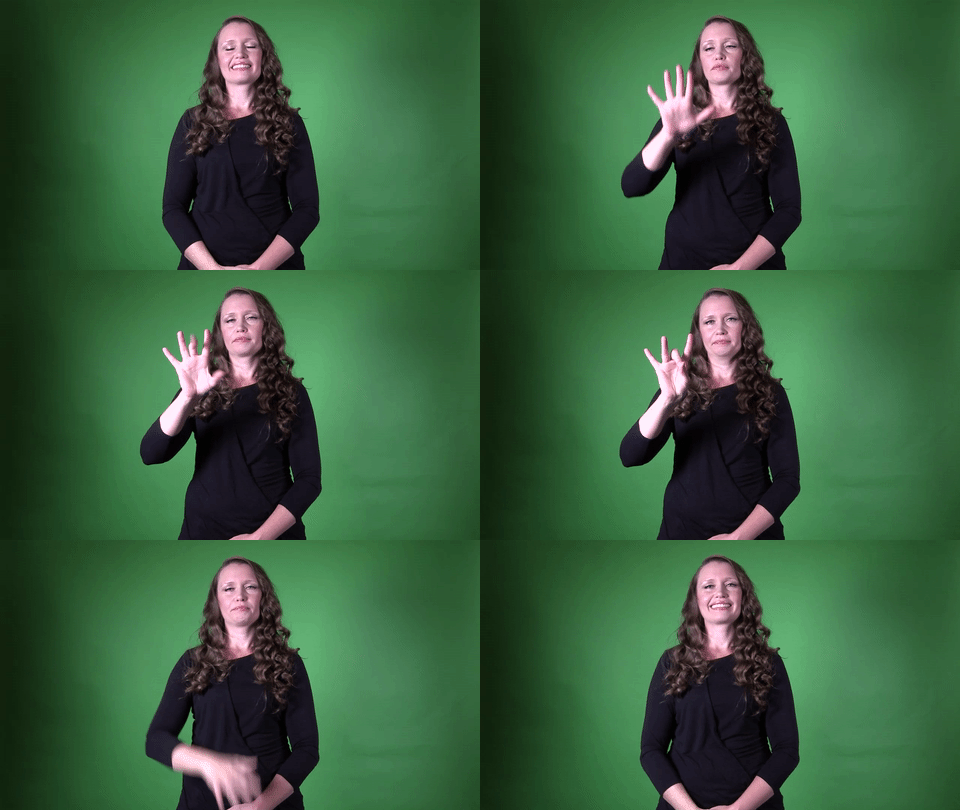
Definition: Refers to the number fifty-eight
Sign for THE NUMBER 58 in ASL

Practice Activities:
To practice the sign for the number 58 in ASL, start by signing each digit separately: 5 and then 8. Repeat this a few times to build muscle memory. Then, sign 58 fluidly, ensuring a smooth transition between the two numbers. Use a mirror or record yourself to check for accuracy in handshape and movement.
Try counting from 50 to 60, emphasizing the sign for the number 58 in ASL when you reach it. This helps reinforce number sequencing and builds confidence. Challenge yourself to say the numbers aloud while signing to strengthen the connection between spoken and signed numbers.
Incorporate the sign for the number 58 in ASL into real-world contexts. Imagine you’re talking about someone’s age, a price, or a score in a game. Use sentences like “My uncle is 58 years old” or “The ticket costs 58 dollars.” Practice signing these in front of a mirror or with a partner.
For a partner activity, take turns asking and answering number-related questions. One person signs a number, and the other person repeats it and gives a context—like “That is my house number” or “I saw 58 birds at the park.” This keeps practice engaging and enhances comprehension.
A fun storytelling prompt is to describe a scenario where 58 appears naturally. For example, create a short story about a person who collects 58 coins or runs 58 miles a month. Sign your story smoothly, integrating the sign convincingly within your narrative.
Flashcard drills can also be helpful. Write different numbers on cards, shuffle them, and sign each one while saying it out loud. Focus on making a quick, natural transition when signing 58. Practicing in various ways will help solidify your proficiency in using the sign correctly.
Cultural Context:
The sign for the number 58 in ASL is an important part of numerical communication in American Sign Language. Numbers are frequently used in daily conversations, from discussing ages to sharing addresses or phone numbers. Knowing how to sign the number 58 in ASL helps improve fluency and ease of communication.
American Sign Language uses a structured system for numbers, making it essential to learn the proper handshapes and movements. The sign for the number 58 in ASL follows the standard numerical transition, moving smoothly from five to eight. Understanding these transitions ensures clear and effective communication.
Numbers in ASL carry cultural significance within the Deaf community. Whether discussing a birth year, identifying a sports jersey number, or giving a total amount, the sign for the number 58 in ASL must be signed accurately. Proper signing demonstrates respect and linguistic competence.
When using numbers in ASL, palm orientation and movement matter. The sign for the number 58 in ASL involves a smooth shift between digits, much like other multiple-digit numbers. Practicing this transition ensures clarity and prevents confusion with similar signs.
ASL learners benefit from consistent practice with numerical signs. The sign for the number 58 in ASL is commonly used in various contexts, such as discussing scores, prices, or addresses. Mastering this sign adds to overall proficiency in American Sign Language.
Numerical fluency supports effective storytelling in ASL. The sign for the number 58 in ASL may appear in personal stories, historical discussions, or everyday conversations. Expressing numbers smoothly enhances the natural flow of ASL communication.
Within the Deaf community, number signs are integral to communication. The ability to smoothly sign the number 58 in ASL ensures clear interactions in educational, professional, and social settings. Consistency in signing builds confidence and strengthens overall language skills.
Dexterity and muscle memory play a role in signing numbers fluently. The sign for the number 58 in ASL requires precise hand movements, reinforcing the importance of regular practice. Engaging in daily practice helps with muscle coordination, making signing more natural.
Non-manual signals often accompany signed numbers in ASL. When signing the number 58 in ASL, facial expressions can help provide context, adding emphasis or emotion. This aspect of ASL highlights how expressive and visual the language is.
Technology and social media have increased the use of ASL numbers in digital communication. The sign for the number 58 in ASL may be used in vlogs, live streams, or
Extended Definition:
The sign for the number 58 in ASL is a combination of two digits, 5 and 8, formed in a fluid motion. This number sign follows the standard number formation rules in American Sign Language. Mastering number signs like this one is important for communication in everyday situations.
To sign the number 58 in ASL, begin with the number 5 handshape, where all five fingers are extended. Then, smoothly transition to the number 8 handshape by touching the tip of the thumb to the tip of the middle finger. The movement between the two numbers should be natural and efficient.
Numbers in ASL rely on clear handshapes and movements to convey meaning. The sign for the number 58 in ASL follows the same principles, ensuring clarity and consistency. Accuracy in finger positioning is essential for avoiding confusion with similar-looking numbers.
Using number signs correctly is important in many daily activities. Whether telling someone an age, discussing prices, or giving addresses, knowing how to sign numbers fluently helps improve communication. Recognizing and practicing the sign for the number 58 in ASL will enhance overall ASL proficiency.
Learning number signs is also valuable for educational and professional settings. In classrooms, students need to understand signed numbers for math and instructions. In business, employees may use number signs to share important numerical information clearly.
Repetition and practice help improve fluency in signing numbers. Watching videos and practicing in front of a mirror can strengthen recognition of the sign for the number 58 in ASL. Engaging with fluent signers also helps build confidence and accuracy in signing numbers.
Using facial expressions and proper hand positioning enhances number clarity in ASL. The sign for the number 58 in ASL should be performed with a smooth transition to maintain visual consistency. A signer’s hand should remain steady and positioned in an easy-to-read way.
Number signs like this one are part of the broader ASL numbering system. The system includes cardinal numbers, ordinals, and specialized numerical signs for dates, time, and measurements. The sign for the number 58 in ASL fits within this structure and follows the natural counting pattern.
Practicing numbers along with daily conversations will strengthen signing fluency. The more frequently the sign for the number 58 in ASL is used, the easier it becomes to recall it effortlessly. Signing numbers with accuracy contributes to better communication within the deaf and hard-of-hearing community.
ASL learning resources,
Synonyms: fifty-eight, number fifty-eight, number 58, the number 58, the number fifty-eight
Educational resources: Find related learning materials in our course bank!
Want more? Check out some of our popular learning activities on the homepage!
Need to look up a sign? Use our highly rated dictionary: https://aslinteractive.com/best-asl-dictionary/
Follow us on tiktok: https://www.tiktok.com/@aslinteractive. More social media links at the bottom of this page!
Long-tail Keywords: what is the sign for the number 58 in ASL, how do you sign the number 58 in ASL, learn to sign the number 58 in American Sign Language
Categories: Numbers – Basics, Numbers 51-60, cardinal numbers
tags: Numbers, Numbers 51-60, Counting, Math, Language Learning
Parameters
*Handshape*:
The sign for the number 58 in ASL uses two distinct handshapes in sequence. Start with the number 5 handshape , fingers spread apart, palm facing outward. Then shift into the number 8 handshape, where the thumb and middle finger touch while the remaining fingers extend. The transition should be smooth, maintaining fluid movement. The sign for the number 58 in ASL is performed in front of the body at chest level, ensuring visibility.
*Palm Orientation*:
The palm orientation for the sign for the number 58 in ASL starts with the palm facing forward as the number five handshape is formed. The fingers then transition smoothly to the number eight by bringing the thumb and middle finger together while the other fingers remain extended. Throughout the sign for the number 58 in ASL, the palm continues to face forward, ensuring clarity and accuracy in communication.
*Location*:
The sign for the number 58 in ASL is produced in the neutral space in front of the signer’s body, typically at chest level. It transitions smoothly from the handshape for 5 to the handshape for 8 using a quick movement of the fingers. The dominant hand forms the number 5, then the thumb and middle finger come together to create the number 8. This sign stays within the personal signing space and maintains clarity for easy visibility.
*Movement*:
To produce the sign for the number 58 in ASL, start by forming the number 5 with your dominant hand, palm facing outward. Then smoothly transition into the number 8 by folding the middle finger down to touch the thumb while the remaining fingers stay extended. The motion should be fluid, maintaining a steady hand shape transition without extra movement. Ensure clarity by keeping the fingers distinct and visible throughout.
*Non-Manual Signals*:
Facial expressions remain neutral when signing the sign for the number 58 in ASL unless emphasizing or clarifying. Eyebrows may raise slightly if asking a question or confirming details. Lip movements may mirror the spoken number for added clarity. Head movement is minimal but may nod slightly in agreement or shake when correcting. Eye contact should remain engaged with the conversation partner to ensure clear communication while performing the sign for the number 58 in ASL.
*Prosody, Dominant/Non-Dominant Hand*:
The sign for the number 58 in ASL uses the dominant hand only. Start with the number 5 handshape, palm facing outward. Then transition smoothly by bringing the fingers together into the number 8 handshape. The movement should be fluid, without breaking the motion between the two numbers. Hand positioning remains neutral, and the fingers should maintain clear articulation for easy readability. Keep the hand steady to ensure the sign for the number 58 in ASL is distinct.
Tips for Beginners:
When learning the sign for the number 58 in ASL, it’s important to practice smooth hand transitions. Start with the number 5 handshape, keeping your fingers spread apart and your thumb extended. Then transition to the number 8 by bringing your thumb and middle finger together, while the other fingers remain extended. This movement should be fluid, without unnecessary pauses or jerky motions.
A common mistake when signing the number 58 is mixing up the number 8 handshape with the number 3. Be sure that your thumb touches your middle finger, not your index finger. Keep your palm facing outward throughout the transition to maintain clarity and prevent confusion with other numbers. If you’re unsure, practice in front of a mirror or record yourself to check for accuracy.
When signing the number 58 in ASL, hand positioning and finger control are key. Avoid stiff or tense fingers, as this can affect the ease of movement. Relax your hand and ensure each number is clearly formed before switching to the next. Smoothness will come with repetition, so take your time at first to make each handshape distinct before focusing on speed.
Context can also help reinforce remembering the sign for the number 58 in ASL. Practice using it in real-life scenarios, like counting money, describing an address, or discussing a historical date. Associating the sign with practical applications will make it easier to recall and more natural to use in conversations.
To develop confidence, drill both forward and backward counting sequences that include the number 58. This will improve muscle memory and help you transition between numbers more effortlessly. The goal is to sign with both accuracy and comfort, ensuring clear communication with others in ASL conversations.
Connections to Other topics:
The sign for the number 58 in ASL connects to broader patterns in numerical representation within sign language. ASL numbers from 50 to 59 follow a recognizable pattern where the first digit (5) maintains a handshape before transitioning into the second digit (8). This shifting pattern helps develop fluency in counting and understanding numerical sequences. Recognizing these patterns can assist learners in quickly adapting to other similar numerical sequences in ASL.
Understanding the sign for the number 58 in ASL supports learning about age, money, and mathematical concepts in sign language. For example, stating an amount like $58 follows the rule where numbers directly integrate with the dollar sign without an additional sign for “dollars.” Similarly, age-related signs use a modified version of these numbers, starting from the chin area to indicate years old. Mastering these techniques enhances clarity when discussing specific numerical information.
The sign for the number 58 in ASL connects with the broader topic of number incorporation in ASL classifiers. Classifier usage often integrates numbers to specify quantity, measurements, and rankings. For instance, a classifier representing a row of objects might incorporate “58” to indicate the exact number in that context. This relationship between numbers and classifiers provides efficiency and precision in signed descriptions.
Learning the sign for the number 58 in ASL also ties into time-related expressions. In ASL, numbers can merge with signs for minutes, hours, and years to convey complex information quickly. For example, “58 minutes” or “58 years” would incorporate the number directly before the unit of time. Understanding these applications reinforces numerical fluency and improves overall communication in ASL.
Summary:
The sign for the number 58 in ASL follows a structured numerical signing system used in American Sign Language. It is a two-part sign, starting with the number 5 and transitioning smoothly into the number 8. This transition must be fluid to maintain the natural flow of ASL counting.
The dominant hand forms the number 5 with the palm facing outward. In a single continuous motion, the fingertips fold into the shape of the number 8. The shift between the numbers must be seamless to ensure clarity and precision.
When signing the number 58, handshape accuracy is crucial for clear communication. A slight hesitation or incorrect transition between the sign components could cause confusion. ASL numbers follow a pattern of logical handshapes that represent numerical values efficiently.
Numbers above 50 in ASL often involve a transformation from an open to a more closed handshape. The number 58 keeps this pattern, where the fingers initially remain spread for 5 and then close slightly into 8. This structure is a linguistic feature of ASL number formation.
The structure of the sign for the number 58 in ASL is in line with ASL’s rule of numerical modification. The sequential movement of the fingers represents the increasing values within ASL’s numerical framework. This makes it easy to understand in fast-paced conversations.
Expressing multi-digit numbers in ASL requires attention to detail. Each digit must be shown distinctly but smoothly linked to the next. The number 58 exemplifies this principle, as both digits are signed separately but in one connected motion.
ASL numbers convey meaning not just through handshape but also through clarity of movement. A signer must ensure the hand remains steady, and the fingers clearly represent each number. Proper palm orientation also plays a role in maintaining consistency.
The position of the hand when signing the number 58 is generally at chest or shoulder height, depending on the context. Keeping the sign within the signing space ensures readability. Any deviation from the normal hand positioning could cause misunderstandings.
Numbers in ASL have different variations based on context. While the number 58 follows a standard form, certain regional variations or personal styles can influence how fast or smoothly it is signed. ASL users typically adapt their pace depending on their audience.
ASL numerical signs are frequently used in daily interactions such as giving addresses, phone numbers, or measurements. The sign for the number 58 in ASL may appear in contexts such as counting, age, or listing sequential events. Practicing fluidity in number signs improves overall ASL fluency.
The number system in ASL differs from that of spoken languages in terms of visual-spatial structure. Instead of relying on vocal articulation, ASL depends on distinct handshapes and transitions. This makes numerical representation a key part of ASL grammar and usage.
Linguistically, ASL numbers function as determiners, quantifiers, and standalone concepts. The number 58 can modify a noun, such as in “58 students,” or stand alone as an answer to a quantity-related question. This reflects ASL’s structural complexity in numerical communication.
The sign for the number 58 in ASL is a part of a larger numerical sequence in ASL counting. It follows a logical build-up from smaller numbers and fits into the standardized system of number formation. Understanding numerical sequences in ASL helps improve number fluency.
Learning ASL numbers, including the number 58, is crucial for effective communication in the Deaf community. Numbers are frequently used in scheduling, shopping, math, and statistics. Mastering number signs enhances comprehension and conversation flow in ASL.
When signing higher numbers, clarity and speed play a significant role in effective communication. The number 58 requires a fast but deliberate transition to maintain accuracy. This ability to transition smoothly is a valuable skill in ASL fluency.
ASL numbers are sometimes modified to suit varying communicative needs. In casual contexts, some signers might shorthand certain number transitions. However, the standard way to sign the number 58 in ASL ensures universal clarity.
Number signs interact with classifiers in certain contexts. For example, the number 58 may be paired with a classifier to describe a quantity of objects. This showcases the dynamic way numerical signs integrate into ASL grammar.
Fingerspelling is not typically used for signed numbers since ASL has an established set of numerical handshapes. The sign for the number 58 in ASL follows this conventional system rather than relying on fingerspelling for clarity. Understanding these distinctions helps avoid potential confusion.
Numbers are an essential part of visual storytelling in ASL. Signers often use numerical signs in narratives to indicate time, order, or statistics. The number 58 could appear in various storytelling or instructional scenarios.
The sign for the number 58 in ASL is just one of many multi-digit number signs requiring precision. Developing proficiency in signing numbers enhances a person’s
Want more? Check out some of our popular learning activities!
ASL Interactive Resources
ASLInteractive YouTube Channel
Follow us on tiktok: @aslinteractive.com
Follow us on Instagram: aslinteractive
Facebook page: aslinteractive
Facebook group: aslinteractive
LInkedIn: ASL Interactive LLC
Twitter: @ASL_interactive
*Some information on this page is AI-generated. AI can make mistakes. Please check the information.


Responses