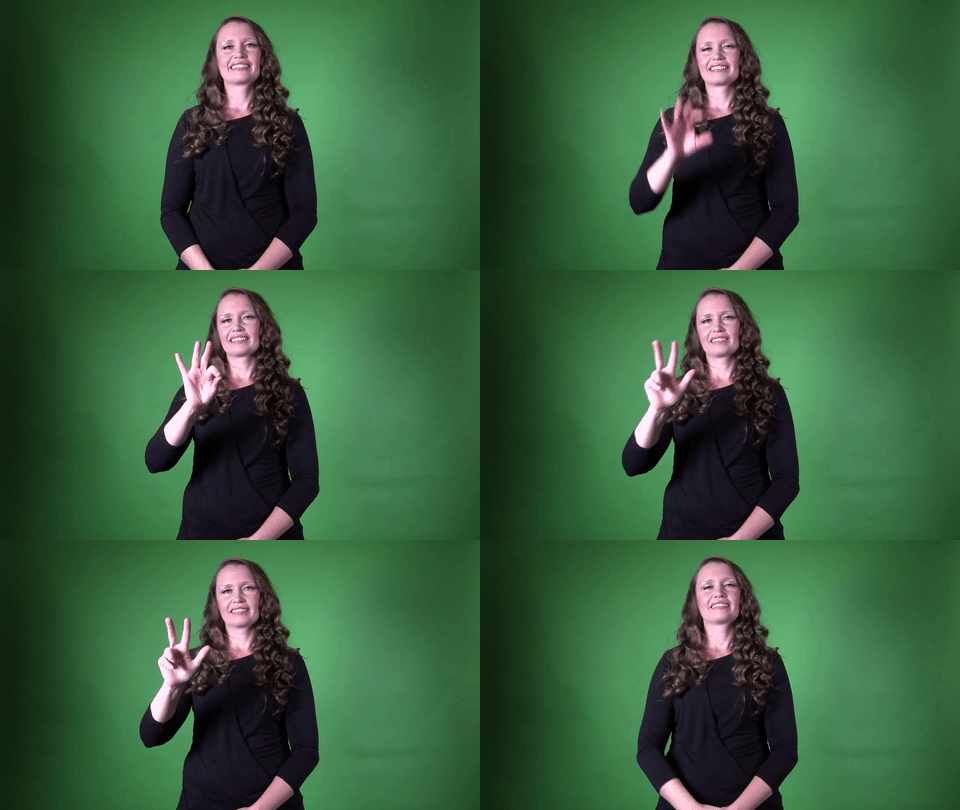
Definition: Refers to the number ninety-three
Sign for THE NUMBER 93 in ASL
Practice Activities:
To practice the sign for the number 93 in ASL, start by signing it repeatedly in isolation. Focus on the handshape, palm orientation, and movement. Make sure your transition from 9 to 3 is smooth and clear while keeping a natural rhythm.
Next, incorporate it in counting exercises. Try counting from 90 to 100, making sure to include the sign for the number 93 in ASL correctly. Challenge yourself by counting backward from 100 to 90 and ensuring fluid transitions between numbers.
Use the sign in context by practicing example sentences. Sign phrases such as “My grandfather is 93 years old” or “There are 93 students in the school.” Create your own sentences and check with a partner or a mirror to ensure accuracy.
Storytelling can enhance memorization of the sign. Make up a short narrative using numbers, such as describing a classroom with 93 students or a race with 93 participants. Signing numbers in real-world applications helps reinforce retention.
Partner activities can add variety to your practice. Work with a friend to quiz each other by showing numbers out of order and identifying them correctly. Another option is a matching game where one person signs a number while their partner fingerspells it to confirm comprehension.
For additional reinforcement, watch online videos demonstrating numbers in ASL and mimic the sign for the number 93 in ASL as you follow along. Record yourself signing and compare it to verified sources to ensure accuracy. Frequent, diverse practice leads to confident and fluent signing.
Cultural Context:
In American Sign Language, numbers play a crucial role in daily conversations, education, and storytelling. The sign for the number 93 in ASL follows the common structure for signing two-digit numbers, using a fluid motion to transition between the digits. Mastering the sign for the number 93 in ASL helps with expressing dates, quantities, and mathematical concepts.
Numbers in ASL are deeply connected to Deaf culture and history. The sign for the number 93 in ASL may be used when discussing historical events, class years, or personal milestones. Using accurate number signs strengthens communication within the Deaf community and supports clear, efficient conversations.
When signing the number 93 in ASL, handshape and movement are essential. Each number sign must be produced distinctly to ensure clarity, particularly in educational or professional settings. Learning the correct production of number signs enhances fluency and confidence in using ASL.
ASL learners often practice numbers through repetition and real-world applications. The sign for the number 93 in ASL appears in discussions about sports scores, addresses, and pricing. Engaging with native signers and practicing number sequences helps develop strong number-signing skills.
Technology and ASL education have made learning number signs more accessible. Videos, online dictionaries, and ASL classes teach learners how to sign the number 93 in ASL correctly. Interactive learning tools and resources allow individuals to refine their skills and understand the importance of accurate number signing.
Numbers are an essential part of storytelling in ASL. When recounting events, people use the sign for the number 93 in ASL to describe ages, statistics, and sequences. Using the right number sign ensures the message remains clear and accurate.
Accuracy in number signs is important in official and casual settings. Whether talking about money, birthdays, or statistics, the sign for the number 93 in ASL must be signed correctly to avoid miscommunication. Paying attention to hand configuration and motion ensures effective communication in ASL.
ASL number signs follow consistent patterns, making them easier to learn with practice. The sign for the number 93 in ASL builds on the foundation of individual number signs, emphasizing smooth transitions between digits. Understanding these patterns makes signing numbers faster and more efficient.
Many ASL learners struggle with number signs at first, but consistent practice leads to improvement. The sign for the number 93 in ASL, like other two-digit numbers, becomes easier over time with exposure and repetition. Watching fluent sign
Extended Definition:
The sign for the number 93 in ASL follows the standard structure for signing two-digit numbers. It combines the individual signs for 9 and 3 in a smooth motion. This number is commonly used in daily conversations, such as discussing age, scores, or quantities.
To sign the number 93 in ASL, start by forming the number 9 with your dominant hand, then transition smoothly to the number 3. The movement should be clear and fluid to ensure proper understanding. Finger placement and hand positioning are important to maintain accuracy.
Numbers in ASL are signed using one hand, and the sign for the number 93 in ASL is no exception. Each number has a distinct handshape that should be articulated correctly. Practicing the transition between 9 and 3 helps improve fluency in signing numbers.
When using the sign for the number 93 in ASL, facial expressions and body language can add context. In different situations, the number might be emphasized by pausing slightly or using a certain expression. This is especially helpful in storytelling, academic settings, or competitive events.
ASL numbers are widely used in both formal and informal communication. The sign for the number 93 in ASL might be seen in classroom discussions, business transactions, or casual conversations. Mastering number signs allows for accurate and efficient communication within the Deaf community.
In ASL, some numbers blend smoothly while others require a small shift in handshape. The sign for the number 93 in ASL involves a transition between two distinct handshapes, making it important to practice. This helps avoid confusion and ensures clarity when signing numbers.
Numbers play a significant role in ASL, and knowing how to sign them correctly improves understanding. The sign for the number 93 in ASL is just one example of how numbers follow a structured pattern in this visual language. Learning to sign numbers accurately enhances overall fluency in ASL.
When signing large numbers, maintaining proper hand positioning is key. The sign for the number 93 in ASL should be clear and recognizable without unnecessary movements. Watching fluent signers can help reinforce correct number signing techniques.
In daily conversations, the sign for the number 93 in ASL can be used in many contexts. Whether discussing years, distances, or amounts, this sign is useful in various situations. Becoming comfortable with number signs allows for smoother interactions.
If you’re new to ASL, practicing number transitions can strengthen your signing skills
Synonyms: ninety-three, number ninety-three, number 93, the number 93, the number ninety-three
Educational resources: Find related learning materials in our course bank!
Want more? Check out some of our popular learning activities on the homepage!
Need to look up a sign? Use our highly rated dictionary: https://aslinteractive.com/best-asl-dictionary/
Follow us on tiktok: https://www.tiktok.com/@aslinteractive. More social media links at the bottom of this page!
Long-tail Keywords: What is the sign for the number 93 in ASL, How do you sign the number 93 in American Sign Language, Learn how to sign 93 in ASL
Categories: Numbers – Basics, Numbers 91-100, cardinal numbers
tags: Numbers, Numbers 91-100, Math, Language Learning, Educational Content
Parameters
*Handshape*:
The sign for the number 93 in ASL uses a combination of two distinct handshapes. First, the hand forms the number 9 with the thumb and index finger touching while the remaining fingers extend. Then, it transitions smoothly into the number 3, where the thumb, index, and middle fingers remain extended while the ring and pinky fingers curl down. This movement is fluid, ensuring clarity in conveying the sign for the number 93 in ASL. ✋
*Palm Orientation*:
The palm orientation for the sign for the number 93 in ASL starts with the palm facing outward while forming the number 9 with the dominant hand. Then, the hand transitions smoothly into the number 3, maintaining the outward palm orientation. The fingers remain steady and clearly visible, ensuring the sign for the number 93 in ASL is distinct and easily recognizable to the viewer.
*Location*:
The sign for the number 93 in ASL is formed in the neutral space in front of the signer’s body, typically at chest or shoulder level. The movement starts with the number 9 handshape, where the thumb and index finger touch to form an “O,” while the remaining fingers extend. Then, it transitions smoothly to the number 3 handshape, where the index, middle, and thumb extend while the ring and pinky fingers curl in. The shift between these handshapes happens in a fluid motion without additional movement.
*Movement*:
To sign for the number 93 in ASL, begin with the hand in a “9” shape, where the index finger and thumb form a circle while the other fingers extend upward. Then transition smoothly to a “3” handshape by extending the thumb, index, and middle fingers while curling the ring and pinky fingers. The motion should be fluid, with a slight wrist movement to indicate the change between numbers.
*Non-Manual Signals*:
When signing the number, maintain a neutral or slightly focused facial expression to emphasize clarity. Eyebrows may remain relaxed, ensuring the receiver can easily distinguish the movement. Head movement should be minimal, staying steady to keep the visual focus on the hand. If the sign for the number 93 in ASL is used in a sentence, natural facial expressions may adjust based on context, such as excitement or emphasis when clarifying a number.
*Prosody, Dominant/Non-Dominant Hand*:
For the sign for the number 93 in ASL, use the dominant hand to form the number 9, with the thumb and index finger touching in an “F” handshape while the other three fingers remain extended. Then, smoothly transition to the number 3, where the thumb, index, and middle fingers are extended, and the ring and pinky fingers are curled down. The motion should be fluid, with a slight downward movement when changing numbers. ️
Tips for Beginners:
When learning the sign for the number 93 in ASL, it’s important to practice transitioning smoothly between the two digits. The number 9 is signed with the thumb and index finger touching in an “O” shape while the other three fingers remain extended. The number 3 follows immediately after, with the thumb, index, and middle fingers extended while the ring and pinky fingers remain folded down. Maintaining clear handshape transitions will help keep your signing fluid and understandable.
A common mistake when signing the number 93 in ASL is allowing the handshape to become unclear or blending the numbers together too quickly. To prevent this, practice forming each number separately before combining them in one motion. Keep your fingers distinct and avoid curling them in ways that could confuse the numbers. Precision is key, so sign with deliberate and controlled movements.
Finger orientation is another essential detail. The palm should face outward to the viewer when signing both numbers. Beginners sometimes accidentally turn their palm inward or tilt their hand awkwardly, which can make the number less recognizable. Checking your palm position in a mirror or recording yourself can help ensure accuracy.
Finger dexterity plays an essential role when signing the number 93 in ASL. If you struggle coordinating your fingers, try stretching and strengthening exercises like wiggling your fingers or making a fist and releasing it. Relaxing your hand before signing can also help prevent stiffness. The more you practice, the more natural the transition between the two numbers will feel.
When signing in conversation, ensure your movements are smooth but not rushed. Over time, you’ll build muscle memory and gain confidence. Aim for consistency, and don’t be afraid to ask for feedback from fluent signers. With practice, you’ll sign the number 93 clearly and naturally.
Connections to Other topics:
The sign for the number 93 in ASL follows a pattern similar to other two-digit numbers in ASL, where the first digit transitions smoothly into the second. This connection makes it easier to recognize the pattern in numbers from 90 to 99. Learning the sign for the number 93 in ASL helps reinforce the movement structure of ASL numbers, especially when counting or giving exact figures.
When discussing years, ages, or quantities, fluency in transitioning between number signs is helpful. The sign for the number 93 in ASL connects to dates such as “1993” or sequential numbers used in sports, addresses, or statistics. Practicing these number transitions also builds a foundation for higher number values, such as those used in financial figures or mathematical contexts.
Ordinal numbers share a connection with cardinal numbers, including 93rd place or ranking. Understanding how to modify the sign for the number 93 in ASL by adding a small wrist twist can turn a cardinal number into an ordinal one. This adaptation appears in competitions, lists, or instructions where ranking is important.
Numbers frequently combine with classifiers in ASL for greater specificity. For example, the sign for the number 93 in ASL can combine with age-related signs to communicate “93 years old.” Additionally, incorporating the number with time-related signs like “minute” or “dollar” provides precision in everyday conversations.
Mastering number transitions improves overall fluency in ASL. Since ASL is a visual language, smoothly signing numbers strengthens communication clarity. Practicing numbers such as the sign for the number 93 in ASL as part of larger number sequences is a useful way to build confidence in numerical communication.
Summary:
The sign for the number 93 in ASL follows a structured pattern associated with signing two-digit numbers. It begins by forming the handshape for 9 and transitions smoothly into the handshape for 3. The movement should be fluid to maintain clarity and ensure an accurate representation of the number.
When signing the number 93 in ASL, the palm orientation typically remains outward. This is consistent with ASL number conventions for numbers above 20. It is important to maintain distinct handshapes to avoid confusion with similar-looking numbers like 39 or 83.
Numerical signs in ASL often follow a sequential and logical progression. The number 93 maintains this pattern by combining two dominant numerals. Proper finger placement helps avoid ambiguity, especially when communicating quickly in conversation.
Handshape precision is crucial for clarity when signing the number 93 in ASL. The 9-hand is created by forming an open circle with the index finger and thumb, while the other fingers remain extended. The transition to the 3-handshape requires retracting the ring and pinky fingers while keeping the index and middle fingers extended.
Speed and fluidity are key when signing the number 93 in ASL. A choppy transition can lead to misinterpretation, particularly in fast-paced conversations. Practicing smooth transitions between numbers improves overall signing fluency.
ASL numbers operate within a visual-spatial linguistic framework. The number 93 is part of a structured numerical system that incorporates logical handshape changes. Consistency in palm orientation helps distinguish numbers efficiently.
Misinterpretations of the number 93 in ASL can happen if handshapes or movements are unclear. If the handshapes are not distinct, one may sign 39 or any other similar combination unintentionally. Ensuring clear hand articulation minimizes confusion.
In Deaf culture, numbers are frequently used in daily communication, storytelling, and providing important information. The number 93 in ASL may appear in addresses, years, or prices. Mastery of numerical signs enhances a signer’s ability to communicate effectively in various contexts.
Numerical incorporation within ASL syntax plays a role in temporal and quantifying structures. The sign for the number 93 in ASL may appear in contexts such as listing item counts or discussing financial amounts. Understanding how numbers function in ASL grammar helps with their proper contextual use.
ASL has a rich numerical system that facilitates counting, mathematics, and everyday numeral usage. Recognizing the specific structure of the number 93 supports overall numerical fluency. The consistency in numerical sign formation contributes to the language’s visual efficiency.
In rapid sign exchanges, maintaining accuracy in numerical signs is essential. The number 93 should be signed in a controlled and deliberate manner. This prevents miscommunication while ensuring the number is understood clearly.
The number 93 in ASL follows historical numerical conventions in sign language development. ASL’s numerical structure has evolved over time within the Deaf community. The system remains efficient, enabling seamless numerical expression.
Some variations may exist based on signing regions or personal signing styles. While the number 93 generally follows a standard formation, minor adjustments in speed or fluidity may occur. Exposure to different signing styles enhances comprehension and adaptability.
Numerical literacy in ASL is an important skill within Deaf education and professional settings. The ability to fluently sign the number 93 contributes to greater communication proficiency. Signers must develop comfort with transitioning between numbers accurately.
The number 93 in ASL can appear in various everyday scenarios such as giving a birth year or identifying a sports jersey number. Knowing how to sign it correctly supports practical communication. Mastery of numerical signs expands a Deaf or signing individual’s expressive capabilities.
Learning numerical signs like the number 93 in ASL fosters a deeper connection with the language. Since ASL relies heavily on visual-spatial components, numbers must be signed clearly. Proper execution strengthens overall signing fluency and comprehension.
Numbers serve a crucial function in ASL beyond simple counting. They are also used in classifiers, ranking systems, and non-manual markers for emphasis. Understanding numerical application enhances a signer’s ability to use numbers effectively in conversation.
ASL learners often practice numerical sequences to develop muscle memory. Signing the number 93 accurately requires repeated usage. Practicing in front of a mirror or with a signing partner can help improve precision.
In educational settings, numerical clarity is emphasized for mathematical instruction using ASL. The sign for the number 93 in ASL is a part of the broader numerical lexicon used in Deaf education. Mastering numbers supports mathematical competence within ASL-based learning environments.
Numbers in ASL contribute to the language’s structural complexity. They incorporate both linguistic principles and spatial organization. The structured, logical formation of the number 93 aligns with numerical conventions across signed languages.
Certain ASL dialects or regional variations may slightly modify movement or flow. However, the fundamental handshapes for the
Want more? Check out some of our popular learning activities!
ASL Interactive Resources
ASLInteractive YouTube Channel
Follow us on tiktok: @aslinteractive.com
Follow us on Instagram: aslinteractive
Facebook page: aslinteractive
Facebook group: aslinteractive
LInkedIn: ASL Interactive LLC
Twitter: @ASL_interactive
*Some information on this page is AI-generated. AI can make mistakes. Please check the information.


Responses